
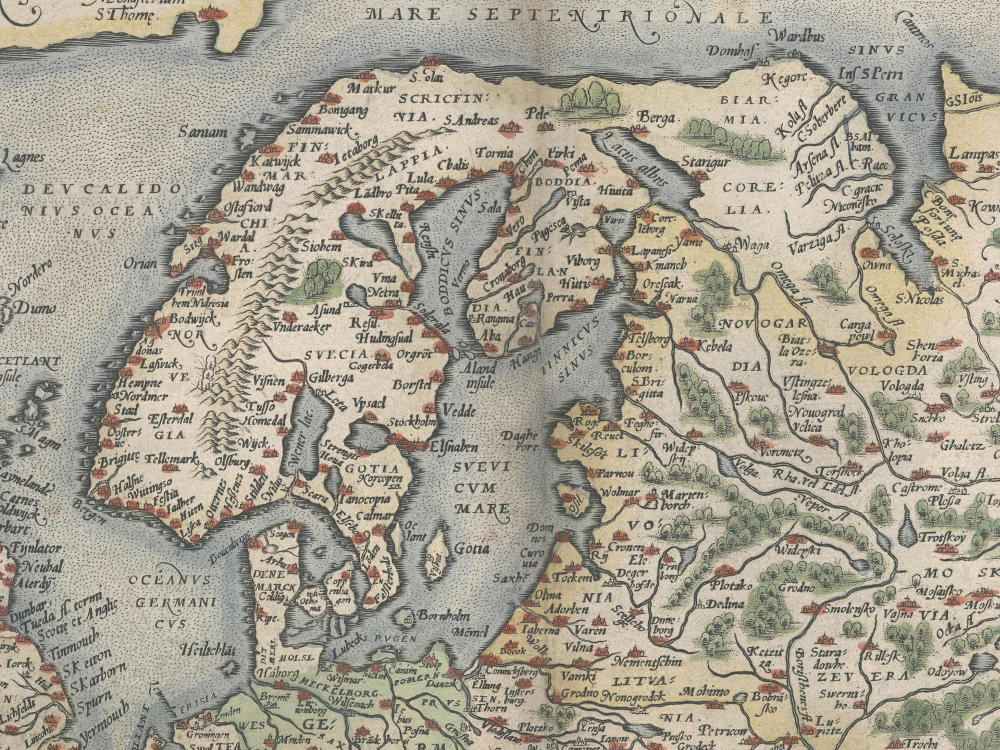
Scandinavia, ca. 1570
Denmark and Sweden in the Sixteenth Century
Travelling from Lübeck via Kiel to Flensburg, Samuel Kiechel left the Holy Roman Empire and entered Denmark. After his experiences in the war-torn Low Countries and the Rhineland, visiting Scandinavia was comparatively safe.
Politically, Denmark was united in a personal union with Norway, meaning that a single monarch ruled both kingdoms. Blekinge and Scania, now in southern Sweden, were also part of Danish territory, as were Schleswig and Holstein.
Schleswig-Holstein is today a federal state of modern Germany. But until the nineteenth century, both provinces had a complex political relationship with Denmark and the Holy Roman Empire. During the late Middle Ages, the kings of Denmark and the nobility of Schleswig and Holstein fought over these provinces. Schleswig was particularly contested. It had been part of Denmark in the early Middle Ages; its inhabitants spoke Danish and followed Danish law. However, its nobility was linked by dynastic ties to Holstein and the Holy Roman Empire. Additionally, both provinces were socially and economically deeply interconnected.
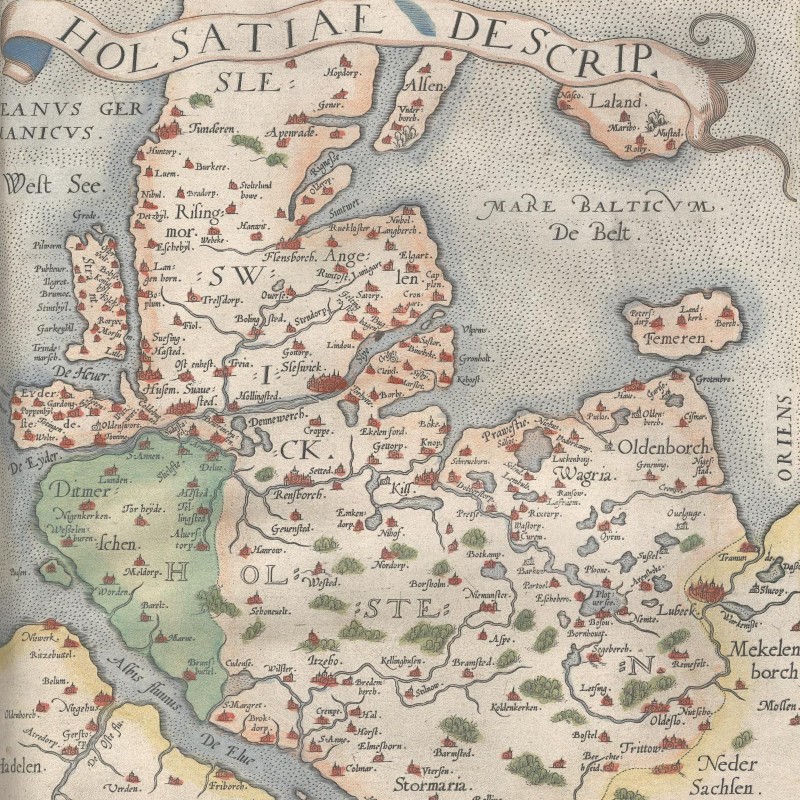
Schleswig and Holstein, ca. 1570
In 1460, the Treaty of Ribe, a complex arrangement aimed at preventing the division of both provinces, was agreed upon. With this treaty, Schleswig and Holstein were united under Danish rule. The King of Denmark became Duke of Schleswig and Count of Holstein (Duke of Holstein from 1474). Nonetheless, in return, the knights and nobility in both provinces received extensive privileges. Holstein was guaranteed to remain part of the Empire, which meant that the Danish king, as Count of Holstein, was technically a vassal of the Emperor. Schleswig, being politically and socially closely linked with Holstein, gained a special status within the Kingdom of Denmark, with the King as the Duke of Schleswig becoming his own vassal. This measure was adopted to create some separation between the authority of the Danish crown and the regional affairs of Schleswig, thus hindering direct Danish interference.
Further north, Denmark was in a tense relationship with Sweden. The tension originated from the aftermath of the dissolution of the Kalmar Union in 1523. The union’s foundations were laid when Margaret I (1353-1412) became the ruler of all three Scandinavian kingdoms in 1389. She was the daughter of King Valdemar IV of Denmark (1320-1375) and married Haakon VI of Norway (1340-1380) in 1363. Margaret and Haakon’s son, Olaf, inherited the crowns of Denmark and Norway after his father died in 1380. Since he was still a minor, his mother ruled on his behalf.
Haakon was not only the King of Norway but also the son of the Swedish king Magnus Erikson (1316-1374). However, the Swedish nobility rebelled and elected Albert of Mecklenburg (1338-1412) as king. Albert and his political and economic allies, the powerful Hanseatic League, soon proved to be very unpopular in Sweden. Swedish noblemen sought Margaret’s support to remove him, promising to recognise her as sovereign in return. During the ensuing war, Albert was captured and imprisoned (1389). Margaret then ruled over all three Scandinavian realms (Finland had been part of Sweden since the twelfth century). However, she had no heir, as her son Olaf had died in 1387.
Margaret chose her six-year-old nephew, Erik of Pomerania (1382-1459), as her heir. He was crowned in Kalmar in 1397 as the first king of all three Scandinavian kingdoms.
However, the Kalmar Union was never particularly stable. No formal act of union was ever ratified, and the regional interests of the nobility repeatedly clashed with the monarch’s centralising ambitions. In particular, Danish dominance caused discontent among the Swedish nobility and led to repeated uprisings and loss of control during the fifteenth century.
In 1513, Christian II was crowned King of Denmark and Norway. At that time, Sweden was effectively autonomous and ruled by a regent. Christian was determined to re-establish his authority and, by extension, the Kalmar Union. He successfully invaded Sweden and, in 1520, after granting amnesty to the rebellious Swedish nobility, was crowned King of Sweden in Stockholm. But this renewed union of the three Scandinavian kingdoms was short-lived.
Just four days after Christian’s coronation, many leading Swedish noblemen were summoned, arrested, and accused of heresy despite the amnesty. The following days saw their execution in what became known as the Stockholm Bloodbath. This massacre fostered widespread resentment and unrest.
The son of one of the executed noblemen was Gustav Vasa (1496-1560). He fled and successfully gained support for a new rebellion. The rebels captured Stockholm in 1523 and took control of other Danish strongholds in southern Sweden. Gustav Vasa was elected King by the nobility and also enjoyed broad support among the Swedish population.
Meanwhile, Christian II of Denmark (1481-1559) lost favour with the Danish nobility after his reforms reduced their privileges. They deposed him in 1523 and selected his uncle Frederick (1471-1533) as king. Busy securing his new position and unable to find allies to confront the Swedish rebels, Frederick chose to negotiate, ultimately leading to the Treaty of Malmö (1524). Through this agreement, Denmark recognised Sweden’s independence, but the southern Swedish provinces of Blekinge and Scania remained under Danish control.
Tensions between both kingdoms remained high in the following decades, escalating into the Northern Seven Years’ War (1563-1570). Sweden fought a coalition of Denmark, Poland-Lithuania and Lübeck, but the war ended with few concessions, as neither Denmark nor Sweden had the resources to continue.
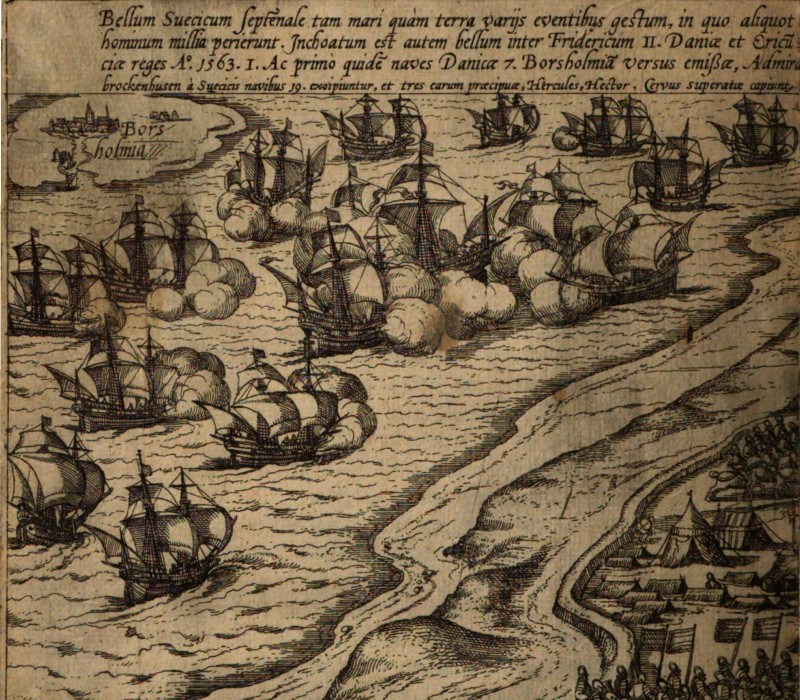
Battle of Bornholm (1563) between Danish and Swedish ships
By the late sixteenth century, Denmark remained Scandinavia’s leading power. Along with the union with Norway, it still controlled the two southern Swedish provinces of Scania and Blekinge, as well as the Duchies of Schleswig and Holstein.
In contrast, Sweden was small and sparsely populated. However, under Gustav Vasa and his successors, the foundation for the kingdom’s rise was laid. They introduced structural reforms, establishing an effective, high-tax system to build and maintain a professionalised, modern army. This enabled the Swedish kings to wage wars and dominate northeastern Europe in the seventeenth century — until Charles XII’s defeat at Poltava (Ukraine) in the Great Northern War (1700–1721).
During Samuel Kiechel’s visit in the 1580s, Denmark and Sweden remained at peace, and our traveller did not need to worry about marauding mercenaries, bandits or a suspicious local populace. However, he faced a different kind of challenge. Winter was not the most forgiving time to visit the northern kingdoms. The cold, snow and ice made life arduous. Additionally, Kiechel had to find and rely on companions not only for orientation but also for communication and to manage different customs and cultural issues.
Mysterious Scandinavia
Until the sixteenth century, Scandinavia, although commercially and politically connected to Europe, remained largely unknown. Most of the information about the peninsula came from ancient sources and was filled with tales of fantastical beasts, wild peoples, magic and mystery. The icy lands kept travellers at bay. With the Kalmar Union, Denmark had become the dominant power, and any interest in the northern regions usually ended in Copenhagen.
The first person to successfully dispel the shroud of ignorance surrounding Scandinavia was Olaus Magnus. Magnus, a Catholic Swedish cleric, was born in Linköping in the Swedish province of Östergötland in 1490. He studied Theology at the Universities of Greifswald and Rostock in northern Germany from 1510 to 1517. In 1518/19, he was sent on a journey through northern Scandinavia.1
After Sweden left the Kalmar Union in 1523, the new king, Gustav Vasa, sent Olaus Magnus and his brother, Johannes, the Archbishop of Uppsala, on diplomatic missions to Europe. However, the introduction of the Protestant Reformation in Sweden ended the brothers’ service to the king. They went into exile and would never return to their homeland.2
In exile, Olaus and Johannes Magnus sought support for Swedish Catholicism but found that most people knew little about Scandinavia and thus had little interest in it.
Carta Marina (1539)
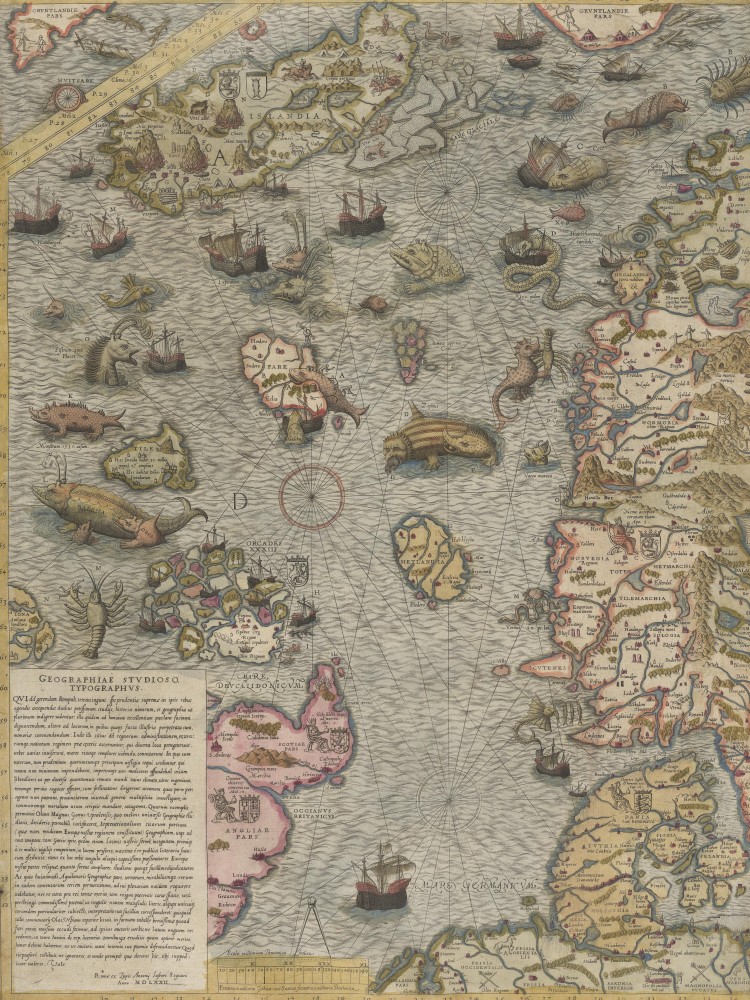
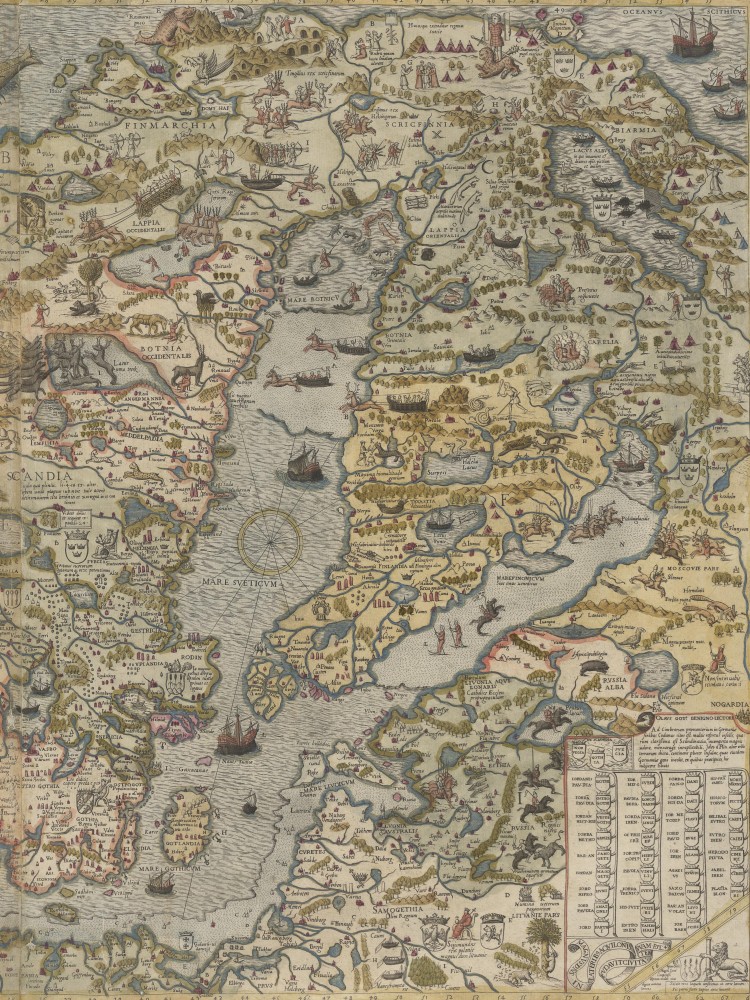
Olaus Magnus’ Carta Marina, 1539
To address the widespread ignorance about Europe’s northern regions, Olaus Magnus decided to utilise the extensive knowledge he had gathered during his journey through Sweden, Norway and Finland in 1518/19. First, he produced and published the Carta Marina (1539), the first map to present a realistic view of the Scandinavian coastline.
The Carta Marina combines old and new ideas. It depicts Scandinavia more accurately than earlier maps, yet also includes images of people, animals and legendary creatures, as was typical in medieval maps. The map features compass roses and rhumb lines, similar to those found on navigational charts. However, in this case, these elements served largely decorative purposes, with no practical use. Magnus may have copied them from Italian navigation maps to enhance the professional appearance of his work.3
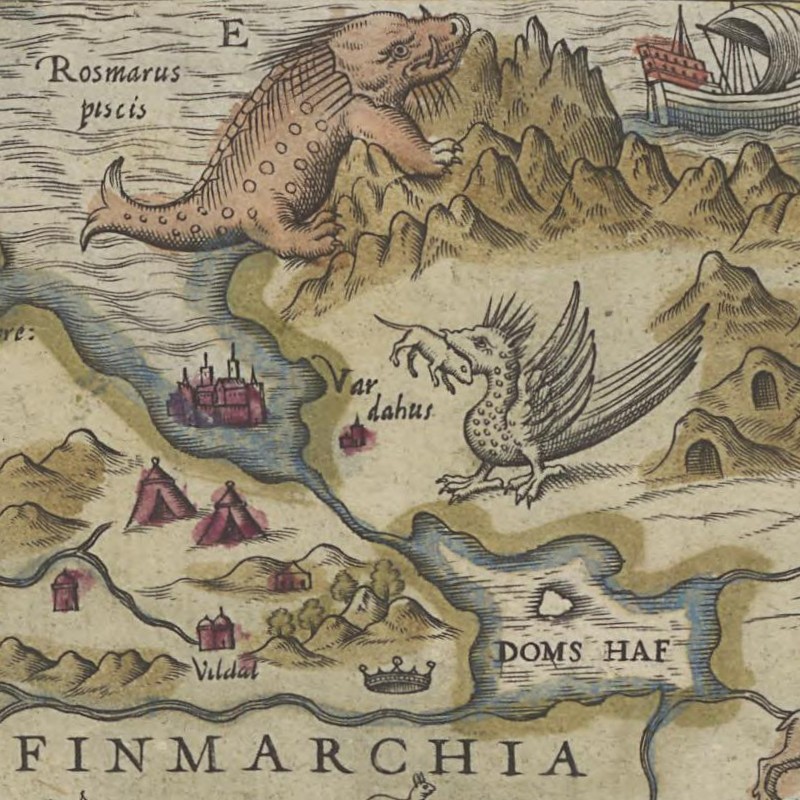
A fish that climbs mountains and feeds on grass. To sleep, it holds onto the mountain with its teeth. Carta Marina, 1539
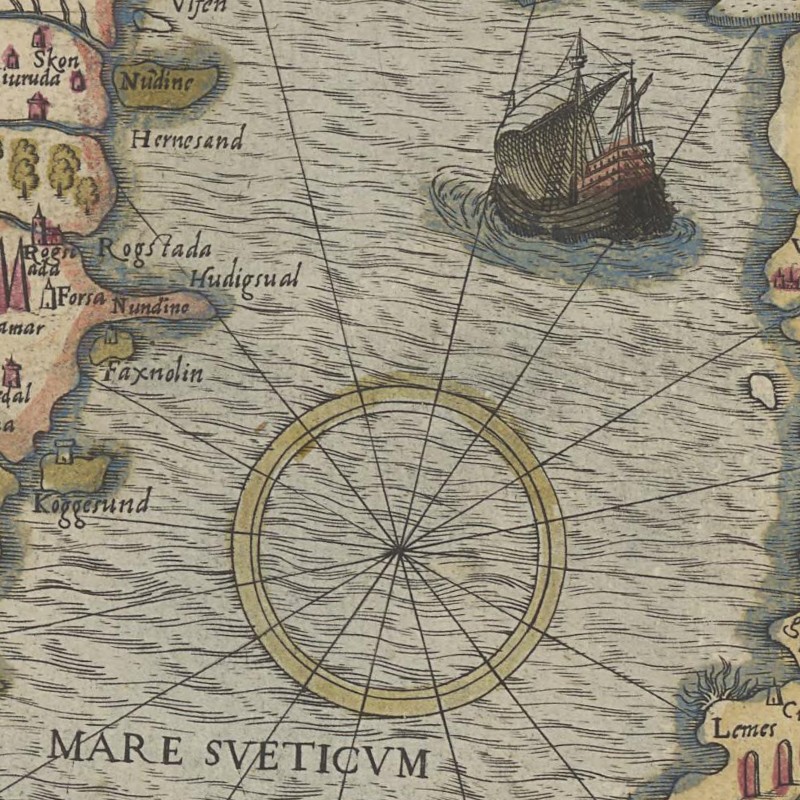
A compass rose on the Carta Marina, 1539
Olaus Magnus recognised that the map, with all its drawings, could be difficult for an audience with limited basic knowledge of the region to understand. To aid his readers, he published a small booklet containing explanations in Italian and German.4 The booklet and map reveal Magnus’s methodical, focused approach. He divided his map into nine sections, each marked with a large capital letter (A-I). The booklet is organised according to these sections. Within each section of the map, Magnus added smaller capital letters to various drawings and geographical features. These letters serve as references to explanations in the booklet. The explanations there incorporate a mixture of Magnus’s own observations and hearsay. Additionally, the booklet references several fantastical creatures, such as sea monsters. For some features of Scandinavia, Olaus Magnus lacked direct knowledge and therefore relied on the well-known works of ancient authors.5
Historia de Gentibus Septentrionalibus (1555)
In addition to his map, Magnus published Historia de Gentibus Septentrionalibus (History of the Northern Peoples, 1555).6 This thorough work covers the land, nature, life, religion, society, culture and history of Scandinavia. The book has twenty-two chapters, each dedicated to a specific subject. However, Magnus frequently blends topics, adding history, moral judgments and warnings. Unlike modern country guides, the book is not arranged geographically and does not describe major provinces and cities.7
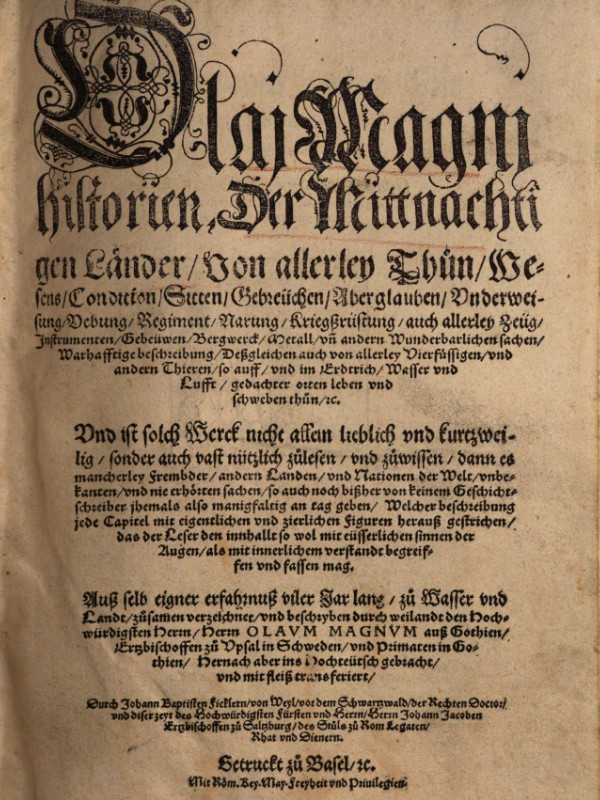
Title page of the German edition of the Historia de Gentibus Septentrionalibus, 1567
While much of the Historia is based on Magnus’s familiarity with his homeland and his travels through northern Scandinavia, he also incorporated details from texts by authors such as Tacitus, Pliny the Elder, Jordanes and others. As a result, the book, like the Carta Marina, combines factual, first-hand knowledge with stories that may seem fantastical to the modern reader. Nonetheless, it should be emphasised that, in the eyes of educated people in the sixteenth century, ancient texts and their authors held high authority, and any reputable scholar was familiar with their writings.8
Among the fantastical stories, one of the main themes Olaus Magnus emphasised throughout his work was the Scandinavian origin of the Gothic people of late antiquity. This origin story is based solely on Jordanes’ Getica (De origine actibusque Getarum) from the sixth century, which was an abridged version of Cassiodorus’ now-lost multi-volume history of the Gothic people. The value of the Getica has long been debated academically. Today, historians generally view Jordanes’ Gothic origin story as largely a fabrication, assembled from fragments of Cassiodorus’ work and other texts, and misinterpreted place and tribal names to fit the narrative.9
However, for sixteenth-century scholars like Olaus Magnus, Jordanes’ Getica and other ancient texts remained unchallenged and trustworthy sources. Additionally, the presumed Gothic origin in Scandinavia carried a political significance. Magnus aimed to dispel the mystery surrounding Scandinavia in popular imagination. Outsiders perceived the north as a frozen wasteland or a gateway to hell. By describing it as the ancient homeland of the Goths — the tribe that raided the Roman Empire, sacked Rome in 410, and later established its kingdom in Italy — it lent Scandinavia historical legitimacy. For Olaus Magnus, seeking to garner support for the Catholic cause in Sweden, such ancient connections could promote public interest in the region.10
By the late sixteenth century, mapmaking had advanced, and both the Theatrum Orbis Terrarum and the Civitates Orbis Terrarum contain accurate, detailed and realistic maps and views of the Scandinavian peninsula and some of its major cities. This development made the Carta Marina somewhat outdated. However, the Historia de Gentibus Septentrionalibus remained relevant. It was translated into various languages and became the most popular reference about northern Europe for a long time.
Unfortunately, the dissemination of knowledge in the sixteenth century was slow, especially for information about some frozen northern countries. News from distant places in Asia or America was certainly more exciting. So, in 1586, when Samuel Kiechel set out on his journey to Denmark and Sweden, the mystery surrounding Scandinavia was still very much real. Despite Olaus Magnus’ great work in introducing the region to popular knowledge, it is hard to estimate how much our traveller actually knew about it. Since he visited Denmark and Sweden in the middle of winter, it’s fair to assume that his understanding of Scandinavia was limited. So, into the snow and cold he went, first through the culturally more familiar lands of Schleswig and Holstein towards Copenhagen, and then — as it turns out, more a spur-of-the-moment decision — on to Stockholm.
Illustrations & References
All images are in order of appearance with links to sources on external websites:
- Scandinavia, in: Ortelius, Abraham, Theater of the World, Antwerp 1587, fol. 2v; Library of Congress.
- Schleswig and Holstein in: Ortelius, Abraham, Theater of the World, Antwerp 1587, fol. 49v; Library of Congress.
- Ens, Gaspar, Rerum Danicarum Friderico II. inclitae memoriae, rerum potiente, terra marique gestarum historia, 1539, pp. 122f; Bayerische Staatsbibliothek.
- Magnus, Olaus, Carta Marina, 1572 (1539); Library of Congress.
- Olai Magni historien, Der Mittnachtigen Länder …, Basel 1567, Bayerische Staatsbibliothek.
- Miekkavaara, Leena, Unknown Europe: The mapping of the Northern countries by Olaus Magnus in
1539, Belgeo [Online], 3-4/2008. Brunner, Kurt, Ein Kartenwerk der Nordlande vom Jahre 1539, Deutsches Schiffahrtsarchiv 12/1989, pp. 173-194, Social Science Open Access Repository. ↩︎ - Ibid. ↩︎
- Ibid. ↩︎
- Magnus, Olaus, Ain kurze Auslegung und Verklerung der neuuen Mappen von den alten Goettenreich und andern Nordlenden, Venedig, 1539; Bayerische Staatsbibliothek. ↩︎
- Miekkavaara, Unknown Europe; Brunner, Kartenwerk der Nordlande; Mead, William R., Scandinavian Renaissance Cartography, in: Woodward, David (ed.), The History of Cartography, vol. 3, pt. 2, Chicago 2007, pp. 1781-1805, see pp. 1787f. ↩︎
- Olai Magni historien, Der Mittnachtigen Länder …, Basel 1567; Bayerische Staatsbibliothek. ↩︎
- Miekkavaara, Unknown Europe. ↩︎
- Ibid. ↩︎
- Christiansen, Arne Søby, Cassiodorus, Jordanes and the History of the Goths. Studies in a Migration Myth,
Copenhagen 2002. ↩︎ - Schmidt-Voges, Inken, „Et nos homines“. Schweden als frontier in der Kartographie und Historiographie des Olaus Magnus, in: Richter, Susan, Roth, Michael und Meurer, Sebastian (eds.), Konstruktionen Europas in der Frühen Neuzeit: Geographische und historische Imaginationen. Beiträge zur 11. Arbeitstagung der Arbeitsgemeinschaft Frühe Neuzeit, Heidelberg 2017, pp. 41-58. ↩︎