
Journal of Samuel Kiechel
25 November – 19 December 1586
In Venice
“On the right side is a long row of houses in which many ships, carracks, galiots, bergantinas, fustas and galleasses stand; the galleasses are impressively large structures, like castles or palaces. There are so many ships and galleys that you would have to walk for over half an hour to pass them all. The ships stand with their tips at the water’s edge and, in case of an emergency, only have to be pushed in.”
Die Reisen des Samuel Kiechel aus drei Handschriften, K. D. Haszler (ed.), Stuttgart 1866, p. 157; Bayerische Staatsbibliothek.
Visiting the Arsenal
Samuel Kiechel wrote that on 6 December he visited the Arsenal with nine other German noblemen and travellers. He had likely met them at the German inn where he stayed. Kiechel noted that the Arsenal was the size of a small town, surrounded by a high wall. Its gate was guarded, and anyone carrying a weapon had to leave it with the guards.
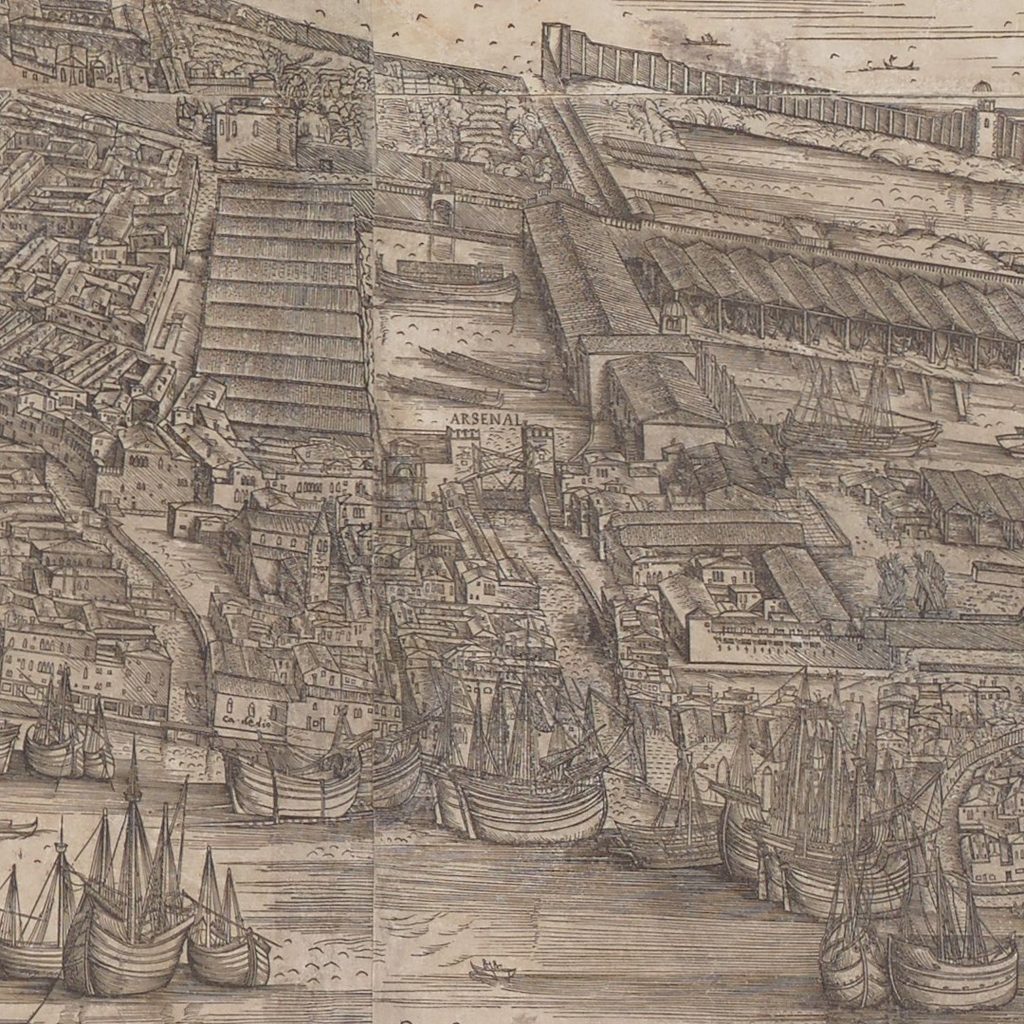
The Arsenal in Jacopo de’ Barbari’s view of Venice, 1500
Beyond the gate, on the right, the visitors were first shown a large, well-stocked wine cellar. The travellers were offered some wine to try. Next to the wine cellar was the place where the oars for the galleys were stored in large numbers. The German word ‘Ruder’ in the journal could mean either an oar or a rudder. Because Kiechel mentioned that they were stored in large numbers, it seems more likely that he meant the oars.1
Further along, on the left, Kiechel saw storehouses full of guns of various sizes, hooks, pikes, halberds, swords, armour and other war material. Opposite the warehouses, on the right, was a large heap of saltpetre for making gunpowder.
Next, on the right, the group was shown the large sheds where many ships, such as carracks, galiots, bergantinas, fustas and galleasses, were stored. The galleasses, in particular, impressed Kiechel with their size, and he compared them to large buildings such as castles or palaces. Kiechel wrote that there were so many ships and galleys that it would take half an hour to walk past them. The ships were placed with their bows to the water, so in an emergency they only needed to be pushed in.
The visitors were also shown many ships and galleys that the Venetians had captured from the Turks during the armada (Battle of Lepanto). They were not used but kept as attractions for visitors.
The Doge’s galley was kept in a separate storehouse. It was painted red and decorated with gold. Unlike other galleys, the slaves or oarsmen were hidden beneath the platform where the Doge, senators, and nobility sat. Samuel Kiechel learnt that the Doge used it every year on Ascension Day during the Marriage of the Sea. In this much-celebrated ceremony, he throws a golden ring into the lagoon.
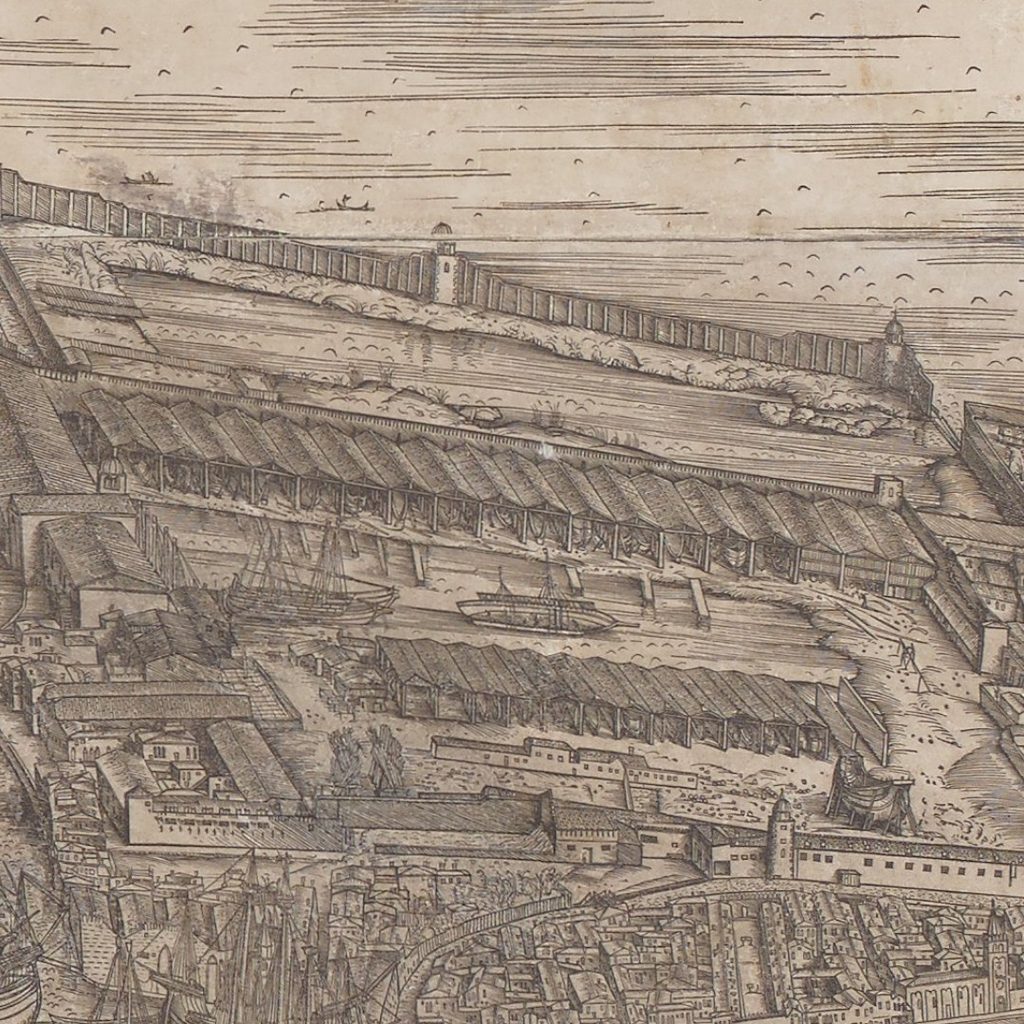
The Arsenal in Jacopo de’ Barbari’s view of Venice, 1500
Next, the visitors were led to a large house where about one hundred women did nothing but sew sails for the ships and galleys. Beside this house, near the gate to exit the Arsenal, was another large storehouse full of armour, long guns, pikes, swords and similar items. Among them, Kiechel saw many old pieces of arms and armour for men and horses, used centuries ago in wars.2
Kiechel heard that many different craftsmen were continuously employed in the Arsenal. He mentioned rope makers, smiths, carpenters, armourers, weapon smiths, crossbow makers, shipbuilders and men who manufactured guns and gunpowder. Overall, there were many hundreds of young and old craftsmen. The workers had their own priests and a church in the Arsenal.
The visitors were led out of the Arsenal, and Kiechel wrote that it was customary to pay a ‘Trinkgeld’ (tip, gratuity or bribe) to the guides and others. Samuel Kiechel found the tour of the Arsenal fascinating and wrote that he visited it twice more when he returned to Venice.
On the way back to the inn, the travellers were shown the city’s bakery. Inside, forty-eight ovens stood, and around eighty people worked there. Kiechel learnt that many of the bakers were also German. No bread was made in the bakery, only biscotti (“pöscoten”). They were baked twice and were very hard. The bakery held large quantities of them, as well as heaps of flour like chalk hills. All the biscuits were for the ships and galleys, to feed the sailors and slaves.
From the bakery towards St Mark’s Square, Kiechel saw multiple galleys. They were always kept ready, day or night, in case of an emergency.3
Factory of Marvels
So far on his journey, Samuel Kiechel had shown an interest in visiting the armouries of the places he passed through. But nothing in Europe compared with the Arsenal in Venice, the large, state-owned shipyard where the galleys of the Republic were built, equipped and maintained. The Arsenal was a manufacturing complex occasionally described as proto-industrial, with production processes so organised and streamlined that, at its height, large numbers of galleys could be built, outfitted and put to sea within weeks.
The Arsenal was established in 1104, but initially consisted only of storehouses for materials and naval equipment, while ships were built in private shipyards around the city. In the 1320s, the storehouse complex was expanded to allow ships to be built on site (Arsenale nuovo). Another expansion took place in 1475 (Arsenale nuovissimo). In the early seventeenth century, the Arsenal covered about twenty-four hectares (~sixty acres), was protected by a wall and towers, and had only one guarded gate and a single channel connecting it to the sea.4
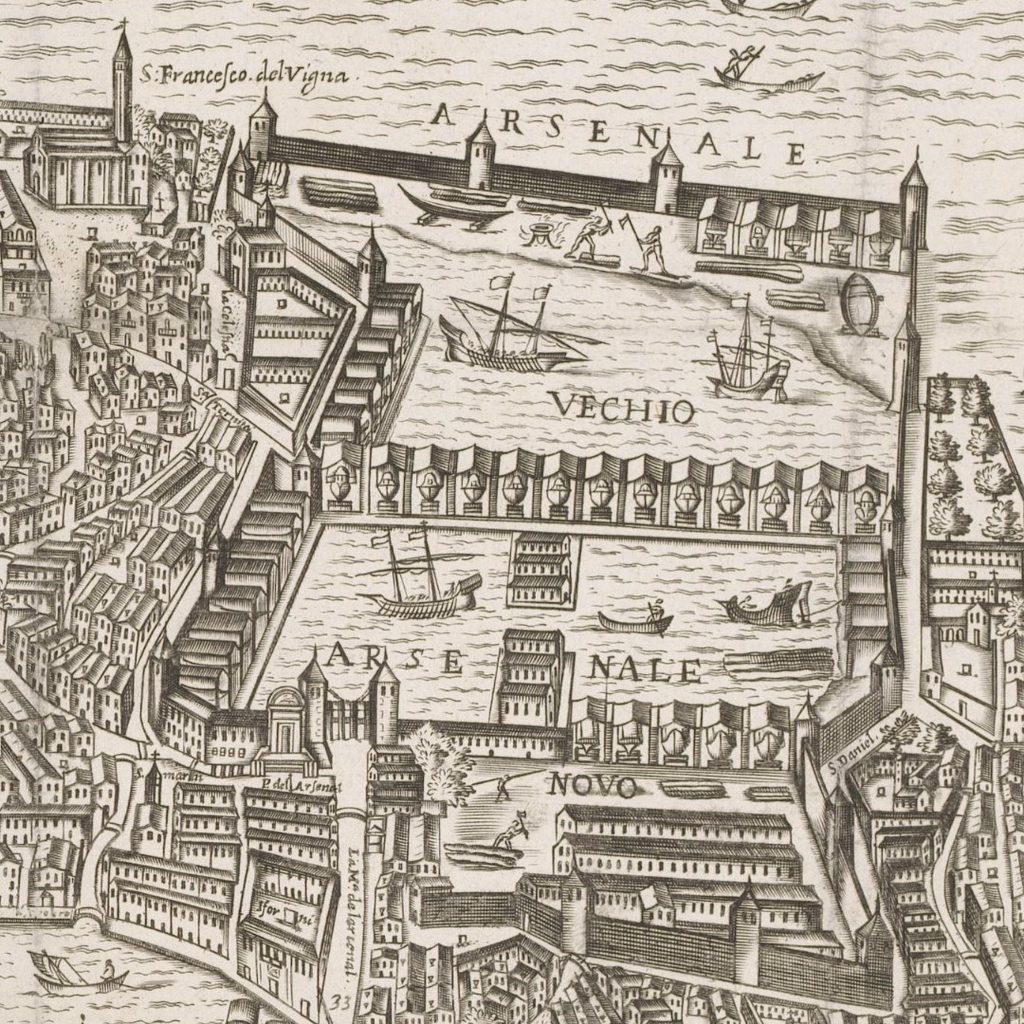
The Old Arsenal (Arsenale Vecchio) and the first expansion (Arsenale Nuovo)
Although Venice and the Arsenal were in decline in the late sixteenth century, the shipyard remained a foundational institution of the Republic and a testament to its past maritime and mercantile power. For early modern visitors to Venice, the Arsenal was among the city’s highlights. The complex was known as the Factory/Workshop of Marvels (L’Officina delle Meraviglie) for its size, skilled workforce and efficient organisation of labour and materials for the mass production of ships.5
The Arsenal in the Sixteenth Century
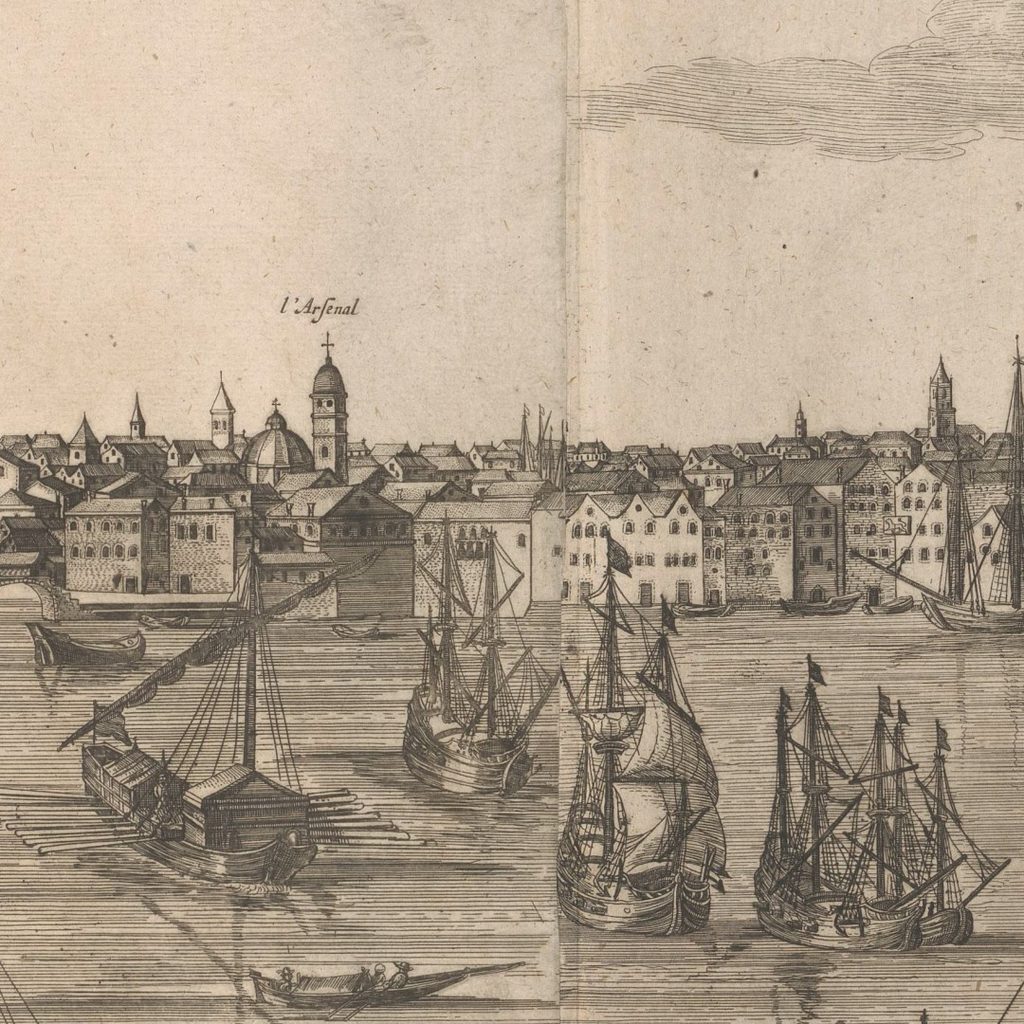
An interesting aspect of the Arsenal was that it was not actually creativity and new ship designs that made it stand out but the sheer efficiency of its production. Kiechel wrote that he saw carracks, galiots, bergantinas, fustas and galleasses stored in the sheds. Not all those ships were built there, and some were in the Arsenal for storage and maintenance.
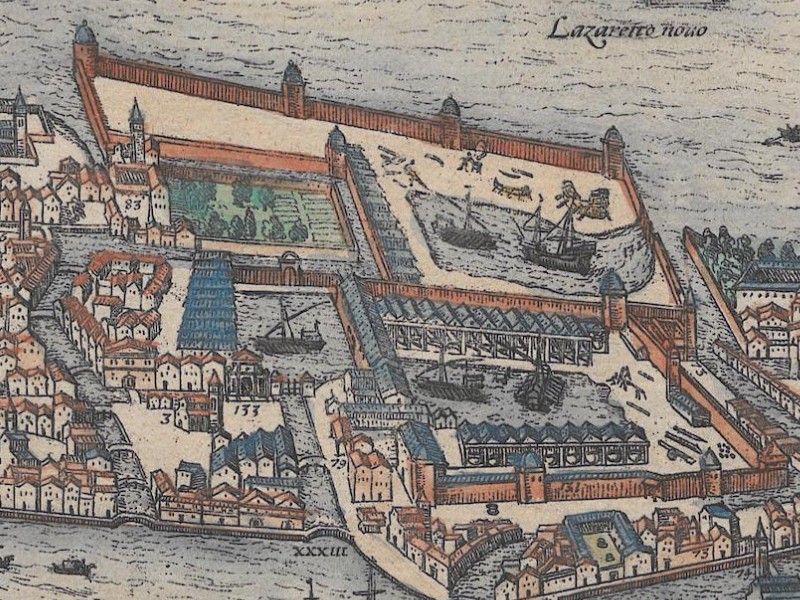
The Arsenal in the Civitates Orbis Terrarum, 1572
Coming from southern Germany, Samuel Kiechel was unfamiliar with ship types and probably wrote down what he heard on the tour through the Arsenal. For the first type of ship he wrote “nauen”. I assume it refers to the Spanish ‘Nao’, the carrack, a three-masted sailing ship used in the fourteenth and fifteenth centuries. The bergantin was a small ship powered by sail and oars; the galiot was a half galley; the fusta a small, narrow galley; and the galleass a new type of heavily armed and armoured warship with sails and oars.
The main ship types produced in the Arsenal until the early eighteenth century were fast, agile light galleys. Their designs had been perfected in the sixteenth century. Production in the Arsenal relied increasingly from Kiechel’s time onwards on standardisation and integrated production that allowed for an assembly-line process. Compared to the informal organisation of work, including for large-scale projects, typical of medieval and early modern societies, the Arsenal’s production cycles featured regular working hours, delegation, dedicated foremen and coordination between work teams.6
The Arsenalotti
Samuel Kiechel mentioned that many different young and old craftsmen worked in the Arsenal. Besides the shipbuilders, the Arsenal contained workshops and storehouses for many other craftsmen associated with producing naval equipment, such as cannon founders, gunmakers, armourers, blacksmiths, rope makers, mast makers and pulley makers, as well as workshops for repair and maintenance. In addition to the skilled craftsmen, a large number of unskilled men worked in the Arsenal as porters, transporting materials or providing muscle-power where needed.
The wine cellars Samuel Kiechel mentioned supplied the workers. The craftsmen received a daily ration of watered-down wine as part of their pay, and master craftsmen doing difficult, challenging tasks were occasionally given rations of undiluted wine as motivation.7
The three major guilds whose members constituted the largest workforce in the Arsenal were the shipwrights, caulkers and oarmakers. The shipwrights made the structural elements of the ships (keel, frame, ribbing); the caulkers were responsible for attaching the hulls, sealing the seams between the planks and for all interior fittings such as cabins. The oarmakers, as the name says, made the oars for the galleys the Arsenal mainly produced.8
The master craftsmen of those three guilds were called arsenalotti. This self-identification points to the special status the Arsenal held within the city. The arsenalotti formed a community that identified closely with their workplace but was also shaped by it. Unlike the rest of the workforce, once they were enrolled in the Arsenal’s registers, the arsenalotti could show up on any day and receive paid work, even if old age or infirmity made them unemployable. However, there was also no actual requirement to work in the Arsenal. Naturally, this policy led to problems down the line.9
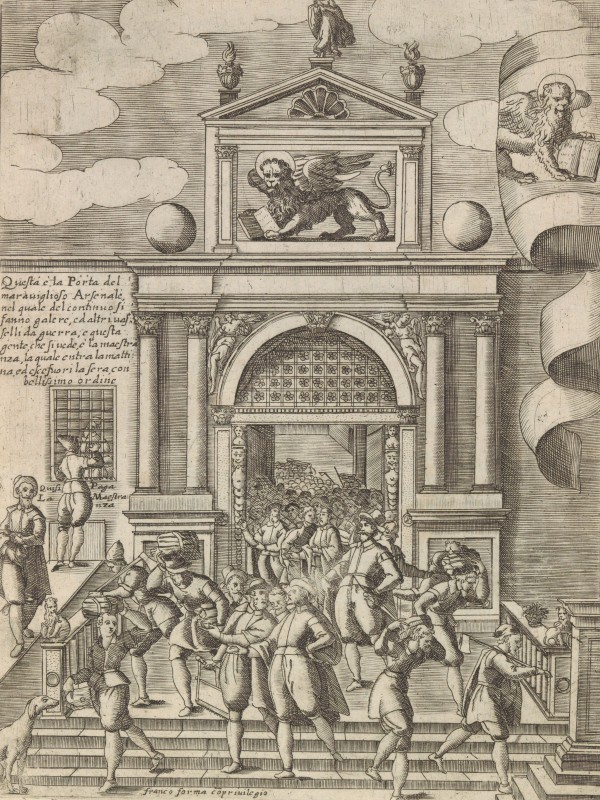
Entrance to the Arsenal, 1610
The Arsenal’s workforce fluctuated greatly throughout its history. It peaked in the mid-fifteenth century, when the Ottoman threat forced the Senate to increase the fleet. To achieve this, many new workers were enrolled. However, after the victory at Lepanto in 1571, the many captured Ottoman ships meant the shipbuilding in the Arsenal was suspended, and the enrollment of new apprentices stopped.10 Samuel Kiechel was shown the Turkish ships but noted that they only served as visitor attractions.
With the ship production halted, the workforce began to decline, and in the 1580s and 90s, the time of Kiechel’s visit, it was close to a crisis point. Private shipyards offered better-paid work, and the craftsmen who still came to the Arsenal were increasingly elderly and used their right to paid work. The Arsenal’s skilled workforce was dying out.11
Only in the first decades of the seventeenth century did the Senate intervene. Apprentices to the crafts were enrolled again, and legislation passed that required the arsenalotti to work for at least 150 days per year in the Arsenal. While the workforce never again reached the numbers it had a century earlier, it stabilised for the rest of the century.12
Our traveller also noted seeing about a hundred women sewing sails. Although few women were employed in the Arsenal, they did cut canvas and sew sails for the ships. However, Kiechel’s figure seems somewhat inflated, as sail production was partly outsourced.13
Marriage of the Sea
Samuel Kiechel mentioned a ceremony performed by the Doge, the Marriage of the Sea. The Feast of Ascension (Fèsta de la Sènsa) on Ascension Day was a public and religious holiday. It was celebrated in commemoration of the Republic’s rise to maritime power, marked by two historic events: the victory over Dalmatian pirates in the year 1000, which opened the Adriatic to Venetian expansion, and the Treaty of Venice of 1177, mediated by the Doge, between Holy Roman Emperor Frederick I Barbarossa and the Lombard League of northern Italian cities, in union with Pope Alexander III, which ended the schism within the Catholic Church.
Part of the festivities was a ceremony called the Marriage of the Sea. The Venetians were acutely aware of their dependence on the sea for their prosperity, as well as their naval power and dominance of maritime trade. The ceremony symbolised this union. As Samuel Kiechel wrote, it took place on the Doge’s galley, the Bucentaur. The Doge, together with the Senate and other notables, would board it and be rowed out of the lagoon into the Adriatic. There, the Patriarch of Venice performed a ceremony, and the Doge threw a golden ring into the sea to conclude the union.
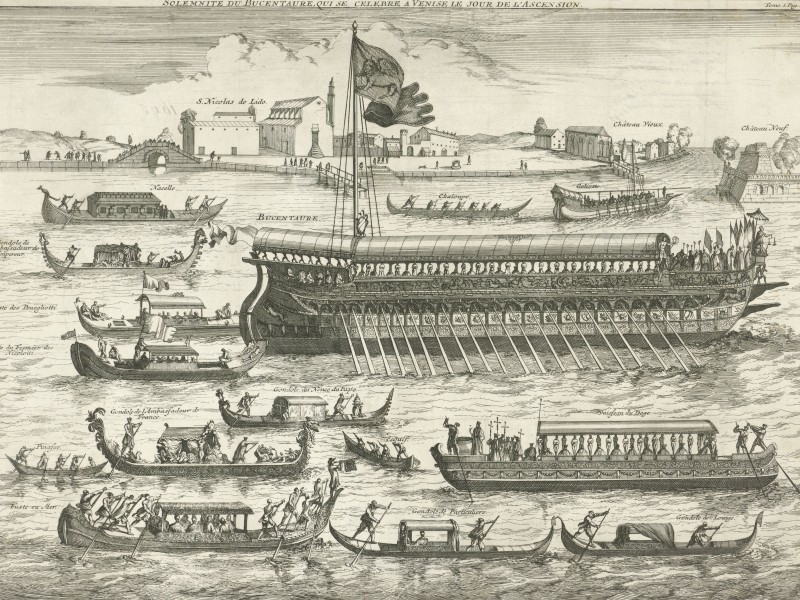
The Bucentaur at the procession during the Feast of Ascension
Illustrations & References
All images are in order of appearance with links to sources on external websites:
- Anonymous, Venetia, 1603 – 1655; Rijksmuseum Amsterdam.
- De’ Barbari, Jacopo, View of Venice, 1500; Minneapolis Institute of Art.
- Anonymous, Venetia, 1603 – 1655; Rijksmuseum Amsterdam.
- Anonymous, Venetia, 1600 – 1699; Rijksmuseum Amsterdam.
- Venice, in: Braun, Georg, Hogenberg Frans, Civitates Orbis Terrarum (1), Cologne 1593, fol. 43v; Heidelberg University.
- Luyken, Caspar, Solemnité du Bucentaure, qui se celebre a Venise le jour de l’Ascension, 1695; Rijksmuseum Amsterdam.
- Die Reisen des Samuel Kiechel aus drei Handschriften, K. D. Haszler (ed.), Stuttgart 1866, p. 156; Bayerische Staatsbibliothek. ↩︎
- Ibid., p. 157. ↩︎
- Ibid., p. 158. ↩︎
- Davis, Robert C., Shipbuilders of the Venetian Arsenal. Workers and Workplace in the Preindustrial City, Baltimore 1991, pp. 3, 48-49. ↩︎
- Ibid., pp. 1-3. ↩︎
- Davis, Shipbuilders of the Venetian Arsenal, pp. 43-44 and 53-54. ↩︎
- Ibid., p. 33. ↩︎
- Ibid., pp. 10-12. ↩︎
- Ibid. ↩︎
- Ibid., pp. 14f. ↩︎
- Ibid., pp. 20f. ↩︎
- Ibid., pp. 22f. ↩︎
- Ibid., p. 107. ↩︎