
Journal of Samuel Kiechel
23 May 1585
From Ulm to Lauingen
“I left Ulm on 23 May in the year 85. It was a Sunday. My brother and some good friends accompanied me to Güntzburg. In the town, we had lunch and refreshed ourselves. Afterwards, I said my goodbyes and went on a raft on the Danube.“
Die Reisen des Samuel Kiechel aus drei Handschriften, K. D. Haszler (ed.), Stuttgart 1866, p. 1; Bayerische Staatsbibliothek.
Ulm in the 16th Century
Samuel Kiechel’s hometown, Ulm, is in the southwest of modern Germany. The city is perhaps best known as the birthplace of Albert Einstein and for the Ulm Minster, a Gothic church with the tallest church tower in the world. Our traveller, on the other hand, is mostly unknown. The Kiechelhaus is what remains of the family. Samuel’s father bought the house in 1583. His older brother Daniel inherited it in 1599 and rebuilt it. Today, the Kiechelhaus is part of the Museum Ulm.
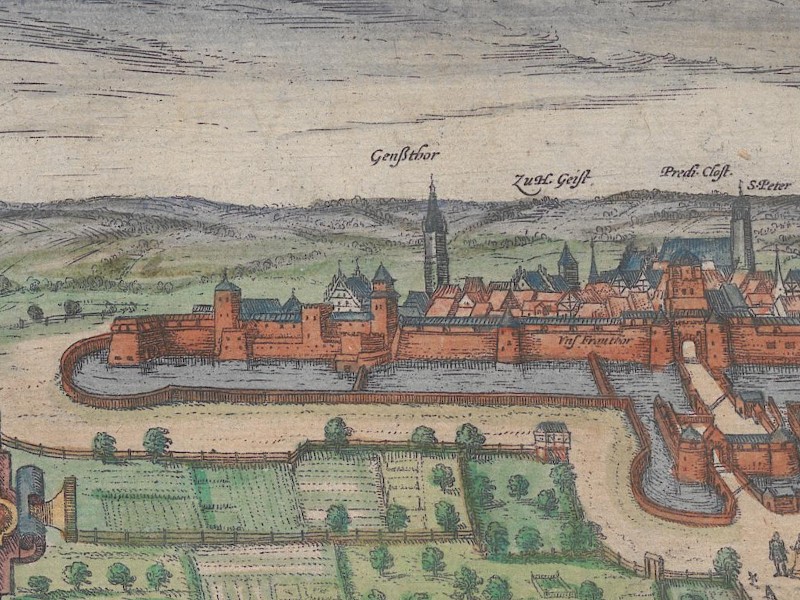
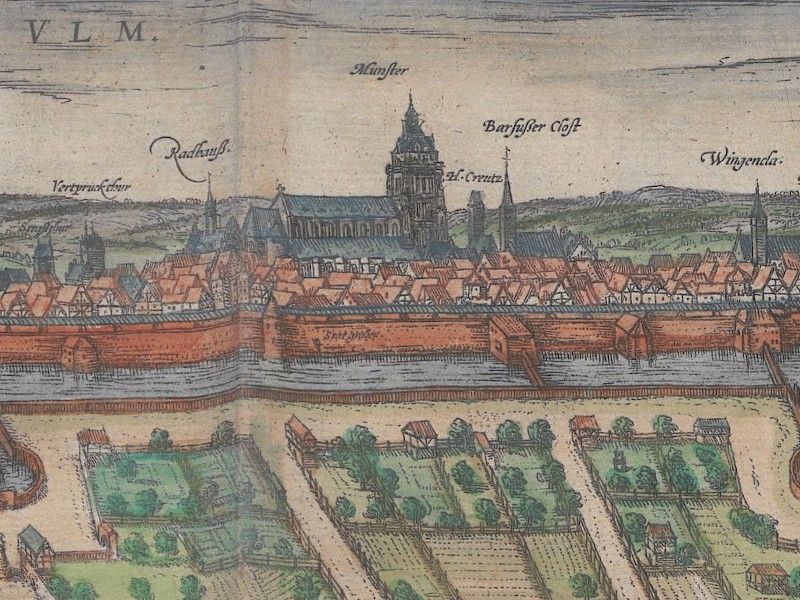
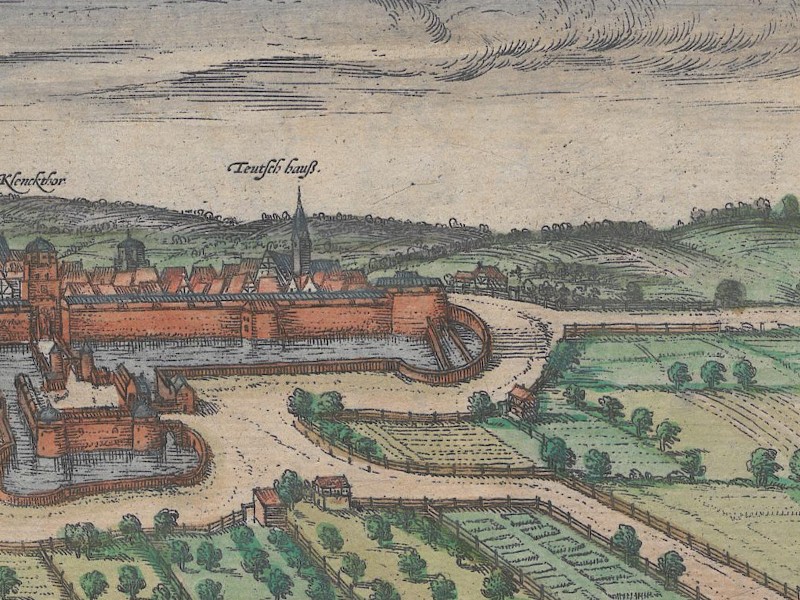
Ulm, 1593
The above view of Ulm from the sixteenth century shows a city exuding wealth and power. Sturdy walls and a moat protect the houses within them. Around Ulm are orchards, gardens and small fields. The majestic Ulm Minster dominates the view. Its construction had not been financed by the church but by the citizens. Despite its size, the Ulm Minster is a church, not a cathedral.
A part of Ulm had been destroyed during World War II, but there are still some sights that existed in the sixteenth century that you can still visit today, like the Ulm Minster, town hall and Gänsturm.
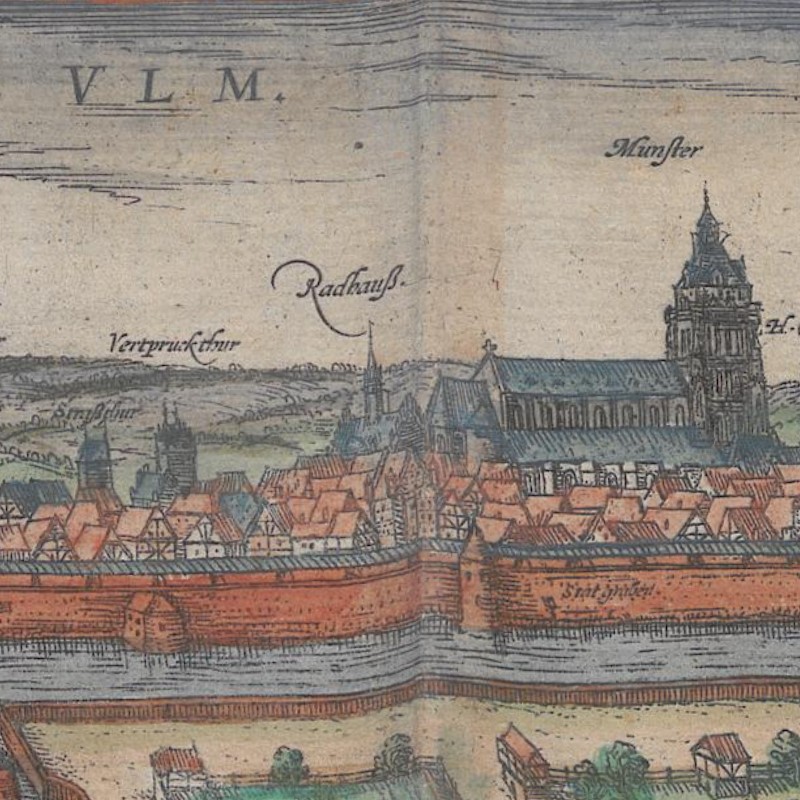
The Ulm Minster (“Munster“), town hall (“Radhauß“) and Herdbrucker-Gate (“Vertpruckthur”), 1593
The view is from the north and does not show the Danube, as the river passes to the south of Ulm. The Herdbrucker-Gate (“Vertpruckthur”) is identified in the image. It is in the background beside the town hall. The gate, connected to a bridge across the Danube, was the city’s main access to and across the river.
Textiles were the source of Ulm’s wealth. Fustian was a type of cloth woven from cotton and linen. It was a commodity of wide renown. The fustian made in Ulm was of the highest quality and exported to places all over Europe. At times, it was even used as a substitute currency.
When Samuel Kiechel left Ulm in 1585, the city had already passed its peak. In the fifteenth century, Ulm had been one of the wealthiest places in Germany. The city’s domain outside its walls included three towns and fifty-five villages. Ulm’s citizens could afford to pay for the construction of their majestic minster.
But then, the political fallout of the Protestant Reformation took its toll. The citizens of Ulm voted in 1531 to make their city Protestant. As in other cities, the destruction of Catholic art and church decorations accompanied this process. Many altars were destroyed or removed, sixty alone in the Ulm Minster.
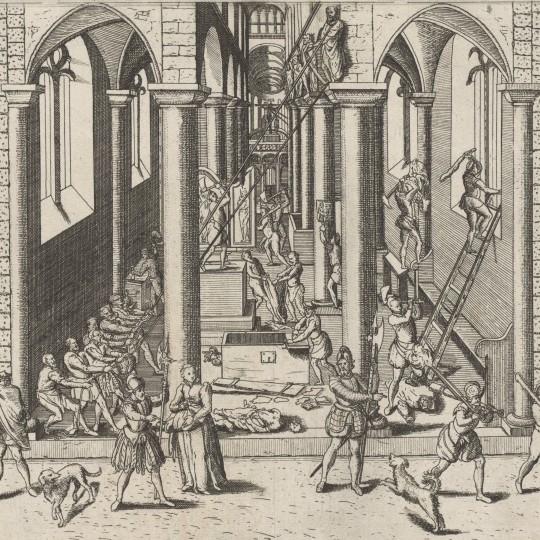
‘Bildersturm’, the destruction of Catholic art and church decorations
Ulm became a member of the Schmalkaldic League in 1531. The League was a defensive alliance of Protestant princes and free cities against the Catholic Emperor Charles V’s attempts to restore religious unity. The political conflict escalated into a military confrontation in 1546 (Schmalkaldic War 1546/1547). In the war, thirty-five of the villages in Ulm’s territorial domain were sacked or burned down. The city struggled to fund the war because of the loss of income from its domain, and the disrupted trade caused by the conflict. In 1546, Ulm surrendered to Charles.
In the aftermath of the surrender, the city had to sign a peace treaty with the Emperor. Ulm had to pay compensation, and the city’s guilds were abolished. The guilds posed a particular concern to Charles V, as they held political power and were considered a hotbed of Protestantism. Charles changed the municipal constitution and handed control of Ulm to the city’s patricians. Despite this, Ulm remained a Protestant city, and ten years later, the guilds were permitted to be re-established.
In the second half of the sixteenth century, Ulm had recovered economically, though it did not return to its previous level of prosperity. Nevertheless, the trade in textiles flourished enough for families like the Kiechels to prosper and finance their sons’ long journey.
Leaving Ulm
Samuel Kiechel mentioned his departure from Ulm only briefly. He did not leave his home alone. Accompanied by his brother and friends, he travelled to Günzburg on the Danube, twenty-three kilometres downstream of Ulm. The distance and the fact that they arrived in the town at lunchtime suggest that the group travelled on horseback.
In Günzburg, they had lunch. Kiechel confusingly referred to the meal as “morgen essen”. The first part, ‘morgen’ (Morgen (n.): morning), refers to a meal in the morning and could be interpreted as breakfast. Samuel would use this term regularly, but always after he had already travelled some distance and at what could only be considered lunchtime.
Afterwards, Samuel said goodbye to his brother and friends. A raft was moored at the bank of the Danube. It belonged to a man named Marte Clonz. The raft already had many passengers on board. Kiechel noticed Anabaptists, Jesuits, Martinists and Papists, as well as various journeymen and women. He went on board, and the raft began its slow journey downstream.
Kiechel’s remark on the various passengers is a sure sign of the aftermath of the Protestant Reformation and the tensions it brought. Under other circumstances, it is questionable whether religious affiliation would have been the first issue our traveller would have commented on.
River Transport
In the sixteenth century, transport options were limited. Wealthy travellers often had their coach or horse; poor people tended to walk or hitch a ride in the back of a cart. However, road conditions were poor, which Kiechel regularly pointed out in his journal. Paved roads were expensive to construct and maintain. Most roads were dirt tracks that quickly became mires in wet weather.
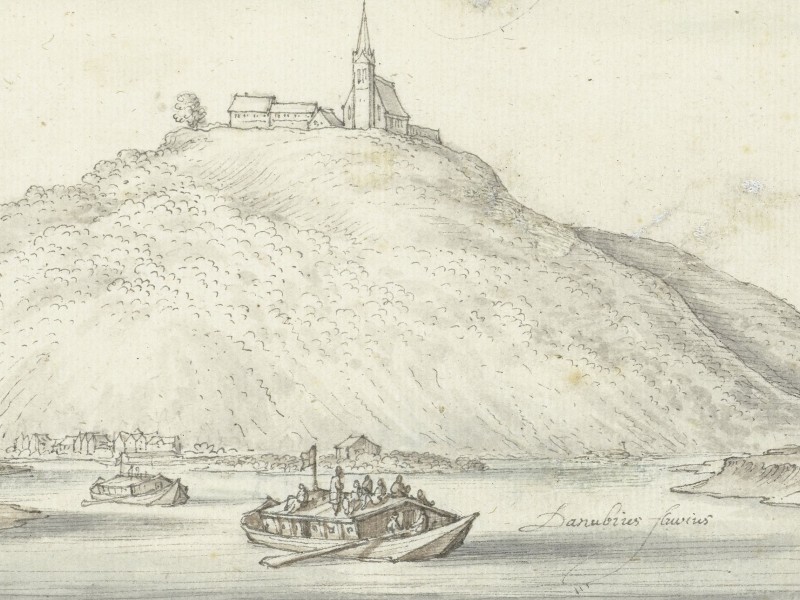
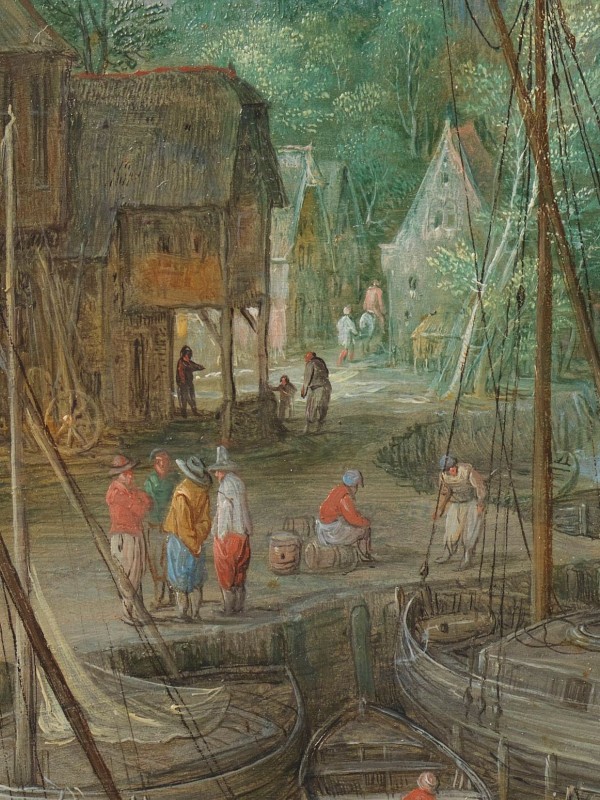
When a river was available, people preferred to travel by boat or barge. It was a faster, more comfortable alternative to land travel and enabled more cargo to be transported.
Rafts were another form of river travel. On the Danube, wood was cut in forests upstream, tied together into rafts, and floated down towards cities like Ulm, Regensburg or Vienna. Transporting passengers was a common practice. It allowed the men working the rafts to generate additional income.1
Final Goodbyes
Like modern public transport, rafts on the Danube stopped at all towns to allow people and cargo to board or disembark. Samuel Kiechel left his raft at Lauingen, just a short distance downriver from Günzburg. Kiechel’s parents lived there, and he wanted to bid them farewell.
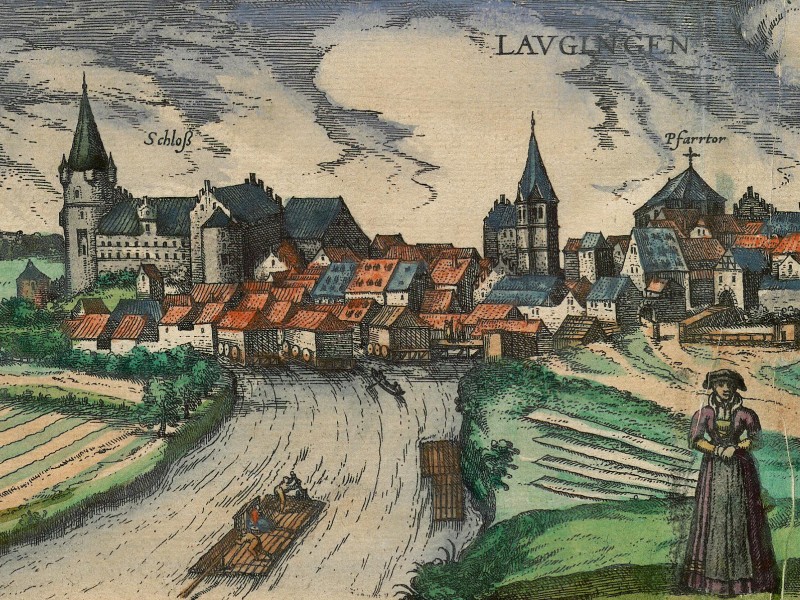
Lauingen, 1594
This view of Lauingen is a neat summary of what Samuel might have seen: a rather majestic-looking but provincial town, the Danube and the countryside he had travelled through. A welcome extra for illustrating Kiechel’s journey are the two rafts in the foreground — one moored on the northern bank of the Danube and the other floating down the river.
Kiechel spent the night in Lauingen. He left in the morning with his parents’ permission and blessing.
To our ears, it might sound strange that a twenty-three-year-old adult asked his parents for permission to go travelling. But this was far from uncommon at the time. The journey was a new and intermittent stage in the young man’s life — between youth and adulthood. It was a once-in-a-lifetime experience and could be the cornerstone of a successful career after his safe return. Or it could end in tragedy. For Samuel and his parents, the moment of departure was undoubtedly heavy with excitement and apprehension, expectations and aspirations, sadness and worry.
Illustrations & References
All images are in order of appearance with links to sources on external websites:
- Ulm, in: Braun, Georg, Hogenberg Frans: Civitates Orbis Terrarum (1), Cologne 1593, fol. 31v; Heidelberg University.
- Hogenberg, Frans, Beeldenstorm, 1566; Rijksmuseum Amsterdam.
- Brueghel, Jan: View of a City along a River, ca. 1630; Rijksmuseum Amsterdam.
- Hollar, Wenceslaus: Gezicht op de Donau bij Ober-Alteich, ca. 1625-50; Rijksmuseum Amsterdam.
- Lauingen, in: Georg Braun, Frans Hogenberg: Civitates Orbis Terrarum (4), Cologne 1594, fol. 45v; Heidelberg University.
- Birgit Jauernig, Flößerei, in: Historisches Lexikon Bayerns. ↩︎