
Journal of Samuel Kiechel
24 February – 15 March 1586
In Stockholm
“This is the capital of the Kingdom of Sweden, where his Majesty holds court; it is on an island, surrounded by water, with two gates, and a bridge connects it to the land. The houses close to the water are built on stilts, and the city has a deep harbour.”
Die Reisen des Samuel Kiechel aus drei Handschriften, K. D. Haszler (ed.), Stuttgart 1866, p. 66; Bayerische Staatsbibliothek.
First Impressions
After a long journey through frozen Denmark and Sweden, Samuel Kiechel reached Stockholm. The Swedish capital lay on the periphery of Western European geographic and cultural awareness and was not a typical destination for travellers.
Nevertheless, two outstanding views of Stockholm appear in volume four of the Civitates Orbis Terrarum, providing a rare visual record of the city. Both images appear on the same page, one above the other, and, aside from the city’s name, neither view offers further information about the buildings depicted.
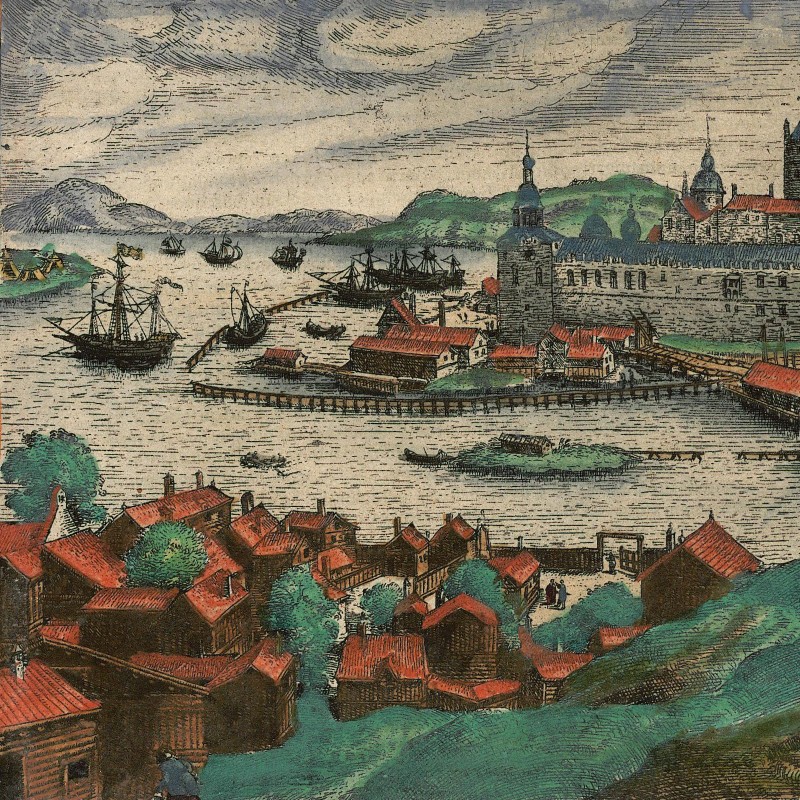
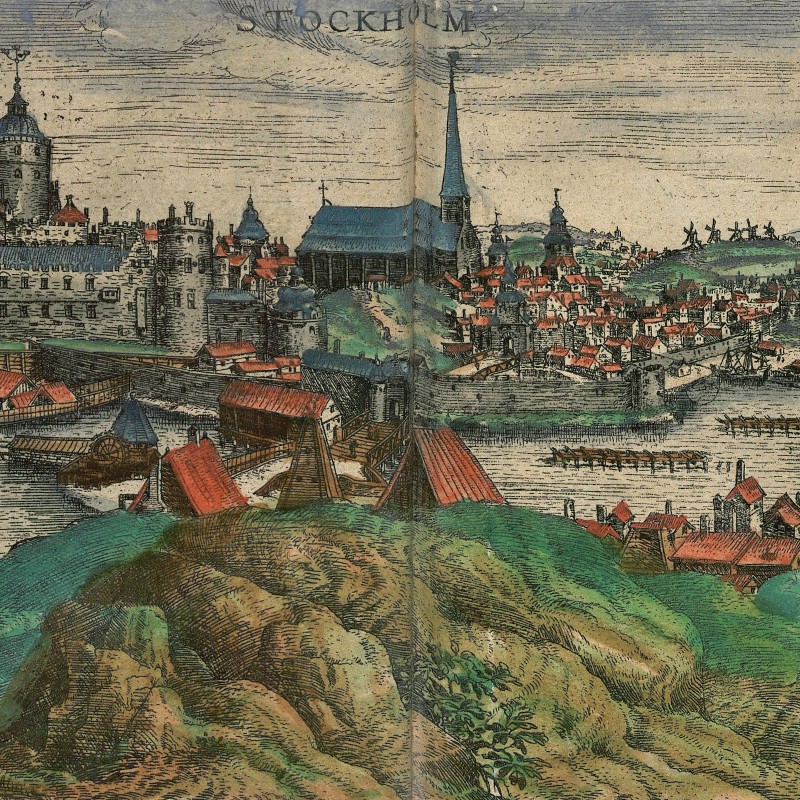
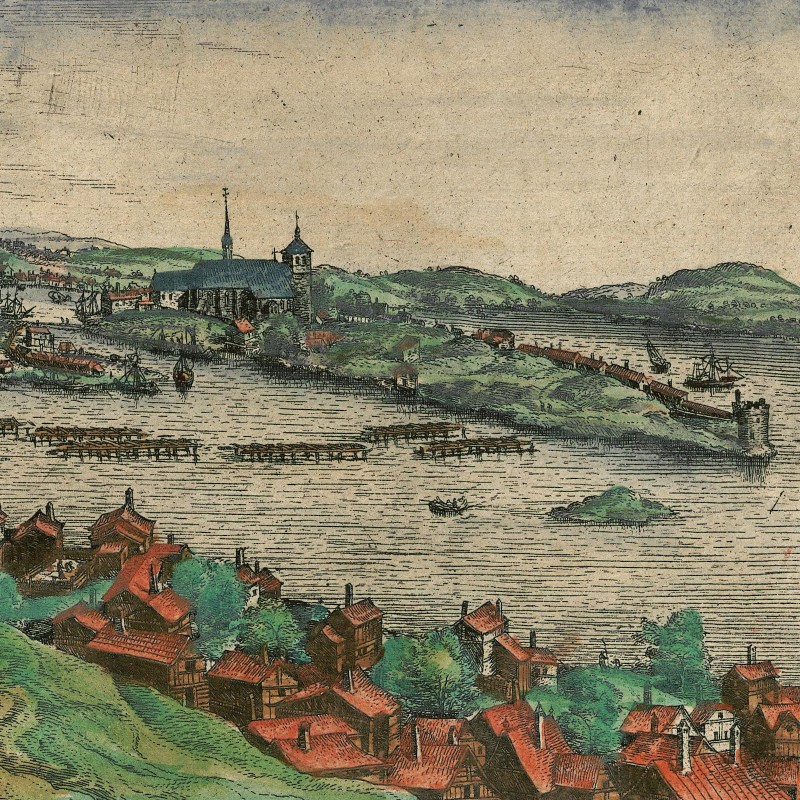
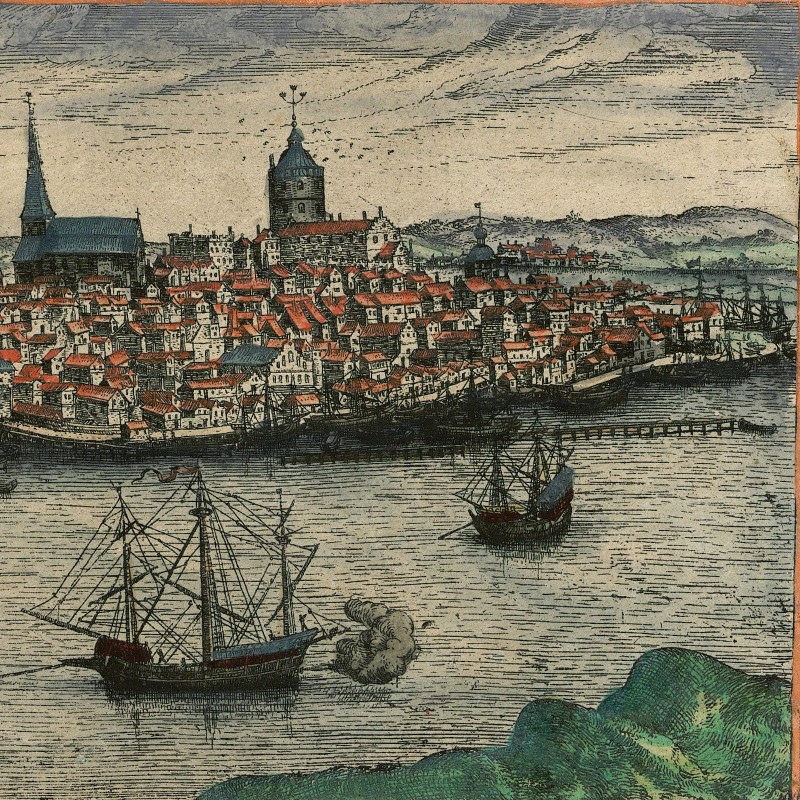
Stockholm from the north, ca. 1588
The first view shows the city from the north. In the foreground, a hill is surrounded by wooden houses. Next is the Norrström in the centre of the image. On the left (east), several large ships are anchored or sailing for the Baltic Sea. Stockholm itself serves as the backdrop, its skyline dominated by the Royal Palace and Storkyrkan (Stockholm Cathedral). To the right (west) is Riddarholmen, another island of Stockholm.
The second view of Stockholm depicts the city from the south and offers a different perspective from the first. Here, the city occupies only the right side of the image and is set in the background. In front of it, the Söderström and its bridge come into view, with two large sailing ships at anchor in the river and more ships moored in the city. As in the first image, the palace and the Cathedral dominate the skyline, though from this angle more houses are visible.
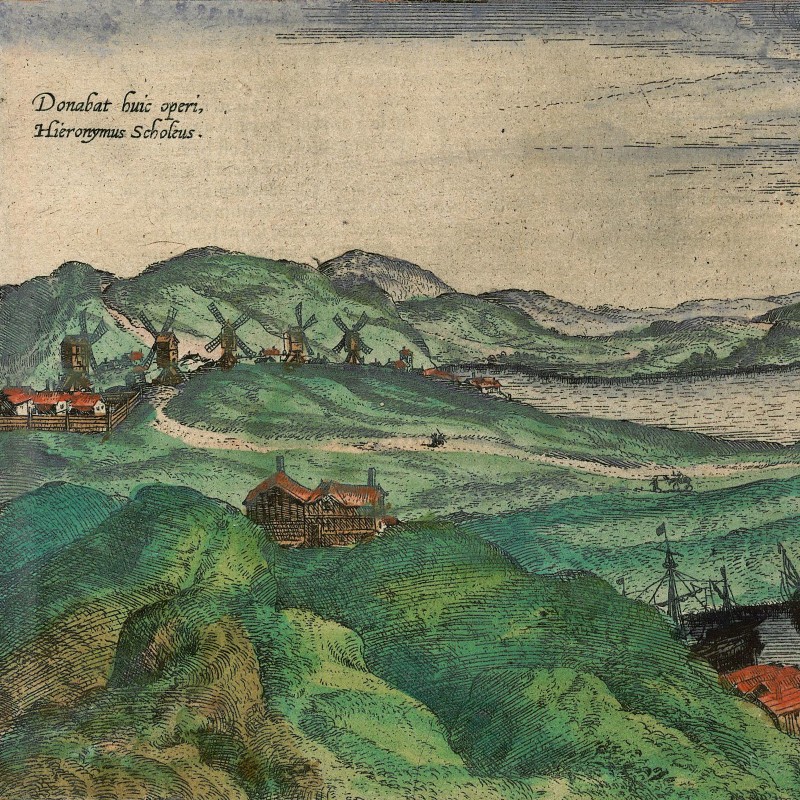
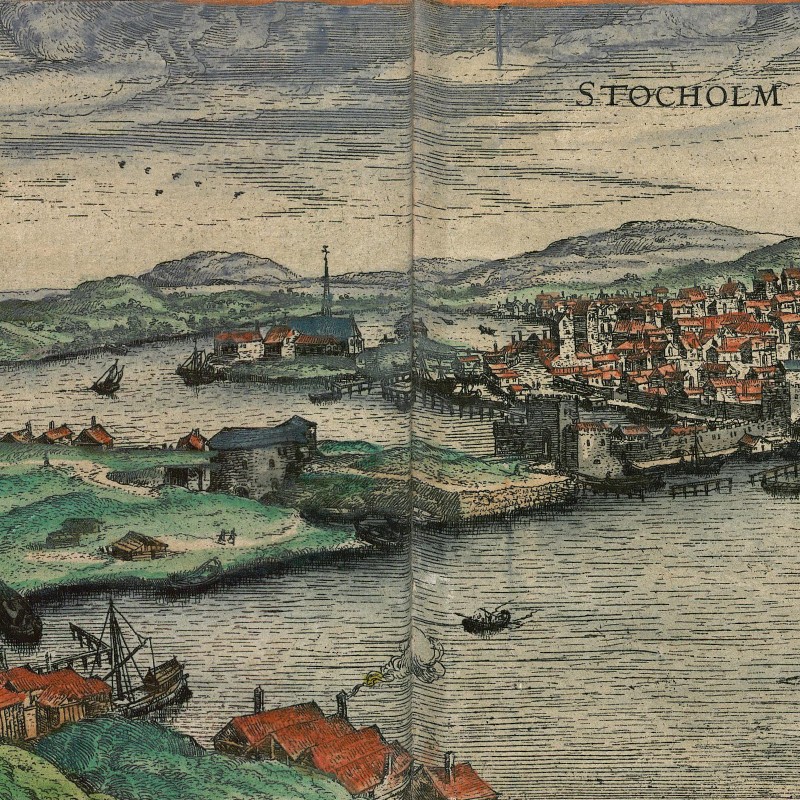
Stockholm from the south, ca. 1588
The left side of the view shows the landscape around the city. Hills surround Stockholm. A road leads from the bridge over the Söderström to a village and five windmills. At the centre of the image, between the city and the hills, the river disappears towards Lake Mälaren. Samuel Kiechel approached from this direction, coming from Strängnäs.
Upon arriving in Stockholm, the traveller described it as surrounded by water, like an island. Two bridges, fortified by gates, connect it to the surrounding countryside. Stockholm is not large and is only protected by poorly built walls. The King of Sweden holds court there. His palace stands at the edge of the city, close to the water, and is fortified by a moat and protected by many mounted guns.1
A map of Stockholm from 1642 provides further insight by offering a plan view of the city and its surroundings. While the city had certainly changed in the intervening decades since the publication of the two views in the Civitates, the map helps to understand the city’s unique geography.
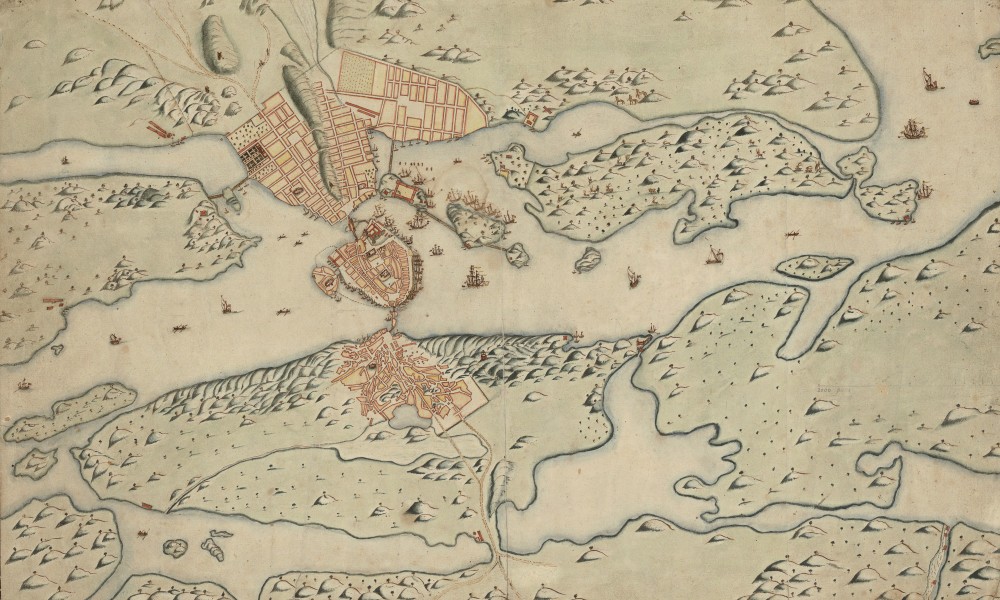
Stockholm, 1642
Stockholm is located at the exit of Lake Mälaren. Water from the lake flows along the Norrström and Söderström around the city, making it an island, as Kiechel described, and then enters the Stockholm Archipelago and the Baltic Sea. The archipelago, just east of the city, consists of over 20,000 islands.
Hemmed in by water on all sides, Stockholm had expanded north and south across the water, as the 1642 map shows. The first steps towards this expansion can already be seen in the Civitates, with wooden houses outside the city along the Norrström. By 1642, those suburbs had grown considerably, and, with its long, straight streets, the northern expansion of Stockholm appears to have followed a planned layout.
The waterway from Lake Mälaren to the Baltic Sea lies at the centre of the map. Large ships are at anchor around Stockholm, and some are sailing towards the sea. Samuel Kiechel wrote that while ships of all sizes could safely anchor in the harbour, the approach was difficult. To reach Stockholm, ships had to sail eighteen miles through an inlet that is never more than a mile wide and leads from the open sea past hills and coastal rocks.2
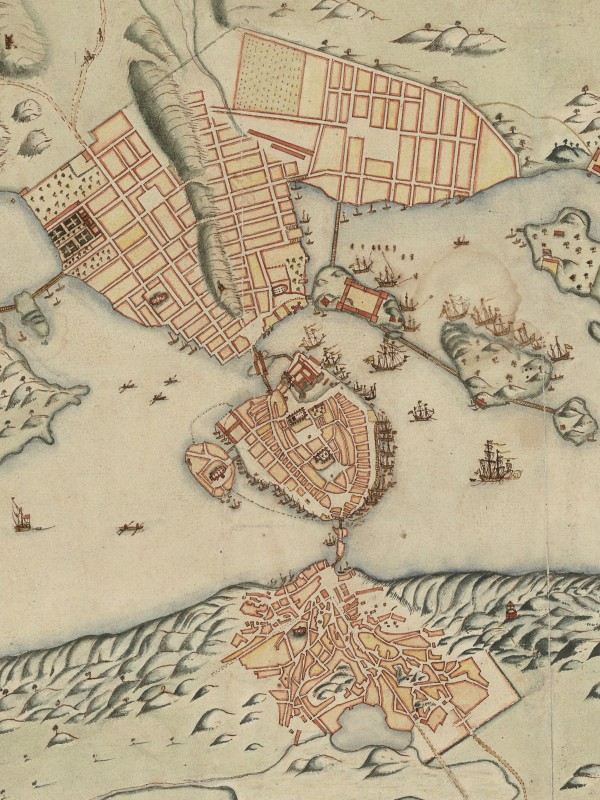
Stockholm with suburbs and harbour, 1642
According to Olaus Magnus, author of the Historia de Gentibus Septentrionalibus (1555), the entrance to Stockholm harbour is narrow and surrounded by rocks and cliffs. It is not straight but curved like a Turkish bow, with many corners, making access dangerous in fog or darkness.3 Together, these accounts emphasise the peril of navigating the Stockholm Archipelago from the Baltic Sea to the city.
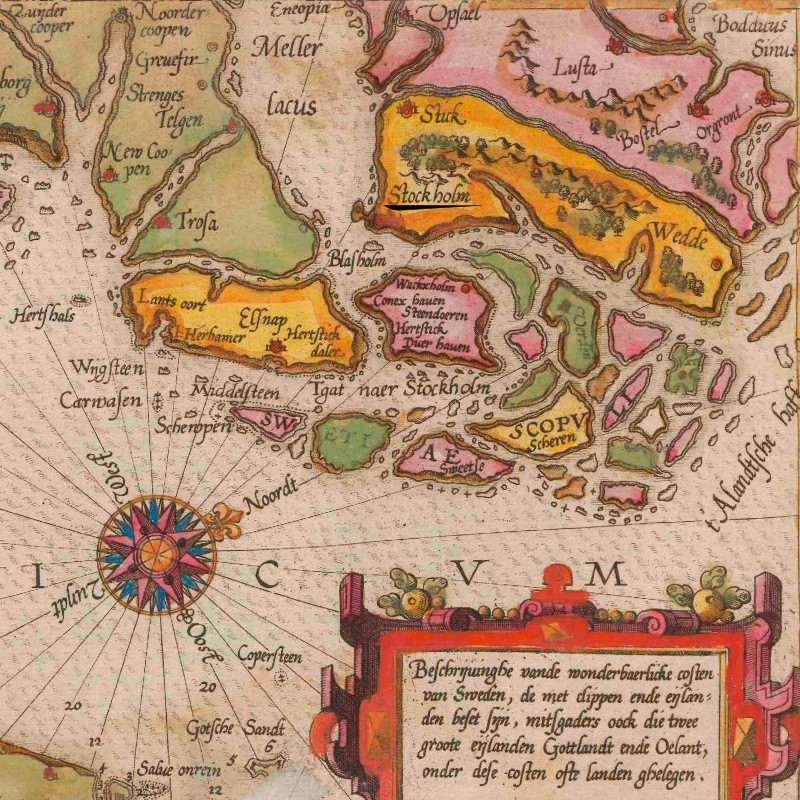
Lake Mälaren (Meller lacus), Stockholm and the Stockholm Archipelago, 1585
The dangerous approach to Stockholm is neatly depicted in a naval chart from 1585. The chart shows the Swedish coast from the east. At the top is Lake Mälaren (Meller lacus). Stockholm is marked, and at the bottom of the image are the myriad of large and small islands that ships had to navigate to reach the city.4
Exploring Stockholm
Upon arriving in Stockholm, Samuel Kiechel began exploring the city. As usual, his descriptions are brief. Our traveller visited Stockholm’s harbour and wrote that it was very deep and large. Heavily laden ships could anchor there. However, at the time of his visit, the sea was frozen, and all ships were locked in the ice. Our traveller saw several large ships he called “orlac schif”, a contemporary term for warships. He heard that the King of Sweden had used them in the conflict with Denmark. Among those ships was one called the “grosse drackh” (Large Dragon). It was the largest and most powerful Swedish ship. It had multiple decks, and Kiechel learnt that the hull was reinforced with osmond, a type of ore produced in the mountains, which stopped gunshots from punching through.5
Contrary to Kiechel, osmond was not an ore but a type of wrought iron. The process of making osmond iron originated in Sweden during the Middle Ages, and it was a popular export good.
Kiechel learnt that Stockholm’s houses closest to the water were built on stilts. Olaus Magnus wrote about the construction of such houses in his Historia. According to him, construction began in winter, when the water was frozen. The stilts were wooden posts made from alder, beech, fir or oak. Those types of wood became as strong as iron in the water. One end of the stilts was sharpened to a point and reinforced with iron. They were driven into the riverbed, and stones were placed around them to support them. When the ice melted in the spring, a solid foundation of stilts was ready to support houses. Magnus further wrote that not only houses but also palaces, towers and walls were built on stilts.6
Furthermore, Kiechel visited an island he called ‘Menckhollm’. The island was linked to Stockholm by a bridge. A monastery stood on the island. Our traveller wrote that it had once belonged to a diocese but was now used to house scholarship holders.7
The island was called “Munckholmen”. It translates as ‘Monk Island’, but it is now known as Riddarholmen. The Greyfriars Monastery on the island was dissolved in 1527 during the Protestant Reformation. Its buildings were repurposed as a hospital and, from 1576, as a school of Theology. The island is depicted in both views in the Civitates.
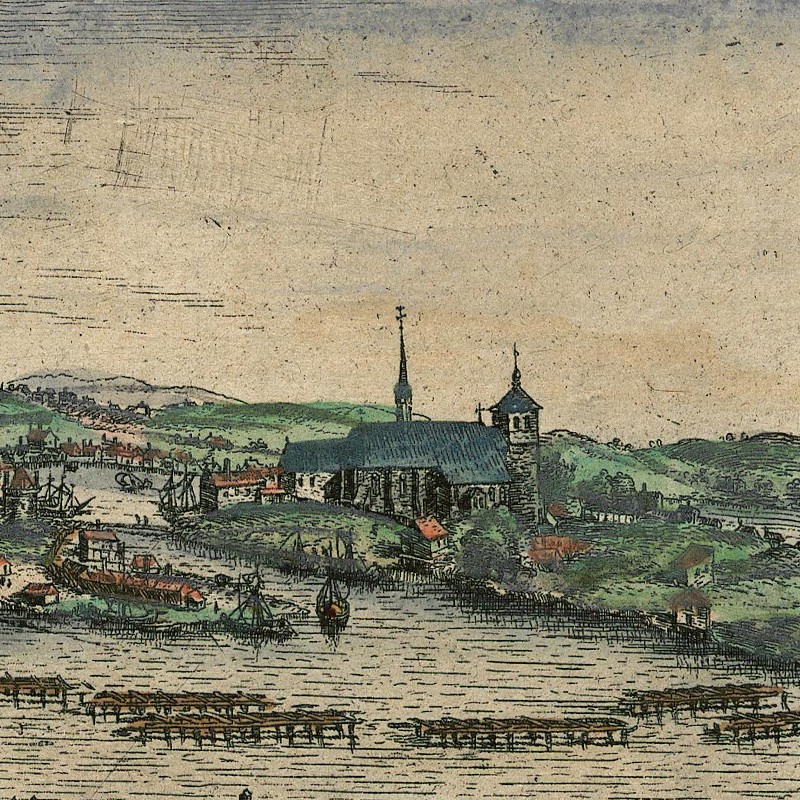
Munckholmen in the Civitates, ca. 1588
Animals
Outside Stockholm, across the water, Kiechel discovered a park. In the park, animals were kept. Our traveller saw many different kinds of game animals, including a deer with very wide antlers, white deer, a smaller deer-like animal with a speckled hide, and elk. The park was probably a hunting ground for the Swedish royal family and nobility.
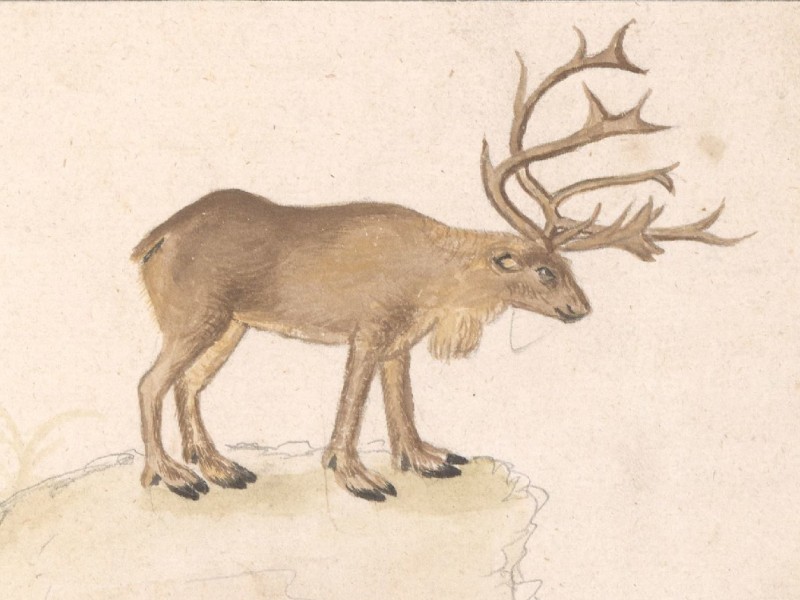
Reindeer
Samuel Kiechel heard that many elk live in Sweden, where they are hunted in late winter as the snow begins to melt. Duke Charles, the King’s brother, enjoys these hunts. According to Kiechel, elk meat is edible but tough to digest.8 (As a clarification, moose are called elk in Europe.)
Kiechel also saw reindeer and noted that they live in Lapland. While dwelling on the subject of Swedish animals, our traveller noted that many lynxes and black foxes live in Sweden. He wrote that black fox pelts are much more valuable than those of the lynx or sable.9
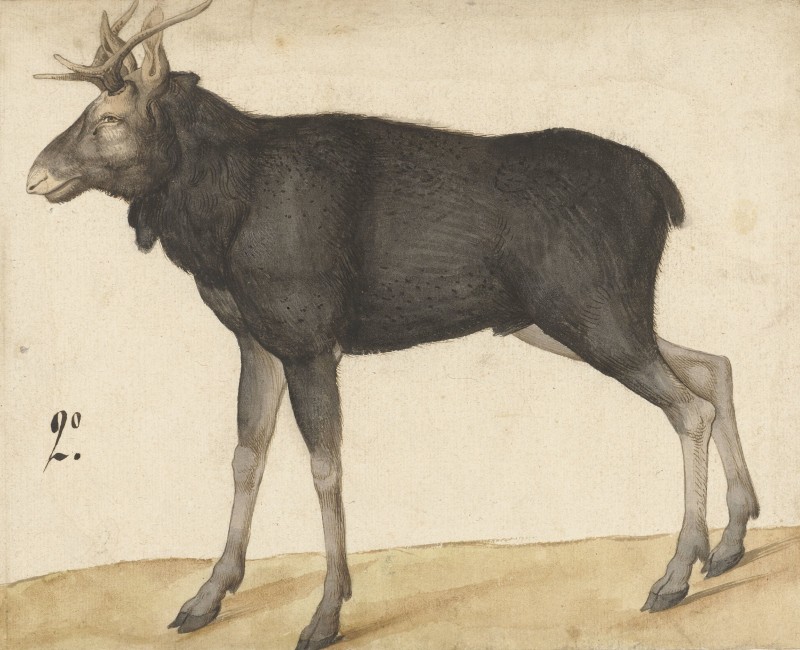
Elk
Olaus Magnus devoted two chapters of his Historia to Scandinavian animals. Much of his writing relies on ancient sources, chronicles, fables and folk tales. Despite three pages on the elk, there’s little contemporary information.10 Magnus summarises ancient authors (even those who never saw elk), discusses elk hooves as medicine, and recounts how elk fight wolves.
As for domesticated animals, Kiechel noticed that the inhabitants of Stockholm kept horses, cattle and pigs in the suburbs outside the city.
Accommodation, Food and Drink in Stockholm
While travelling through Sweden, Kiechel learnt that there were no regular inns in the country. Travellers had to arrange private accommodation. The same was true in Stockholm. Samuel wrote that he stayed in Jacob Loorman’s house. Loorman was originally from Lübeck but had married in Sweden and now lived in Stockholm.
Kiechel does not explain how he knew about this private accommodation. Presumably, his companions, who were also from Lübeck and had been to Stockholm before, knew Loorman and took Kiechel along. It was typical in the early modern period for travellers to stay with countrymen, if possible.
Samuel Kiechel was satisfied with the accommodation and wrote that his host took good care of him. He paid one Reichstaler per week for food, drink and a place to sleep. Regarding the cost of living in Stockholm, Kiechel considered one Reichstaler per week good value for money. Partridge and other poultry were often served. But no wine was available, and guests were only given beer.
Regarding drinks, Kiechel noted that wine and other foreign drinks were very expensive in Sweden due to high customs duties. A half-pint of wine that cost him four Kreuzer at home in Ulm was available in Sweden for a quarter of a Reichsthaler. A Kreuzer was small change, whereas a Reichsthaler was a large silver coin.
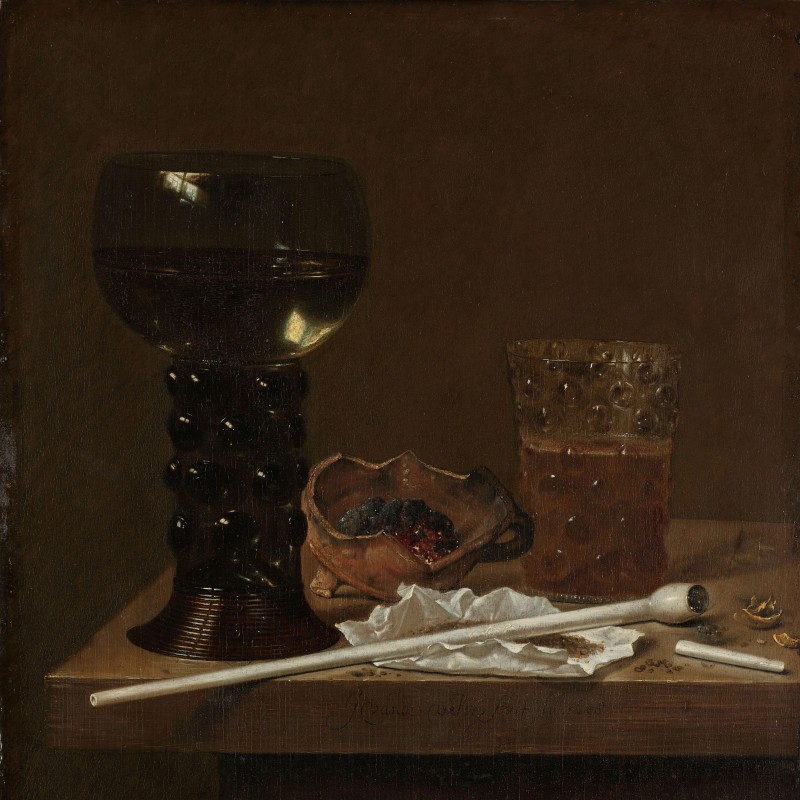
Furthermore, our traveller learnt that the wine served in Stockholm was mostly from the Rhine region, though he assumed it was watered down. Luckily for Samuel, the Swedish beer was very good. Apart from the local varieties, there were also foreign beers from Lübeck, Rostock, Gdańsk and other places for sale. Finnish and Lithuanian mead were sold in Stockholm, and Samuel observed that Swedish women enjoyed drinking it.11
Olaus Magnus wrote that three varieties of wine were available in Sweden. Spanish wine was good, mild and sweet. French wine was often sour and hard, and was used as sacramental wine at church. Wine from the Rhine region was of good quality and sold in the taverns for a high price. In addition, Magnus wrote, the people of Sweden produced a local wine. They made it from pears, apples and medlar, seasoned with pepper, ginger and cloves. A herbal wine was produced from sage, wormwood and lavender.12 Olaus Magnus also mentioned the mead production, as described earlier, and wrote that Polish, Lithuanian and Gothic (Swedish) mead were available for sale.
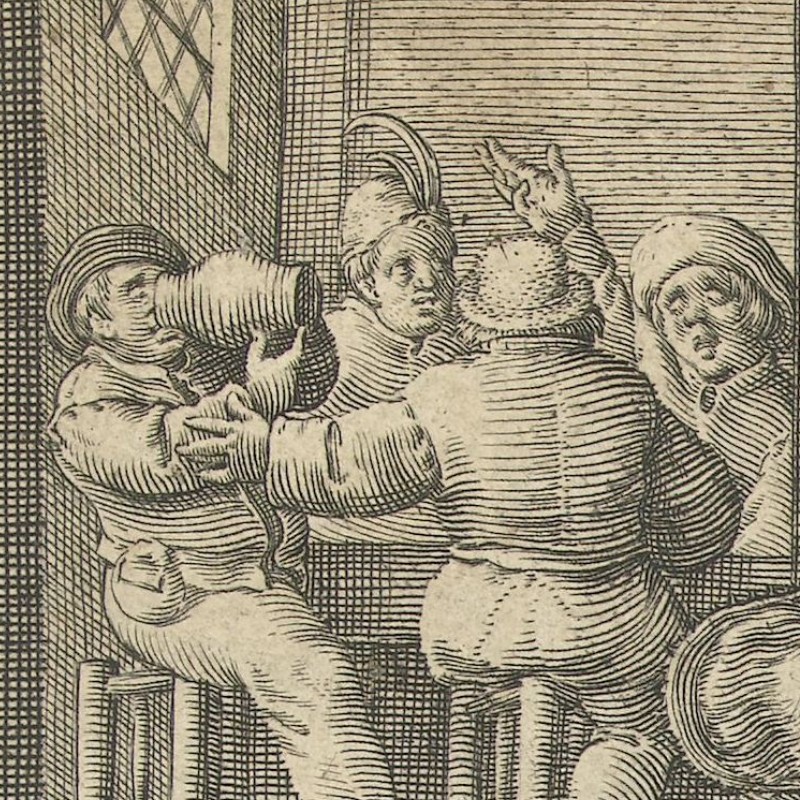
Regarding drinking customs in Sweden, Samuel Kiechel wrote that when seated at a table, people drink one after another, and each man toasts the one beside him. He raises his glass or tankard, offers his hand, and blesses his neighbour. The same happens when one of the men leaves the table to go outside. When he returns, everyone at the table offers their hand and welcomes him back. According to our traveller, this was a common custom not only in Sweden but also in Denmark and in other cities along the Baltic coast, as far as Lithuania and Livonia. It is understood that offering your hand means you are not envious or hateful towards the other drinkers.13
As for getting the drink out of the body, Kiechel reported that houses in Stockholm lack toilets. Instead, people went to what he calls ‘between the gates’ and other places made for this purpose. These were obviously public toilets. Kiechel further wrote that these places had separate spaces for men and women. As a foreigner unfamiliar with local customs, Kiechel mentioned that he entered the women’s toilet. An old woman caught him as he left. She scolded and insulted him. But our traveller did not understand a word.14
Finally, Kiechel noted that the Swedes make very large cheeses that weigh many pounds each. He heard that some cheeses are so large that two men have difficulty carrying them, but he had not seen them. Our traveller further wrote: If a landed nobleman is planning his marriage, a cheese is used to show his wealth and how many peasants he has on his land. All peasants must deliver milk from all their cows on a specific date. The collected milk is used to make the cheese that shows the nobleman’s wealth and power.15
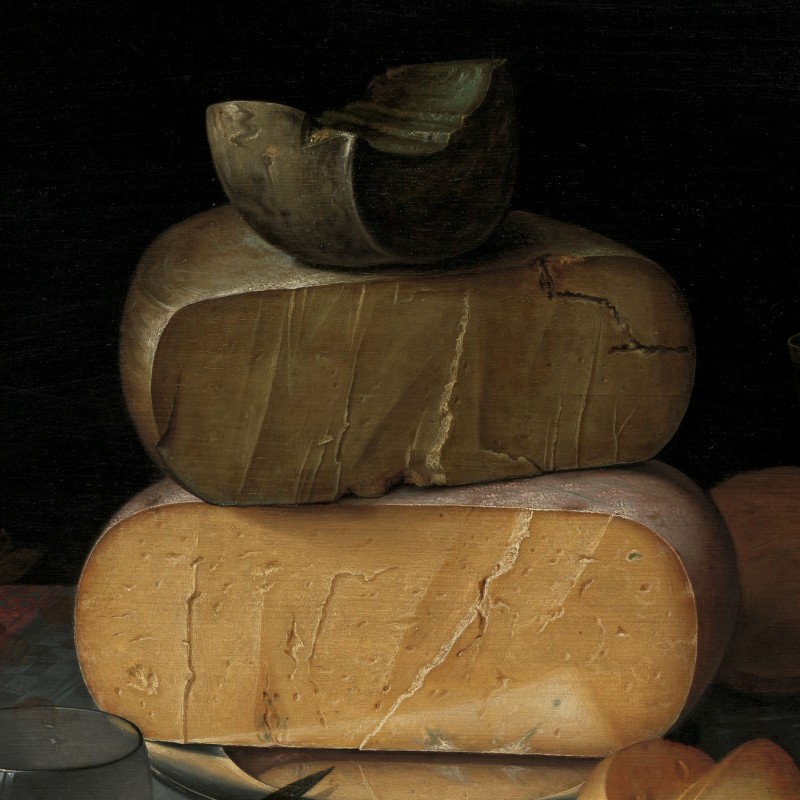
Olaus Magnus recommended the Swedish cheese. He wrote that the Swedes have the best cheese because of the country’s high-quality pastures. The cheeses are so large and heavy that two men are needed to carry them. However, the cheeses are made only by women, and no man is allowed to participate in the process. Women from various villages come together in the summer to make cheese from the milk. First, they heat the milk. They cut up small cheeses that had been dried in the sun and air and add them to the hot milk. According to Magnus, these pieces of cheese work similarly to gravel added to mortar. The gravel provides stability to the mortar wall, and the bits of old cheese improve the structure and consistency of the new cheese. The hot milk with the cut-up pieces of cheese is then poured into square wooden moulds and left to dry.16
Olaus Magnus furthermore wrote that the Swedes in the east of the country make good sheep’s cheese, whereas the Finns produce good-quality goat cheese. The goat cheese is mostly smoked.17
Illustrations & References
All images are in order of appearance with links to sources on external websites:
- Stockholm, in: Braun, Georg, Hogenberg Frans: Civitates Orbis Terrarum (4), Cologne 1594, fol. 38v; Heidelberg University.
- Anonymous, Karta över Stockholm med omgivningar, 1642; National Library of Sweden.
- Waghenaer, Lucas Jansz., Thresoor der zeevaert, Amsterdam 1596, fol. 126v; Utrecht University Repository.
- de Boodt, Anselmus Boëtius, Rangifer / Renne, 1596 – 1610; Rijksmuseum Amsterdam.
- Anonymous, Eland (Alces alces), 1550 – 1570; Rijksmuseum Amsterdam.
- van de Velde, Jan Jansz., Still Life with Roemer, Beer Glass and a Pipe, 1658; Rijksmuseum Amsterdam.
- de Bruyn, Nicolaes, Feestend gezelschap aan tafel, 1581 – 1656; Rijksmuseum Amsterdam.
- Vrancx, Sebastiaen, The Crane on the Antwerp Quay by the Frozen Scheldt, 1622; Rijksmuseum Amsterdam.
- van Dijck, Floris Claesz, Still Life with Cheeses, c. 1615; Rijksmuseum Amsterdam.
- Die Reisen des Samuel Kiechel aus drei Handschriften, K. D. Haszler (ed.), Stuttgart 1866, p. 66; Bayerische Staatsbibliothek. ↩︎
- Ibid. ↩︎
- Olai Magni historien, Der Mittnachtigen Länder …, Basel 1567, p. 75; Bayerische Staatsbibliothek. ↩︎
- Waghenaer, Lucas Jansz., Thresoor der zeevaert, Amsterdam 1596, fol. 126v; Utrecht University Repository. ↩︎
- Reisen des Samuel Kiechel, p. 67. ↩︎
- Magni historien, Der Mittnachtigen Länder, p. 313. ↩︎
- Reisen des Samuel Kiechel, p. 66. ↩︎
- Ibid., p. 67. ↩︎
- Ibid. ↩︎
- Magni historien, Der Mittnachtigen Länder, pp. 474f. ↩︎
- Reisen des Samuel Kiechel, pp. 67f. ↩︎
- Magni historien, Der Mittnachtigen Länder, pp. 338-340. ↩︎
- Reisen des Samuel Kiechel, p. 68. ↩︎
- Ibid., pp. 66f. ↩︎
- Ibid, p. 69. ↩︎
- Magni historien, Der Mittnachtigen Länder, pp. 364f. ↩︎
- Ibid. ↩︎