
Journal of Samuel Kiechel
9 June 1585
Dresden
“Dresden is in the land of Meissen, and the Elector of Saxony has his residence there. The city is small and heavily fortified. It is a pleasant place with beautiful, straight, wide streets. The houses of Dresden are built of stone.”
Die Reisen des Samuel Kiechel aus drei Handschriften, K. D. Haszler (ed.), Stuttgart 1866, p. 4; Bayerische Staatsbibliothek.
Visiting Early Modern Dresden
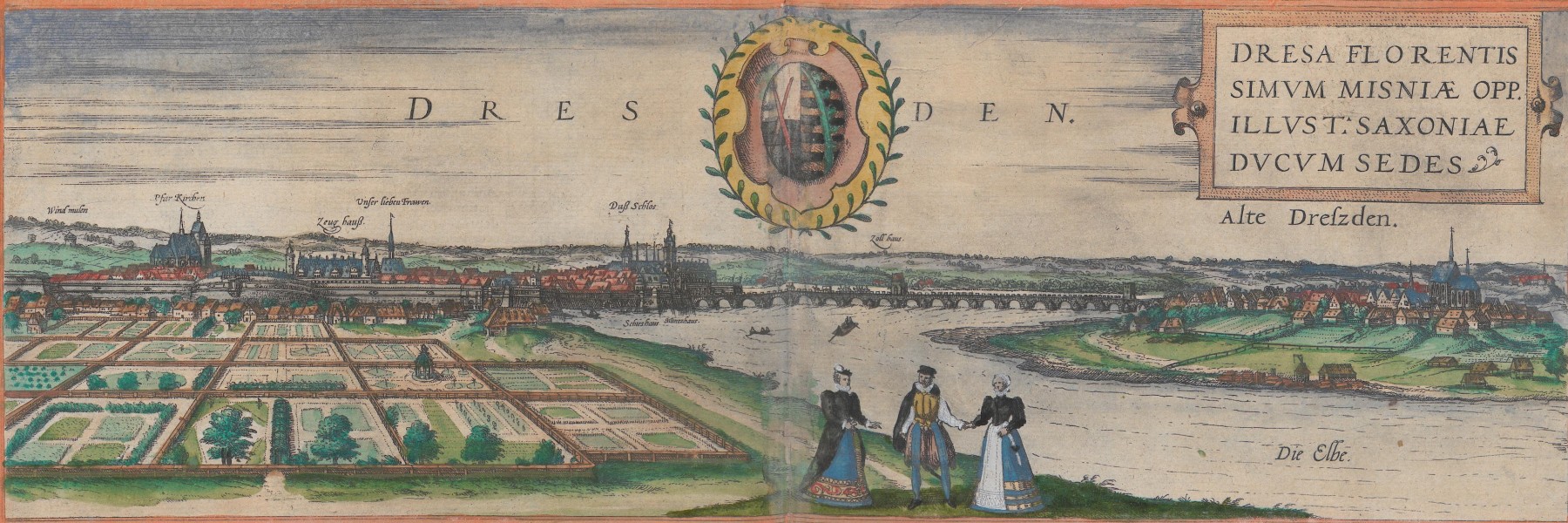
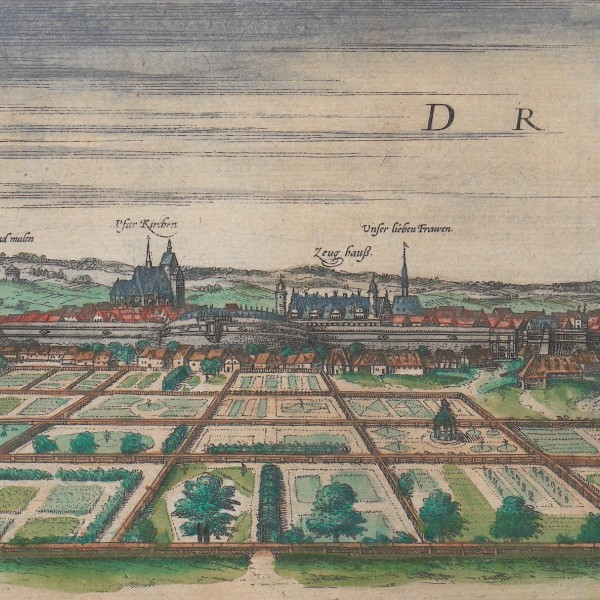
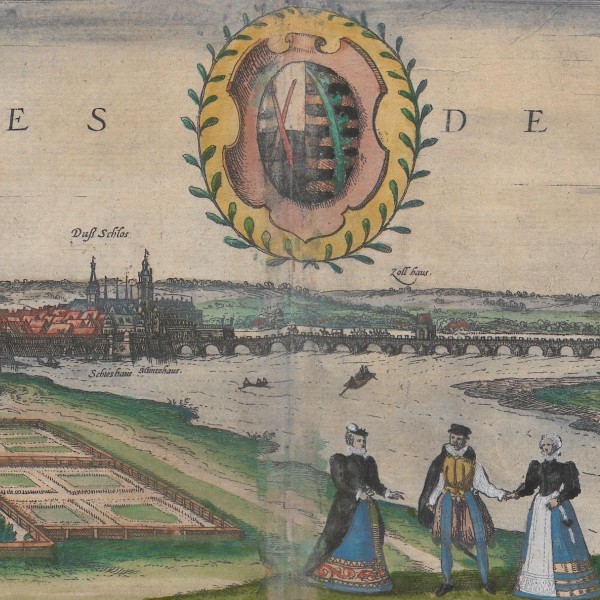
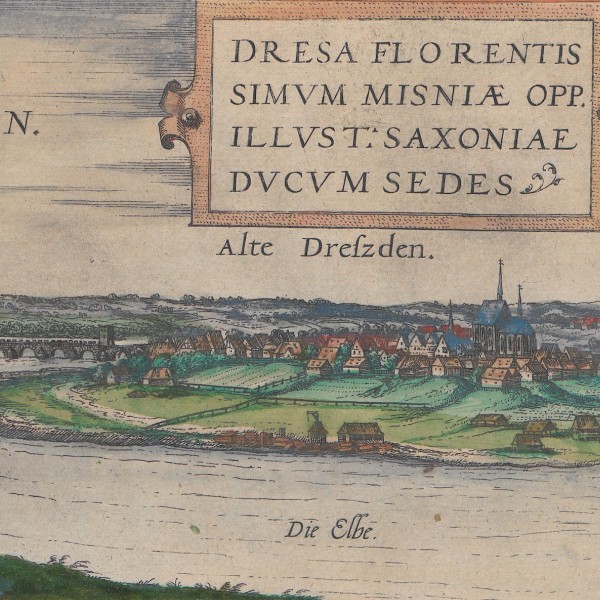
Samuel Kiechel’s first impression of Dresden could not have been much different to this view of the city in the Civitates Orbis Terrarum. The view presents Dresden from the south — the direction our traveller had arrived from. Small fields, gardens and meadows surround the city on the river Elbe. A long stone bridge leads across the river and connects the two parts of Dresden. The settlement on the western bank of the river is the larger of the two and is fortified by a wall. But the fortifications could no longer contain the growing city, and houses had been built outside the wall. Dresden’s two major churches, the armoury and the palace of the Elector of Saxony, stand out and dominate the skyline.
Between 1546 and 1591, the walls of Dresden were modernised and in part rebuilt. In the image, they look sturdy and are in the style of the early modern period. At least three bulwarks are visible, with intermittent sections of curtain wall between them. The increased use of gunpowder made the old, medieval fortifications of cities and castles obsolete. High walls were no longer a sufficient protection. Lower, sturdier walls with protruding bulwarks provided the defenders with better lines of fire and became the new architectural norm. For modern visitors to the city, Brühl’s Terrace on the bank of the Elbe had once been part of Dresden’s early modern fortifications.
The view of Dresden confirms some of Samuel Kiechel’s observations. Our traveller wrote that the city was small and heavily fortified. The Elbe flowed through it, and a delicate stone bridge led across the river.
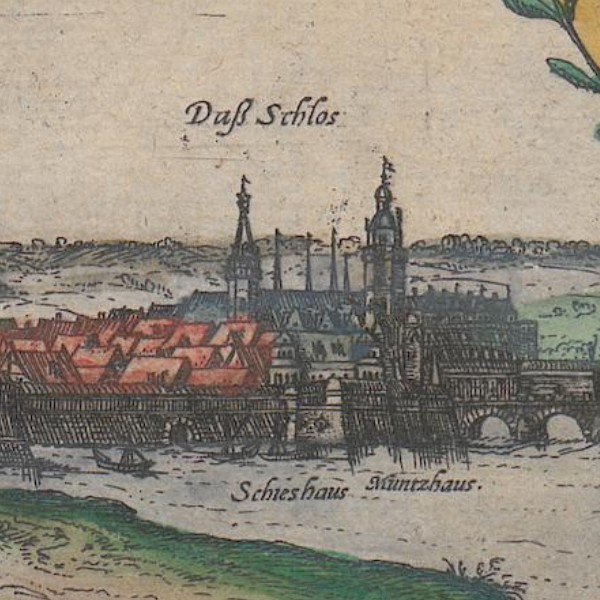
Palace of the Elector of Saxony in Dresden (“Daß Schlos”)
The description of Dresden in Kichel’s journal is just one paragraph long. As usual, our traveller started by identifying the territory and ruler to which the city belonged. Dresden was in the land of Meissen — an administrative district of the Duchy of Saxony — and it was the residence of the Elector of Saxony. The palace of the Elector is seen close to the river in the centre of the image (“Daß Schlos”).
Entering Dresden, our traveller observed that its houses were well-built and made of stone. Beautiful, straight and broad streets led through the city. At the market square, Kiechel took up his accommodation in the inn “Zum Goldenen Ring” (Golden Ring).
The market square our traveller mentioned is today’s Altmarkt (Old Market Square). At its southwestern corner stood the inn where Kiechel stayed.
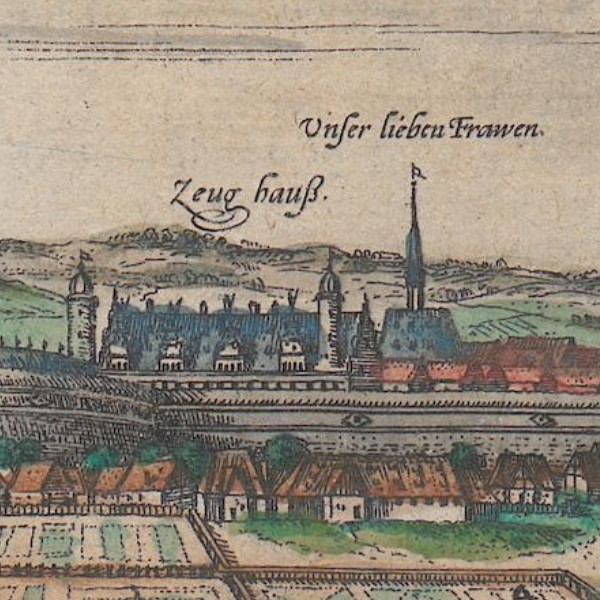
Frauenkirche (“Unser lieben Frawen”) and armoury (“Zeug hauß”)
Samuel Kiechel visited the armoury (“Zeug Hauß”) of Dresden. He was impressed and described it as among Germany’s most beautiful half-timbered buildings and a joy to look at. The armoury was also well stocked.
In the view, the roof of the armoury is to the left of the Frauenkirche (“Unser lieben Frawen”, Church of Our Lady). The Frauenkirche is a former version of the rebuilt, famous, eighteenth-century baroque Church that is today a major attraction in Dresden. The armoury (“Zeug hauß”) was modified and converted into the Albertinum (Museum of Modern Art) in the late nineteenth century.
The armoury of Dresden is mentioned in the text accompanying the view in the Civitates Orbis Terrarum. In contrast to Kiechel’s observations, the text does not describe the building itself but rather its contents: the armoury contains many types of armour, arquebuses, shot, powder and other items used in war. The many heavy guns are of such beauty and size that the author of the text refused to write more about them, as he suspected people would not believe him.1
The Bridge and Altendresden
Kiechel mentioned the bridge across the Elbe. He wrote that it was beautiful and delicate, connecting the New Town on the western bank of the river with the Old Town on the eastern side.
A print from 1585 provides a closer look at the bridge and the palace.
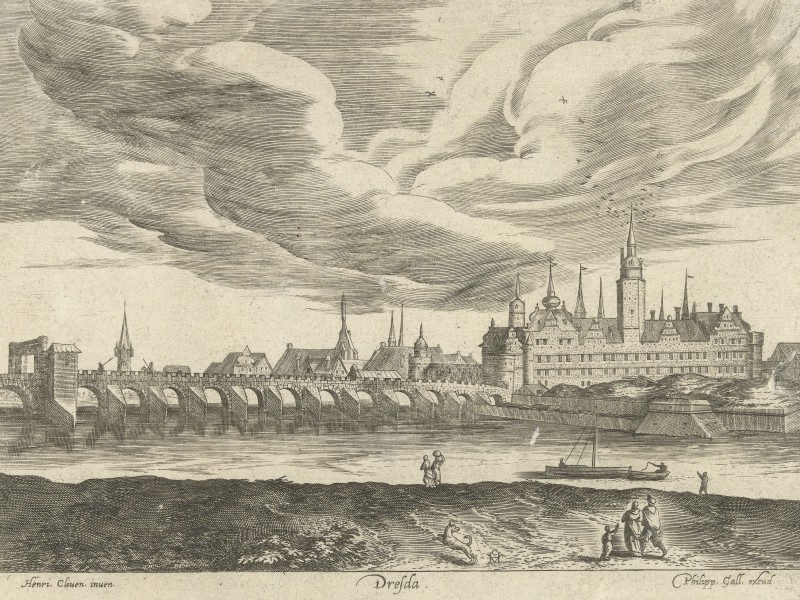
Palace and bridge across the Elbe River, 1585
This image was made from the river’s eastern bank. It is almost identical in point of view to that of a later and more famous painting of Dresden. The Italian artist Bernardo Bellotto painted it in 1748 (Dresden From the Right Bank of the Elbe Below the Augustus Bridge).
What our traveller identified as the Old Town and what is marked in the view as “Alte Dreszden” is today part of Dresden-Neustadt (New City). The name ‘Neustadt’ was given to the area in the eighteenth century.
In the Middle Ages, two separate settlements were founded — one on each side of the river. The settlement on the western bank of the river developed into the city of Dresden, with all its sights and historic buildings still visible today. The settlement on the Elbe’s eastern bank remained a village called Altendresden. In 1549, Altendresden became part of Dresden, but the name remained in use throughout the sixteenth and seventeenth centuries.
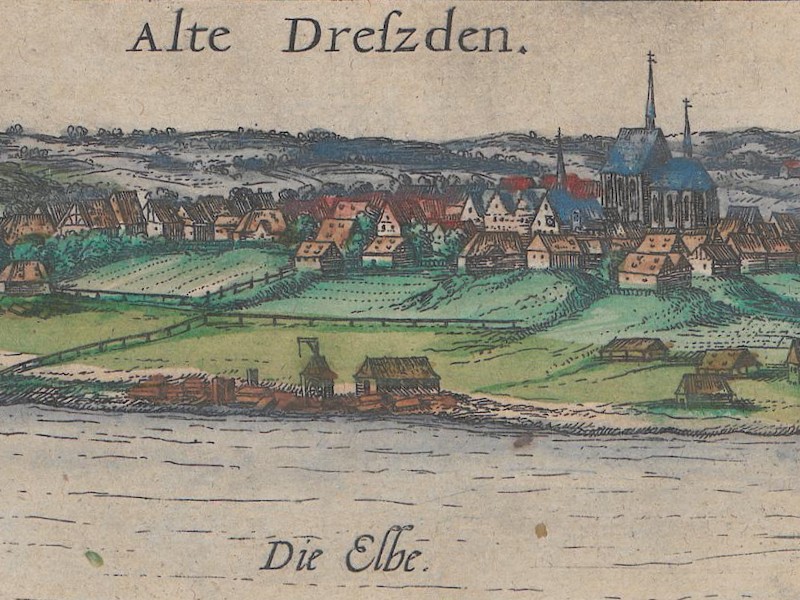
Altendresden (“Alte Dreszden”)
A Panegyric of Early Modern Dresden
Besides two Itineraria, the messenger and post rider Daniel Wintzenberger had written a short panegyric of his hometown.2 (A panegyric is a speech or text praising someone or something.) This text is in the form of a poem.
Wintzenberger writes: Dresden has four inns at the market square — the Golden Lion, Golden Sword, Golden Ring and the Morningstar. A fifth inn is on a side road (Seegasse).
The city has two main churches, the Church of the Holy Cross (Kreuzkirche) and the Church of Our Lady (Frauenkirche). The Church of the Holy Cross is a graceful building with a beautiful altar and stone font. The tower of the Church has two walkways at the top. From there, guards watch for fire or other dangers and warn the city’s inhabitants. The tower’s roof is made of copper and painted green. On top of the church tower is a golden cross.
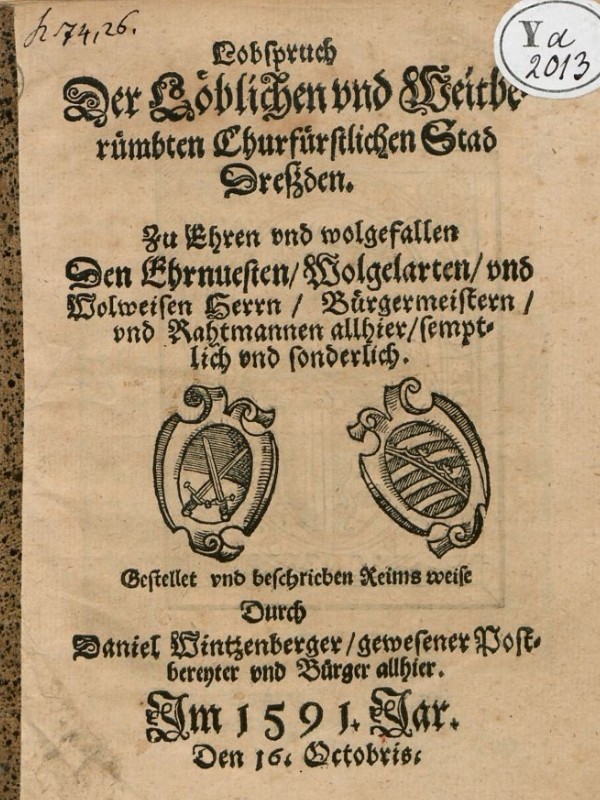
Title page of Wintzenberger’s Panegyric, 1591
The houses in Dresden are well-built and beautiful. The council enforces a strict regimen to keep the city clean. People have to take care of the street in front of their houses. Refuse must be removed quickly, or the person responsible for that part of the street will be fined.
On his journey, Samuel Kiechel often showed interest in the price and availability of food and drink in the places he visited. The following part of Wintzenberger’s panegyric would likely have caught the attention of our traveller:
Many butchers live in Dresden. They import animals from Poland, Bohemia, Silesia and the surrounding land of Meissen. Meat is readily available in the city and sold at a reasonable price. The bakeries of Dresden sell bread for a Groschen, half a Groschen, three Pfennig or one Pfennig.
As for drinks, wine from Greece, Spain, Franconia and the Rhineland is available. But there is also good local wine from the hills along the Elbe and Bohemia. Beer is imported from Freiberg, Torgau, Belgern and other places. But the beer produced in Dresden is also of high quality.
The final part of Wintzenberger’s panegyric is about the bridge across the Elbe. He writes that the bridge’s construction began in 1119 and took thirty years. The bridge was 900 cubits long ( cubit = the distance from the fingertips to the elbow) and had twenty-one arches. Later, the bridge was shortened by three arches.
Illustrations & References
All images are in order of appearance with links to sources on external websites:
- Dresden, in: Braun, Georg, Hogenberg, Frans, Civitates Orbis Terrarum (1), Cologne 1593, fol. 28v; Heidelberg University.
- van Cleve, Hendrick, Dresda, 1585; Rijksmuseum Amsterdam.
- Wintzenberger, Daniel, Lobspruch der Loeblichen vnd Weitberuembten Churfuerstlichen Stad Dreßden, Dresden 1591; University Halle-Wittenberg.
- Braun, Georg, Hogenberg, Frans, Civitates Orbis Terrarum (1), Cologne 1593, fol. 28; Heidelberg University. ↩︎
- Wintzenberger, Daniel, Lobspruch der Loeblichen vnd Weitberuembten Churfuerstlichen Stad Dreßden, Dresden 1591. ↩︎