
Journal of Samuel Kiechel
23 – 28 July 1586
From Riga to Dorpat
“In the afternoon, we travelled through a beautiful, flat and fertile countryside. But there were no people or animals to work the land. […] My companion told me that not even three years ago he had seen with his own eyes, because of the lack of farm animals, three or four women pulling a plough so that they could grow a bit of food.”
Die Reisen des Samuel Kiechel aus drei Handschriften, K. D. Haszler (ed.), Stuttgart 1866, p. 111; Bayerische Staatsbibliothek.
Outside Riga
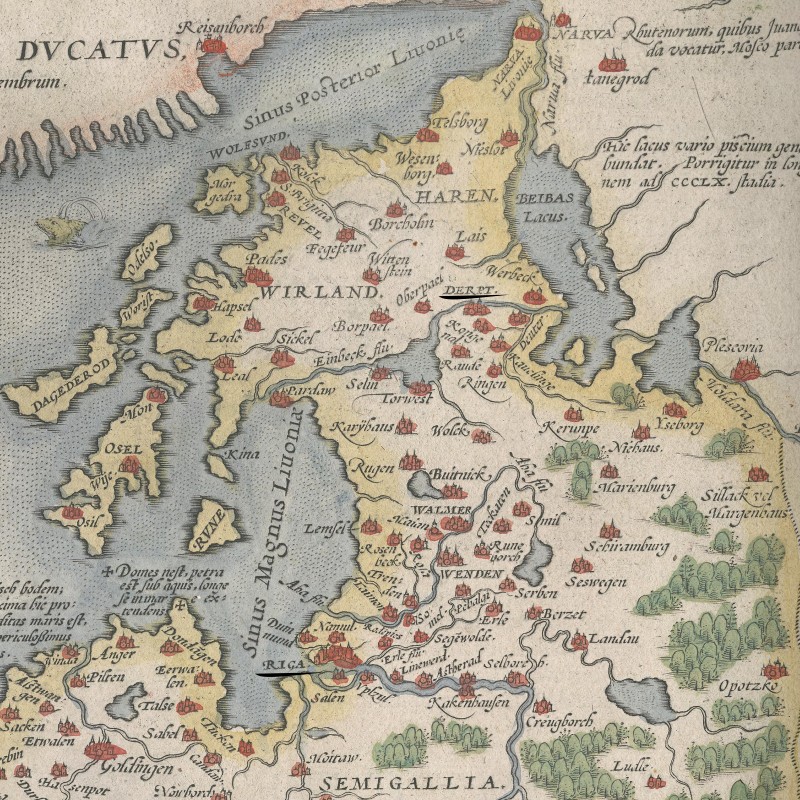
Map of Livonia from 1587 with Riga and Dorpat (Derpt)
Samuel Kiechel left Riga on 23 July with a carter he had met there. Their destination was Dorpat on the eastern border of Livonia. Kiechel had bought food and drink in preparation for the journey. The road outside Riga was deep and sandy. They stopped in the evening at a hamlet called Subur (?). The following morning, the two men continued and, after an hour’s travel, came to a river. A boat ferried them and other passengers to the other bank. They stopped for lunch at a peasant’s house and then drove on until the evening. Kiechel noted that there were few settlements in this area and that he had heard the peasants were not very trustworthy. They spent the night in a field.
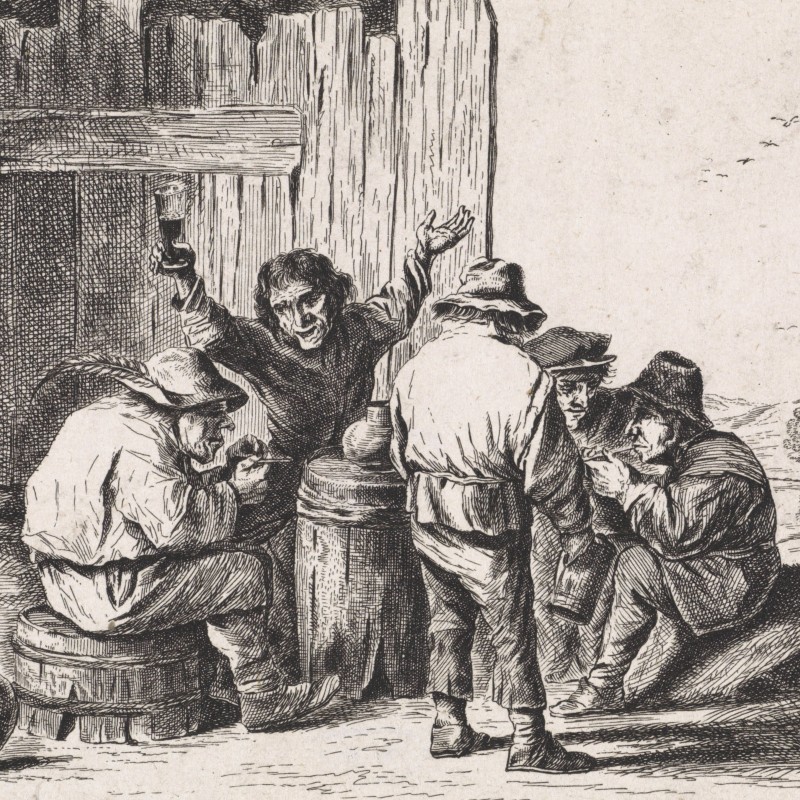
The next day, the travellers drove through a forest. At its edge, Kiechel noticed a peasant with a barrel of beer. The man stood in the nearby field, selling beer from the barrel. Kiechel considered it a strange sight because there were no villages or houses nearby. He guessed the next village was over an hour away. But when he asked his companion about the peasant and the beer barrel, he was told there was a fair in a small town one mile away. When the people at the fair went home, they would stop there for a drink. Kiechel still found this behaviour strange.1
In the evening, Samuel Kiechel and the carter arrived at a nobleman’s house. Earthworks surrounded the place to fend off attacks, and it had a drawbridge. Before the two men were allowed to enter, the woman of the house asked the carter for the letters he had brought. Afterwards, they were led inside and given a small room for the night. In the room was a bed, but it had neither bedding nor straw. The travellers decided to sleep on the floor, and Kiechel complained that they did not get much food either.
Samuel Kiechel wrote in his journal that the house was called Neuenhof and belonged to Melchior von Höfen, a mercenary in the service of the King of Poland. Our traveller learnt that, despite its simple fortifications, the Muscovites could not capture the place during the war. The inhabitants of several surrounding villages had brought their belongings to the house and sought refuge there. With them, there were enough men, guns and ammunition to defend it. Samuel was somewhat sceptical about this story. He remarked in his journal that, from the state of the fortifications, the Muscovites probably never seriously tried to capture this house.2
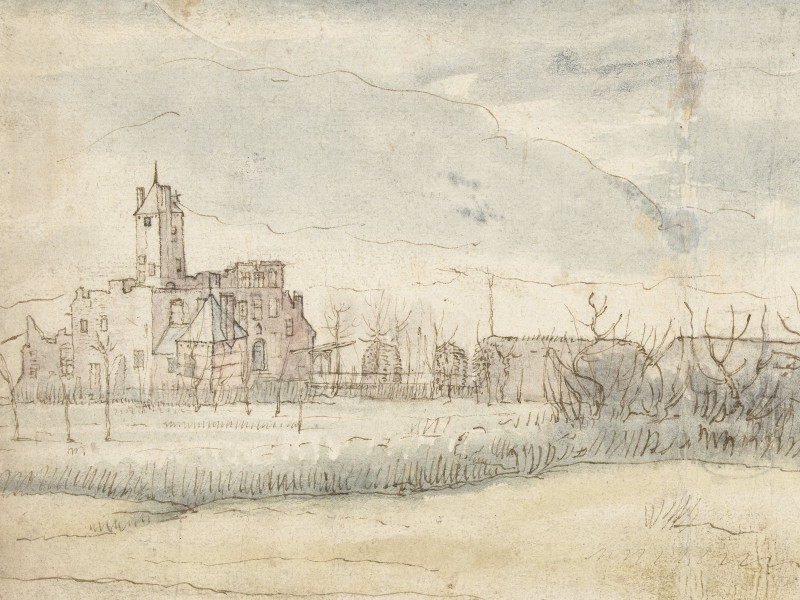
The place was most likely not just a house but a small castle. In medieval and early modern German, the term “house” was also used to refer to certain fortifications.
The Livonian War
When Samuel Kiechel visited Livonia, the region had just emerged from a long and devastating war. The Livonian War had raged for over twenty years, from 1558 to 1583.3 It began when Russian troops invaded Livonia, but this attack was preceded by years of Russian pressure and demands for tribute. Russia had been ruled since 1533 by Ivan IV (the Terrible). He was the first Russian ruler to use the title ‘Tsar’ (1547). Ivan had expanded his empire southwards by conquering the Tatar Khanates of Kazan (1552) and Astrakhan (1554/56) and was now eyeing the Baltic province of Livonia.
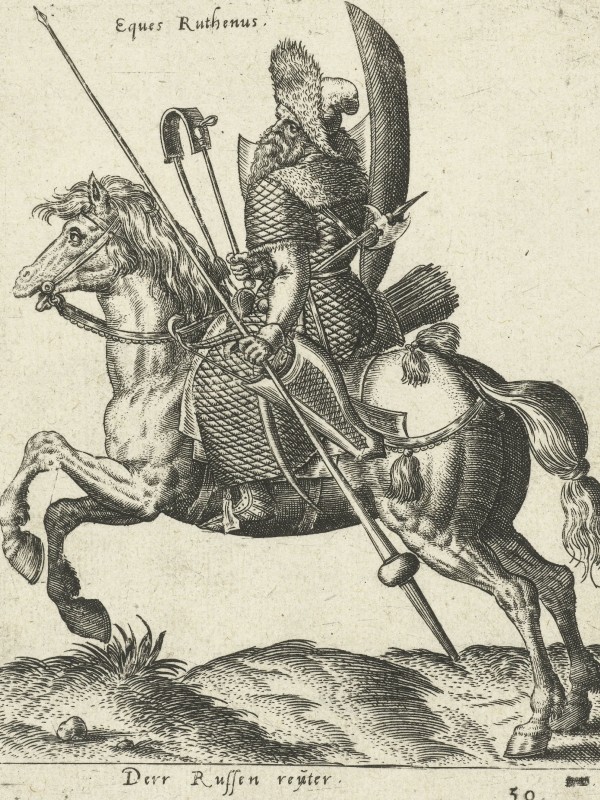
Russian horseman, 1577
Livonia had been divided into various local domains since the thirteenth century. It was ruled by an uneasy confederation of bishoprics, wealthy cities, landed nobility and the Livonian branch of the Teutonic Order. Divisions within Livonia were not only due to political ambitions or the divide between the rich cities and the poorer countryside, but also along confessional lines. The Protestant Reformation spread remarkably quickly to Livonia. Riga became Protestant in 1522 and Reval (Tallinn) in 1523. But the Teutonic Order and the bishoprics remained staunchly Catholic.4
Due to the disparate and often fractious relationship between the Livonian territories, the province was not prepared for war. As Russian pressure grew, diplomatic embassies were sent to Moscow to placate the Tsar, negotiate a peace treaty and promise some form of tribute. At the same time, the Livonians sought help from the Holy Roman Empire, Sweden and Poland-Lithuania. Attempts to secure support proved largely ineffectual, as the neighbouring powers had little interest in entering into conflict with Russia. Only Sigismund II Augustus, the King of Poland and Grand Duke of Lithuania, agreed to the Treaty of Pozwol in 1557. But this treaty was less a genuine offer of help than an attempt to establish his own claim over Livonian territory.
There is an argument that news of the Treaty of Pozvol prompted Ivan IV to invade Livonia. However, other factors likely also motivated the attack, including purported historical Russian claims to the territory, the conquest of the profitable ports of Riga and Reval (Tallinn), and the missed payment of tribute. In addition, Ivan was on a roll after the conquests of Kazan and Astrakhan. He became convinced that he was divinely ordained to expand his domain over Livonia, and his early success in the war seemed to prove him right.5
Whatever the reasons, Russian troops moved into Livonia and met little resistance. They quickly captured the cities of Narva and Dorpat and advanced further west towards the Baltic Sea. The Master of the Livonian branch of the Teutonic Knights tried to organise resistance but was defeated. The Knights’ strongholds fell or surrendered one after another. Meanwhile, repeated attempts to secure support from neighbouring powers proved unsuccessful, and even Sigismund II Augustus, who had promised protection in the Treaty of Pozvol, showed no signs of entering the war.
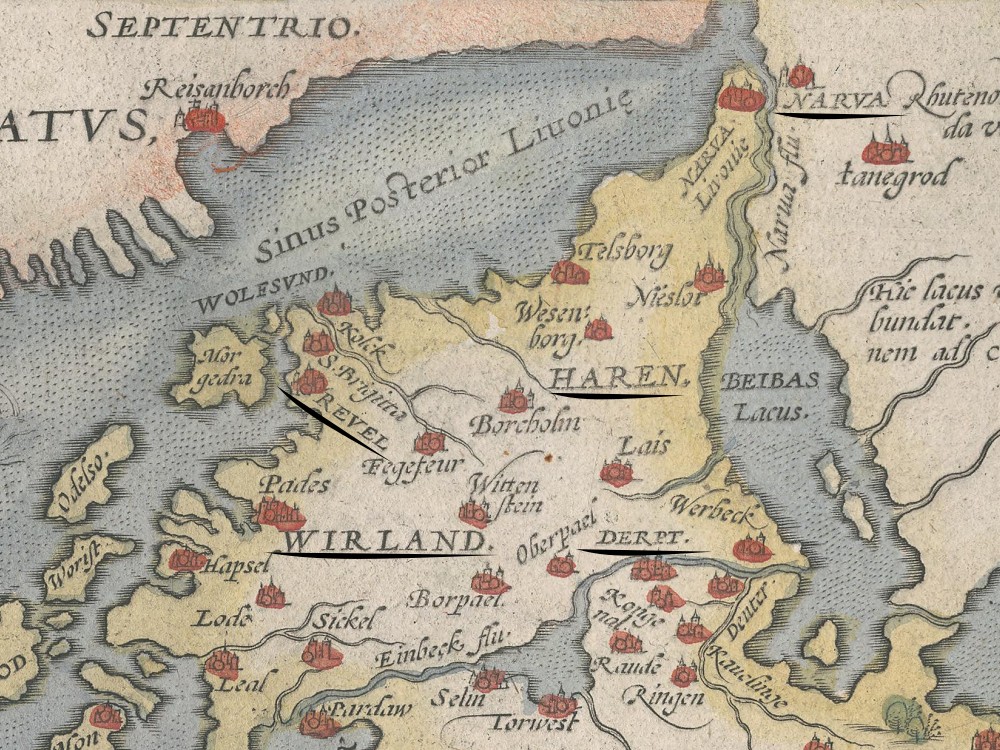
Map of Livonia from 1587 wit Dorpat (Derpt), Narva, Reval (Revel) and the counties of Harrien (Haren) and Wierland (Wirland)
On their own and helpless in the face of Russian advances, the various Livonian territories began to look after themselves. The city of Reval and the northern territories of Harrien (Harju) and Wierland (Virumaa) sought the protection of the Swedish King in 1561. In contrast, the southern Livonian territories accepted Sigismund II Augustus as ruler. Gotthard Kettler, the Master of the Teutonic Knights, followed the Prussian example and turned what remained of the Order’s territory in Livonia into a Duchy. He became the first Duke of Courland and a vassal of the Polish king.6
After early Russian success, the war began to stagnate. The following two decades were marked by ongoing conflict and shifting alliances. From 1563 to 1570, the Northern Seven Years’ War between Sweden and a coalition of Denmark and Poland-Lithuania played out in part on the Baltic Sea and in northern Livonia. Meanwhile, domestic problems stemming from the long war, raids by Tatars and Lithuanians, defections, and Ivan IV’s increasing paranoia led to conflict with the Russian people and nobility. The Oprichnina, the Tsar’s personal political police force, persecuted anyone deemed suspicious of treason. With their allegiance only to Ivan and special privileges, the Oprichnina established a regime of repression and terror. These internal struggles and the persecution of leading noblemen paralysed the army and led to losses in the war in Livonia.7
In the 1570s, both Sweden and Poland-Lithuania finally joined forces against Russia. This followed the ousting of the Swedish King Eric XIV (1533-1577) in 1568 for insanity, after which his brother John III (1569-1592) succeeded him. John was married to Catherine Jagiellon (1526-1583), daughter of Sigismund I, King of Poland and Grand Duke of Lithuania. While Eric had no sympathy for Poland and sought to avoid conflict with Russia, John had a more pro-Polish outlook.
Faced with internal pressure, mounting losses and being pushed out of Livonia, Tsar Ivan asked Pope Gregory XIII to mediate. In 1582, he agreed to a ten-year truce with Poland-Lithuania, and in 1583 Sweden signed a truce. Ivan had not only failed to conquer Livonia but also lost Russian territory. His empire was financially exhausted and politically unstable.
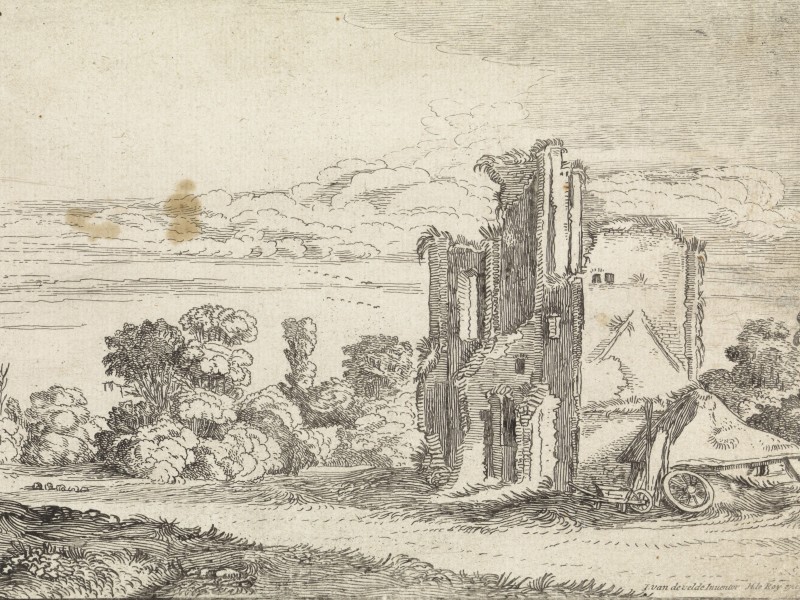
However, Livonia bore the brunt of the conflict. Although the war produced few major battles, fortresses and cities were repeatedly besieged. A hallmark of the conflict was the use of new technologies in warfare, especially gunpowder. The walls of the province’s cities and castles were old and offered little resistance to new siege weapons. Attackers often found it easier to take a place, but were then in the same difficult position as the former defenders. As a result, various castles and towns changed hands repeatedly, often accompanied by massacres or the deportation of the civilian population. The armies moving back and forth left a trail of destruction, as soldiers, particularly mercenaries, rarely concerned themselves with the fate of the local people.
An Outsider’s Observations
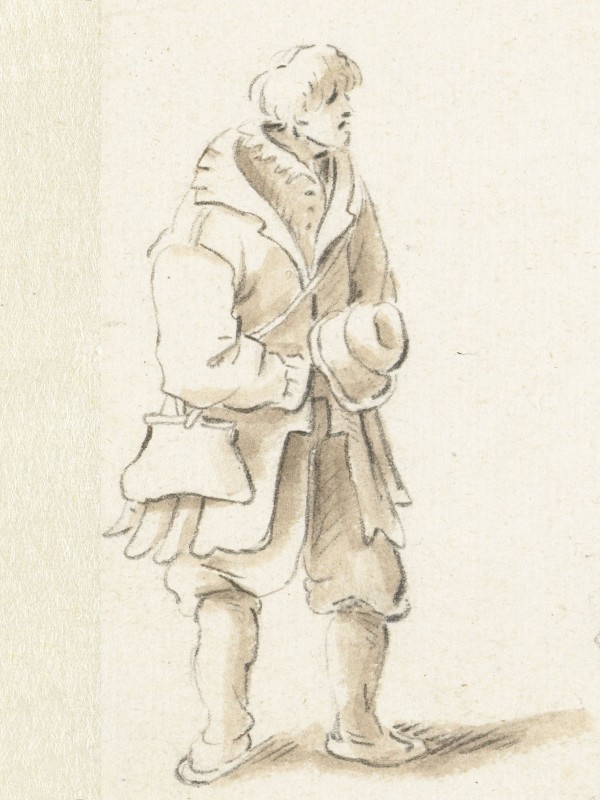
Samuel Kiechel visited Livonia only three years after the end of the war. What he witnessed on his journey to Dorpat and later to Reval was a country scarred by the long conflict. Kiechel’s descriptions capture the situation in Livonia well; he saw destroyed or depopulated villages, summer fields with crops in full growth but no one tending them, and experienced the fear and mistrust that pervaded society. Though his observations are typically sparse, they are intriguing because he was an outsider. People who travelled to Livonia in the 1580s did so with a purpose: to seek employment (mercenaries, private teachers, estate managers) and/or profit (merchants). All of those people had personal or business interests in Livonia that shaped their perception of the land. Kiechel had no stake in the place, and it is not even clear whether he had planned to visit the province or if it was just another spur-of-the-moment decision. He had no personal connection to people in Livonia and, most likely, little prior knowledge of the territory. His observations are therefore straightforward and unvarnished.
One example of Kiechel’s observations about the province is the man with the barrel selling beer in the field. Our traveller considered it merely a strange sight compared to what he would have expected — tables, benches, a hut from which the beer is sold — signs that this was a legally sanctioned establishment for selling drinks. He did not question it further.
The man and his barrel were likely a consequence of a lack of administrative oversight and policing, and of the general neglect of the population in the province after the war. The man sold his beer in the field because, in a town or village, the local innkeepers would have objected, and even if he had somehow been allowed to, he would have had to pay a levy. Outside, in the fields, he could sell the beer tax-free, and because it would be cheaper than in the towns, people would buy it. In the field, no one would wonder where he got the barrel of beer from. Did he brew it himself, or had he stolen it? The risk of the authorities interfering was low. In whose jurisdiction did the man sell his beer? After Livonia had been split up between the victors of the war, who was in charge now? The new Polish lords had bigger issues to attend to, and the local Livonian noblemen who had kept their lands no longer had the resources to deal with such minor issues.
Onwards to Dorpat
Samuel Kiechel and his companion left the nobleman’s house the next morning (26 July). Our traveller noted that the villages they passed through were uninhabited and desolate. He learned that the Muscovites had burned them during the war. In the evening, the travellers stopped in a village called Dünne (?) and spent the night in a peasant’s house.
Kiechel wrote that this region was called Öslin and that the people living there had their own language. It was called ‘undeutsch’ and was similar to the language of Lapland. The region was part of Livonia, but the Livonians did not understand the language.8
Öslin presumably meant Ösel, today Saaremaa. Saaremaa is an island off the west coast of modern Estonia. In the Middle Ages, until the Protestant Reformation, the Bishopric of Ösel–Wiek was one of the constituent parts of Livonia. Since Samuel Kiechel was travelling from Riga northeastward towards Dorpat, he would not have passed through Ösel. He had likely misunderstood something. As for the language, the native population of the northern part of Livonia spoke a Finno-Ugric language (Estonian) related to Finnish. Lapland, the northernmost region of Scandinavia, stretched across northern Sweden and Finland. Its inhabitants speak Sámi languages, which are also related to the Finno-Ugric language family. This part Kiechel got right.
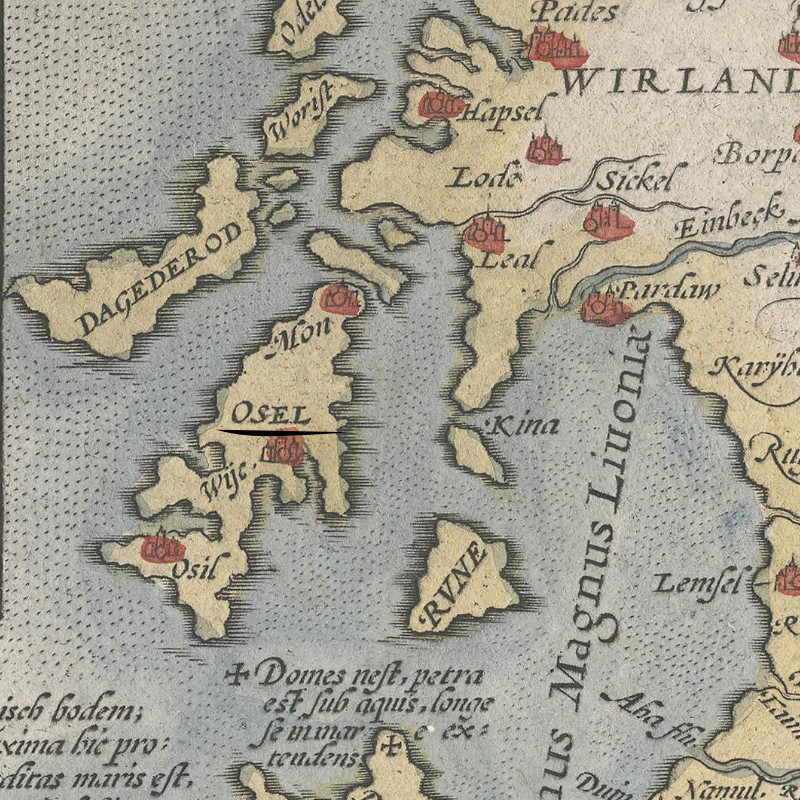
Ösel on a map from 1587
However, the native language was not called ‘undeutsch’ (un-German). The term itself is problematic today, as it carries deeply ideological connotations. In the late Middle Ages and early modern period, the term ‘undeutsch’ appears in sources to denote someone not of German origin. This differentiation was not based on a specific Germanness but on language. Without modern bureaucracy and personal identification, language was the general way to determine someone’s origin. The Livonian nobility and the merchants and craftsmen in the cities spoke German; the rural peasants spoke Estonian or Latvian; and there were also Swedish, Danish, Polish, Lithuanian and Russian immigrants in the region. The term was used to demarcate the Germans who ruled the province until the Livonian War and, afterwards, still constituted the upper class, from everyone else. While discriminatory, it did not yet carry any ideological meaning of a higher culture or a master race. This particular negative ballast stems from the twentieth century, particularly Nazi ideology.
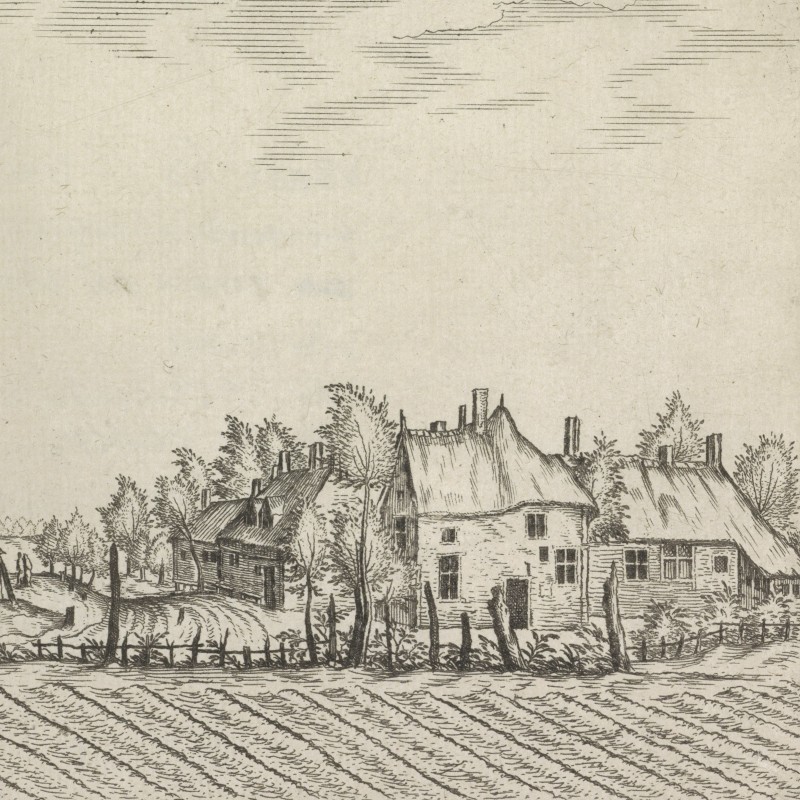
The following day, Kiechel and his companion continued to Dorpat, travelling through forests and past good meadows. But our traveller saw very few people or animals. The land was deserted. The landscape was beautiful and fertile, yet there were not enough people to work the fields. Kiechel noted that he had never seen such beautiful flax. His companion told him that three years ago he had seen three or four women pulling a plough because there were no farm animals left to do the job. The women had to do it themselves to grow enough food to survive.9 While the people in the larger cities might have been somewhat more protected from the war’s devastation, the peasants in the villages of Livonia were defenceless against attacks and atrocities.
The travellers spent the night in the house of a peasant in a village called Dennys (?). They left early the following morning and arrived at the gate of Dorpat before it opened.
Illustrations & References
All images are in order of appearance with links to sources on external websites:
- Ortelius, Abraham, Theatre of the World, Antwerp 1587, fol. 88v; Library of Congress.
- Anonymous, Vijf boeren rond een ton, 1626 – 1740; Rijksmuseum Amsterdam.
- Rubens, Peter Paul, Gezicht op Kasteel Crayenhof te Zwijndrecht, 1606; Rijksmuseum Amsterdam.
- de Bruyn, Abraham, Russische ruiter, 1577; Rijksmuseum Amsterdam.
- Poelenburg, Simon, Landschap met ruïne, 1602 – 1649; Rijksmuseum Amsterdam.
- Saftleven, Herman: Een zittende en drie staande mannen, 1619 – 1685; Rijksmuseum Amsterdam.
- van Doetechum, Johannes of Lucas, Boerderijen bij een geploegd veld, 1559 – 1561; Rijksmuseum Amsterdam.
- Die Reisen des Samuel Kiechel aus drei Handschriften, K. D. Haszler (ed.), Stuttgart 1866, p. 110; Bayerische Staatsbibliothek. ↩︎
- Ibid. ↩︎
- Frost, Robert I., The Northern Wars. War, State, and Society in Northeastern Europe, 1558 – 1721, Harlow 2000, pp. 23-43. ↩︎
- Angermann, Norbert, Brüggemann, Karsten, Geschichte der Baltischen Länder, Ditzingen, 2018, pp. 37-63. ↩︎
- Ibid., pp. 101f. ↩︎
- Ibid., p. 104. ↩︎
- Frost, The Northern Wars, pp. 25-27. ↩︎
- Reisen des Samuel Kiechel, p. 111. ↩︎
- Ibid. ↩︎