
Journal of Samuel Kiechel
25 November – 19 December 1586
In Venice
“Right beside the church is the palace where the governing duke lives, an impressive, splendidly vast building with many rooms and chambers. Among them, I saw the great hall where the whole senate usually assembles, a multiple hundred [men], and they meet every Sunday at noon.”
Die Reisen des Samuel Kiechel aus drei Handschriften, K. D. Haszler (ed.), Stuttgart 1866, p. 153; Bayerische Staatsbibliothek.
The Queen of the Adriatic
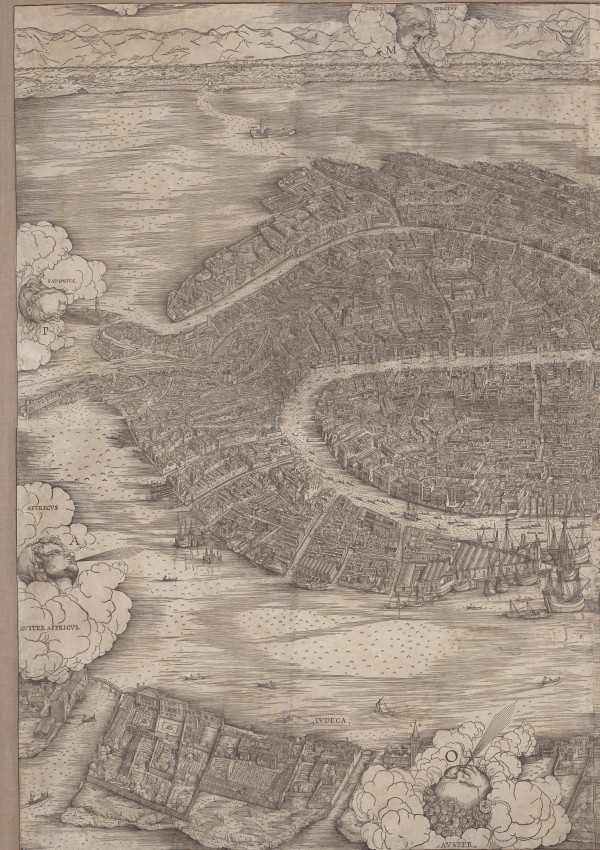
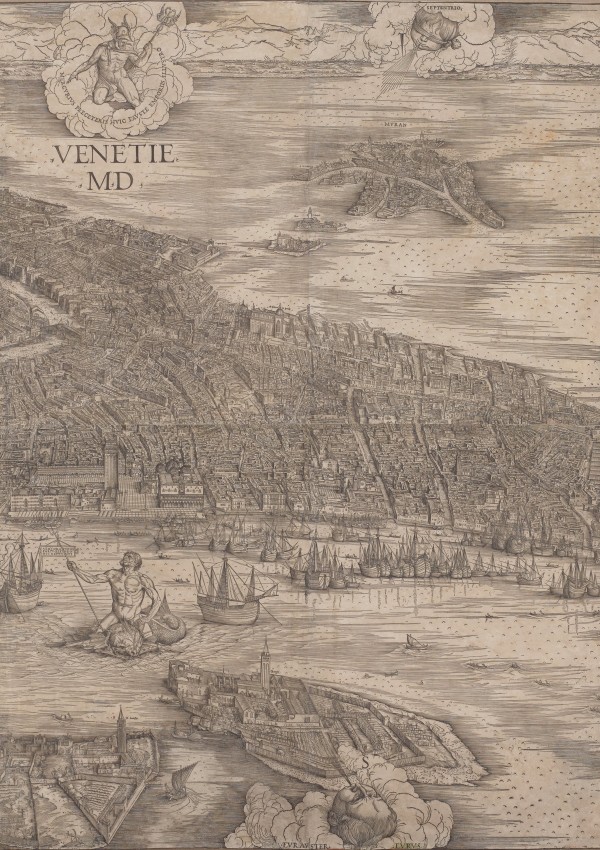
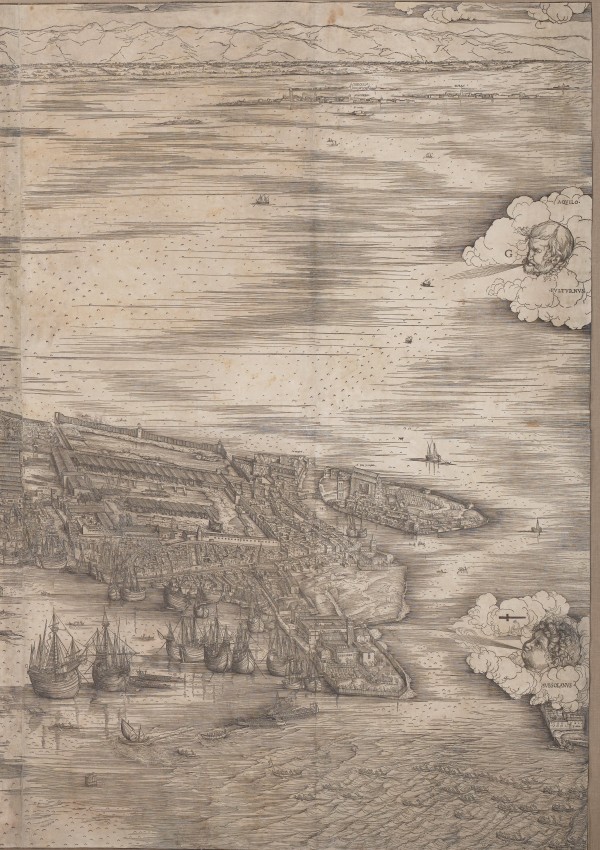
Jacopo de’ Barbari’s view of Venice, 1500
One of the most magnificent sixteenth-century views of Venice shows the city in a bird’s-eye perspective from the south. Venice is at the centre, surrounded by the waters of the lagoon. The woodcut was made by Jacopo de’ Barbari around 1500. The depiction of the city is incredibly detailed, from houses, churches and palaces to the busy harbour filled with ships of all sizes and the myriad boats in the Grand Canal. In the foreground are the islands Giudecca, long and narrow, and San Giorgio Maggiore. In the background, we see the Venetian Terraferma with Mestre and Treviso, and on the horizon, the Alps.
The heart of the city, with St. Mark’s Square (Piazza San Marco), the Doge’s Palace, St. Mark’s Basilica and its free-standing bell tower (Campanile di San Marco), which also served as a landmark for approaching ships, is clearly recognisable in de’ Barbari’s view. East of it is the walled Arsenal, Venice’s shipyard, one of the earliest pre-modern industrial complexes that mass-produced galleys for the Republic.
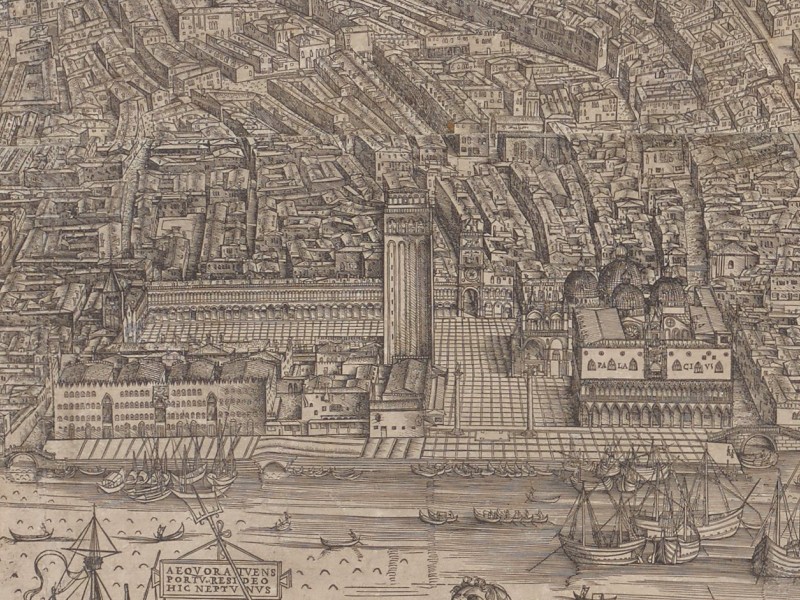
St. Mark’s Square, the Doge’s Palace and St. Mark’s Basilica
The woodcut contains symbolic elements related to the city’s foundations and the source of its power and wealth. At the top of the view is the Roman god Mercury, god of trade and commerce, with the inscription “MERCVRIVS PRECETERIS HVIC FAVSTE EMPORIIS ILLVSTRO” (“I Mercury shine favourably on this above all other trade centres”). Below St. Mark’s Square, we see Neptune riding a dolphin, with an inscription hanging from his trident reading: “AEQVORA TVENS PORTV RESIDEO HIC NEPTVNVS” (“I Neptune reside here, smoothing the harbour waters”). The personifications of the eight winds, also derived from Greek and Roman mythology, are depicted around the edges of the view. Maritime trade lay at the heart of Venice’s prosperity and at the centre of the Republic’s politics.1
A bird’s-eye view of Venice closer to the time of Samuel Kiechel’s visit appears in volume one of the Civitates Orbis Terrarum. The view is far less detailed and, compared to de’ Barbari’s woodcut, almost simplistic. However, it is much easier for the viewer to digest, particularly because it contains a legend at the bottom identifying 188 places in the city. In addition, the islands in the lagoon and some canals are named directly in the view.
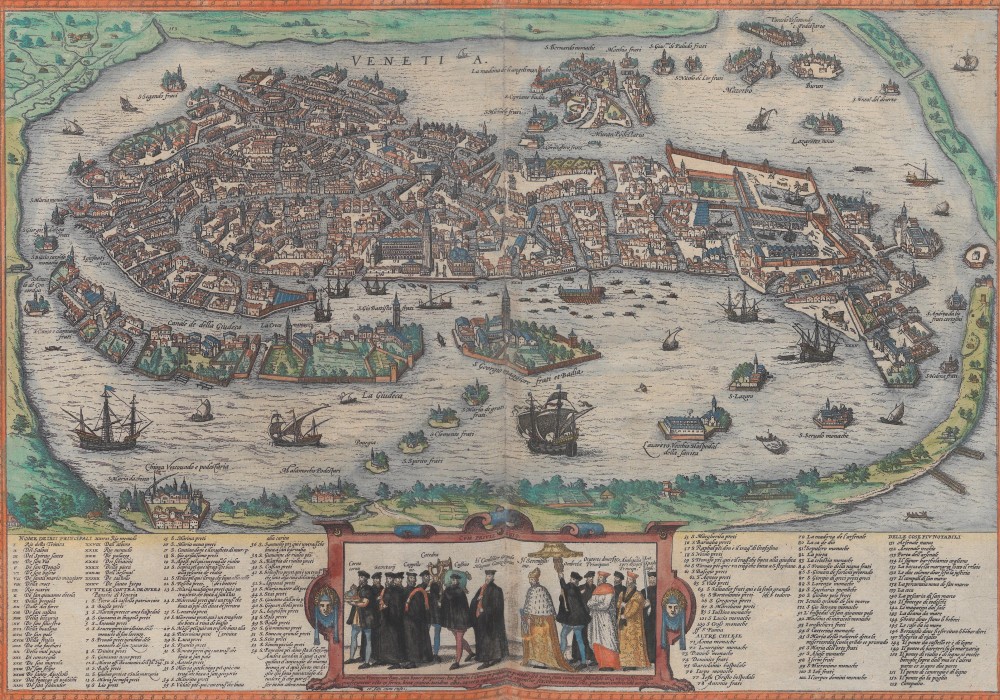
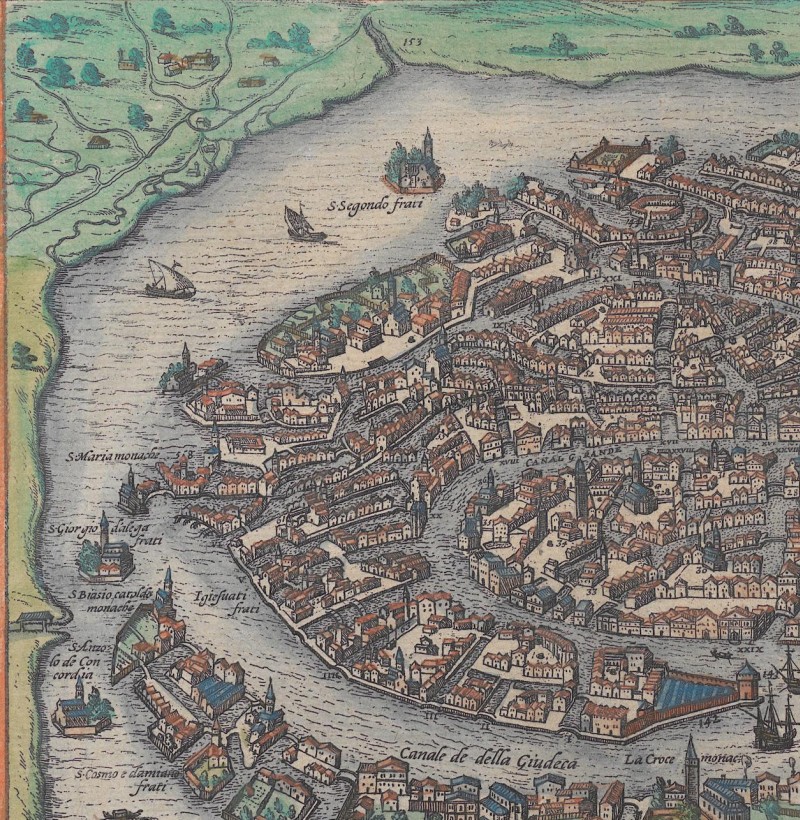
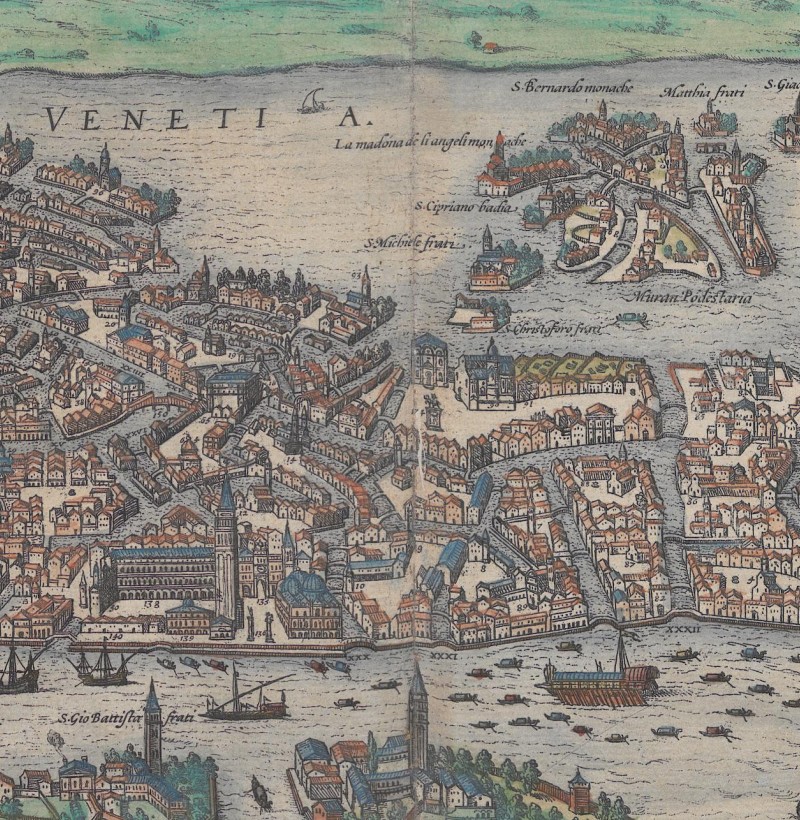
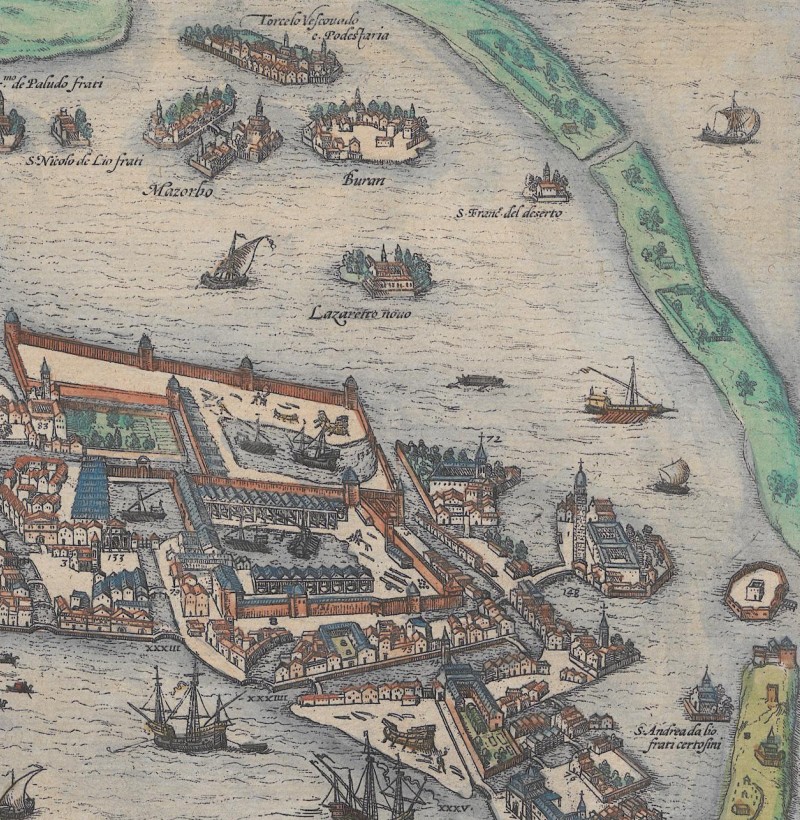
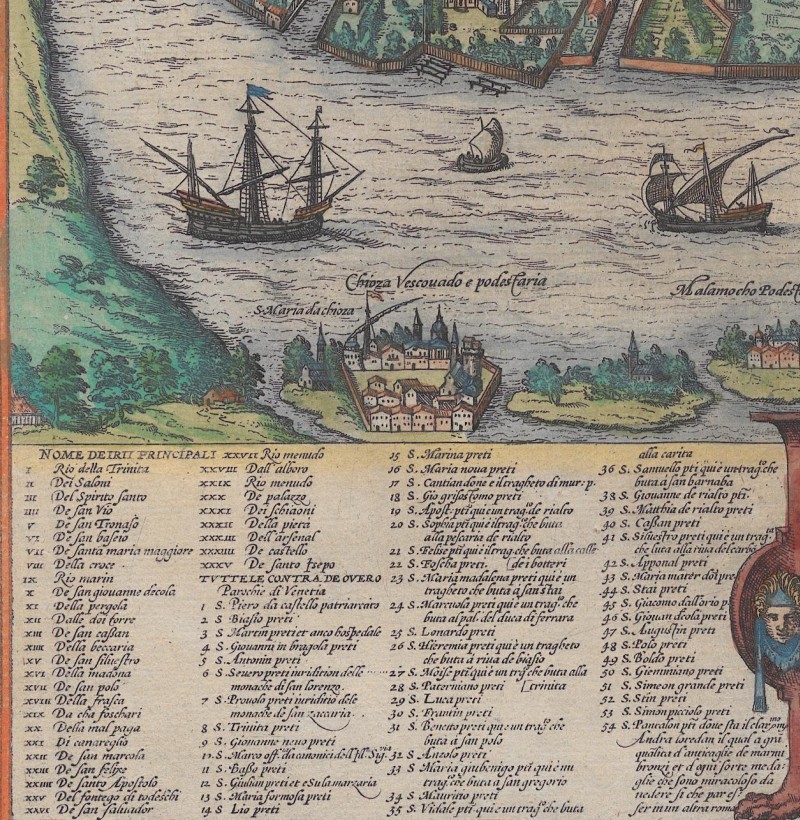
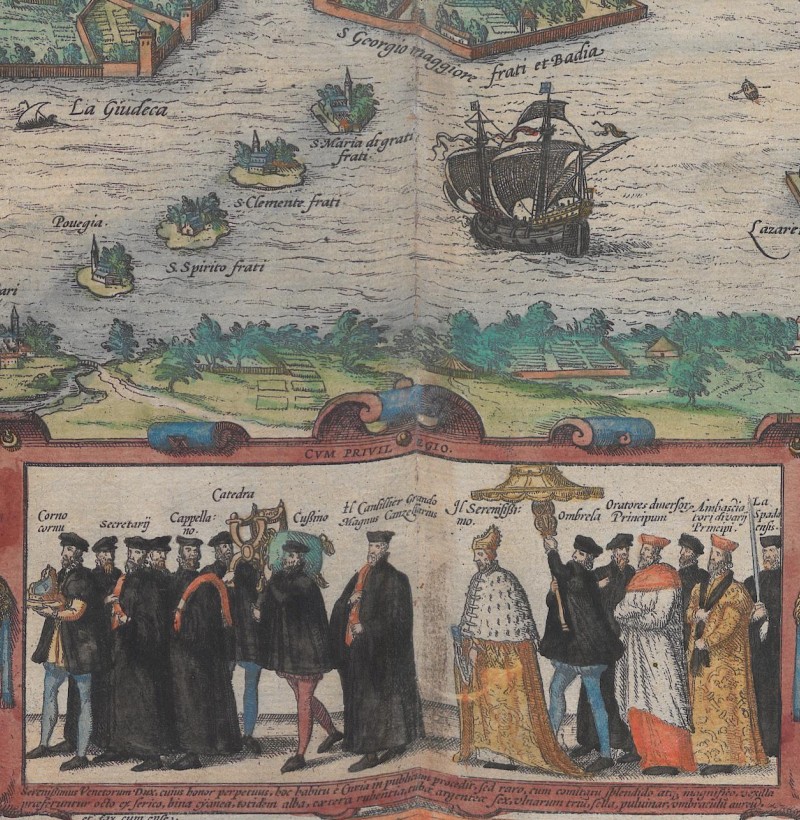
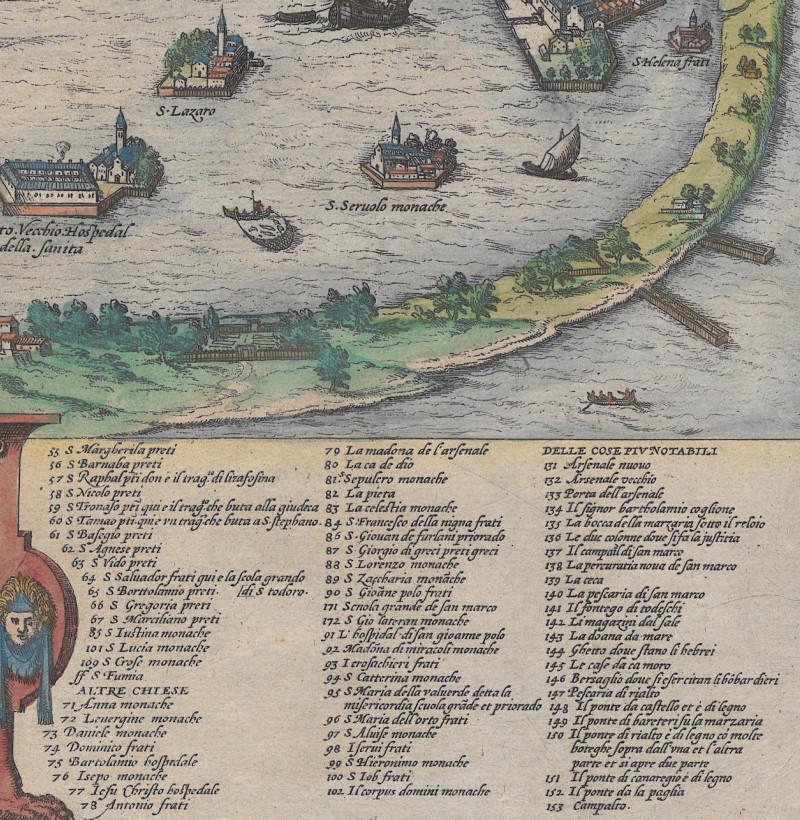
Venice, 1572
Venice in the Sixteenth Century
Throughout the early modern period, Venice was a major destination for travellers. The city was a symbol of prosperity, culture, art and splendour. For pilgrims, it was the gateway to the Holy Land. Ships left regularly for ports along the Levantine coast, and devout travellers could not only buy passage but also book complete tours to the holy sites. Venice’s markets were renowned for their wide selection of rare and exotic goods. But the main attraction was the city itself — built on water and accessible only by boat, with its canals and gondolas, markets, splendid churches and busy harbour. The wealth the Venetian Republic had amassed was spent on construction, frescoes, paintings and sculptures by celebrated Renaissance artists. The Doge’s Palace and St. Mark’s Basilica still offer a window into this time.
But beneath the splendour, the Venetian Republic was in a slow decline. In the late Middle Ages, the city held territorial possessions across the eastern Mediterranean and dominated maritime trade routes to the Levant, Egypt, the Black Sea and Constantinople. The Republic had developed a system of public-private partnership. The city’s shipyard, the Arsenal, produced large trade galleys that were rented to private investors for the annual convoy east. The oarsmen of those galleys were not slaves but free men and could be counted on to defend their ships. Each year, these public convoys set out for ports in the east, bringing back expensive and highly sought-after commodities like silk, incense and spices. Timber, iron, manufactured goods, slaves and weapons were exported. Often, to the consternation, criticism and even hostility of the Pope and other Christian rulers, Venetian merchants made no distinction between customers in the east, whether fellow Christians or Muslims, such as the Mamluk rulers of Egypt. Profit was the driving motivation and source of the Republic’s power.
After the convoys returned, the shareholders and the state split the profits. In addition, many private vessels sailed the Mediterranean, increasing the volume of goods available in the city and filling the Republic’s coffers with customs duties.2
But in the late fifteenth and sixteenth centuries, the Republic came under pressure. The Portuguese discovery of a sea route around Africa threatened Venice’s monopoly in the spice trade. Until then, the spice trade had followed the land route. Cloves, pepper, nutmeg, cinnamon and other spices arrived from the east by caravan at ports in Syria, Palestine and Egypt, where Venetian merchants picked them up. News of the discovery prompted Venice to secretly cooperate with Muslim Egypt to drive out Portuguese competition. Egypt, which at the time controlled maritime trade along the northern coast of the Indian Ocean, also saw its dominant position and profits threatened by the newcomers. But the Portuguese could not be dislodged, not least because Mamluk Egypt was in terminal decline and under pressure from another eastern power, the Ottoman Empire.
The Ottomans were also a cause for concern in Venice. Their aggressive expansion along the eastern Mediterranean coast and into Europe put pressure on the Venetian colonies. One after another, Venice lost territory to the Ottomans. After centuries of aggressive trade and expansion, the Republic was forced to consolidate its losses and protect what it still held.
Furthermore, Venice faced trouble at home. The so-called Italian Wars (1494-1559) were a succession of military conflicts for domination of the peninsula between Habsburg Spain and France. They began when France invaded Italy in 1494. But the conflict’s roots lay in Italy’s fragmented political landscape. For a long time, the Italian city-states, republics and feudal domains had fought each other in shifting constellations. While the Peace of Lodi (1454) had brought a temporary reprieve, animosities remained. The French invasion was motivated by a claim to the throne of the Kingdom of Naples and was heavily encouraged by the Duke of Milan, Ludovico Sforza. After sacking Naples (1495), an alliance between Italian territories, Spain and the Holy Roman Empire formed to drive the French out. But the war descended into a protracted conflict with shifting allegiances as old rivalries among the Italians resurfaced.
As a result of pressure from the Ottomans and the Italian War, the Republic’s trade routes were disrupted and the city’s income fell. The Venetians had to focus their resources on the conflicts at home. The annual trade convoys could no longer be financed, and trade became an entirely private enterprise. However, private ships were easier prey for pirates and privateers, now active in larger numbers and often Ottoman-sponsored.
A final significant success came when a combined fleet of the Holy League, an alliance of Spain, Venice, Genoa, the Papal States and other Italian domains, achieved a major victory over the Ottoman fleet at Lepanto in 1571. The victory halted Ottoman advances into the western Mediterranean and, after nearly two centuries of Ottoman onslaught, showed that they could be defeated. But in the end, the success was more symbolic than practical. The Holy League was an uneasy alliance that fell apart shortly after.
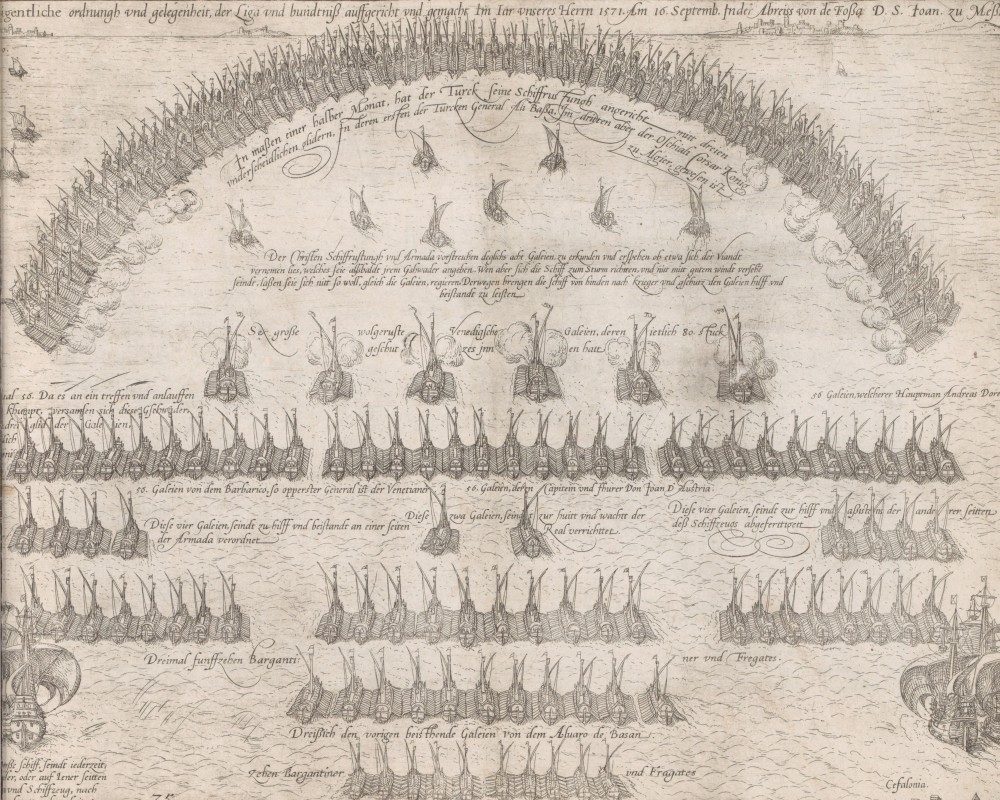
The two fleets at Lepanto, 1571
Failing to capitalise on the victory meant that, while the Ottomans were temporarily stopped, the alliance made no tangible gains. Within a few years, the Ottomans had rebuilt their fleet and pressure on the Venetian eastern border continued unmitigated. While travelling along the coast of Italy, Samuel Kiechel witnessed Ottoman privateers harassing coastal towns and communities unhindered.3
However, Venice’s decline was slow, and among its impressive buildings, busy markets, unmatched art and bustling canals, travellers would barely notice it. Samuel Kiechel was fascinated by the city and, while typically sparse in his descriptions, detailed some of his observations.
Around St. Mark’s Square
Samuel Kiechel’s first impressions of Venice were of a famous, powerful and well-built city. He was astounded; Venice was miraculously built into the sea, and you would not find a similar place anywhere in the world.
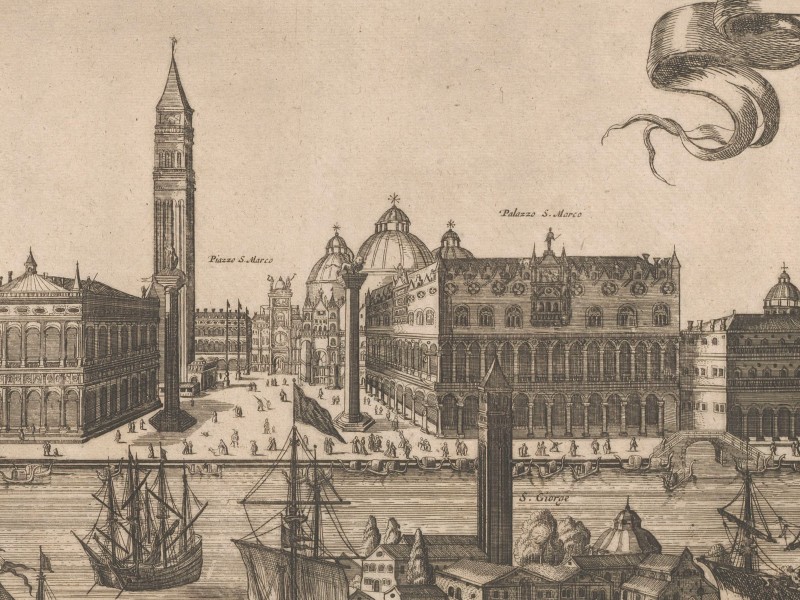
The Doge’s Palace (right), St. Mark’s Basilica behind it and the bell tower on the left
First, Samuel went to St. Mark’s Square and wrote that the bell tower in the square (Campanile di San Marco) was built so that someone could ride a horse to the top. Apparently, he climbed it and noted that, in clear weather, people could see from the top of the tower across the whole city to the surrounding monasteries, the Lido, Malamocco, Murano and other beautiful places.
Down below in the square stood the impressive yet delicate St. Mark’s Basilica and the palace where Venice’s ruler, the Doge, resided. Kiechel’s description of the basilica is very brief. I will pick it up in the next post, when our traveller returns and visits the treasure chamber below the church.
The Doge’s Palace is described in the journal as a large, beautiful building with many rooms. However, it was not open to the public, and only high-ranking visitors were granted access. Fortunately for Kiechel, a noble visitor had just arrived. He wrote that while he was outside, a Duchess from Piedmont and her entourage were led into the palace. Kiechel walked up to a group of her servants and joined them. The palace guards did not notice or stop him.
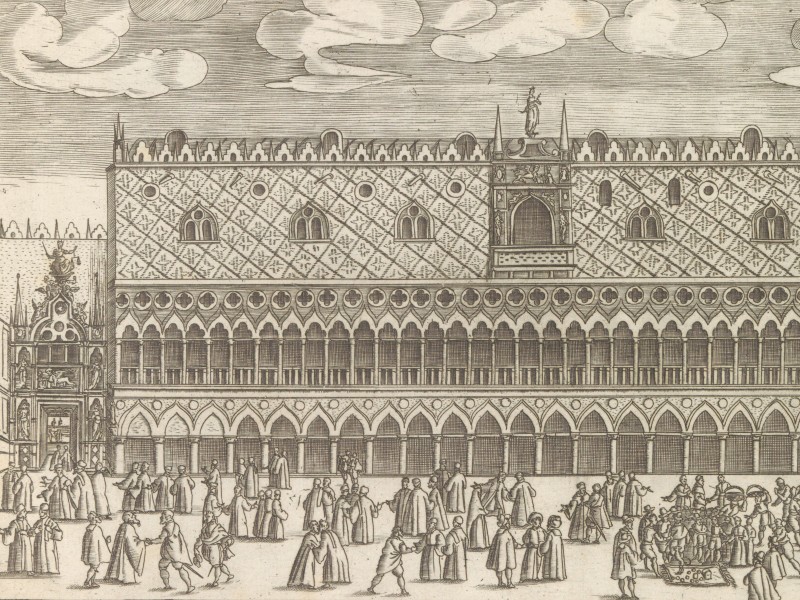
The Doge’s Palace
Inside the palace, our traveller saw the large hall where the Venetian Senate met. He learnt that the Senate comprised many hundreds of men and met in the hall every Sunday afternoon. People were allowed to witness the sessions, provided they arrived on time. The hall was very long and wide, with many benches. The walls and ceiling were decorated with gold and painted with historic scenes that appeared lifelike to our traveller. There were also many paintings of their former Doges and various popes. But building and decorative work in the hall were still in progress at the time of Kiechel’s visit.
Next to the Senate Hall was another large room, also painted with historic scenes. But Samuel noted that this room was not comparable in size to the Senate Hall. Opposite the Senate Hall, on the left, was the city’s armoury. It consisted of five large rooms filled with many beautiful, strange and curious arms and armour.
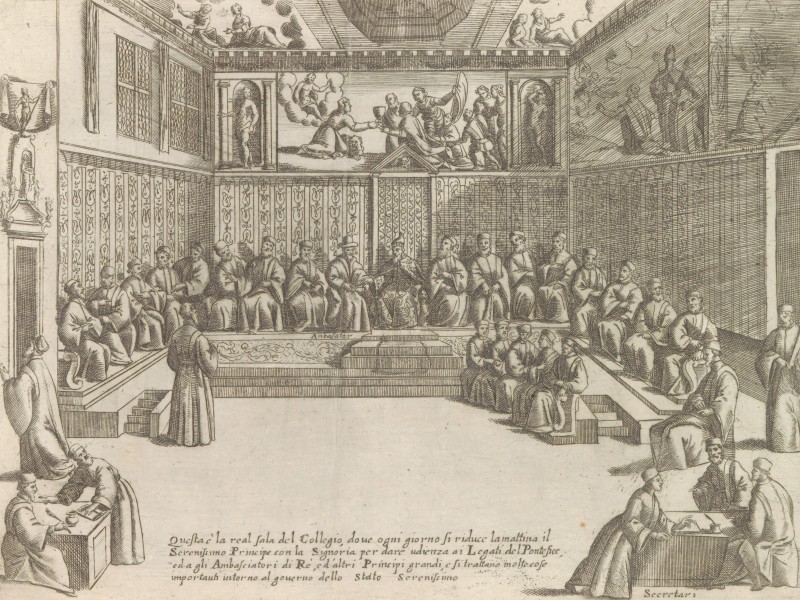
The Council Chamber
The visitors were led through the armoury, and Samuel mentioned seeing an enormous crystal lantern set in silver. It was so large that a man could fit inside. In another room of the armoury was a small, locked box. Inside were a dress and a dagger. Kiechel learnt that both items had been presented to the city by an ‘Indian’ king who had recently travelled to Rome to be baptised by the Pope.
The box contained another item made of iron and steel. Samuel Kiechel described its purpose: a husband could fasten it around his wife’s hips and across her vagina if he did not trust her.
Kiechel also saw an iron box about a foot long. He was told it belonged to Count Octavio, who had been declared an outlaw by the city some years earlier. Octavio had been feuding with another nobleman. When they made peace, Octavio gave the box as a present to his former enemy. A servant delivered the key, and the nobleman, eager to know what was inside, opened it. Two guns hidden in the box fired and killed him. Kiechel was fascinated by the box and described it as an intricately made but devious present.
From the armoury, the visitors were led into the hall where the Doge received guests. Beside it was the Doge’s chapel, where he went to Mass if he could not go to St. Mark’s. Next to the chapel was a beautiful room where the Doge and the city’s ten noble leaders met (the Council of Ten). Kiechel noted that the Council members wore long red robes when they assembled. Otherwise, they wore black robes, like all other Venetian noblemen.4
The Doge’s Palace
The Doge’s Palace was the centre of power of the Venetian Republic. The doge (from Latin: ‘dux’, meaning leader) was the formal head of state of the Venetian Republic. While the position was always held by a member of the Venetian aristocracy, the title was not hereditary. Venetian doges were elected and held the title for life. They did not hold sole authority in the Republic. Kiechel mentioned the Senate and the Council of Ten, but there were also the Great Council, the Minor Council and the Council of Forty. All these assemblies met in rooms in the palace.
The current palace was constructed in the fourteenth century but was rebuilt and expanded in the centuries that followed. It stands in the south-eastern corner of St. Mark’s Square. The palace’s northern wing connects to St. Mark’s Basilica, and its southern wing faces St. Mark’s Basin and the harbour.
Samuel Kiechel noted that access to the palace was restricted, although it is difficult to say whether this meant the whole building was off-limits or just the first and second floors, where the Doge’s apartments and the various offices and assembly halls were. The ground floor of the palace consisted mostly of a large courtyard with arcades along its sides. According to Kiechel, security around the palace seemed somewhat lax, as our traveller managed to hide among the servants of a noblewoman to get a tour of the place.
All the rooms Kiechel mentioned were on the second floor of the palace, in the eastern wing facing the Rio di Palazzo canal. First, the visitor was impressed by the Senate Hall. The lifelike paintings set in gold along its walls and ceiling were new, as a fire had destroyed the room in 1574. As Samuel noted, reconstruction work was still ongoing and would not be finished until 1595. The room beside the Senate Hall, Kiechel mentioned briefly, was the Council Chamber of the Minor Council. It too had been damaged by the fire, but restoration work had already been completed.5
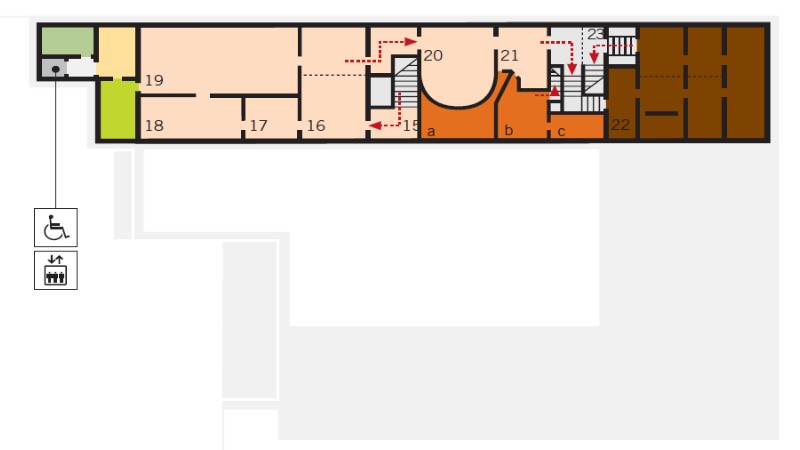
Floor plan of the east wing of the second floor of the palace, showing the Council Chamber (18), Senate Chamber (19), Chamber of the Council of Ten (20) and Armoury (22). The Doge’s chapel is in the unnumbered room to the left of the Council Chamber.
The chamber of the Council of Ten lies between the Senate Hall and the armoury, and the visitor must pass through it on the way to the armoury. The items held in the Venetian armoury seemed to have been of particular interest to our traveller. He mentioned a huge crystal lantern, a dagger, and a dress of ‘Indian’ origin. I could not find any details about those items. The dress and dagger might have been from India, or, more likely, from America, as native people were regularly brought back by Spanish ships as novelties to show around European courts or in an attempt to Christianise.
Furthermore, Samuel Kiechel was shown a chastity belt. Somewhat amusingly, he manoeuvres around describing it, apologising and mangling some Italian words in his writing. Literally, he wrote: “a screwed work of steel and iron which a man can screw in front of the s.v. [salva venia = with permission] vulva when il marito mistrusts sua dona”.6
Not untypical for his time, Kiechel would not mention anything related to sexual matters directly. There is another instance later in the journey when he will mix Italian words into his descriptions as well. As a German Lutheran, he was not comfortable writing about them despite his curiosity.
The mechanical booby-trap our traveller mentioned might be the so-called Devil’s Box (Scatola del Diavolo), still in the armoury, or at least a similar item. It is a sixteenth-century device containing four pistol barrels rigged to discharge when the box is opened. However, I found no mention of the noblemen or of a feud involving such a device.
Finally, the visitors were shown the Doge’s private chapel. The chapel is beside the senate hall, on the opposite end of the wing from the armoury. It appears that Samuel Kiechel mixed up the sequence of the rooms he saw when he later wrote down his experiences.
As mentioned above, Venice was a fascinating city for travellers, associated with all kinds of wonders. In some ways, it still is, and the Doge’s Palace, with all its decorations and artwork, remains as impressive as it was in the sixteenth century. Nothing could have prepared Samuel for the sights, noises, smells, the busy canals and streets, and the astonishing buildings rising out of the water. It must have been quite overwhelming for our traveller from central Germany.
But curiosity wins out. After having smuggled himself into the palace, he will do the same to visit the Venetian Treasure Chamber in St. Mark’s Basilica.
Illustrations & References
All images are in order of appearance with links to sources on external websites:
- Anonymous, Platea divi Marci Venetiis, c. 1570 – 1660; Rijksmuseum Amsterdam.
- De’ Barbari, Jacopo, View of Venice, 1500; Minneapolis Institute of Art.
- Venice, in: Braun, Georg, Hogenberg Frans, Civitates Orbis Terrarum (1), Cologne 1593, fol. 43v; Heidelberg University.
- Hogenberg, Frans, Ware eigentliche ordnungh und gelegenheit, der Liga und bundniß auffgericht und gemacht im Jar unseres Herrn 1571. Am 16 Septemb. inder Abreiss von de Foß D.S. Joan. zu Meßina, 1571 – 1573; Rijksmuseum Amsterdam.
- Anonymous, Venetia, 1600 – 1699; Rijksmuseum Amsterdam.
- Anonymous, Façade van het Dogepaleis te Venetië, 1610; Rijksmuseum Amsterdam.
- Anonymous, Vergadering in de Sala del Collegio, 1610; Rijksmuseum Amsterdam.
- Palazzo Ducale, Fondazione Musei Civici di Venezia.
- Doosry, Yasmin, Zu Ruhm und Ehre der Serenissima: Eine Venedig-Ansicht aus dem Jahr 1500, in: Damm, Roland, Doosry, Yasmin, Scheld, Alexandra (eds.), Der Venedig-Plan von 1500 Restaurierung eines Riesenholzschnitts im Germanischen Nationalmuseum, Nürnberg 2012, pp. 6-19 ↩︎
- de Larivière, Claire Judde, The ’Public’ and the ’Private’ in sixteenth-century Venice: from Medieval Economy to Early Modern State, in: Historical Social Research 37/4, 2012, pp. 76-94. ↩︎
- Crowley, Roger, City of Fortune. How Venice Won and Lost a Naval Empire, London 2011. ↩︎
- Die Reisen des Samuel Kiechel aus drei Handschriften, K. D. Haszler (ed.), Stuttgart 1866, pp. 152-154; Bayerische Staatsbibliothek. ↩︎
- Palazzo Ducale, Fondazione Musei Civici di Venezia. ↩︎
- Reisen des Samuel Kiechel, p. 154. ↩︎