
Journal of Samuel Kiechel
20 – 24 June 1585
From Wittenberg to Magdeburg
“I arrived at lunchtime in Magdeburg, a heavily fortified and powerful imperial city. The Elbe River flows close to its walls. The city is divided into an old town and a new town and has an impressive cathedral.”
Die Reisen des Samuel Kiechel aus drei Handschriften, K. D. Haszler (ed.), Stuttgart 1866, p. 6; Bayerische Staatsbibliothek.
Table of Contents
The Road to Magdeburg
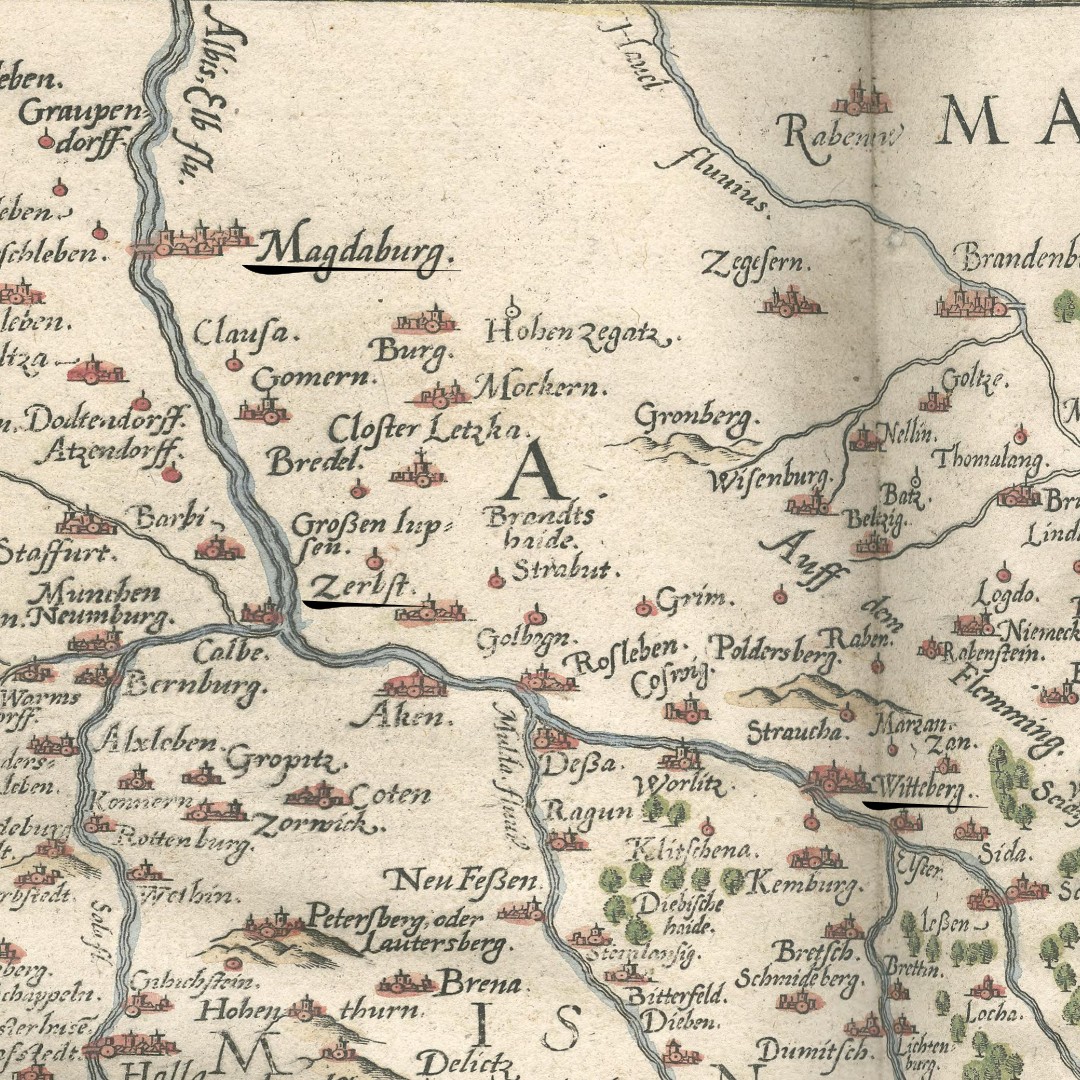
Samuel Kiechel stayed in Wittenberg for two days before leaving on 20 June, travelling via Zerbst to Magdeburg. Zerbst was situated in the Principality of Anhalt, approximately halfway to his destination. Our traveller stopped there for the night and recommended the local beer.
The Principality of Anhalt was one of many minor early modern German states. Kiechel never failed to mention the territories he passed through. Without regulated borders or signposts, he presumably asked his guides or the local people he encountered.
The following morning, Samuel continued to Magdeburg, where he arrived at lunchtime. Kiechel’s description of the city is typically brief: Magdeburg is a powerful, heavily fortified imperial city with an impressive cathedral, divided into the old and new towns. The river Elbe flows close to the city’s walls.
A Protestant Stronghold
Magdeburg, 1572
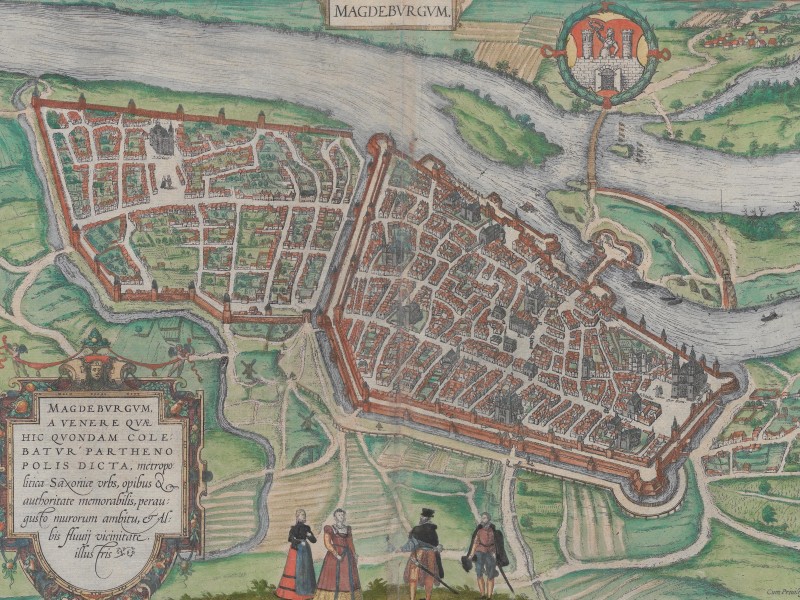
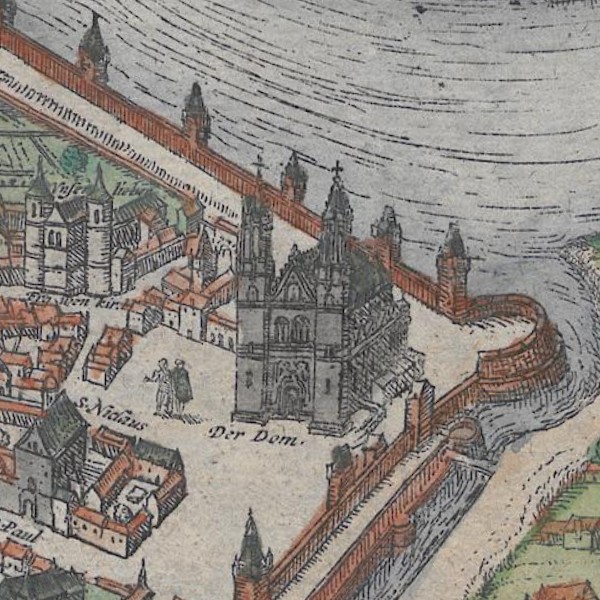
A bird’s-eye view in the Civitates Orbis Terrarum shows Magdeburg from the west. The Old Town is on the right side (south), and the New Town on the left. Walls and a moat protect both parts. The Elbe River runs past Magdeburg, with a bridge crossing it. The churches are labelled and depicted on a slightly larger scale than other buildings. Magdeburg Cathedral is located on the right side (“Der Dom”).
Magdeburg, ca. 1600
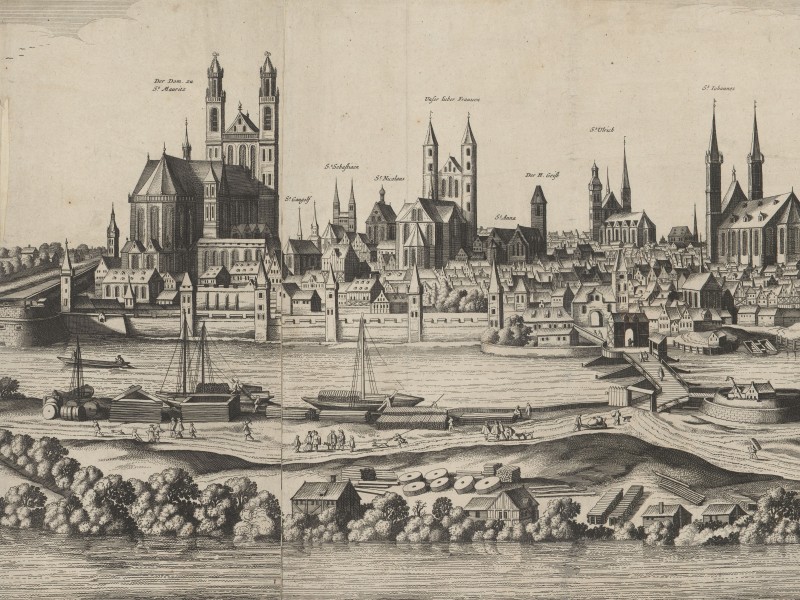
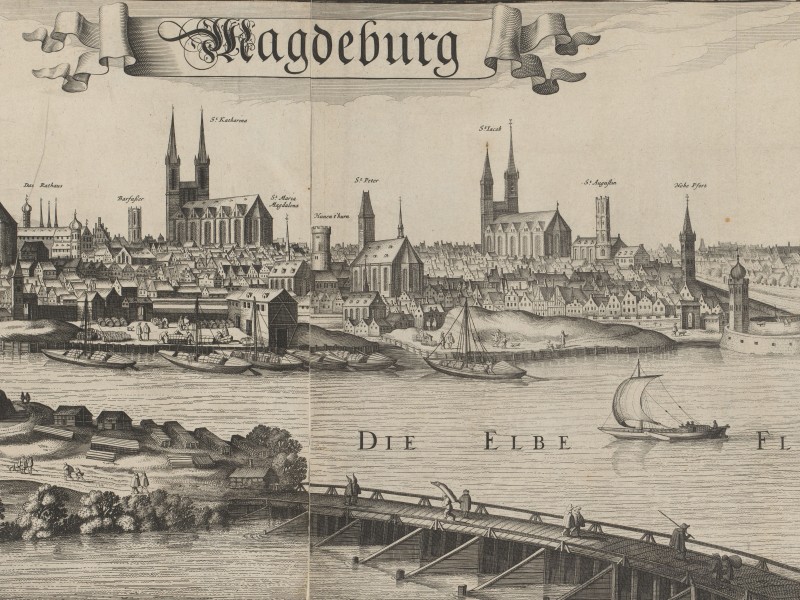
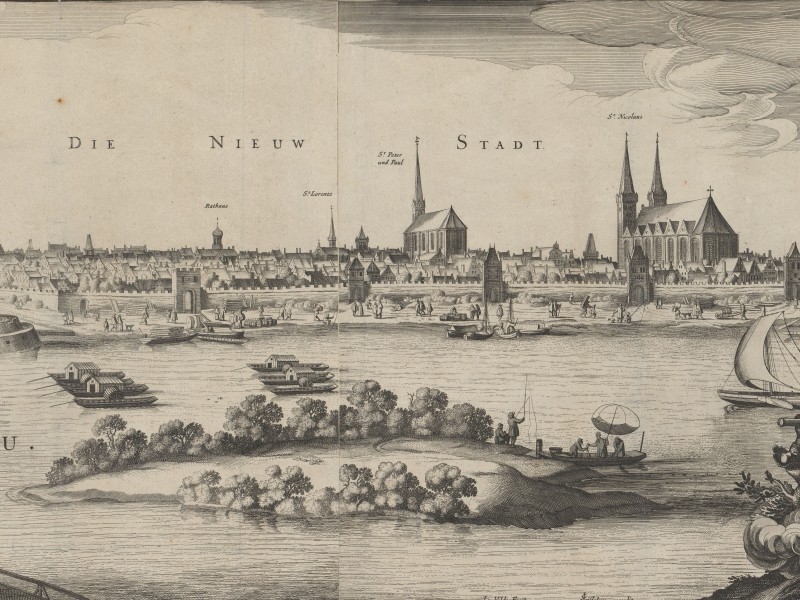
Samuel Kiechel approached Magdeburg from the east, and a similar sight must have greeted him. With the city entirely on the western bank of the Elbe River, Kiechel would have had an unobstructed view. He would have seen the Elbe, a large island in the middle of the stream and two bridges connecting the island to both sides of the river. On the other side of the Elbe loomed the majestic silhouette of Magdeburg with its numerous churches, including the impressive cathedral. Our traveller would have crossed the bridges and undoubtedly noticed the lively activity along the river, with many boats being loaded and unloaded.
It should be noted that this print offers a rare view of Magdeburg. About fifty years after Samuel Kiechel’s visit, the city no longer existed in that form. The print is dated 1637 but is a copy of a painting by Jan van der Velde, dating from around 1600. By 1637, the Thirty Years’ War had taken its toll, and Magdeburg was in ruins.

Magdeburg Cathedral from the east
Magdeburg’s impressive skyline in the print highlights the city’s historic importance as a key political and religious centre in medieval Germany. The city was first mentioned in records in 805 and grew in prominence during the reign of Otto I (912–973). Otto, King of East Francia, was crowned Roman Emperor in 962 by Pope John XII. As was common among many medieval rulers, Otto had no fixed capital but travelled between various imperial palaces (“Kaiserpfalz”). Magdeburg became one of his main residences. He granted the city to his first wife, Eadgyth, granddaughter of Alfred the Great, as dower. Both Eadgyth and Otto were buried in Magdeburg Cathedral.
In the tenth century, the Elbe River was the main border between East Francia, situated on the western bank, and the numerous Slavic tribes to the east. Magdeburg’s strategic location made it a key staging point for missionaries spreading Christianity towards the east. The Archbishopric of Magdeburg was established for this purpose in 968. The Cathedral of Magdeburg is the oldest Gothic cathedral in Germany. It remains a prominent feature of the city’s skyline today. Its construction began in 1209 after the previous church had burned down.
Magdeburg Cathedral (“Der Dom”)
Magdeburg’s religious significance persisted into the sixteenth century. Close to Wittenberg, Luther’s ideas swiftly gained supporters within the city. The reformer was invited to preach at St. John’s Church on 26 June 1524. Magdeburg adopted Protestantism in the same year.
Amid rising religious tensions across the Empire, the city joined the Schmalkaldic League, the defensive alliance of Protestant territories and cities, in 1531. After the League’s defeat in the Schmalkaldic War (1546/47), Emperor Charles V introduced the Augsburg Interim, a decree aimed at re-establishing Catholic dominance within the Empire. Magdeburg refused to accept the Interim.

Magdeburg’s bustling riverfront and St Catherine’s Church
Following this refusal, the city was placed under imperial ban and besieged by Maurice of Saxony (1521-1553). Despite being a Protestant, he had stayed loyal to Emperor Charles V during the Schmalkaldic War. The siege lasted a year, from 1550 to 1551, but Magdeburg held out. At the same time, Maurice was considering leaving the Emperor’s side to join the other Protestant Princes. He began secret negotiations with the city, and Magdeburg agreed to surrender to him on favourable terms. Soon after, Maurice led a successful Protestant rebellion.
In the wake of the siege and the rebellion, Magdeburg became a refuge and stronghold for Protestants. Luther’s teachings and pamphlets opposing the Catholic Church and the Emperor were printed in the city and, from there, widely distributed.
The Peace of Augsburg in 1555 ended the religious conflict, but tensions remained high and flared up again sixty years later with the Thirty Years’ War (1618–1648). Magdeburg and its people suffered greatly during this time. Imperial troops besieged the city and captured it on 20 May 1631. In the war’s worst massacre, soldiers killed about 20,000 residents and burned the city down. The cathedral was one of the few buildings that survived.
During the brief period of peace, our traveller, Samuel Kiechel, visited the city. His comments were typically brief, but, as with Wittenberg, the visit to Magdeburg must have meant something to the young Protestant from Ulm. The majestic view of the city depicted in the print above likely left a strong impression on him.

Return to Wittenberg
Samuel Kiechel spent one day (22 June) in Magdeburg and hurriedly left the following morning. He had heard that the former superintendent of Augsburg, Georg Mylius, had come to Wittenberg and would give his first sermon on 24 June. Our traveller was eager to return to Wittenberg for this occasion.
Georg Mylius (1548 – 1607)
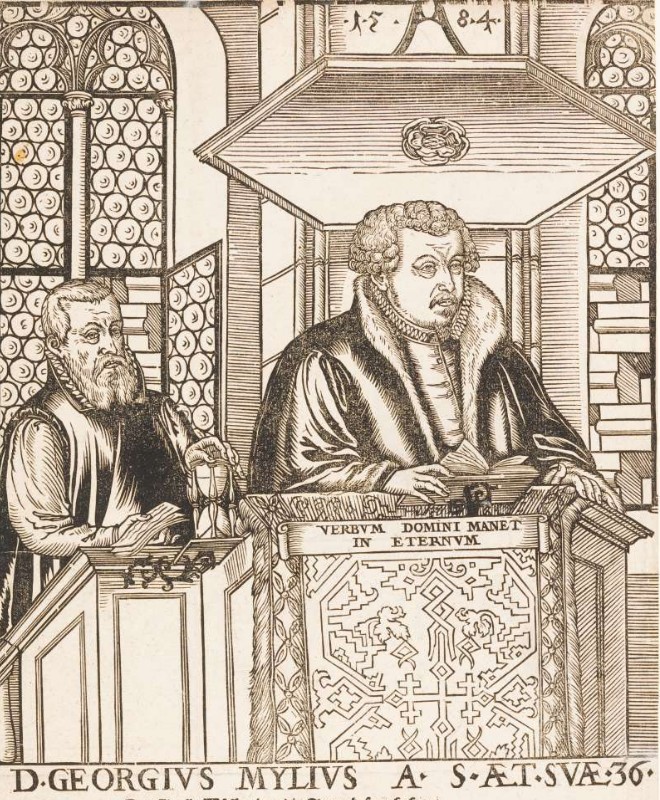
Georg Mylius (1548 – 1607) was a Protestant theologian from Augsburg. He fled his hometown after the Gregorian calendar reform sparked clashes between the city’s Catholic and Protestant inhabitants. Mylius spent a year in Ulm before moving to Wittenberg in 1585 to take the position of professor of theology at the university. Kiechel had probably heard of Mylius during the theologian’s time in Ulm.
Hearing the news of Mylius’ arrival, Samuel Kiechel decided to return to Wittenberg. He left Magdeburg on 23 June with a messenger and arrived in Zerbst at lunchtime. The messenger was old and struggled to keep up with our traveller. Kiechel left him behind and found another man to guide him to Wittenberg, where they arrived on the same day. He spent 24 June in Wittenberg, attending church along with many other townspeople to hear Mylius’ sermon.
The Calendar Reform
Samuel Kiechel regularly mentioned the date in his journal. However, he did not use it to preface his daily entries. Sometimes, the date is in the middle or at the end of a paragraph. If our traveller did not write down the date, he usually lets the reader keep track of time by referring to a day as ‘the next/following day’ or by stating how many days he had spent in a place.
However, the dating in Kiechel’s journal is not as straightforward as it would seem. At the time of his journey, the Julian calendar had been in use for about 1600 years. While it accurately set the length of a year at 365 days, it was eleven minutes too long compared to the solar year. The error itself was minor, but the minutes had accumulated over time. By the sixteenth century, the Julian calendar was noticeably diverging from the astronomical year.
Print of the Gregorian Calendar, 1595
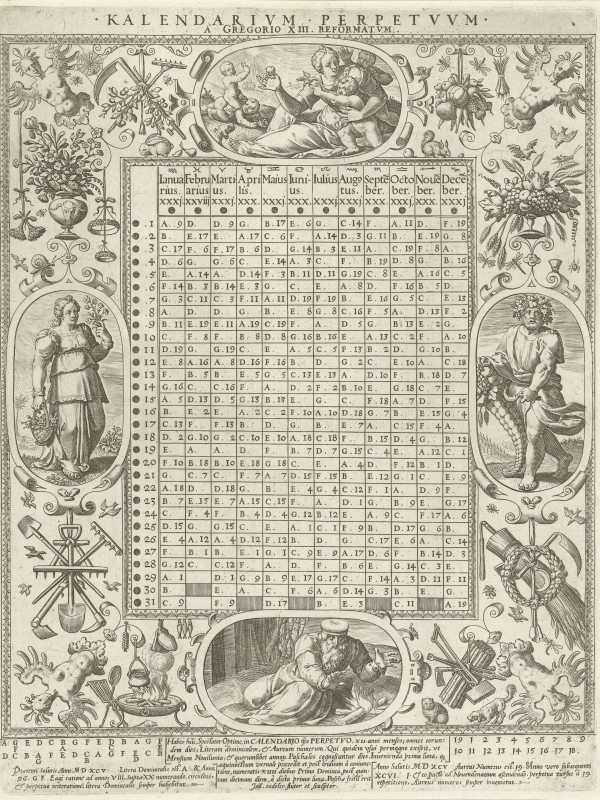
In 1582, Pope Gregory XIII initiated a calendar reform. The new calendar corrected the estimated average length of the year, aligning it more accurately with the astronomical year. The Gregorian calendar was announced in a papal bull and adopted in Catholic regions of Europe.
However, since a papal decree announced the new calendar, it became a subject of religious contention immediately. Protestants refused to adhere to a papal order. For a time, there was concern that the new calendar was a scheme to assert Catholic dominance. The widespread adoption of the new calendar in Protestant and Orthodox territories took considerable time, with some regions only adopting it in the early twentieth century. During these centuries, two calendars were in use across Europe.1
Kiechel began his journey in 1585, three years after the introduction of the Gregorian calendar. He was a Protestant, and his hometown of Ulm did not adopt the new calendar until 1700. Kiechel, therefore, used the old Julian calendar in his journal. He occasionally mentioned that two calendars were in use, but did not elaborate. As he was not writing with an audience in mind, there was no need for explanations.
For this project, I used the date I found in Kiechel’s journal (Julian calendar) to avoid errors in my calculations of the Gregorian date and to prevent confusion when comparing it to the source.
Illustrations & References
All images are in order of appearance with links to sources on external websites:
- Ortelius, Abraham, Theater of the World, Antwerp 1587, pp. 48-49; Library of Congress.
- van de Velde, Jan, Gezicht op Maagdenburg, 1637; Rijksmuseum Amsterdam.
- Magdeburg, in: Braun, Georg, Hogenberg Frans, Civitates Orbis Terrarum (1), Cologne 1593, fol. 30v; Heidelberg University.
- Anonymous, Image of Georg Mylius, 1584; Herzog August Bibliothek Wolfenbüttel.
- Sadeler, Johann, Kalendrivm Perpetvvm, 1595; Rijksmuseum Amsterdam.
- Hamel, Jürgen: Die Kalenderreform Papst Gregors XIII. von 1582 und ihre Durchsetzung, in: Geburt der Zeit. Eine Geschichte der Bilder und Begriffe. Eine Ausstellung der Staatlichen Museen Kassel vom Dez. 1999 bis 19. März 2000, Wolfratshausen 1999, pp. 292-301. ↩︎