
Journal of Samuel Kiechel
18 – 23 February 1586
From Norrköping to Stockholm
“We arrived at lunchtime in Strängnäs […] where, just then, a fair was being held on the lake, and Duke Charles, who is the lord of the town, was there […] He walked among the merchants’ stalls, encouraging the people to buy and sell and to treat each other fairly.”
Die Reisen des Samuel Kiechel aus drei Handschriften, K. D. Haszler (ed.), Stuttgart 1866, p. 65; Bayerische Staatsbibliothek.
Travelling on Ice
Samuel Kiechel and his companions spent a night in Norrköping and left the following morning (18 February). However, half a mile outside the town, one of the two men they had hired as guides began to complain and refused to continue the journey. Kiechel mentioned that they had only hired him because he owned a sledge and a horse. The travellers decided to stop at a farmstead to get a new horse and rid themselves of this obstinate man. However, to their growing frustration, they were not only unable to rent a horse; now, their second guide joined the first, and both men refused to travel any further. Additionally, the peasants at this farm sided with the two guides. The argument nearly led to a fight. Eventually, Kiechel and his companions had no choice but to return to Norrköping to hire new horses and sledges. While the guides were unwilling to continue, they guided the group back to the town. But due to the trouble, the travellers refused to pay them. Because of these difficulties, the group travelled only three miles to a village called Birlingstau before nightfall.
The following day, Samuel Kiechel and his companions continued their journey, arriving in Nyköping at midday. Our traveller noted that their route crossed the frozen sea.
This sea was the Bråviken, a bay of the Baltic Sea with Norrköping at its western end. Olaus Magnus mentioned it, writing that a rushing river flows through the city of Norrköping and into this bay. Along the coast of the Bråviken are many rocks that resemble artificial formations and look like heads, hands, feet and fingers.1


Map of the south coast of the Bråviken with Norrköping in the lower left corner (1653)
Since it was winter, the bay was frozen and, as Kiechel noted, served as a roadway. It was easier to travel on the ice than along rough, frozen paths. Olaus Magnus observed in the Historia that people travel in winter across the ice, where ships sail in summer. To mark routes across frozen lakes and bays, holes are drilled into the ice, and cranberry bushes or small fir trees are placed upright in them. The holes freeze again, securing those markers in place. They are positioned a gunshot apart, and severe punishments exist for removing them.2
Magnus also wrote about the tools used on the ice. He described various types of crampons worn by fishermen, travellers, and soldiers to stand or walk safely on the frozen surface. Axes and pickaxes of different sizes and shapes are used to break the ice.3
Mining in Scandinavia
When the travellers approached Nyköping, they passed a copper mine. The mine belonged to Duke Charles (1550-1611, King of Sweden from 1604 to 1611). He was the brother of the current Swedish King, John III (1537-1592), and had his court in Nyköping. The Duke was married to a daughter of the Elector Palatine from Heidelberg (Maria of the Palatinate, 1561-1589, daughter of Louis VI, Elector Palatine). Our traveller observed that the construction of the Duke’s castle in Nyköping was not yet finished. From the outside, it appeared rough and incomplete.

Olaus Magnus wrote at length about mining in Scandinavia. In the Historia, he stated that there are many large iron, copper and silver mines across Scandinavia. The Swedish crown derives a significant income from levies and taxes on the mines.4 Magnus explains that once all the ore near the surface has been mined, miners go deeper into the mountainsides. They use wooden supports to secure their tunnels and mark them with signs. Treadwheels are used to lower miners underground and to bring ore and water to the surface. Men, horses, or bears power the wheels.5
However, underground work is dangerous; cave-ins and toxic gases claim many miners’ lives, and some fall to their deaths when the ropes used to climb down break.6 Because of these dangers, miners are a rough lot, and many have fled their homes due to misdeeds and are never allowed back. They tend to be unruly and prone to violence, but Olaus Magnus adds that the miners have their own statutes and a mining law and strictly adhere to them. They fear nothing and are willing to go deep into the mines, but many die underground.7
Magnus’ Carta Marina features different symbols for various types of ore. On the map, a black dot indicates an iron ore mine, a black square a copper mine, and rectangles represent silver mines.

Stockholm (Holmiak), Nyköping (Nicopia) and Strängnäs (Strengis) on the Carta Marina (1539) with various symbols indicating iron ore (dot), copper (square) and silver mines (rectangle)
To Stängnäs
Kiechel and his companions stopped in Nyköping to change horses. Our traveller wrote that Nyköping was an unfortified town in an unappealing area. He speculated that it did not draw many nobles or foreign dignitaries. An inlet from the Baltic Sea near the town allowed ships to reach Nyköping during the summer.
It took the travellers some time to find fresh horses. When they eventually set off again, they lost the road amid all the fresh snow and travelled into the night until they reached a farmstead. The owner was not particularly pleased to see them because they had woken him, but he permitted the group to stay overnight. The farm was called Önnersta.
The next morning, the travellers pressed on along snow-covered roads and across frozen lakes. They arrived at Strängnäs, a small, unfortified town, by midday. According to Kiechel, Strängnäs was the seat of an archdiocese.
Duke Charles at the Fair
At the time of Kiechel’s visit, a fair was held in Strängnäs. His companions, as merchants, had business to attend to at the fair, so the group spent the next two days in the town.
According to Olaus Magnus, it was an ancient Scandinavian tradition to hold fairs on the ice during winter. These fairs occur at fixed times: in winter, during the first full moon after Epiphany (6 January). At these events, grain and other foodstuffs, iron, copper, textiles, pelts, silver tableware and jewellery are sold. Olaus Magnus notes that another fair takes place in Strängnäs at the end of February and additional ones in March.8

While Samuel Kiechel’s companions were busy, our traveller had time to explore. He learnt that merchants from Stockholm attended the fair in Strängnäs, where many horses were bought and sold. Kiechel observed that Swedish horses are strong and sturdy animals. However, they are rarely ridden because the roads are too poor in summer — deep, swampy, waterlogged, and full of moss, as Kiechel would experience on his return journey. Eight or nine-year-old horses had never carried saddles and had only been used to pull sledges. Furthermore, Kiechel noted that Swedish horses reach their prime at nine or ten years old. Up to age five, they are not used because their muscles are not yet strong enough.
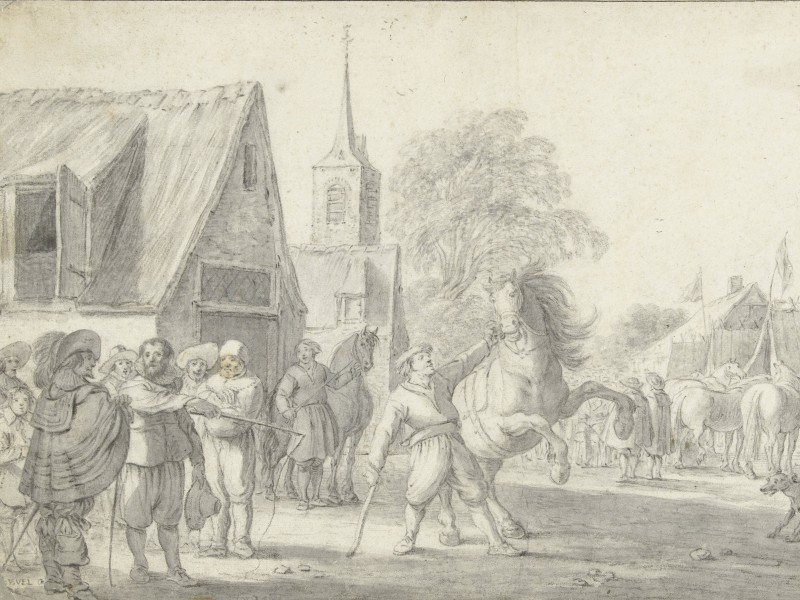
Horses played a vital role in daily life during early modern times, used for transport, travel, work, and warfare. Samuel Kiechel always mentioned when he travelled on horseback, noting whether he had bought or rented the animal, the difficulties in acquiring it, the price, and often, the horse’s quality and temper. Horses allowed for faster travel and could also carry the traveller’s luggage.
Similarly, Olaus Magnus wrote extensively about Scandinavian horses. Chapter seventeen of his Historia de Gentibus Septentrionalibus describes the domesticated animals of Scandinavia, with a notable focus on the horse. Magnus explains how to differentiate between a good and a poor horse, how to raise foals and accustom them to the bridle, how to maintain horses’ health and prevent injury, how to care for and treat them, why Swedish horses are superior to others, details of horses used in warfare, and the horses’ docility.9 Unlike our traveller, he clearly states that Swedish horses are regularly ridden.
While in Strängnäs observing the busy fair, Kiechel saw Duke Charles. As Strängnäs was part of Charles’ domain, he watched the Duke moving among the stalls of small traders, encouraging fair dealings. During this, he was approached by an old peasant. Kiechel noted that in Sweden, it is common to find people over a hundred years old. The old man presented Duke Charles with two beautiful marten pelts.
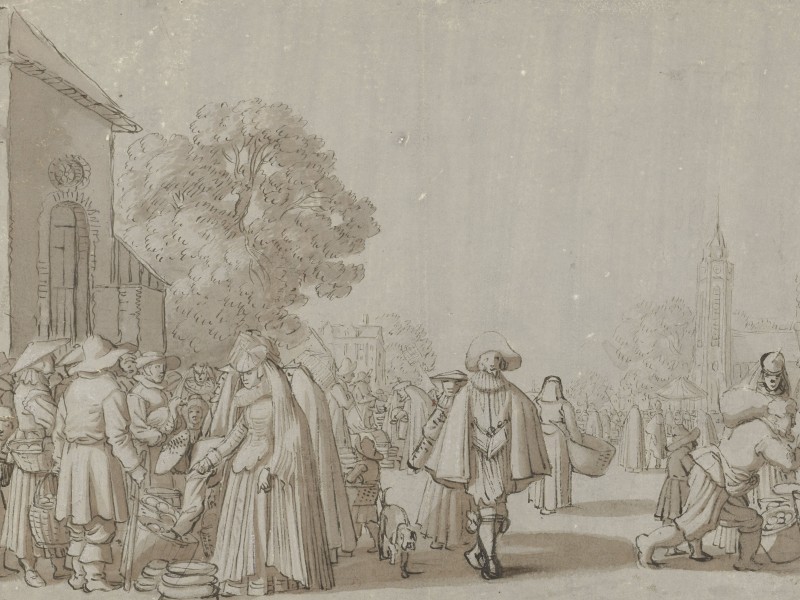
The Duke accepted the gift and continued wandering the fair. However, the old man did not leave but followed the Duke. Eventually, a servant asked why he hadn’t gone. The man approached the Duke again and, regarding the gift, asked Charles for a horse. The Duke laughed and told the old man to come to his residence.
Describing the encounter, Kiechel noted that he did not fully understand their conversation because they were speaking in Swedish. How he understood anything at all is unclear. Perhaps he interpreted what he saw, or his two German companions, who spoke some Swedish, translated it for him.
Kiechel also learnt that the Duke was not particular about etiquette and often spent half a day with an old peasant who told him about local customs. This peasant was allowed to enter the Duke’s residence and discuss events with him.
Finally, To Stockholm!
After his companions had concluded their business at the fair, Kiechel and one of them left Strängnäs on 23 February. They travelled in a horse and sledge that belonged to a man from Stockholm who wished to sell both and had lent them to Kiechel for a test ride. They travelled together in a convoy with five other sledges. Overnight snow had covered all tracks, and most of the day was spent crossing a large frozen lake.
This lake between Strängnäs and Stockholm is Lake Mälaren. Strängnäs lies on its shores, with Stockholm at its exit into the Baltic Sea, making it quite practical to use the frozen lake as a route. Being close to the Swedish capital, many influential noblemen have built palaces along Lake Mälaren’s shores. According to Olaus Magnus, there are also silver, iron, and copper mines in the surrounding area.10
Finally, in the evening of the same day, Samuel Kiechel arrived in the Swedish capital.
Illustrations & References
All images are in order of appearance with links to sources on external websites:
- Slabbaert, Karel, Galgewater in Leiden met ijsvermaak, 1639 – 1654; Rijksmuseum Amsterdam.
- Anonymous, Östergötland, detaljkartor, 1653; Swedish National Archives, Stockholm.
- Luyken, Caspar, Embleem: mijnbouw, ca. 1700; Rijksmuseum Amsterdam.
- Magnus, Olaus, Carta Marina, 1572 (1539); Library of Congress.
- de Vlieger, Simon, Wintergezicht bij een stadspoort, 1610 – 1653; Rijksmuseum Amsterdam.
- van de Velde, Esaias, Paardenmarkt, 1600 – 1630; Rijksmuseum Amsterdam.
- van de Velde, Jan, Marktscène, 1603 – 1641; Rijksmuseum Amsterdam.