
Journal of Samuel Kiechel
16 – 24 July 1585
From Bremen to Emden
“The gate of Emden was heavily guarded. We had to wait for half an hour before we were allowed to enter the city. At the gate and the inn, we were asked for our names and the place from which we had arrived.“
Die Reisen des Samuel Kiechel aus drei Handschriften, K. D. Haszler (ed.), Stuttgart 1866, p. 14; Bayerische Staatsbibliothek.
The Eighty Years’ War (1568-1648)
Frisia, the region along the German North Sea Coast, was flat, open and sparsely populated. Between major trade ports like Hamburg, Bremen and Emden, there were mainly smaller towns and villages. Samuel Kiechel travelled west through Frisia. His destination was the Netherlands, that is, the independent Dutch provinces. The further west he went, the more he began to notice the signs of the war that devastated the Low Countries, spilling across the borders to Germany in the form of migrants, refugees and banditry.

Map of the Low Countries, 1570
The Low Countries became part of the Habsburg Empire when Maximilian I (1459–1519) inherited the Burgundian Netherlands upon the death of his wife, Mary of Burgundy, in 1482. Maximilian and his successors steadily expanded their holdings, and his grandson, Charles V (1500–1558), ruled over a domain that encompassed the Holy Roman Empire, Austria, Spain, Italy, the Netherlands and the Spanish colonies in America.
Charles was born in Ghent, Flanders. Growing up in the region gave him a personal connection and interest in the Netherlands. But this changed after his abdication in 1556. The Habsburg Empire was divided between Charles’ son Philip II of Spain (1527–1598) and his brother Ferdinand (1503-1564).
Ferdinand received the Holy Roman Empire and the title of Emperor. Philip inherited Spain, southern Italy, the American colonies and the Netherlands. Born and raised in Spain, Philip’s upbringing at the Spanish court greatly influenced his personality and political approach. After ascending to the throne, the Burgundian, Flemish and Dutch provinces became marginalised. The local nobility, which had previously held influence and power in provincial administration under Charles, was sidelined. Philip appointed his half-sister, Margaret of Parma, as regent, and an increasing number of Spanish noblemen assumed governance of the provinces.
Additionally, the Protestant Reformation took hold in the Netherlands during the mid-sixteenth century, with Calvinism becoming particularly popular. The staunchly Catholic Philip sought to suppress this movement, leading to widespread religious persecution.

Destruction of Church Decorations, 1566
The Eighty Years’ War began with a series of minor attacks, insurrections, and revolts against high taxes, religious repression and political marginalisation. Over time, it evolved into a war of independence. However, no single significant event or formal declaration marked the start of the protracted conflict. Historians often retrospectively identify the ‘Beeldenstorm’ in 1566 — when Dutch Calvinists destroyed religious images and decorations in many cities — as the war’s beginning. Nonetheless, there is no consensus on this.
Initially, the Spanish responded swiftly and suppressed the revolts. However, their brutal tactics, which included sacking cities and massacring garrisons, alienated the local population. When Spain went bankrupt in 1575 and unpaid Spanish mercenaries rampaged through the Low Countries, even the previously loyal Catholic provinces joined the rebellion. In 1576, the provinces signed the Pacification of Ghent, agreeing to unite in their efforts to expel all foreign armies.

Sack of Antwerp, 1576
However, this cooperation was short-lived. Radical Calvinists antagonised some southern provinces, prompting them to return to Spanish rule. Other provinces were retaken by Spanish forces. In 1579, the seven remaining Calvinist northern provinces formed the Union of Utrecht. They declared independence from Spanish rule in 1581 and formed the Dutch Republic (Republiek der Zeven Verenigde Nederlanden).
The conflict, particularly the Spanish repression of Dutch Calvinists, directly influenced neighbouring countries, especially the Holy Roman Empire. Many Dutch fled and settled in German cities near the border. Samuel Kiechel mentioned the numerous Dutch inhabitants in Hamburg and Bremen. Because these refugees often included merchants and artisans, their skills significantly contributed to the prosperity of the cities they settled in.
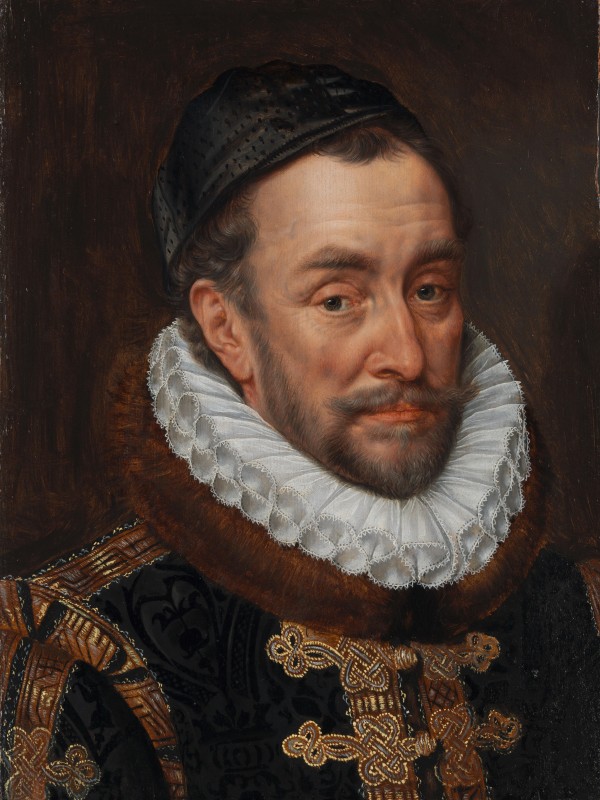
William the Silent (1533-1584), Prince of Orange and leader of the Dutch Revolt
In the 1580s, Spain was expanding its control by reconquering some provinces. In 1584, William the Silent (1533-1584), the leader of the Dutch Revolt, was assassinated, and a year later, Antwerp fell after a Spanish siege. Kiechel learnt about the siege while travelling to England and visited Antwerp on his return journey.
In 1585, England decided to support the Dutch provinces by sending troops and financial aid to the rebels (Treaty of Nonsuch, 10 August 1585). English support for the Dutch Republic marked the beginning of the Anglo-Spanish War (1585-1604). In response, Philip II launched the Spanish Armada in 1588, a large fleet intended to subdue the English and to escort an invasion army from the Spanish Netherlands to England.
However, the voyage of the Armada was a disaster. Fast, more manoeuvrable English ships, storms and the shallow waters along the Dutch coast destroyed many ships. The defeat marked the end of Spanish successes. Under Maurice of Orange (1567-1625), William the Silent’s son, the rebellious provinces started retaking several fortified cities from the Spanish.
After this period of intense conflict, a long truce was agreed upon that lasted from 1609 to 1621. Once the ceasefire ended, the conflict resumed, although neither side made significant gains or losses. Meanwhile, the devastating Thirty Years’ War (1618-1648) raged in neighbouring Germany, diverting attention from the Dutch conflict. The war concluded in 1648 with the Peace of Münster, where Spain recognised the independence of the northern provinces but retained control over the southern Low Countries. This division remains with us today, with the Dutch Republic corresponding to modern Netherlands and the Spanish part to present-day Belgium.

The Ratification of the Treaty of Münster, 1648
Westward
On his journey from Bremen to Emden, Samuel Kiechel travelled along the North Sea coast in what is now the German state of Lower Saxony. Lower Saxony is a modern name. In the sixteenth century, the region consisted of two counties: Oldenburg and East Frisia. The landscape Kiechel observed on his journey was a distinctive mix of marshland, moorland, and sandy heathland, due to its proximity to the sea.
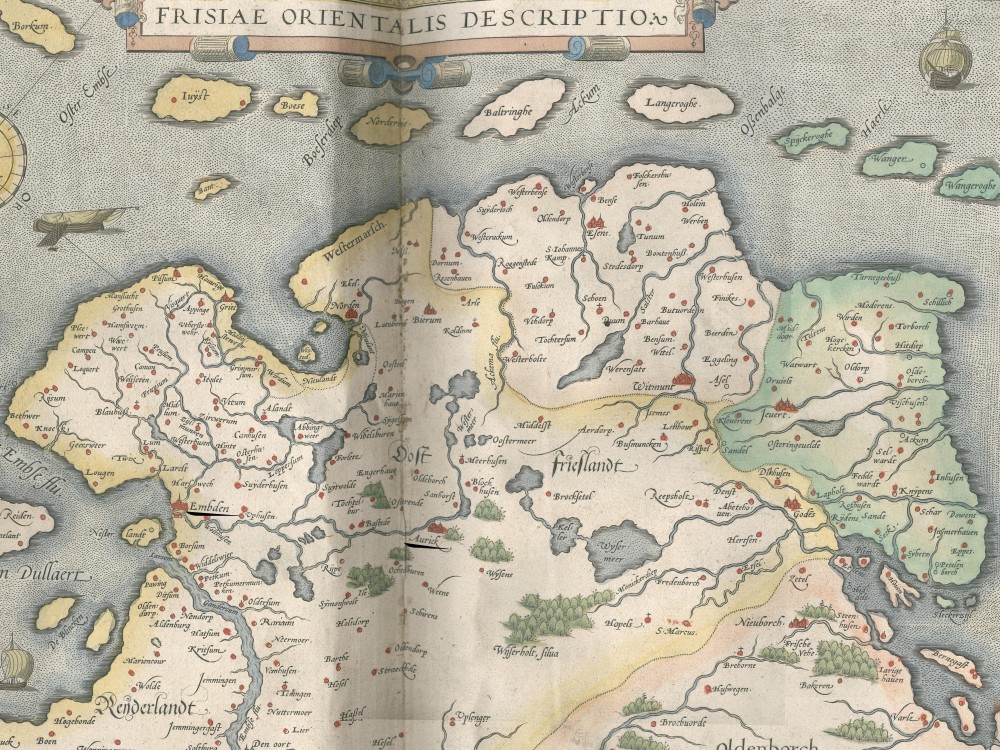
East Frisia in 1570 with Emden and Aurich
Kiechel spent 15 July in Bremen and left the following day with a West Frisian nobleman and his servant. He learnt that the nobleman had to leave his hometown due to war — presumably the Eighty Years’ War. The three men hired a carter to drive them west to Delmenhorst, five miles from Bremen.
In Delmenhorst, Kiechel saw a splendid fortress and learnt that it belonged to Count Johann of Oldenburg (Johann VII of Oldenburg and Delmenhorst). The travellers did not linger but proceeded on their journey, arriving in Oldenburg in the afternoon. Their route took them through forests and across open heathland.
The three men had dinner in Oldenburg before hiring another carter to take them another five miles. They left the town in the evening and travelled through the night. The road once again passed across open heathland. Before dawn on 17 July, they reached a village called Fronberg in the territory of the Count of Emden. The travellers paused to try drying their clothes and belongings, as it had rained during the night.

Eventually, they hired another carter to drive them to Aurich, three miles from Fronberg. According to Kiechel, Aurich was poorly built but had a strong castle. The town served as the seat of the Counts of Frisia.
Unlike the feudal societies that dominated much of medieval Europe, the Frisian tribes maintained their autonomy and freedom until the fifteenth century. The so-called ‘Frisian freedom’ only came to an end when elected military leaders and chieftains began establishing themselves as the ruling elite, carving out territories. They redefined ‘freedom‘ not as personal liberty but as freedom from foreign rulers. However, loss of unity among the scattered Frisian communities meant that they could no longer resist external attacks. Some areas were subdued by force, while others agreed to be incorporated into the Empire under their chieftains. When Kiechel visited the County of Frisia, it was governed by Edzard II (1532-1599), who resided in Aurich. Edzard belonged to the House of Cirksena, a family descended from a line of Frisian chieftains who became the rulers of the County of East Frisia.
In Emden
Kiechel and his companions tried to find another carter to take them the remaining two miles from Aurich to Emden. Their search was difficult because the townspeople were reluctant to assist. Kiechel learnt that they were concerned about their horses. Bandits and privateers menaced the area. Eventually, the travellers found someone willing to take them to Emden, where they arrived in the evening.
The gates of Emden were heavily guarded, and the travellers had to wait half an hour before they were allowed in. The guards recorded their names and where they arrived from. The innkeeper where Kiechel stayed did the same.
Personal identification was unknown in the sixteenth century. Instead, travellers faced questioning at city gates. Collecting names of those seeking entry was part of the security measures designed to keep out spies and criminals. The guards documented the names, and, according to Kiechel, the innkeeper did likewise. Both lists were compared to spot any discrepancies. Kiechel encountered similar precautions several times during his journey.
The security measures in Emden were strict because of the nearby Dutch border. Emden was on the eastern bank of the Ems estuary. Groningen, on the opposite side, had fallen under Spanish control in 1580, prompting many Dutch Protestants to flee to Emden. The bandits and privateers Kiechel mentioned as threatening the area were a result of the conflict.

The Ems Estuary, 1570
The proximity to the Dutch border was both an advantage and a risk for the city. On one hand, the war could easily spill over the border, as it did in 1568 when a Spanish mercenary army pursued fleeing Dutch troops into East Frisia and, after defeating them, carried out a spree of death and destruction. On the other hand, many Dutch Calvinists, having fled their homeland, settled in Emden and strengthened the city’s prosperity and commercial success. Its strategic position on the Ems and its secure harbour allowed Emden to become an essential trading hub during a time when Dutch ports were under blockade by the Spanish.
Samuel Kiechel described Emden as a small, well-constructed and pleasant city. It was under the authority of the Count of Emden and served as the capital of East Frisia. Emden’s proximity to the sea, with an inlet from the Ems River leading into the city, enabled ships to anchor within the walls.

View of Emden, 1575
A bird’s-eye view in the Civitates Orbis Terrarum shows Emden from the south. The city is fortified with walls and surrounded by canals. Two large canals extend deep into Emden, seemingly dividing the city into four sections. These canals also form the city’s harbour. As Kiechel noted, we see many ships moored within Emden’s boundaries.
Samuel Kiechel planned to continue his journey by sea, but no vessel dared to set sail. Privateers prowled the waters, making travel dangerous. Kiechel was compelled to wait in Emden from 17 to 24 July, when several warships were expected to arrive to escort the other vessels.
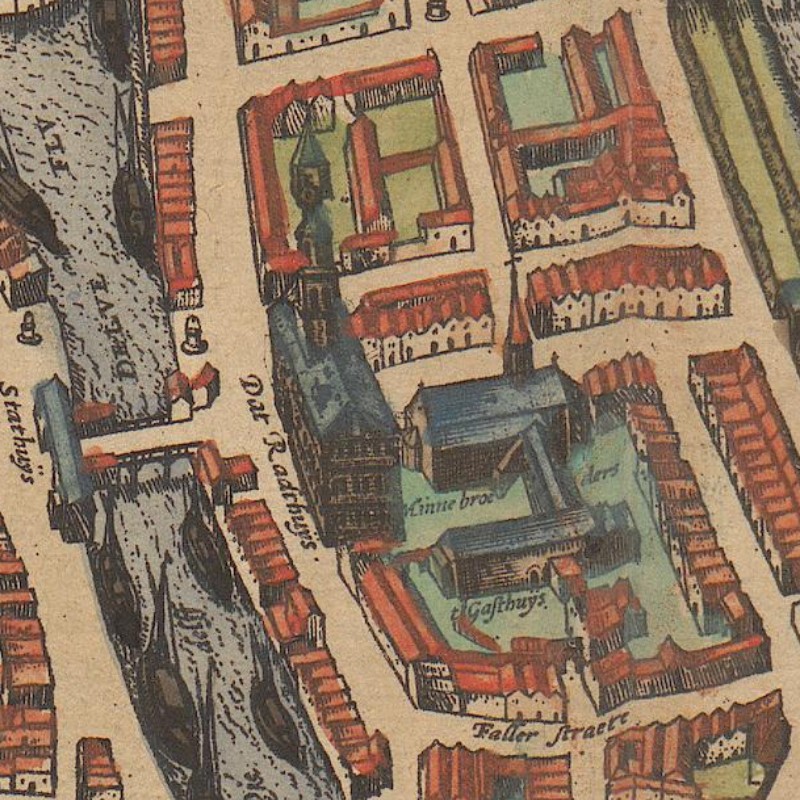
The town hall and western canal in Emden. Beside the town hall is a building named “Gasthuys“ (Inn). Maybe Samuel Kiechel stayed there?
Illustrations & References
All images are in order of appearance with links to sources on external websites:
- Saftleven, Herman, Stadspoort met uitzicht op zee, 1619 – 1685; Rijksmuseum Amsterdam.
- Ortelius, Abraham, Theater of the World, Antwerp 1587, fol. 30v; Library of Congress.
- Hogenberg, Frans, Beeldenstorm, 1566; Rijksmuseum Amsterdam.
- Hogenberg, Frans, Spaanse Furie in Antwerpen: moord in de straten (1576), 1588; Rijksmuseum Amsterdam.
- Key, Adriaen Thomasz., Portrait of William I, Prince of Orange, c. 1579; Rijksmuseum Amsterdam.
- ter Borch, Gerard, The Ratification of the Treaty of Münster, 1648; Rijksmuseum Amsterdam.
- Ortelius, Abraham, Theater of the World, Antwerp 1587, fol. 43v; Library of Congress.
- Anonymous, Landschap met boerenkar, 1606 – 1700; Rijksmuseum Amsterdam.
- Emden in: Braun, Georg, Hogenberg, Frans, Civitates Orbis Terrarum (2), Cologne 1575, fol. 41v; Heidelberg University.