
Journal of Samuel Kiechel
24 February – 15 March 1586
In Stockholm
“Also, you can read in Swedish chronicles that the Swiss have their origin in Sweden; that may be so, but the land as well as the people are similar.”
Die Reisen des Samuel Kiechel aus drei Handschriften, K. D. Haszler (ed.), Stuttgart 1866, p. 68; Bayerische Staatsbibliothek.
Origin Stories
Olaus Magnus, the Swedish cleric and author of the Carta Marina (1539) and Historia de Gentibus Septentrionalibus (1555), made it a central theme of his work to highlight the Scandinavian origins of the ancient Goths. Widely believed in the Middle Ages and early modern period, this origin story is now considered a fabrication.
Another origin story linking Scandinavia to central Europe, equally fantastical, is mentioned by Samuel Kiechel. While in Stockholm, Kiechel learnt that Swedish chronicles claim the Swiss originated in Sweden.1 It remains unclear how he knew about this claim. Since Kiechel was neither a student nor fluent in Latin or Swedish, it is unlikely that he read Swedish chronicles. Presumably, he heard this origin story from his travel companions or his host.
The legend that the Swiss originated in Sweden was somewhat popular in the late Middle Ages and early modern period, though less well known than the Gothic-Scandinavian connection. It was also more prevalent in Swiss chronicles than in Swedish writing, and Olaus Magnus never mentioned it. Today, this origin story is mostly forgotten.
As was typical of Kiechel, he refrained from expressing an opinion on the origin story and instead noted the similarities between the two countries and their peoples. He described Sweden as mountainous, with many rocks and cliffs, creating a harsh landscape that makes travel difficult. Large freshwater lakes lie between the mountains. The lakes are full of fish, but no carp are found in the country; they have to be imported. Pike are caught in the lakes, then dried and exported.2
The Swedish people, Kiechel remarked, are strong, hard-working and gruff. Due to the country’s harsh but healthy conditions, they live long lives and rarely need medicine. However, Swedish clothing is of poor quality and old-fashioned; peasants wear pleated garments, while city dwellers wear straight clothes. Kiechel considered the Swedish language quite coarse.3
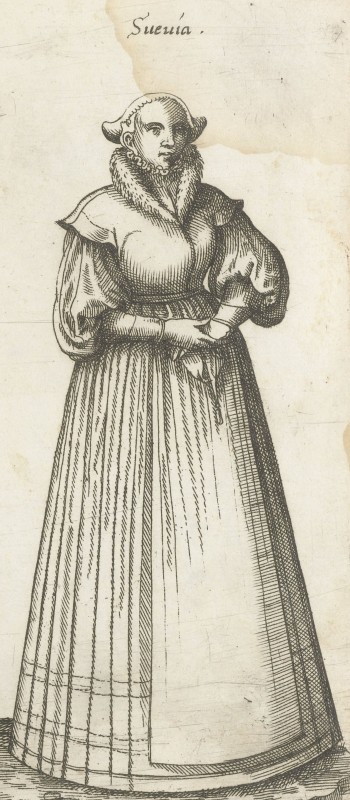
Swedish woman, 1585
Lapland
Furthermore, Kiechel learnt during his time in Stockholm that the Swedish king also ruled over other countries. He heard that Finland, which borders Sweden to the north, is a Swedish principality with its own language. Next to Finland is Lapland. According to the information Kiechel received, the population of Lapland is fierce and pays tribute to three lords: the king of Denmark, the ruler of Muscovy, and the king of Sweden. Kiechel was told that the Swedish king receives three parts of the tribute, while the other two rulers share one part. He was also told that Lapland has no defined end and has its own language.4
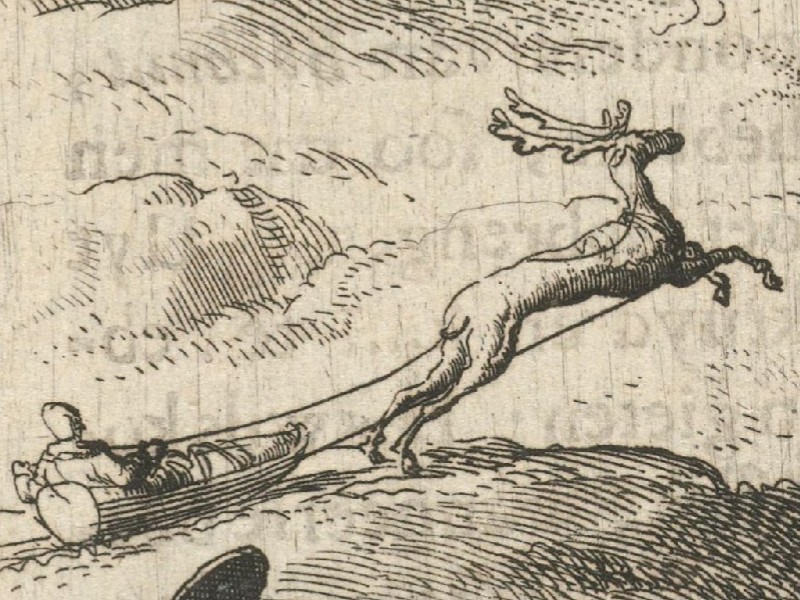
In Lapland, Kiechel wrote, a small deer is found, which he called a reindeer. It is used in winter to pull sledges. The young reindeer are said to run very fast. Their coats are speckled with various colours. The skin of the reindeer is used to make boots, gloves and shoes called “lappschuch” (laplander shoe). According to Kiechel, these shoes are ideally suited for cold weather. He wrote that people sometimes wear four or five pairs of socks at once, yet still get cold feet. But if someone wears one pair of socks and the “lappschuch”, he will not get cold feet. The colder it gets, the more warmth these shoes provide, as long as they are not wet. Kiechel described the shoes as coarse and hairy on the outside and smooth on the inside.5
Kiechel also recorded hearing that many inhabitants of Lapland were supposed to be warlocks and witches. These and other stories about Lapland were relayed to him by people he described as trustworthy. However, since he had learned only through hearsay and had witnessed nothing himself, he decided not to write more about it.6
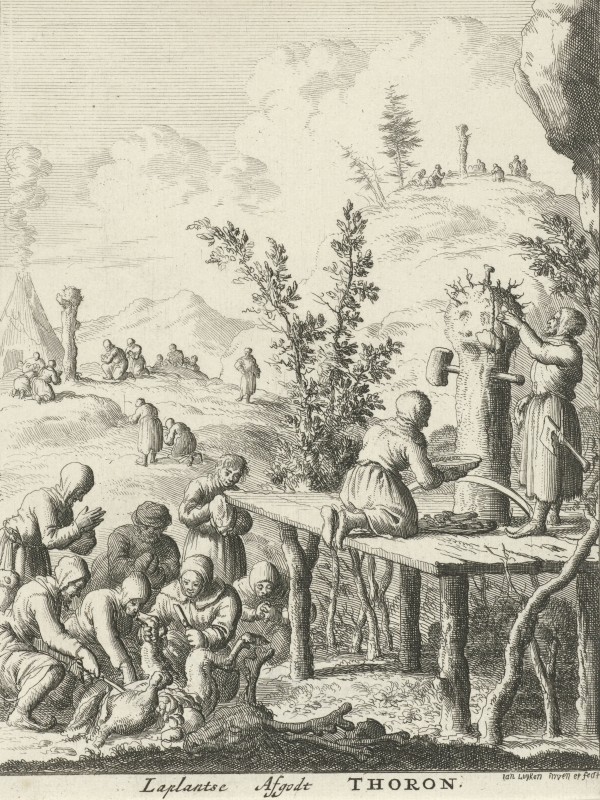
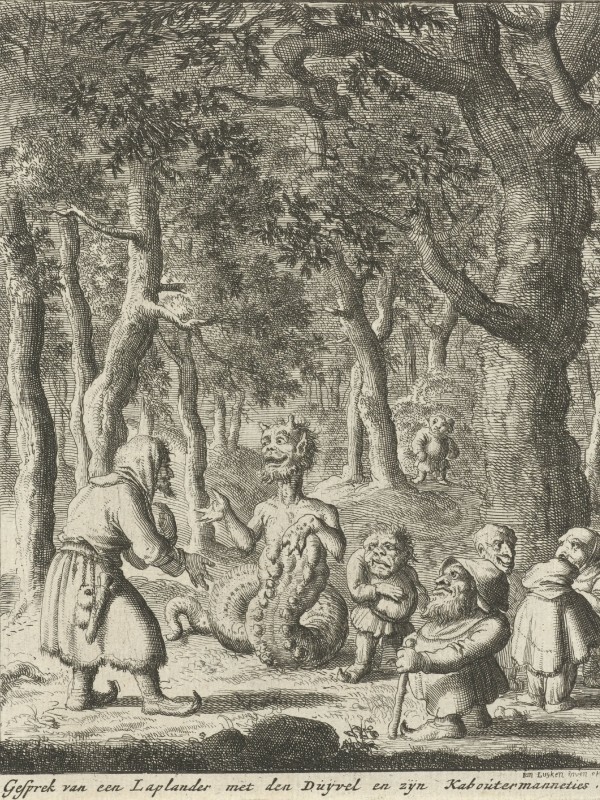
Assumptions about heresy and witchcraft in northern Scandinavia were widespread and persisted a century after Kiechel’s journey. These are two Dutch prints from 1682. In the first image, Laplanders worship their old gods, and in the second, a Laplander is in conversation with the devil.
The issue of the tribute of the Laplanders is also found in Olaus Magnus’ Historia. Magnus added that they are usually peaceful people and do not attack their neighbours. But when the Laplanders are provoked, they will fight with weapons and magic.7 With regard to the witches and warlocks in Lapland, this is also found in Olaus Magnus’ book and seems to have been a common assumption about the people in the far north, believed to be true. Some examples of superstition, witchcraft and wizardry are on Magnus’ Carta Marina.8
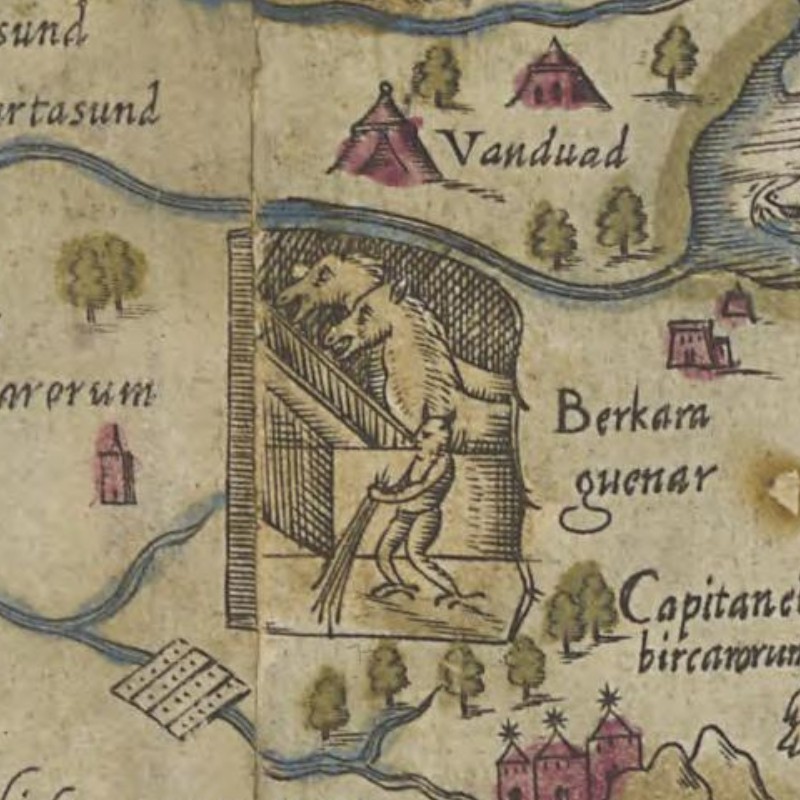
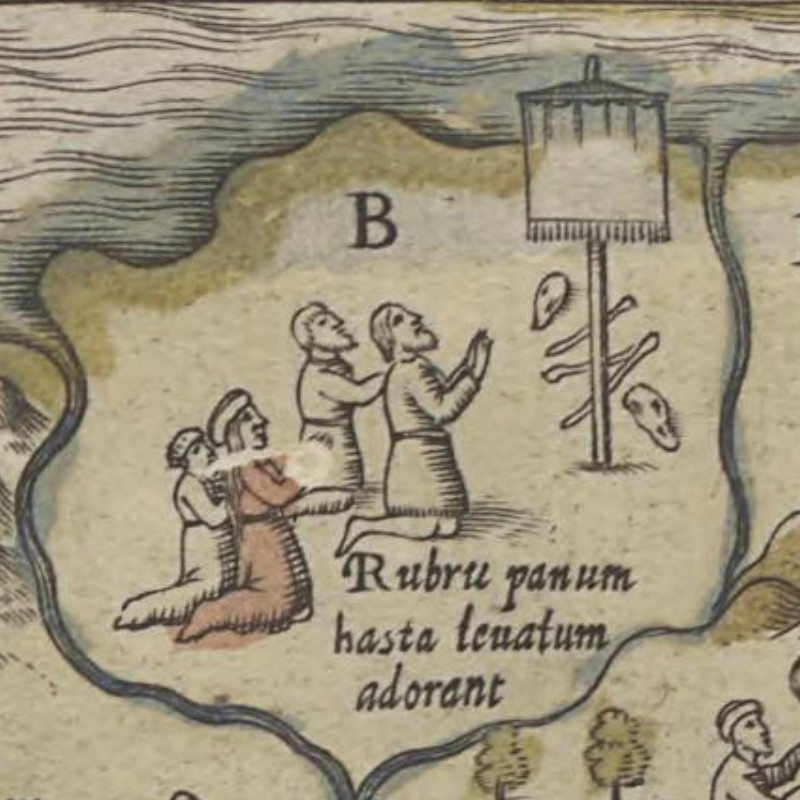
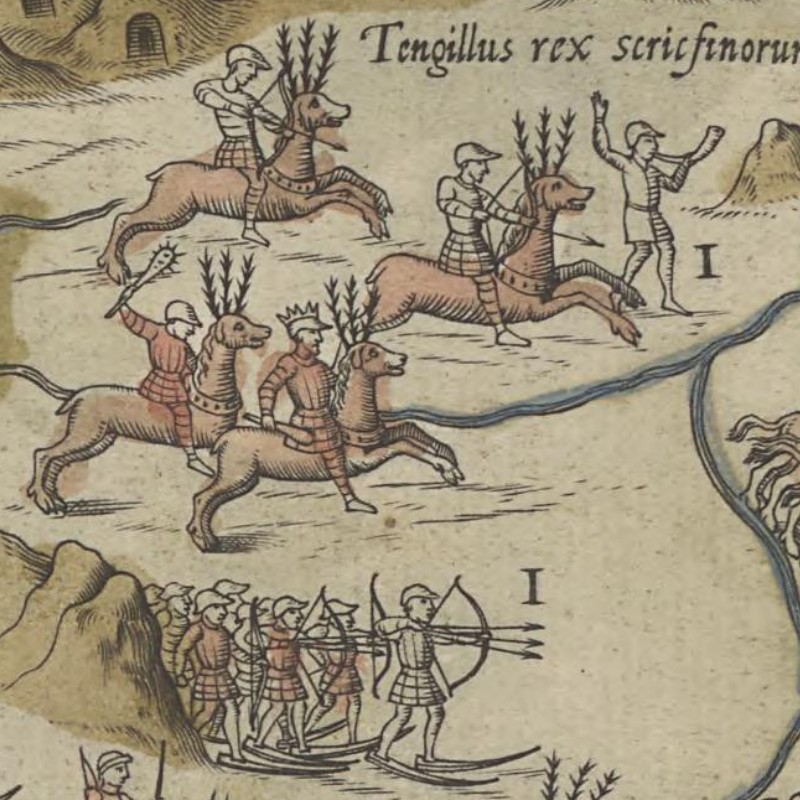
Examples of superstition and witchcraft on the Carta Marina (1539)9
Excursion to Uppsala
Samuel Kiechel had arrived in Stockholm on 23 February. After about two weeks in Sweden’s capital, he felt he had seen enough and was quite bored. Kiechel wrote that he did not know what Stockholm was like in summer, but even then, anyone walking outside the gates would quickly find themselves between mountains and coastal cliffs.
Kiechel decided to visit nearby Uppsala and left Stockholm on 7 March by sledge in the company of a Dutch woman.
The way women travelled in Sweden struck Kiechel as quite strange. He reported that sledges are designed so that a woman can lie down for the journey and is fully covered except for her face. Both the sledge and its passenger are covered with carpets (blankets) tied down and woven together, like a child in a cradle. In the event of a crash or a runaway horse, the woman cannot act because her hands are also under the blankets. Many women also cover their faces, looking out only through a small glass window to protect themselves from the severe cold. Each ‘woman-sledge’ has a servant at the back to drive it.10
Our traveller and his companion arrived in Rüsburg (Rosersberg?), where they spent the night in the house of the local reeve. They were treated well and served good food and beer.
The following day, Kiechel continued to travel with the Dutch woman for another mile. The snow was so deep that it reached the bellies of their horses. Soon, they arrived at the house of another reeve. The woman had business there and parted company with our traveller. After a short break, Kiechel continued alone. He had one more mile to travel to Uppsala, but it took him over three hours due to the snow. Sometimes the snowdrifts were so deep that his horse had trouble getting through, and Kiechel mused that, had his horse been a lazy animal, it would have gotten stuck.
In Uppsala
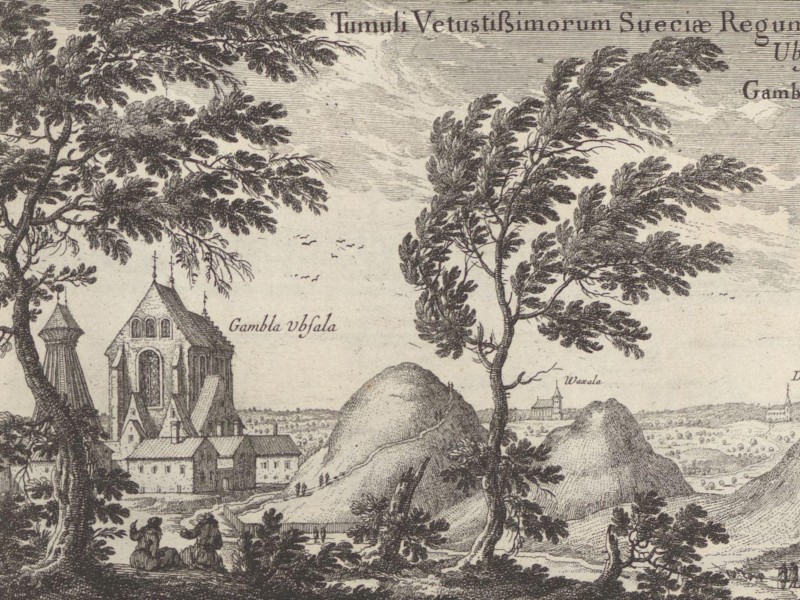
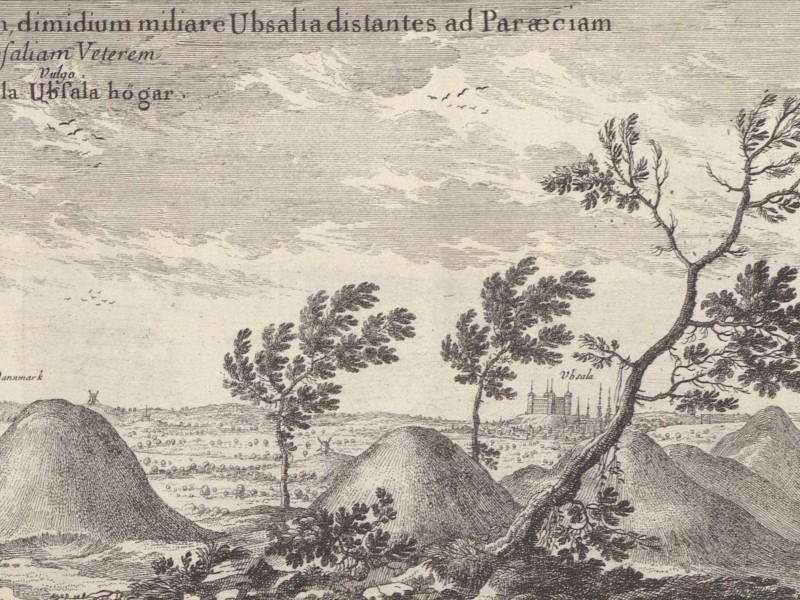
View of Uppsala, 1668
Uppsala, according to our traveller, was an unfortified town in flat countryside, unusual in this mountainous country. The town had been the seat of an archbishop and had a beautiful cathedral church built in the country’s typical style. Kiechel wrote that he had not expected to find such an impressive church in Sweden.
The last archbishop of Uppsala had been Johannes Magnus, the older brother of the above-mentioned cleric, mapmaker and historian Olaus Magnus. Both brothers went into exile when the Protestant Reformation arrived in Sweden.
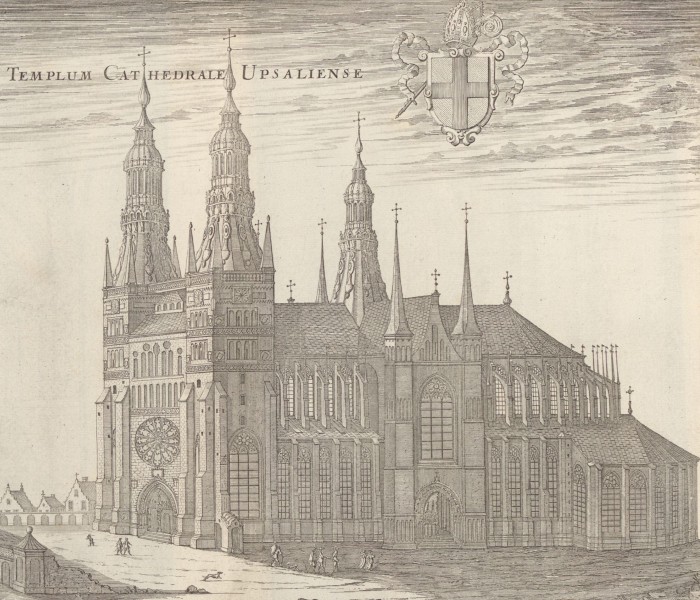
Uppsala Cathedral, 1670
Samuel Kiechel spent 9 March in Uppsala. He visited the cathedral and learnt that the Swedish kings and queens are buried there. Our traveller saw the beautiful tomb of Gustav Vasa. The tomb was made of white alabaster, with a life-size sculpture of the king placed upon it.11
To the left of the tomb, Kiechel saw a large silver box, which he was told contained the relic of Saint Eric. He learnt that the box had once been gold, but during a war the gold melted, turning it into silver — a transformation regarded by locals as miraculous. Kiechel was willing to believe this account, noting the Swedish people’s strong belief in Saint Eric. He added, more sceptically, that otherwise the gold would have turned to wood long ago.12
In Uppsala, Kiechel also visited a royal palace that resembled a fortress but was intended as a place of pleasure. The building stood on a hill and was encircled by a long wall. Even after twenty-four years, construction was still ongoing. The palace’s master builder, from Silesia, welcomed Kiechel and invited him to his house.
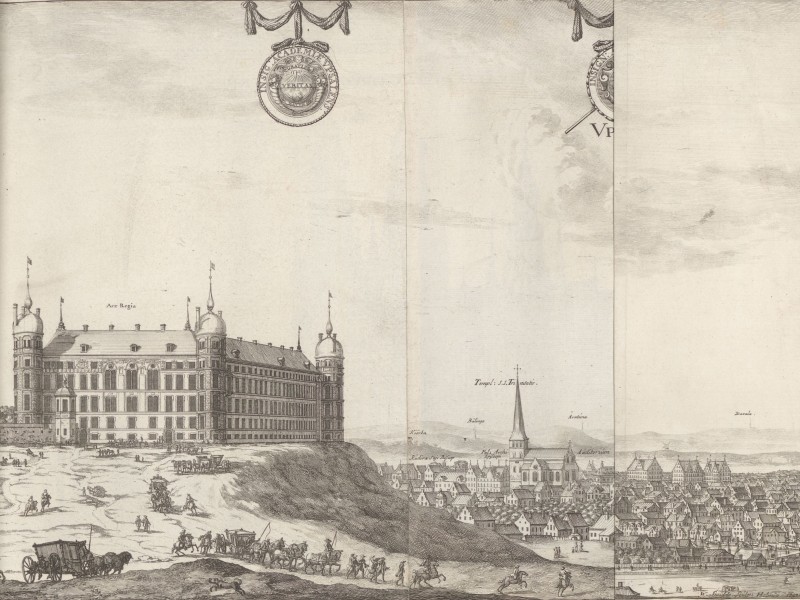
Uppsala, view of the town and palace, 1690
While visiting the palace, Kiechel observed many beautiful rooms with high vaulted ceilings, decorated with sculpted figures and other finely crafted works. The rooms were richly coloured. Kiechel mused that building them must have cost a great deal. He noted, however, that the finished rooms soon needed repair; the completion of one often coincided with the decay of another. He considered the construction an endless task, attributing this to the cold climate. Workers were busy building the palace church, burning large amounts of wood to keep the mortar from freezing and allowing construction to continue.13
On 10 March, Kiechel returned to Stockholm with a German man. They travelled across frozen lakes, making their journey faster than if they had used the snow-covered roads. Kiechel noted his enjoyment of watching peasants fish under the ice, observing how they cut small holes just wide enough for fishing lines to pass through. The lines were strung from hole to hole. After some time, groups of forty to fifty people would gather to reel in the line and catch many fish. These fish, called “strömling”, are about half the size of a herring and are either dried or eaten raw.14
Stömming, also known as Baltic herring, is a subspecies of the Atlantic herring.
Olaus Magnus provides more detail about ice fishing. He described a common way to icefish as using a hook and line passed through a hole in the ice. A small fish is used as bait to catch larger fish. As for the process described by Kiechel, Magnus wrote that the holes in the ice are placed sixty to a hundred paces apart. The fishing line, passing from hole to hole, has many hooks attached. It stays under the ice for a whole night and is pulled out the next day.15
Departure
After returning to Stockholm, Kiechel spent another four days in the city, seeking an opportunity to leave Sweden. He was somewhat worried about being stuck in Stockholm. Kiechel wrote that if a traveller does not manage to leave Stockholm in winter, he won’t be able to do so until Pentecost because of the ice. As spring temperatures rose, ice floes would continue to block waterways, while roads in Sweden turned into swamps with the snowmelt.
Planning to leave Stockholm, Kiechel bought a horse for nine Reichsthaler. To evaluate the animal, he had been allowed to try it out on his excursion to Uppsala. As for companions, our traveller met a Dane who wanted to leave Stockholm and return home. The man had fled the city of Narva in Livonia because of his debts, but Kiechel did not know this when they met. Kiechel and the Dane agreed to travel together. His new companion bought a sledge and horse on credit from a Lübeck merchant. Kiechel, in hindsight, doubted that the merchant would see the credit repaid.
Both men left Stockholm on 12 March, but just half a mile outside the city they were already lost. They continued into the night until they reached a village. There, they asked the local parish priest for accommodation, but the priest refused for a long time. Eventually, he agreed to let the travellers into the stable. Kiechel wrote that his companion looked very thirsty. This phrase was used by our traveller when he mistrusted someone. Samuel was also worried because of the events of this first day. If they lost their way so close to Stockholm and had difficulty finding accommodation, how would they be able to leave the country? The two men had to cover eighty to ninety miles to reach the Øresund. Such thoughts went through Kiechel’s mind during the night, and in the morning they decided to return to Stockholm. The village they spent the night in was called Büsskirch (Botkyrka?), and it turned out to be only two miles from Stockholm.
Illustrations & References
All images are in order of appearance with links to sources on external websites:
- Luyken, Jan, Ritueel met een Sami noaidi trommel in Sápmi (Lapland), 1682; Rijksmuseum Amsterdam.
- Grassi, Bartolomeo, Tedesche / Tedesche del’campo / Suevia, 1585; Rijksmuseum Amsterdam.
- Luyken, Jan, Sneeuwlandschap met Sami op houten latten en in door rendieren getrokken sledes, 1682; Rijksmuseum Amsterdam.
- Luyken, Jan, Laplantse Afgodt Thoron, 1682; Rijksmuseum Amsterdam.
- Luyken, Jan, Gesprek van een Laplander met den Duijvel en zijn Kaboutermanneties, 1682; Rijksmuseum Amsterdam.
- Magnus, Olaus, Carta Marina, 1572 (1539); Library of Congress.
- Perelle, Adam, Oud-Uppsala met grafheuvels en de stenen van Mora, 1668; Rijksmuseum Amsterdam.
- Marot, Jean, Templum Cathedrale Upsaliense, 1670; Rijksmuseum Amsterdam.
- Swidde, Willem, Uppsala, 1690; Rijksmuseum Amsterdam.
- Die Reisen des Samuel Kiechel aus drei Handschriften, K. D. Haszler (ed.), Stuttgart 1866, p. 68; Bayerische Staatsbibliothek. ↩︎
- Ibid. ↩︎
- Ibid. ↩︎
- Ibid., p. 69. ↩︎
- Ibid. ↩︎
- Ibid. ↩︎
- Olai Magni historien, Der Mittnachtigen Länder …, Basel 1567, p. 118; Bayerische Staatsbibliothek. ↩︎
- Magni historien, Der Mittnachtigen Länder, pp. 100-109. ↩︎
- Magnus, Olaus, Ain kurze Auslegung und Verklerung der neuuen Mappen von den alten Goettenreich und andern Nordlenden, Venedig, 1539; Bayerische Staatsbibliothek. ↩︎
- Reisen des Samuel Kiechel, pp. 69f. ↩︎
- Ibid., p. 71. ↩︎
- Ibid. ↩︎
- Ibid., pp. 70f. ↩︎
- Ibid., pp. 71f. ↩︎
- Magni historien, Der Mittnachtigen Länder, p. 569. ↩︎