
Journal of Samuel Kiechel
23 – 26 August 1586
From Narva to Reval
“After one mile, we arrived at a mill. The miller refused for a long time to give us a horse. My companion pretended he wanted to strike the miller and pulled out his gun. The miller relented and saddled a horse. I was fearful, but my companion said he knew how to deal with those people and that nice words would not achieve anything.”
Die Reisen des Samuel Kiechel aus drei Handschriften, K. D. Haszler (ed.), Stuttgart 1866, p. 127; Bayerische Staatsbibliothek.
Left Behind
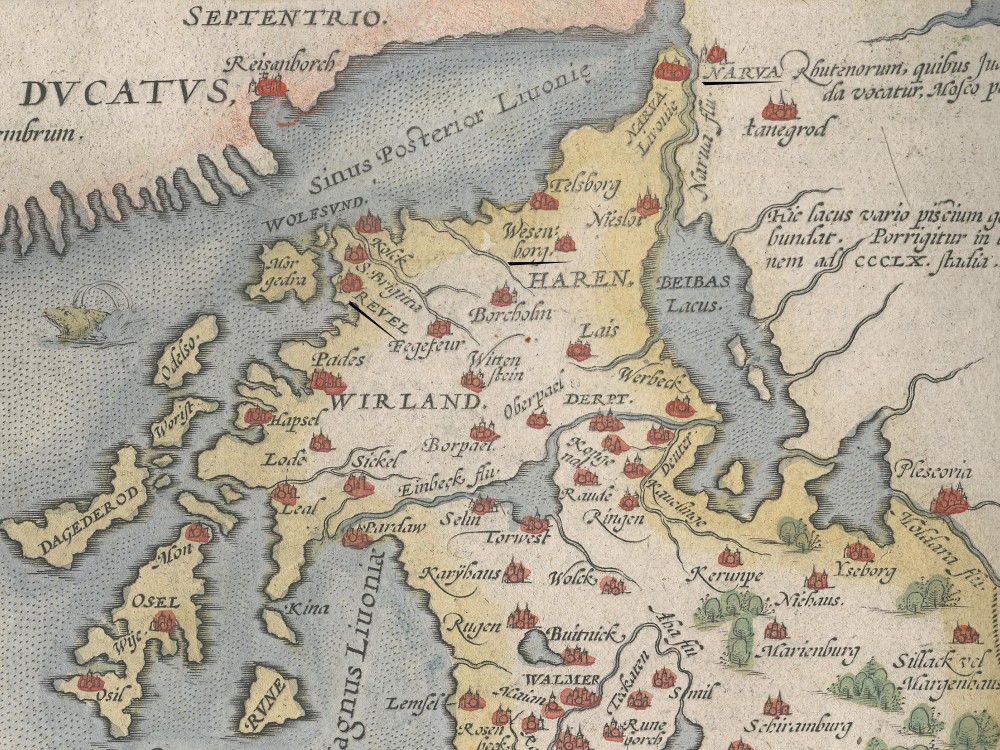
Map of Livonia with Reval, Wesenberg and Narva
Samuel Kiechel had met a Swedish messenger in Narva, who was willing to guide him to Reval (Tallinn) for a few coins. They left Narva on 23 August. Two miles from the city, they changed horses and then rode through the night. The advantage of travelling with a royal Swedish messenger was that peasants had to supply them with fresh horses, and Samuel Kiechel benefited from this. The peasants were presumably too timid to ask whether he was also a messenger. The two men continued the next day and night, changing horses five times.
At lunchtime on 25 August, they arrived at the castle of Wesenberg (Rakvere). The castle was large and halfway between Narva, Reval and Dorpat (Tartu), with all three places about fifteen miles away. Wesenberg was badly damaged and in disrepair from the recent war (Livonian War).
Kiechel’s companion went into the castle to report to the local commander, a Swedish nobleman, and to ask for two fresh horses. Our traveller waited in the small village outside. But the commander of Wesenberg was no peasant and demanded to know for whom the second horse was intended. The Swedish messenger told him that Kiechel was German, whereupon he was given a single fresh horse. The messenger took it and left without telling our traveller.
Outside the village, Samuel Kiechel waited, expecting his companion’s imminent return. Time dragged on, and it dawned on him that he had been left behind by the messenger. Kiechel wrote that he could not ask anyone for help, since the villagers spoke only the local language (Estonian, although Kiechel called it ‘undeutsch’), and the soldiers spoke only Swedish. He spoke neither language.
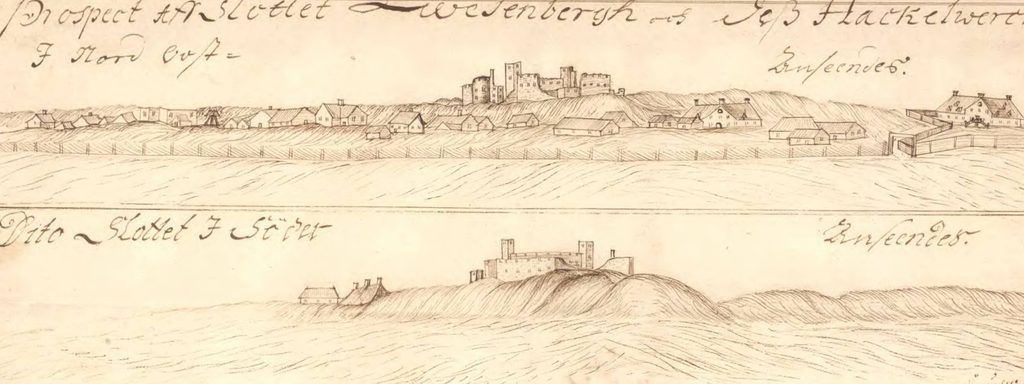
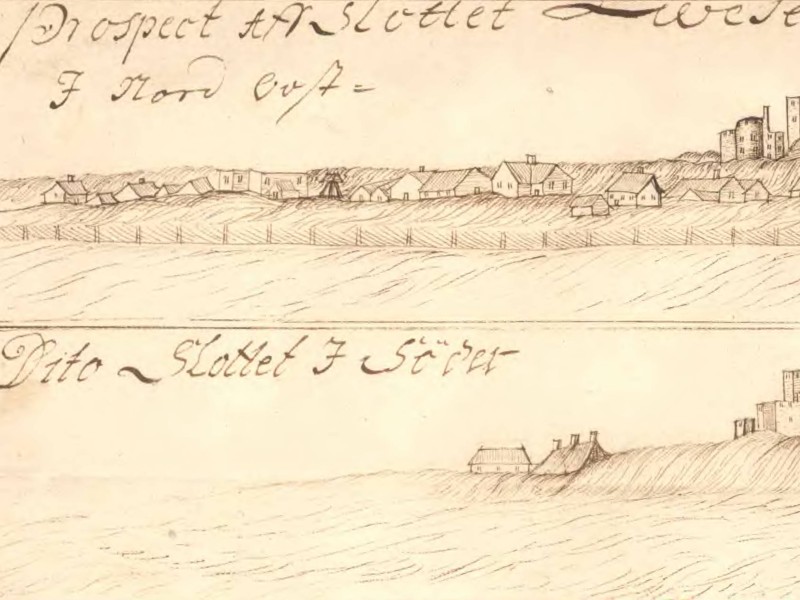
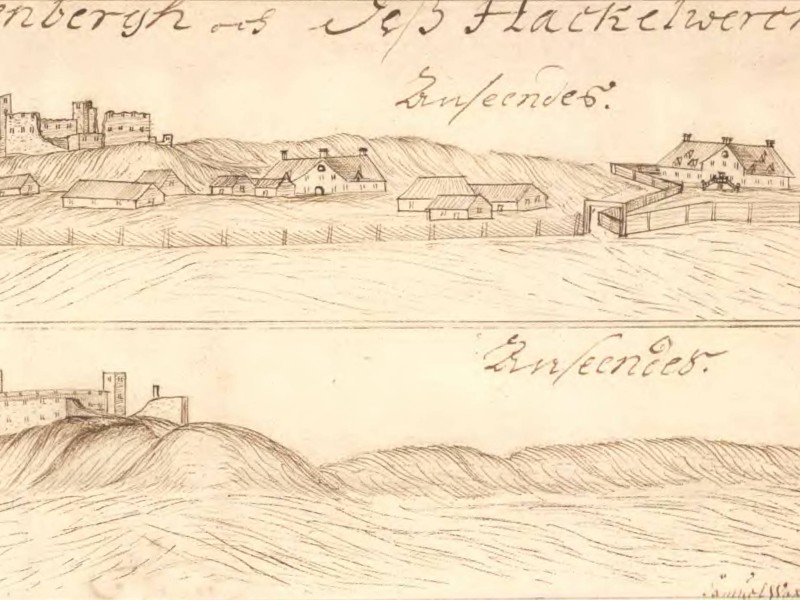
Eventually, Kiechel decided to enter the castle, seek out the commander, and ask for a horse so he could leave. When he was led before him, Samuel claimed he was a servant of a merchant from Lübeck who urgently expected him back, and offered to pay for the horse. The commander’s answer was harsh. He accused Kiechel of abusing the postal system, which was meant to supply only Royal messengers with horses. He said it was not his duty to help Kiechel or any merchants, but only those who travelled in the service of his Swedish Majesty. After more hard words, Samuel was just glad to be allowed to leave the castle.1
Suspicions and Superstitions
Samuel Kiechel walked back to the village below the castle and began looking for help. He found someone who spoke German, and together they walked around, trying to find a villager willing to lend him a horse. But he had no luck.
Wasting more and more time trying to find a way out of his predicament, Kiechel finally came to the house of a German gunsmith. The man invited him in and offered some food. Another guest was in the house: a Livonian nobleman. The nobleman listened to Kiechel’s dilemma and promised to take our traveller in his carriage to his estate, three miles away and roughly along the road to Reval. He also promised to find a way to help Kiechel continue his journey.
It was a lucky coincidence that Kiechel met the nobleman. Continuing on his own would have been difficult. Although he presumably knew which direction Reval lay, the city was still about a hundred kilometres away, a long walk on foot and more than enough time to get lost. He also did not speak the local language, making it hard to ask for directions. Nevertheless, despite this stroke of luck, Kiechel wrote that he was suspicious of the nobleman. He noted that since the war, many rabble and petty criminals had roamed the land. Apparently, the fear and mistrust that pervaded Livonian society after the long war had left its mark on him.2
But since the alternative was to be stuck in Wesenberg, Kiechel agreed, joined the nobleman in his carriage, and they set off. Along the road to the estate, Kiechel saw many cranes. He observed that they were often in groups of thirty to forty birds. They live in remote places close to forests with water and marshland. The cranes are difficult to hunt because one always keeps guard and warns the others.
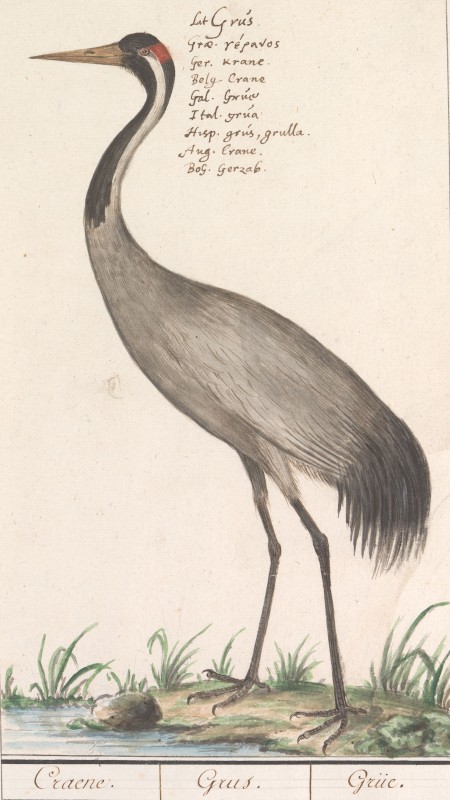
Drawing of a crane, ca. 1596-1610
Samuel Kiechel and his new companion drove for two hours until they arrived at the nobleman’s estate after nightfall. It was raining heavily, and Kiechel was soaked. The road had been deep and soggy. They arrived so late that everyone at the estate had gone to bed. Kiechel noted that the house had only a single bed. One of the nobleman’s friends had come to visit, and he was lying in it. When they arrived, he got up, put on his clothes, and went to a neighbouring room with some straw. Kiechel was given the same room, and they slept on the straw.
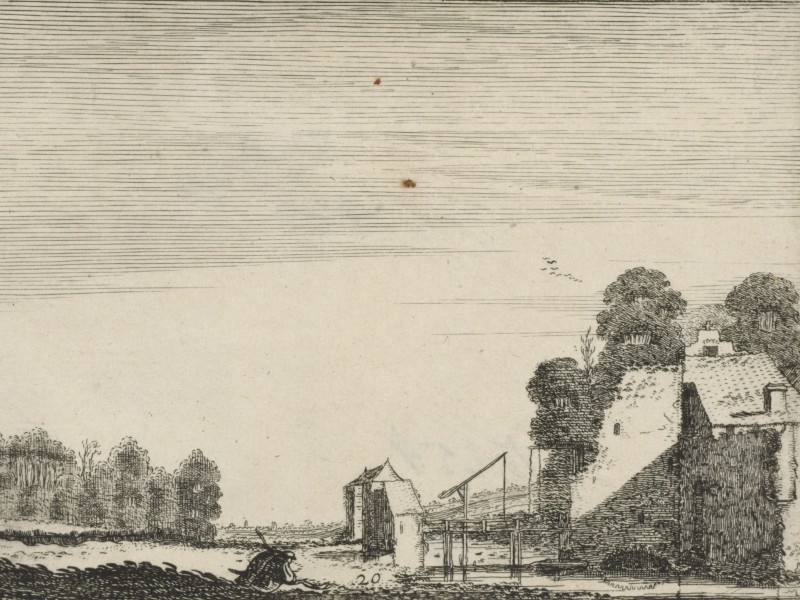
To explain the poor circumstances of this household, Kiechel wrote that the Livonian nobility had been very wealthy before the war. But the Muscovites had destroyed the villages, farmsteads and castles. No one wanted to rebuild them until a stable peace was agreed. Now the nobility were poor, and the land was deserted.
The Livonians were probably right to be reluctant. The Livonian War had ended in a truce between Sweden and Russia, and hostilities broke out again in 1590. They agreed to peace only in 1595.
The following morning, Samuel Kiechel heard that six of the noblemen’s sheep were taken by wolves during the night. A few days earlier, seven sheep had disappeared. The nobleman thought that the animals were stolen or led away by witches or warlocks, of which there were supposedly many in the land. Kiechel also learnt that some people looked like wolves. They were called werewolves and did a lot of damage.
The nobleman sent a boy to look for traces of blood. The boy returned with the head of a sheep and half of a lamb. He told the nobleman that he had seen many ravens circling a spot, had gone there, and had found the dead animals. Meanwhile, the people of the estate searched for holes in the fences where the sheep might have escaped, or a wolf might have got in, but found none. They concluded that werewolves had taken the animals.3
Tales about witches and werewolves were common in the sixteenth century. Witch trials took place across Europe, where people, especially women, were accused of witchcraft and heresy. In the heated religious atmosphere of the sixteenth century, with the Protestant Reformation challenging papal authority and the diverging strands of Christianity seeking to consolidate their legitimacy, the hunt for heretics and apostates was in full swing. It was the time of the Inquisition, and people generally accepted that witches, warlocks and werewolves existed and used magic to harm others. In any desolate region that had suffered a catastrophe, such as post-war Livonia, such superstitions spread especially quickly. Samuel Kiechel accepted the story that werewolves had taken the sheep, and it likely contributed to his worries.
The nobleman led Kiechel around his estate, showing him the fields, meadows and woods he claimed were his. The man’s name was Georg von Bergen. But Kiechel felt uneasy and would rather have continued his journey.
When they returned, a German steward arrived at the estate. He was travelling towards Reval and spoke the local language. He agreed to take Kiechel along, and after lunch they set out together. The nobleman gave Kiechel a horse to ride to the next hamlet.4
Stealing Horses
After an hour’s travel, they came to a farmstead. A saddled horse stood in front of the house, and its owner, a peasant, was about to ride out. Kiechel’s companion knew that Swedish messengers could requisition horses. He claimed Kiechel was a messenger in the service of the King of Sweden, on his way to Reval with important letters. He then took the peasant’s horse by force, told Samuel to mount it, and they rode away. If the peasant wanted the horse back, he would have to send someone after it.
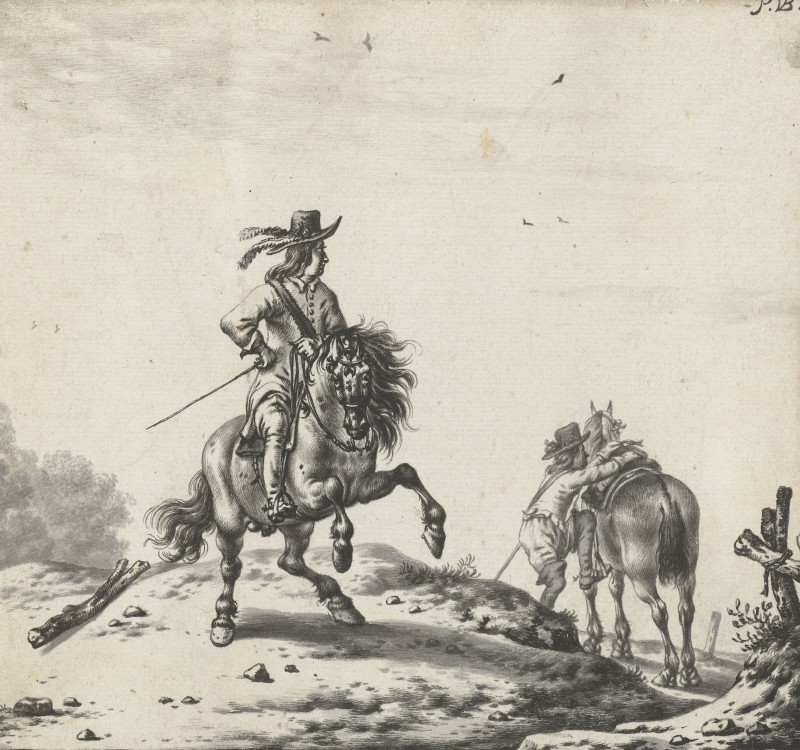
A mile further along the road, they came to a mill and tried the same trick again. But the miller stubbornly refused to give them one of his animals. Only when Kiechel’s companion drew his gun and pretended he wanted to strike the miller did the man relent and hand over a horse. Understandably, Samuel Kiechel was uneasy about this approach. But his companion assured him that he knew the local people and how to deal with them. They would not get anything by just asking nicely.
The two men rode for two miles until night fell, then arrived at a farmstead. They entered the house and called for its inhabitants, but no one answered. The house was empty, though a fire was burning in the fireplace. They went outside and called out, but no one responded. Outside the house was a meadow where some horses were grazing. Kiechel’s companion caught one of the horses and put his saddle on it. He left the miller’s horse there.
When the two men were about to ride off, the owner of the farm appeared. He asked what they were doing with his animals. But Kiechel’s companion told the same story, that Samuel was a Swedish messenger and had to hurry on. The man believed it and did not complain. However, Kiechel wrote that he grew increasingly worried that someone might raise an alarm and accuse them of stealing horses. He worried that, in such a case, it would not end well for them, and he was probably right.
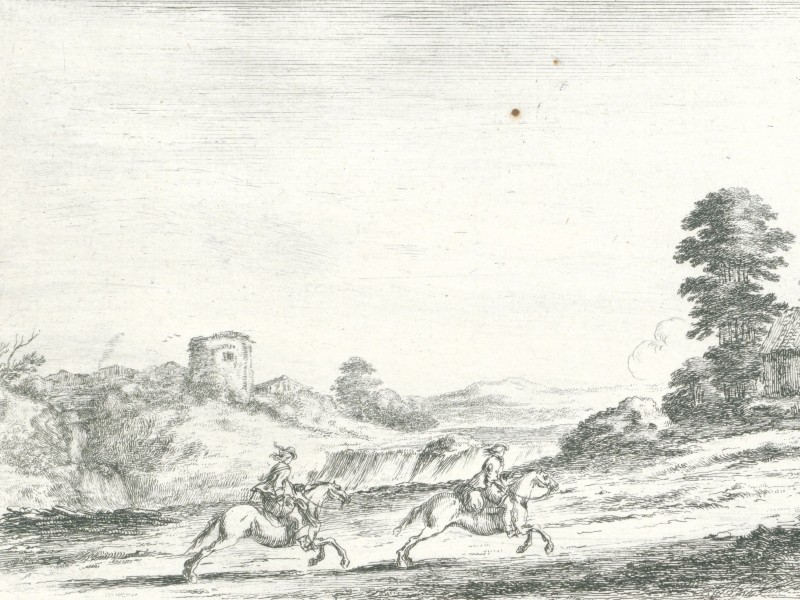
It was after midnight when the travellers arrived at a hamlet seven miles from the nobleman’s estate. They let the horses graze but tied their front legs together so they would not escape during the night. They then settled on a bench in front of a peasant’s house. Kiechel’s companion told him he was from Speyer, had lived in Livonia for many years, and had served as a mercenary.
The following morning (26 August), the two men went to collect their horses but could not find them. Eventually, Kiechel’s companion found his horse, but the other was gone. Kiechel mused that the owner might have come during the night and taken it back. He never saw the animal again.
Samuel Kiechel and his companions were now only five miles from Reval. Unfortunately, the peasants in the villages along the road did not fall for the ruse of posing as messengers and refused to provide them with a fresh horse. Eventually, Kiechel managed to acquire a new one, but only after agreeing to pay for it.
They rode on towards Reval and met a diplomatic delegation from the King of Sweden. Kiechel learnt that the Muscovites and the Swedes had planned a meeting to negotiate peace. The meeting was to take place in a field half an hour from Narva. Both sides would pitch their tents, but they did not trust each other.
The Swedish delegation stopped the travellers and asked where they had come from. Kiechel considered that if he had still been on one of the horses they had taken the previous day, and if one of the peasants had been there, he would have been in deep trouble. Fortunately, this was not the case, and the two travellers were allowed to continue.
In a village a short distance from Reval, the two men had lunch before going their separate ways. Kiechel paid for the meal because his companion refused any recompense for helping him. The man rode on to Pärnu, a town in Livonia, while Kiechel entered Reval. He wrote that he felt a great relief when he arrived in the city.5
Fear and Mistrust in Livonia
This long account of the journey from Narva to Reval highlights, more than any other part of Kiechel’s journey through post-war Livonia, the growing unease, and I would say fear, that the traveller experienced. The atmosphere in the province was tense, and outside the cities, suspicion, lack of authority and arbitrary threats of violence prevailed. While this largely resulted from the Livonian War, its roots were already present in the province’s society since the Middle Ages.
Since the German conquest and settlement of Livonia in the thirteenth century, the province has been divided along cultural and ethnic lines that shaped wealth and political power. The upper class of Livonian society consisted largely of Germans, who also made up much of the middle class. Most were merchants or professional craftsmen. The Latvians and Estonians, as well as Swedes and Finns, formed the lower class and the peasantry. This division was not rigid, and many Germans also worked as servants, day labourers, and in similar roles, just as Latvians and Estonians were found among the craftsmen. But this broad characterisation of Livonian society persisted well into the early modern period. Within this fractured society, Latvians and Estonians were increasingly disadvantaged. They had no access to certain professions and were not allowed to work as merchants. Although similar restrictions on access to trades were also common in Western Europe to keep supply, prices and quality stable, ethnicity played a major role in who was excluded in Livonia. Most native Livonians therefore lived in the country as peasants on German-owned estates.6
Divisions within Livonia’s already fractured social fabric deepened during the Livonian War. For the Germans, the Muscovites were the main enemy. The Muscovites also viewed the war as primarily against the German Livonians. Initially, they sought to exploit divisions in the province by distinguishing between Germans and the Latvians and Estonians in the captured cities. The Germans, meanwhile, viewed their Latvian and Estonian countrymen with suspicion, and many claims and accusations of collaboration with the Muscovites circulated. These accusations were not unwarranted, and Livonian peasants helped the Muscovites because they had little sympathy for their German elite. But sources also mention native Livonians attacking small contingents of Muscovites. The German elite used accusations of Estonians’ and Latvians’ unreliability as convenient excuses for the quick surrender of cities like Dorpat.7
In rural Livonia, conditions were even more difficult. The peasantry was caught between the war’s factions and suffered most at the hands of armies on all sides. They lacked the power to resist. Refusing to cooperate with the invaders had drastic consequences, and if they collaborated, peasants faced retribution from their rulers.8
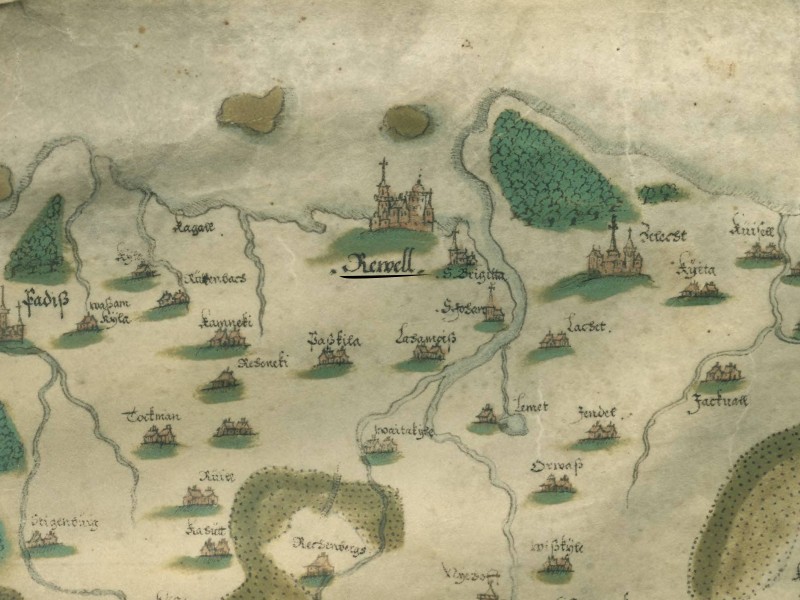
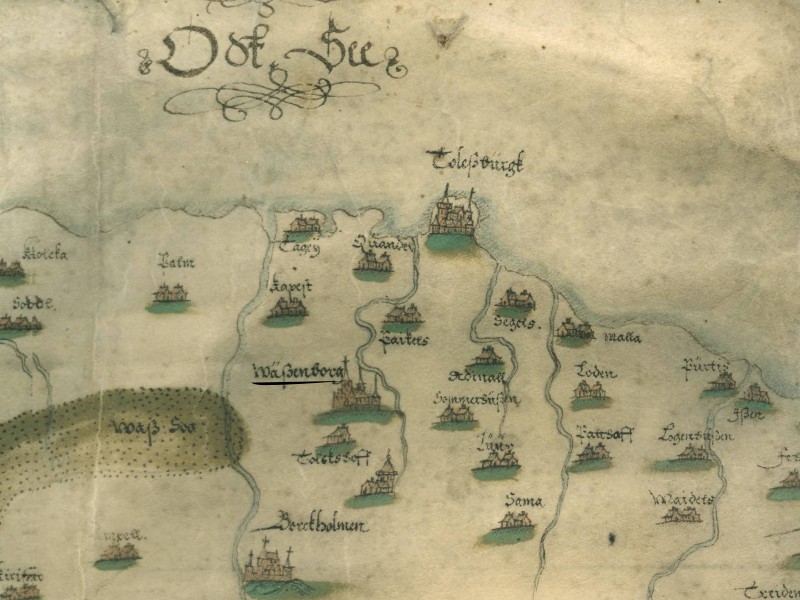
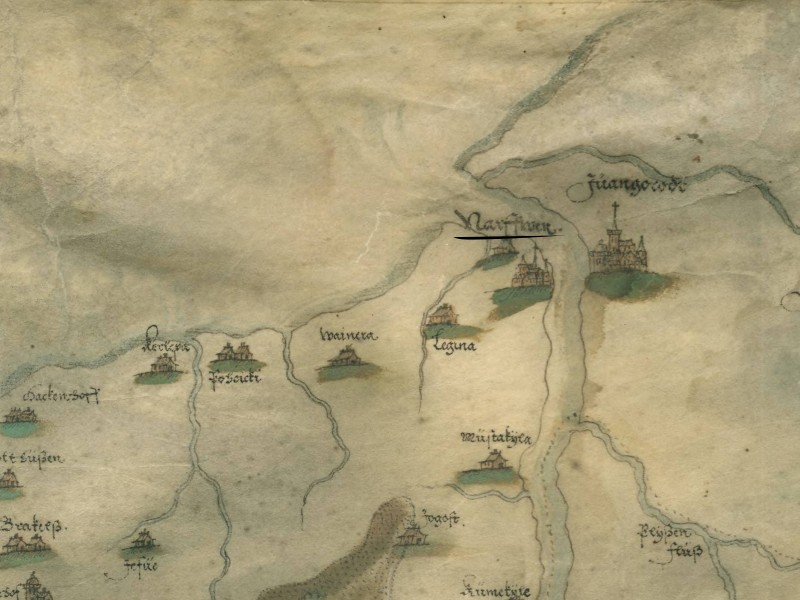
Swedish map of northern Livonia with Reval (Rewell), Wesenberg (Wäßenborg) and Narva (Narffwen), ca. 1600-1649
The end of the Livonian War left the province in a perilous state. Destruction and desolation were everywhere, as Kiechel frequently noted. Livonia’s old ruling powers had either disappeared, such as the Teutonic Order and the Bishopric of Dorpat, or had lost influence, such as the landed nobility and the cities. The land was now divided between the northern Swedish part and southern Livonia under the Polish-Lithuanian Commonwealth. The Germans remained the upper class in the province but now had to contend with Swedish, Polish and Lithuanian nobles, governors and administrators in positions of power. Recriminations and mistrust between the various groups were rife in Livonia.
The new rulers, the Swedes and Poles, had yet to establish their full authority across the province and were largely focused on cities and strongholds such as Wesenberg. In the province’s rural areas, safety and justice remained rare commodities. Samuel Kiechel’s journey from Narva to Reval in particular leaves a clear impression of the situation in the province and its impact on the population.
For Samuel Kiechel, who had no personal connections in Livonia and knew little about it, being left by the Swedish messenger in a village in the countryside must have been disconcerting and even frightening. From what he had seen and heard during his time in Livonia, he was apparently suspicious even of other Germans. Throughout the journal, Samuel occasionally voiced suspicions and misgivings about people he met or companions he had. But this never happened without a clear reason, especially towards fellow countrymen whom Kiechel considered social equals. His experiences in Livonia must have affected him deeply.
Beyond earlier experiences on the route between Riga and Narva, Kiechel’s stay on the estate, and especially his companion’s behaviour, deepened his worries. On the road to Reval, the two men were clearly stealing horses, and apparently no authority in the land could stop them. The ease with which Kiechel’s companion threatened violence shows that the man, familiar with the country, knew that repercussions were unlikely. But his repeated claim that Kiechel was a royal messenger may nevertheless have been a precaution. If they were caught, the peasants would point to our traveller as the one who had impersonated a messenger. Yet Samuel Kiechel depended on the man and, given the circumstances, would not have reached Reval without him.
Even so, in summary of this episode, Samuel Kiechel wrote of his heartfelt relief and astonishment at reaching Reval safely. It was presumably also the relief of now being able to leave Livonia by ship, rather than risk another overland journey.9
Illustrations & References
All images are in order of appearance with links to sources on external websites:
- Anonymous, Östersjöprovinserna. Wesenberg (Rakvere). Prospect Aff Slottet Wesenbergh och dess Hackelwerck, 1683; Riksarkivet Stockholm.
- de Boodt, Anselmus Boëtius, Craene. / Grus. / Grue, 1596 – 1610; Rijksmuseum Amsterdam.
- van de Velde, Jan, Ruïne van een huis met een houten brug in een landschap, 1616; Rijksmuseum Amsterdam.
- Verbeeck, Pieter Cornelisz., Twee ruiters, 1620 – 1654; Rijksmuseum Amsterdam.
- della Bella, Stefano, Twee galopperende ruiters in een landschap, 1620 – 1664; Rijksmuseum Amsterdam.
- Anonymous, Karta över Estland och Lifland. 1600-talets förra hälvt., 1600-1649; Riksarkivet Stockholm.
- Die Reisen des Samuel Kiechel aus drei Handschriften, K. D. Haszler (ed.), Stuttgart 1866, pp. 124f; Bayerische Staatsbibliothek. ↩︎
- Ibid., pp. 125f. ↩︎
- Ibid., pp. 126f. ↩︎
- Ibid., p. 127. ↩︎
- Ibid., pp. 127-129. ↩︎
- Angermann, Norbert, Brüggemann, Karsten, Geschichte der Baltischen Länder, Ditzingen, 2018, pp. 48-59. ↩︎
- Frost, Robert I., The Northern Wars. War, State, and Society in Northeastern Europe, 1558 – 1721, Harlow 2000, p. 77f. ↩︎
- ibid., pp. 78f. ↩︎
- Reisen des Samuel Kiechel, p. 129. ↩︎