
Journal of Samuel Kiechel
15 – 19 October 1586
In Breslau
“On the 18th, my companions and I were shown the armoury by Bartholomäus Ebn, a citizen of Breslau. This happened against my wishes because it [the armoury] was in two separate houses, some distance apart. We saw many guns mounted on wheels, arquebusses, armour, pikes, swords, and other armaments used in warfare.”
Die Reisen des Samuel Kiechel aus drei Handschriften, K. D. Haszler (ed.), Stuttgart 1866, p. 137f; Bayerische Staatsbibliothek.
At the Gate
Samuel Kiechel and his companions had arrived in Breslau (Wrocław)1. As a sign of the difficulties ahead, guards stopped them at the gate and questioned them for a long time. The issue was the plague that had broken out in parts of Poland, such as Posen (Poznań), which the travellers had just visited. The guards wanted to know where Kiechel and his companions had come from. The travellers denied having been in Posen, but the guards did not believe them. Kiechel wrote that they had acquired a passport from Danzig (Gdańsk), which they now presented, but it did not help much either. After long arguments, only a “Trinkgeld” could persuade the guards to let them enter the city.2
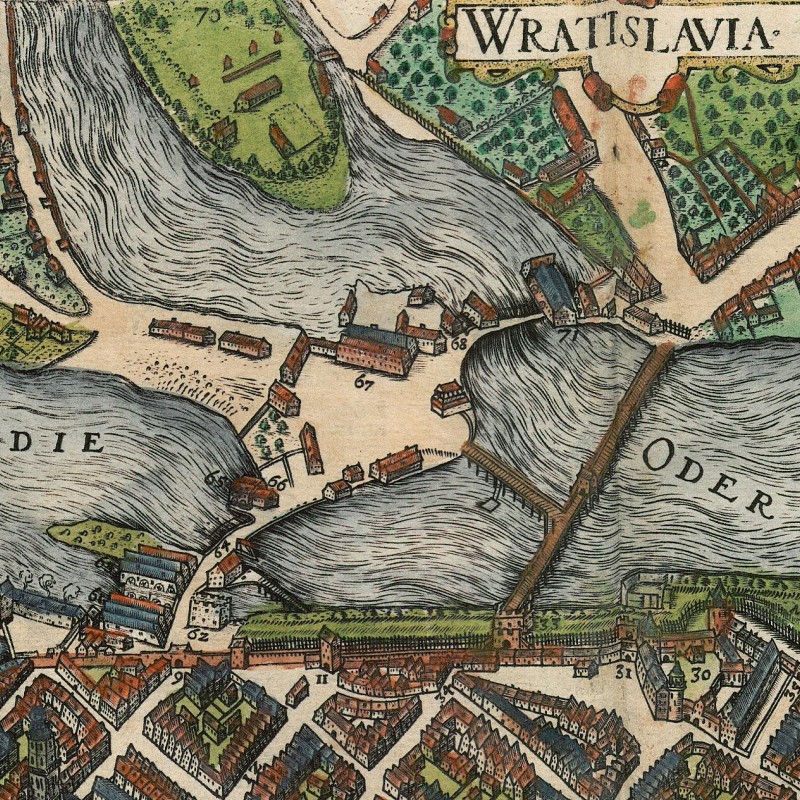
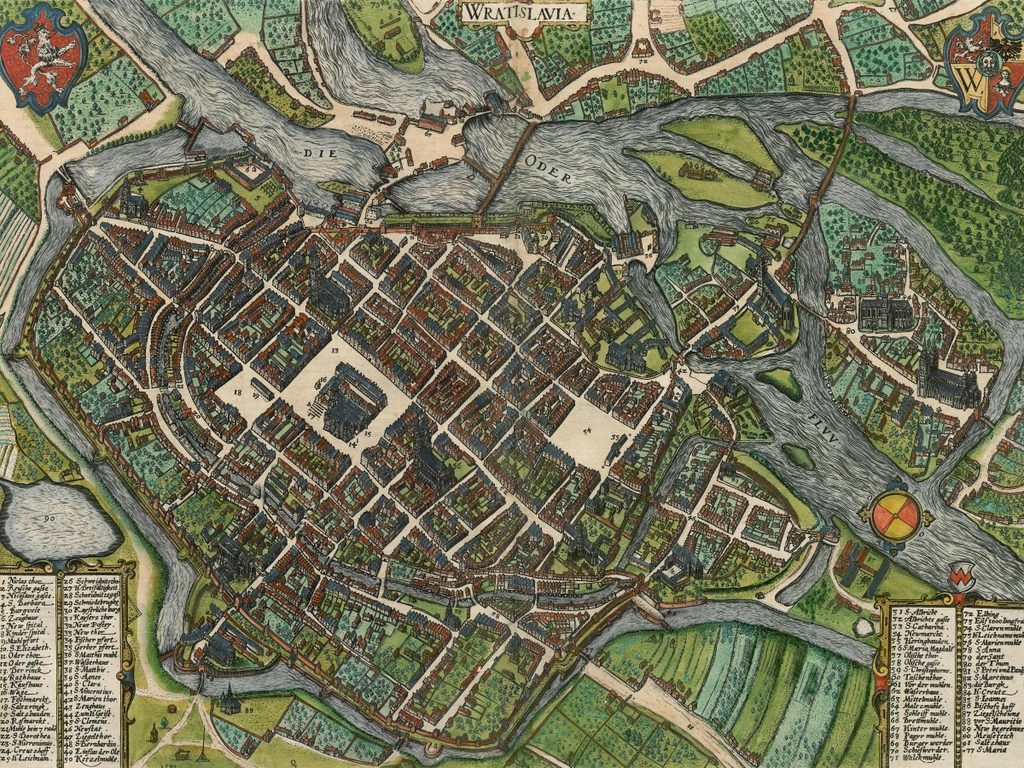
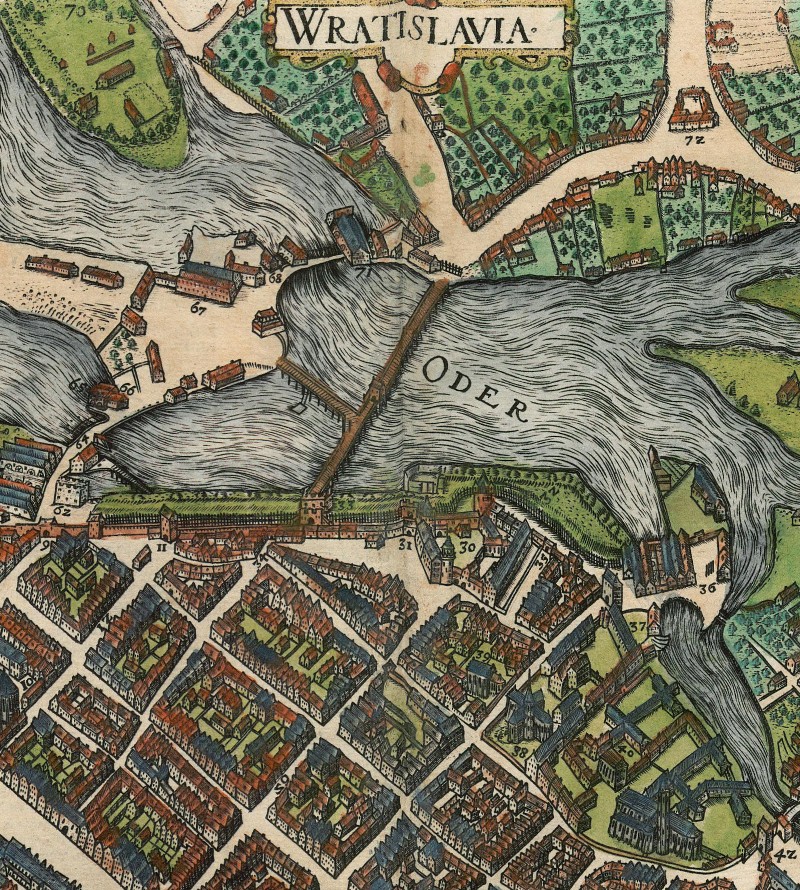
Samuel Kiechel approached Breslau from the north and had to cross the Oder River. He could have entered the city through Mill Gate (9) or New Gate (33). The buildings along the river (63-68 and 71) are water-powered mills.
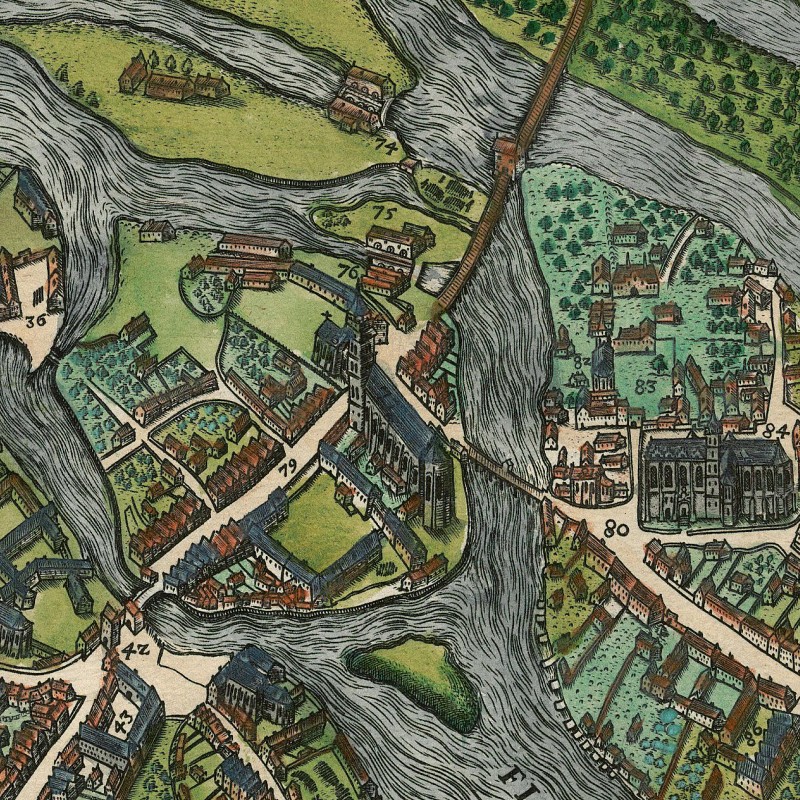
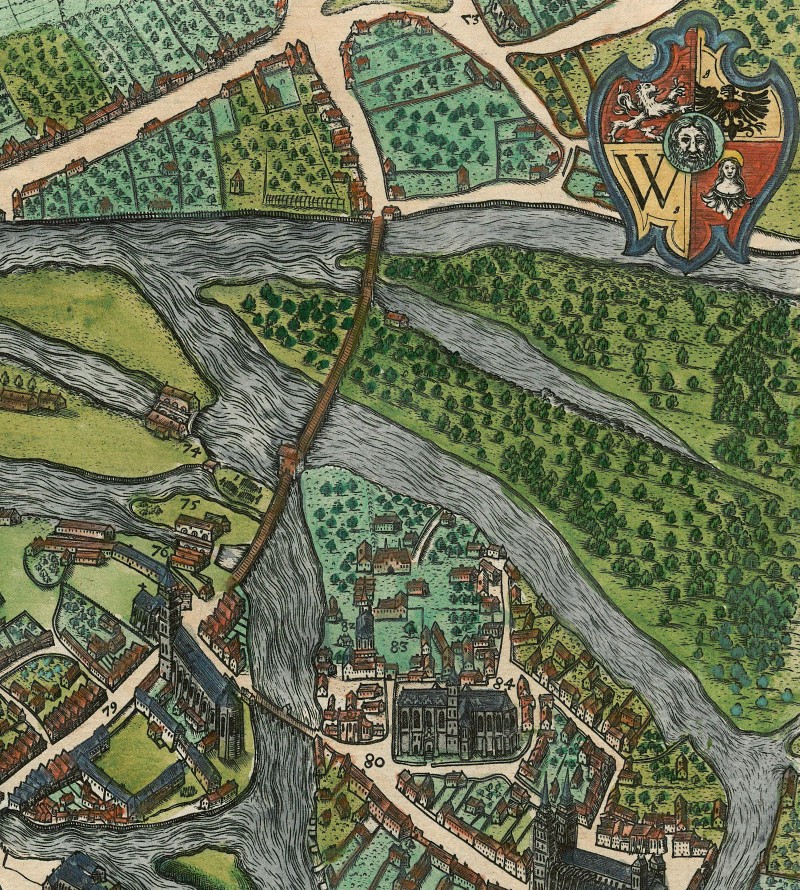
Alternatively, he could have entered the city from the east. A road ran across the small Sand Island, past three mills (74-76) and the Church of St Mary (77), to the St Mary Gate (42). On the island to the right stands Breslau Cathedral (80).
One effect of the plague outbreak in the region was that foreigners and travellers were viewed with suspicion. Did the new arrivals come from a city where the disease was already rampant? Apparently, news of the plague in Posen had spread quickly. Kiechel wrote that villages along the road were being blocked off. This may have been a local measure to keep potential plague carriers out.
At the city gates, both travellers and local guards faced a major problem. How could a traveller prove he hadn’t visited a place suffering from the plague? How could a guard know whether this traveller was telling the truth? Documentation in the sixteenth century was minimal and easily manipulated, so it was not necessarily accepted. The guards at the gate of Breslau apparently disregarded the traveller’s passport from Danzig.
In the end, the time-honoured method for dispelling doubt was applied to the guards. As mentioned before, Kiechel used the term “Trinkgeld” for a tip or gratuity for services rendered, or, as in this case, as a bribe.
In the City
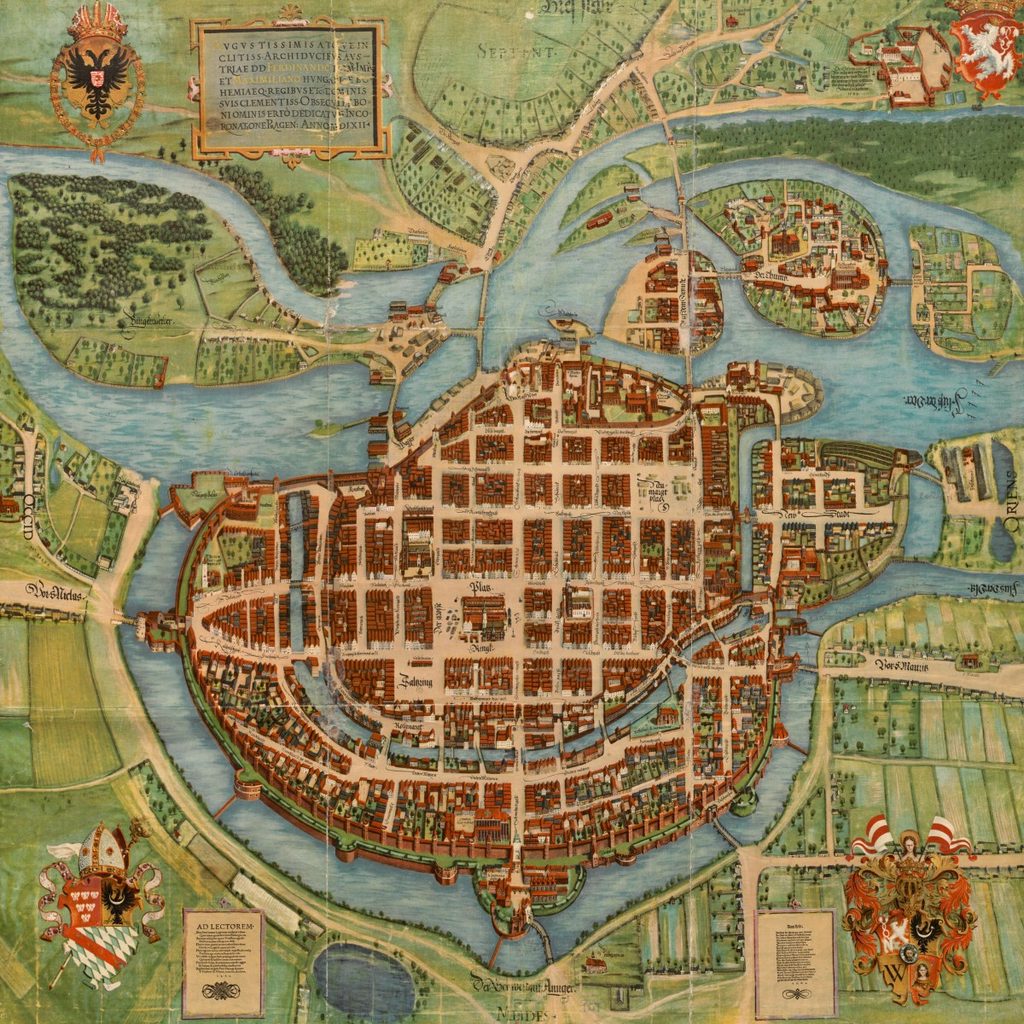
Breslau, 1562
Samuel Kiechel wrote that Breslau is a large, pleasant, well-built and fortified city. It is the capital of Silesia, and the Emperor is its guardian. The city has an exquisite, large market square, surrounded by tall, well-built stone houses. Our traveller had not seen anything comparable elsewhere in Germany. The city also has many other fine buildings, and its streets are wide and long.
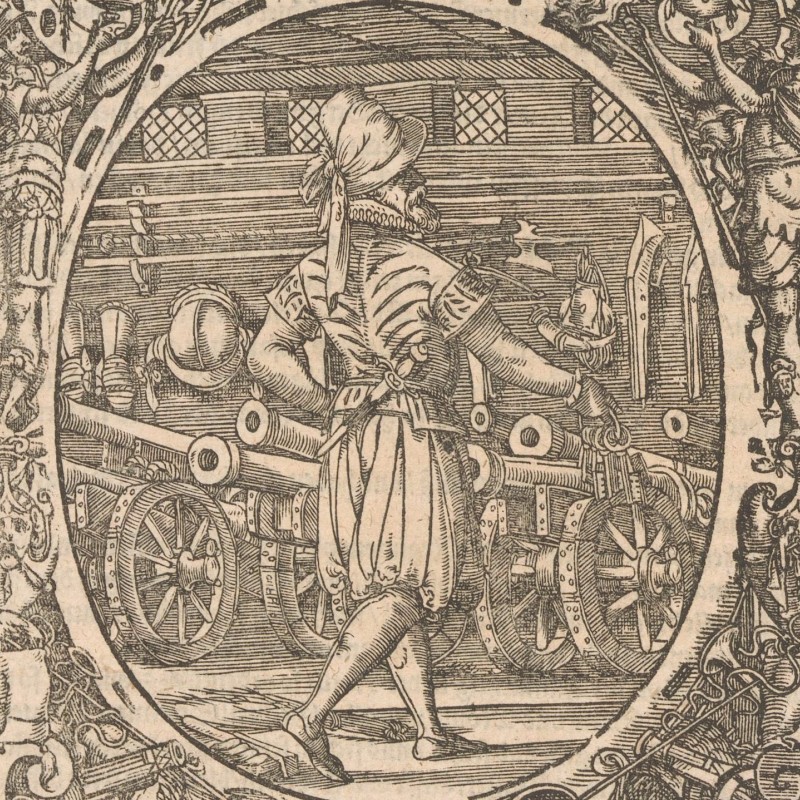
On 18 October, Bartholomäus Ebn, a citizen of Breslau, showed the travellers the city’s armoury. Kiechel noted that he did so against his will. The armoury consisted of two houses, some distance apart. It is fair to assume Kiechel opposed it because of the injury he had sustained just a few days earlier. The cart of Kiechel’s companion had rolled over his leg, leaving our traveller in pain and unable to walk. While he never mentioned any long-lasting issues from the accident, he must still have had difficulty walking so soon after the incident.
In the armoury, the travellers were shown many large guns mounted on wheels, arquebuses, armour, pikes, swords, and other items used in war. Their guide told them that both houses of the armoury had only been established in the last ten or twelve years. The Emperor did not want the city to have weapons and armour. But because of the city’s proximity to the border with the Kingdom of Poland, Breslau’s citizens asked to be allowed to arm themselves. The Emperor graciously granted their wish.
Kiechel and his companions continued their tour, and by the time they had visited both armouries, it was already afternoon. Kiechel noted that the city also had large granaries.
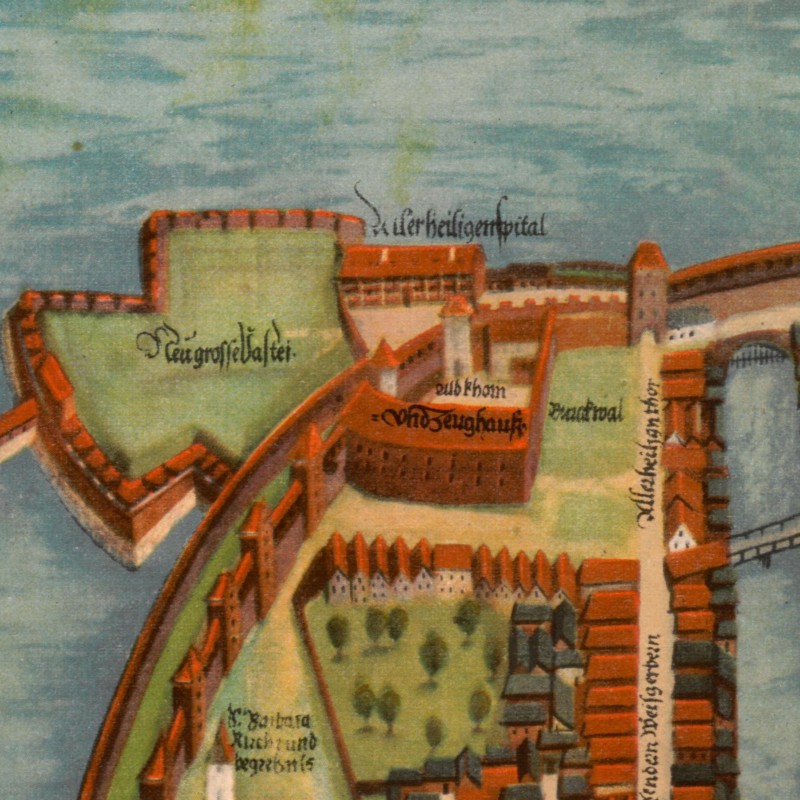
One of the two armouries of Breslau (“Zeughausz”)
Samuel also wrote that Breslau was a bishopric and had a cathedral. He was somewhat astonished to find that it was still inhabited by clerics. The local beer was called “Scheps” and was strong. If someone drank too much, he would be drunker than on wine.3
About Breslau
Like Posen (Poznań), Breslau is one of Poland’s oldest and most culturally significant cities. First mentioned in the tenth century, it was part of the domain of Mieszko I, the first known Polish ruler. In 1000, the Bishopric of Breslau was established. The current cathedral was built in the thirteenth and fourteenth centuries. Like Posen, Breslau saw an influx of German settlers in the thirteenth century, driving the city’s expansion and economic growth.
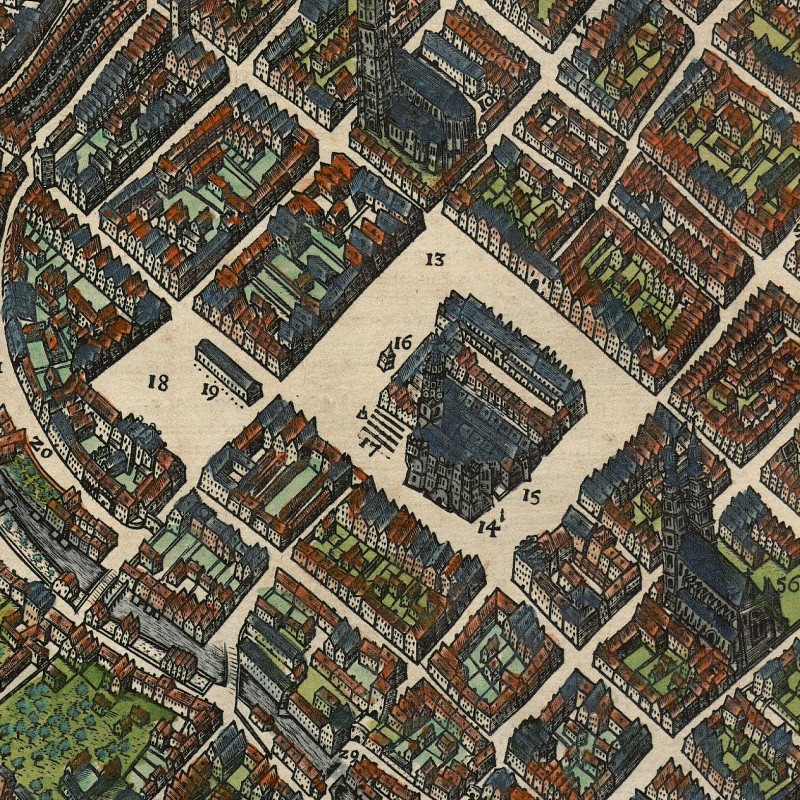
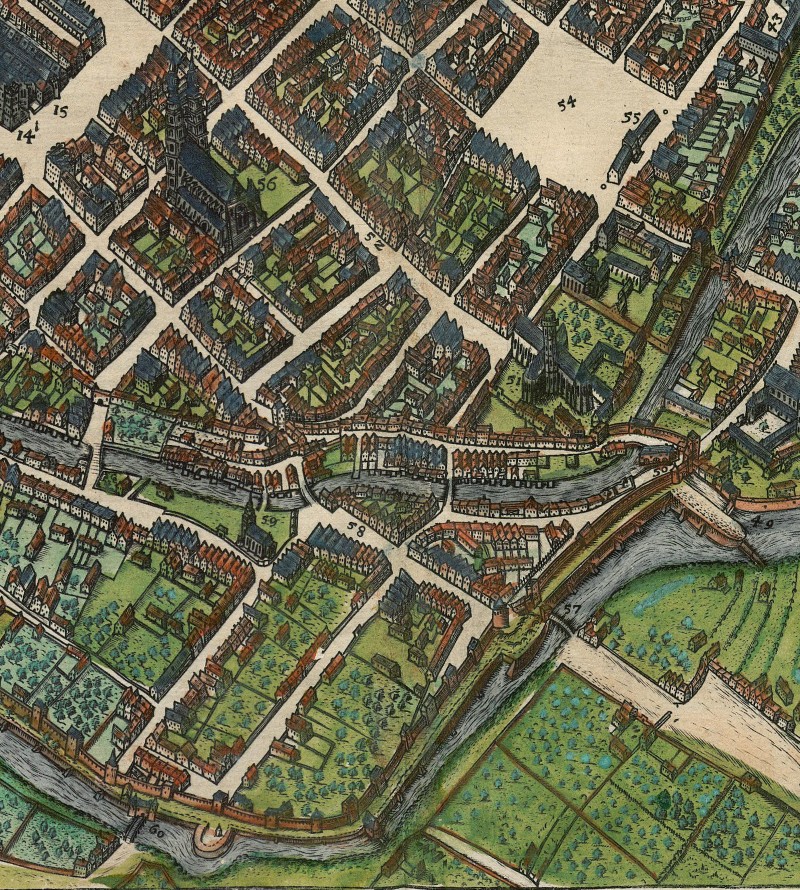
The Market Square of Breslau (13), the Fish Market (17), and the Salt Market (18), with the town hall (14), the weighing house (16), and the warehouse (15).
Unlike Posen, Breslau was no longer part of the Kingdom of Poland when Samuel Kiechel visited. As our traveller noted, the city was the capital of the province of Silesia. Silesia had been a contested territory between Poland and Bohemia since Mieszko I conquered part of it in the tenth century. In 1335, the province came under the rule of the King of Bohemia (Treaty of Trenčín, 1335). The treaty was a trade-off: the Polish King Casimir III (1310-1370) gave up Silesia, and in return King John of Bohemia (also John of Luxembourg, 1296-1346) and his son Charles (1316-1378), the future Holy Roman Emperor, relinquished all claims to the Polish crown which they had inherited from the extinct Bohemian Přemyslid Dynasty.
In 1526, Silesia and Breslau became part of the Habsburg Empire when Louis II of Bohemia and Hungary (1506-1526) died in the Battle of Mohács against the Ottoman Empire. Louis and his sister were married to Mary and Ferdinand of Habsburg. Ferdinand (1503-1564), later Emperor Ferdinand I, inherited Louis’ titles and territories.
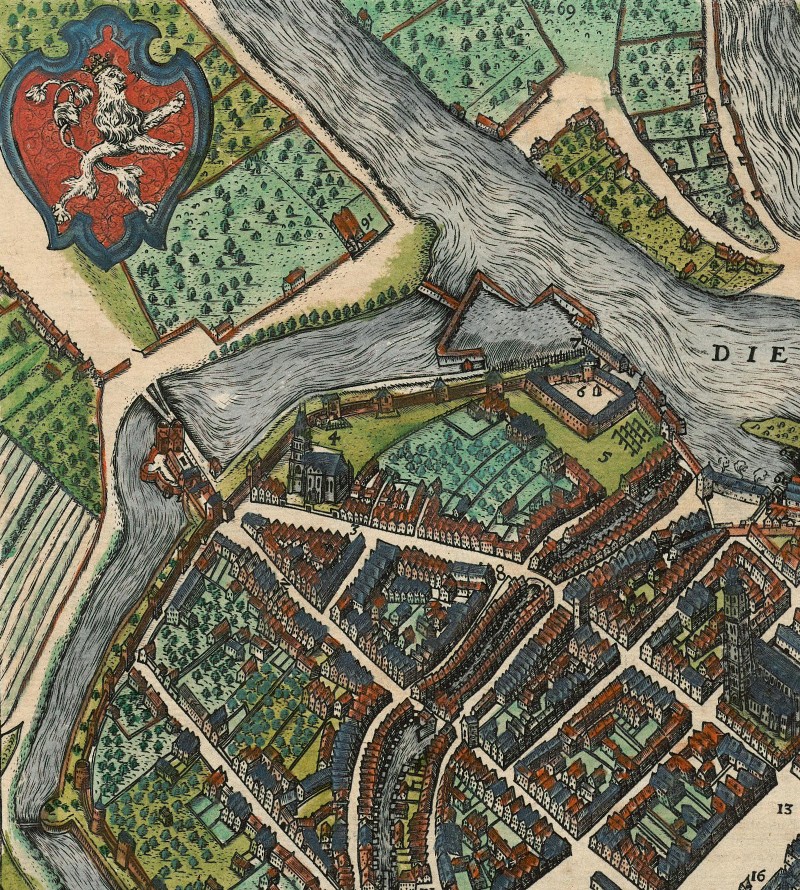
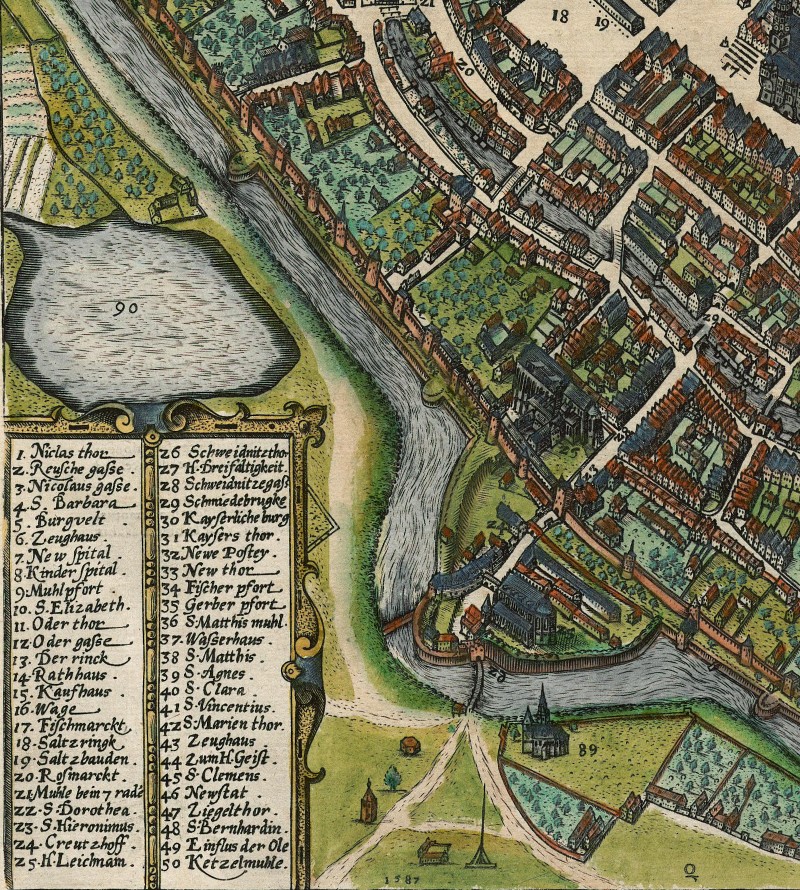
At the time of Samuel Kiechel’s visit, Breslau was large, powerful and economically prosperous. Two bird’s-eye views from the late sixteenth century depict it as an impressive city. The first view, originally dated 1562, survives only as a copy (seen above). The second image appears in volume four of the Civitates Orbis Terrarum and was first published in 1588.
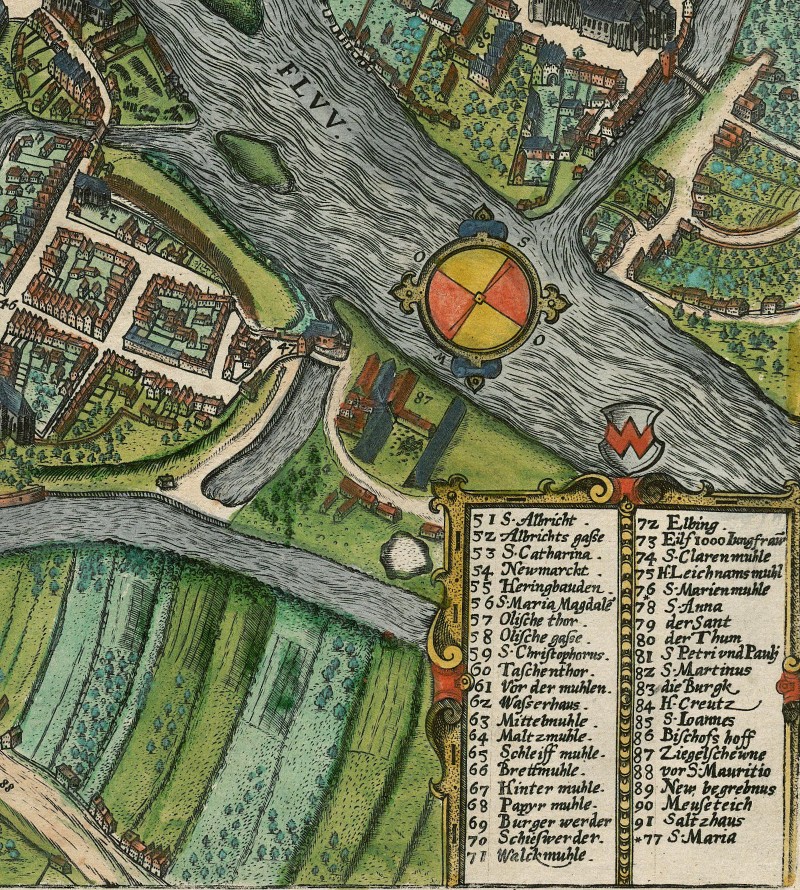
Breslau, 1588
Both views are quite similar. They show Breslau from the south. To the north lies the Oder River, and a wide moat surrounds the city, with a broad canal running through it. The city appears densely populated, with many houses along straight, wide streets. The two views are impressively detailed and include the names of many municipal buildings and churches. Like Posen, Breslau’s cathedral stands on an island in the river. In the view, it appears in the upper right corner.
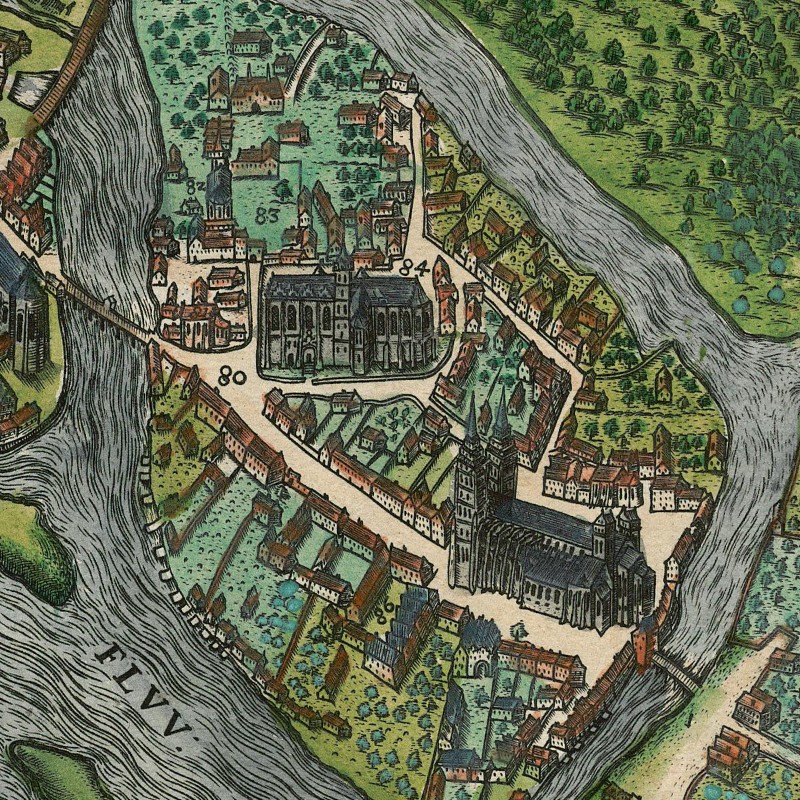
Breslau Cathedral on an island in the Oder River
Kiechel mentioned the cathedral and expressed astonishment that Catholic clergy still inhabited or used it. Breslau was both a Protestant city and a Catholic bishopric. The Protestant Reformation arrived in 1518 and quickly gained many converts. In 1523, it was officially introduced in Breslau and became the dominant confession. Compared with many other cities, the transition was relatively peaceful, without the destruction of Catholic church icons and decorations. The monastic orders were expelled from the city, but their property was not sacked; instead, it was repurposed.
The Bishops of Breslau sought support from the staunchly Catholic Habsburg rulers to push back and re-establish Catholicism. But facing strong, unified Protestant opposition in the city and, because of Silesia’s fragmented nature, lacking rural strongholds, their efforts remained half-hearted and inconsequential. The Habsburg Emperors were also too distracted by threats from the Ottoman Empire to become involved in Silesia. As a consequence, Breslau remained Protestant, but no one attempted to disband the bishopric or bar the bishop from the city, as had happened in Livonia and elsewhere.
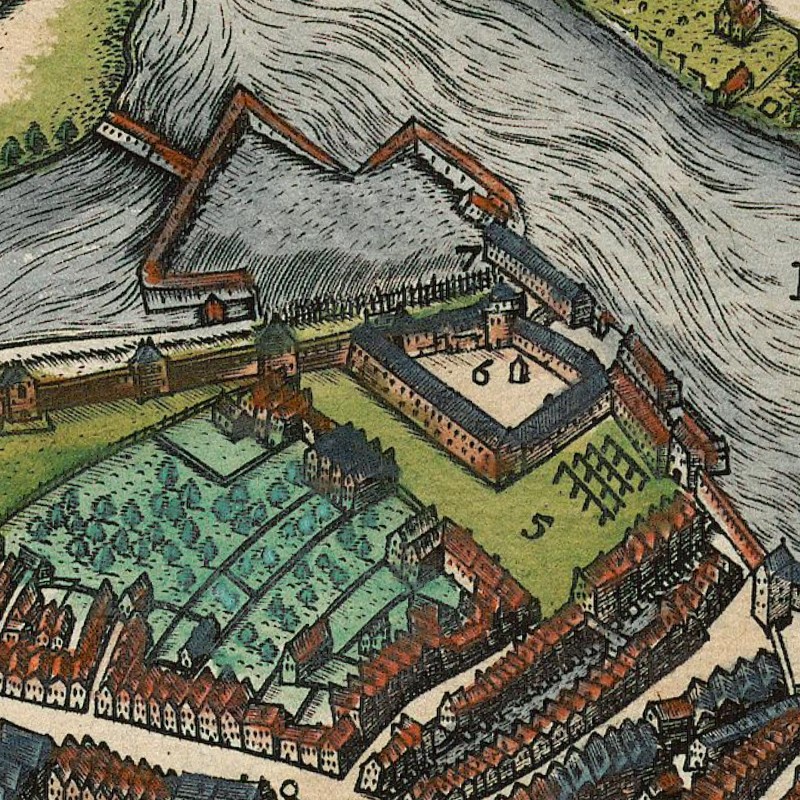
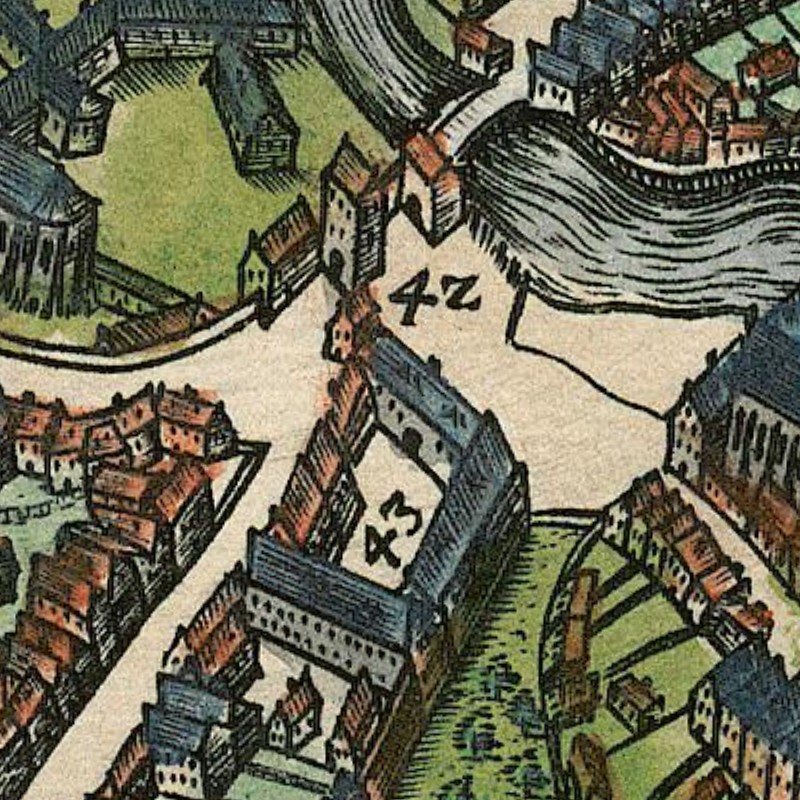
The two armouries of Breslau that Samuel Kiechel visited (6 and 43)
Samuel Kiechel also noted that he visited Breslau’s armoury. He complained that he did not want to visit them because they were in two separate houses, some distance apart. In both views, one armoury (“Zeughaus”) sits in the northwestern corner of the city, where the moat meets the Oder River. The other armoury is in the northeast, by St Mary Gate at the foot of the bridge across the Oder River. The armoury in the northwestern corner consisted of a complex of buildings, some of which still stand today. The first was built in the late fourteenth century and initially served as a granary in case of a siege. Additional buildings were added in the sixteenth century to house a forge and a gunsmith’s workshop. During this period, the city moved its weaponry and armour from the town hall cellar, where they had originally been stored, into the armoury. This relocation was probably what Kiechel meant when he wrote that the armoury was newly established.
As a final note, the beer Samuel Kiechel mentioned (“scheps”) was called Schöps and appears to denote a specific type of wheat beer brewed in the city in the early modern period.
Changing Plans
Kiechel stayed in Breslau for five days, seeking an opportunity to travel to Krakau (Kraków). But he could not find companions. Neither the Dutchman he had met in Danzig nor Hans Haas wanted to go there. However, Haas told Kiechel that if he went to Venice instead, he would join him.
Unable to visit Krakau, Kiechel considered the offer and decided to change his plans. The three men agreed to travel to Vienna together. In preparation, the Dutchman bought one of Hans Haas’ horses, and Haas kept the other. Kiechel stayed in the carriage. He wrote that he wanted nothing to do with the horses. Presumably, his leg would also have made riding difficult. The group hired a new coachman to guide them to Vienna and sent the old one back to Posen.
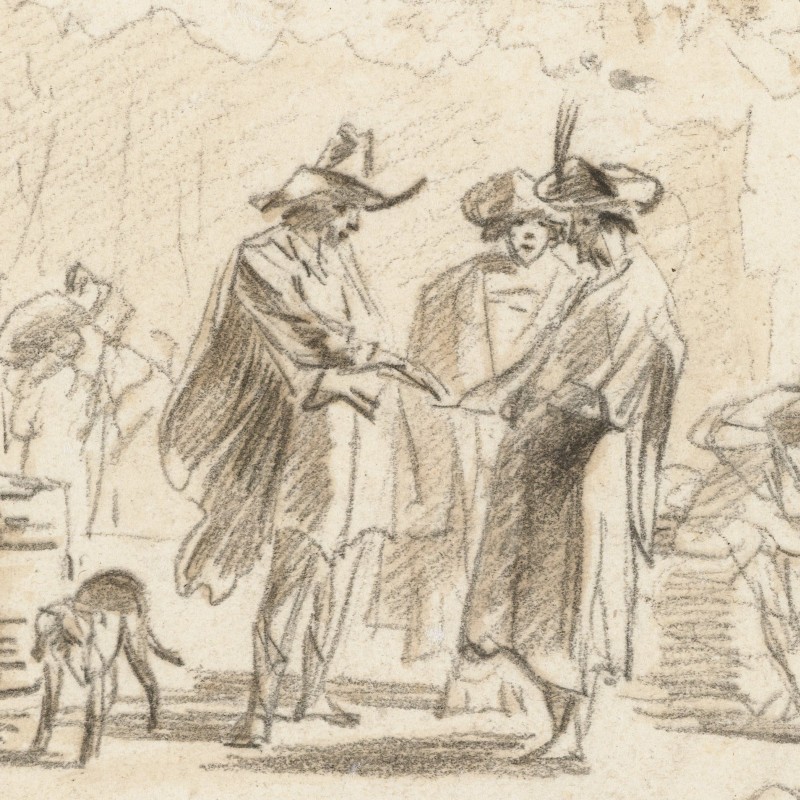
Kiechel noted that when they left Posen a few days earlier, Hans Haas had no intention of travelling beyond Breslau. It would turn out to be a long journey. This was a brief retrospective aside by our traveller. Hans Haas would be Kiechel’s longest-lasting companion, and they would travel together through Italy to Sicily and Malta, then back to Naples, where they would finally go their separate ways.
Unfortunately, Samuel provided no further information about his long-time companion beyond the fact that Haas was from Nuremberg. The name is quite common, and so far I have been unable to find out anything about him.
The travellers left Breslau on 19 October. In an episode similar to their departure from Posen, they were about to board the carriage when the two horses were startled and bolted. The new coachman, not yet accustomed to the animals’ temper, could not stop them. The horses ran until the carriage hit a kerb and became stuck.
They decided to walk out of the city before getting back into the carriage. The coachman sat on one of the horses to keep them in check.4
Illustrations & References
All images are in order of appearance with links to sources on external websites:
- Breslau, in: Braun/Hogenberg, Civitates Orbis Terrarum (4), Cologne 1594, fol. 42v; Heidelberg University.
- Weiner, Barthel, Contrafactur der Stadt Breslau, 1562 (copy from 1929); University Wrocław Digital Library.
- Amman, Jost, Commandant in het arsenaal, 1573; Rijksmuseum Amsterdam.
- Breslau, in: Braun/Hogenberg, Civitates Orbis Terrarum (4), Cologne 1594, fol. 42v; Heidelberg University.
- Berchem, Nicolaes Pietersz, Kooplieden en Oosterlingen in een haven, 1630 – 1683; Rijksmuseum Amsterdam.
- For Kiechel’s journey to Vienna, I will continue to use the German names as found in the journal and add the modern names in parentheses. The Polish and Czech names can differ significantly from the German names, and I want to avoid unnecessary confusion. ↩︎
- Die Reisen des Samuel Kiechel aus drei Handschriften, K. D. Haszler (ed.), Stuttgart 1866, p. 137; Bayerische Staatsbibliothek. ↩︎
- Ibid., pp. 137f. ↩︎
- Ibid., pp. 138f. ↩︎