
Journal of Samuel Kiechel
4 – 14 October 1586
From Danzig to Breslau
“The plague ruled in Posen, and already around 50 houses were locked by the authorities. Therefore, it was not advisable to stay too long, because it is a pitiless people; when a house is locked and the people inside have nothing to live on, they will get nothing, not even for money, because there is no one who will take pity, and the people locked in the houses will suffer from hunger.”
Die Reisen des Samuel Kiechel aus drei Handschriften, K. D. Haszler (ed.), Stuttgart 1866, p. 135; Bayerische Staatsbibliothek.
To Posen (Poznań)
Samuel Kiechel and his new companion, a Dutchman, left Danzig (Gdańsk)1 in a coach. They arrived that evening in Drompky (?), a village in Cashubia. No food or drink was available there, and the travellers had to sleep on straw.
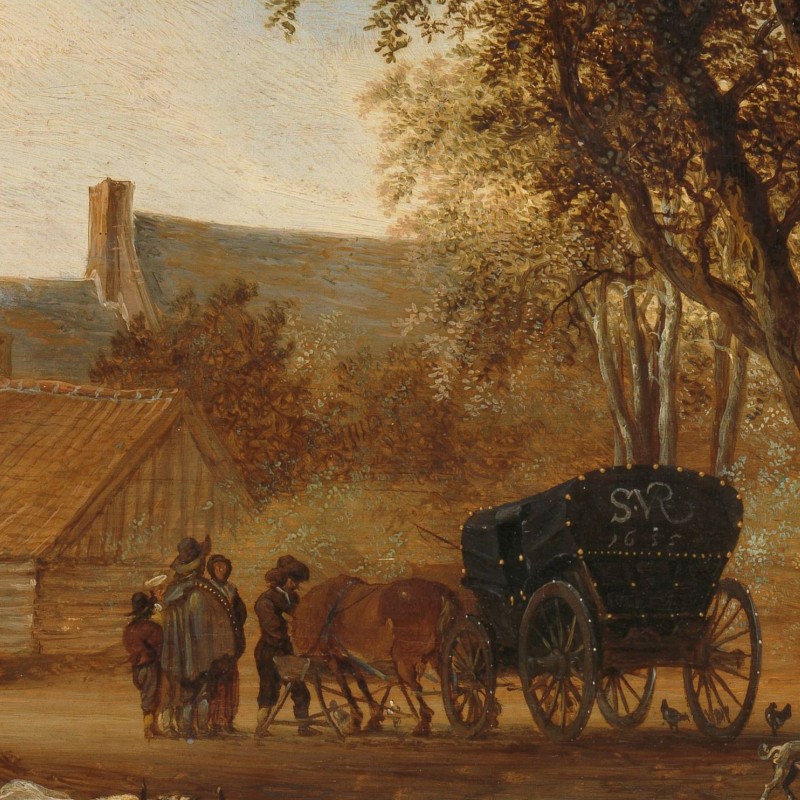
The following morning, they continued through flat countryside with many forests. After lunch at a roadside inn, they stopped that evening at the house of a Cashubian nobleman. They stayed there for the night, and Kiechel noted that the Cashubian nobility welcomes visitors who bring enough food and, in particular, wine for themselves and their hosts. The place was called Woythal (?) and consisted of only three or four houses on a small stream.
The two travellers left the nobleman’s house early the next morning. They stopped for the night in the village of Macowitzgen (?) and travelled the following day to a place called Scheschof (?). On 8 October, Kiechel and his companion arrived in Posen (Poznań).2
After deliberately visiting various towns and cities in Prussia, Poland-Lithuania and Livonia over the past months, it seemed our traveller had little interest in the places along the road to Posen. His route led through a remote, rural region. The details are sparse, and I could not find the villages he mentioned.
Posen lies to the south-west of Danzig. On a more easterly route, our traveller could have passed through Graudenz (Grudziądz), Bromberg (Bydgoszcz) and Thorn (Toruń) without a detour. All three towns were economically and politically relevant places on the Vistula at the time and would certainly have been more interesting, with better accommodation, than the villages he passed through instead. But since Kiechel did not lean towards introspection in his journal entries, it is difficult to explain his decisions.
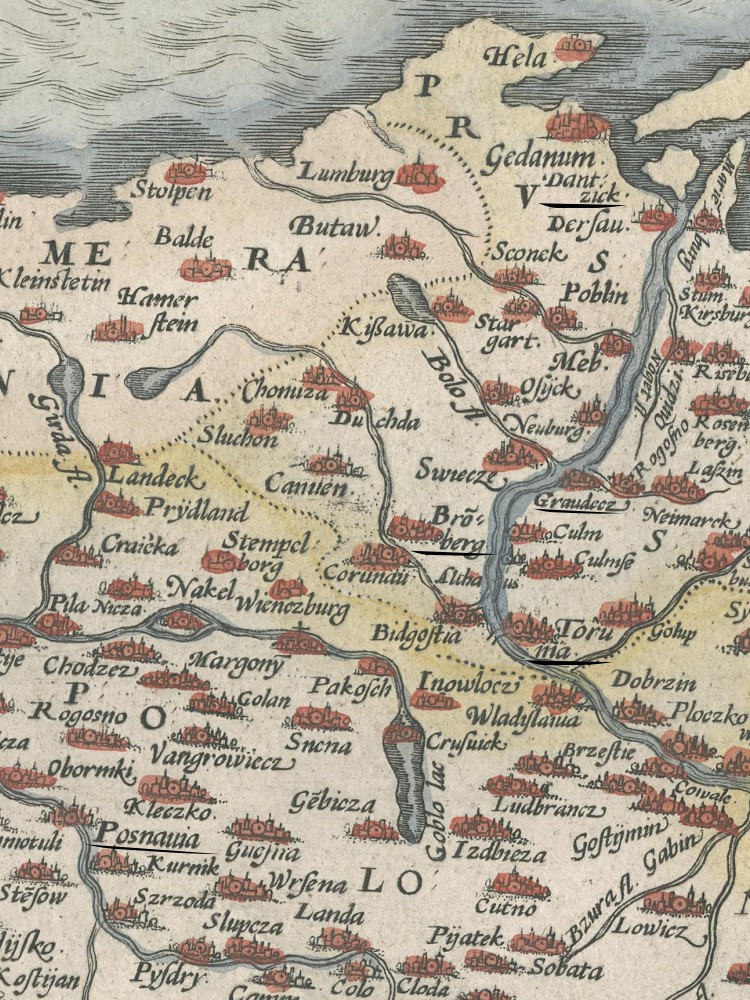
Map of the region between Danzig (Dantzick) and Posen (Posaunia) and the towns of Graudenz (Graudecz), Bromberg (Brõberg) and Thorn (Torunia)
Posen
Posen is one of Poland’s oldest and most historically and culturally influential cities. It is linked to the first recorded Polish ruler, Mieszko I, in the tenth century. The city’s cathedral is the oldest in Poland. The town and cathedral stood on an island in the Warta River. In the centuries that followed, floods repeatedly threatened the island, and it offered no room to expand.
In the thirteenth century, what is now the Old Town of Posen was built on the left bank of the Warta, opposite the cathedral. At the time, many German settlers moved into the city and surrounding area. This migration was part of a broader eastward movement of Germans, often supported and instigated by local Polish lords who lacked people to work their land. The rapidly growing population of the Holy Roman Empire in the thirteenth century made it desirable for many to move east into what is now western Poland and along the Baltic Sea coast. These migrations were not always peaceful. Kiechel had just visited Livonia and Prussia, two regions conquered by the Teutonic Order.
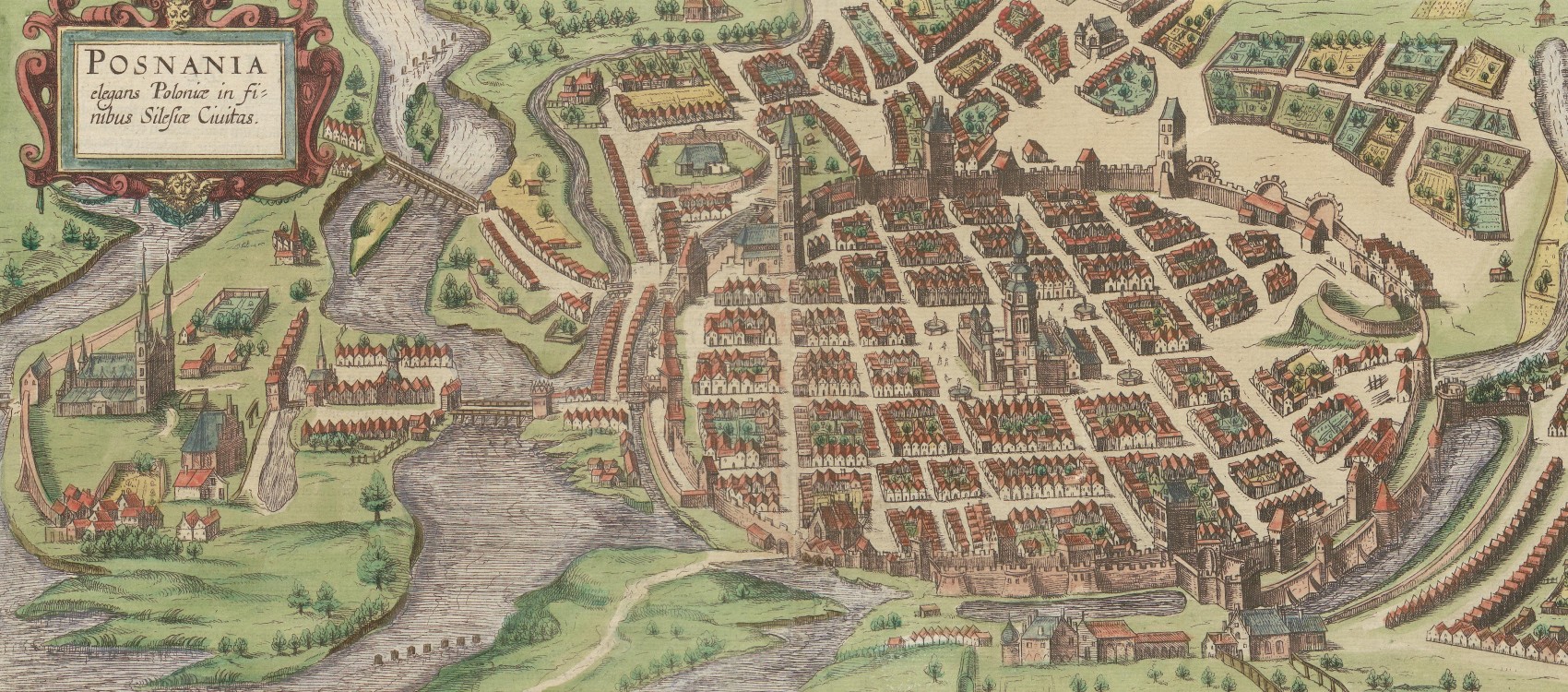
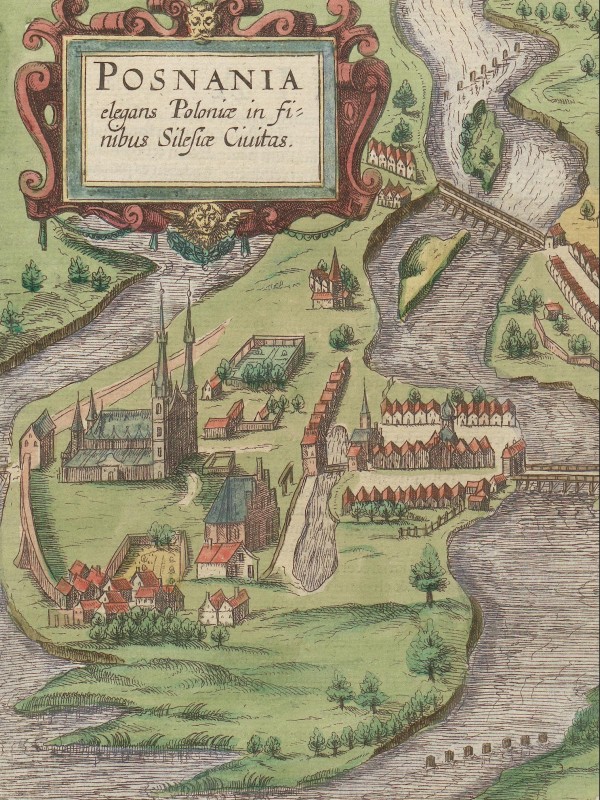
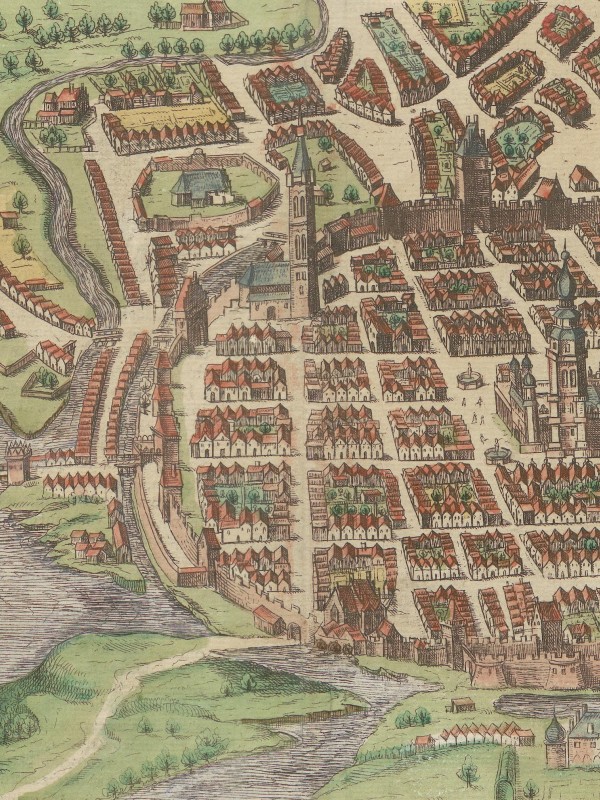
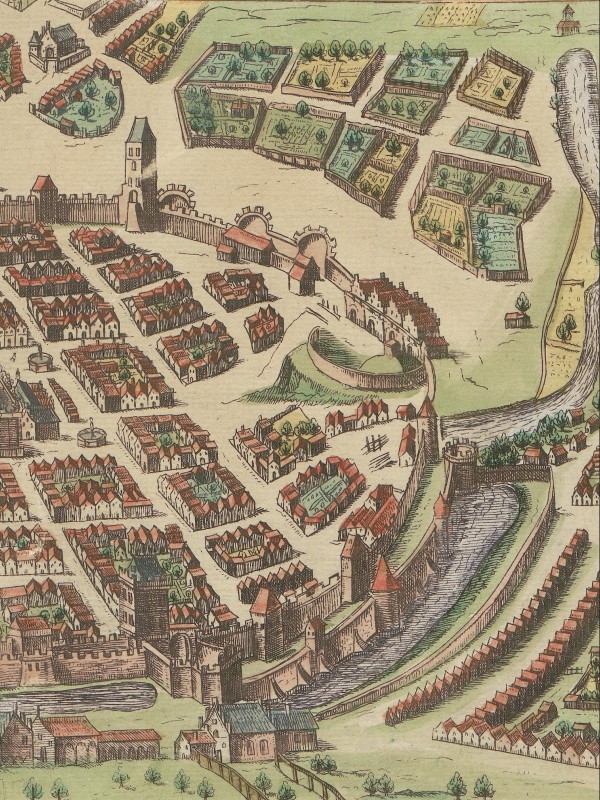
With room to expand and an influx of people, Posen was growing rapidly. In the sixteenth century, the city was booming. It was an important commercial centre along the east-west trade routes and attracted merchants and artisans alike. This early seventeenth-century view shows Posen from the north. We see a large city surrounded by suburbs. Posen Cathedral stands on the island on the left (East) side of the view. The church in the city centre is Saint Stanislaus. The Jesuits had it rebuilt as the Basilica of Our Lady of Perpetual Help in the mid-seventeenth century.
The Plague
Samuel Kiechel wrote that Posen is in Poland; it is large but not heavily fortified. The houses on the market square are well-built and painted, and the Warta River flows through the city. The day after their arrival was a Sunday, and the travellers spent it seeking an opportunity to continue to Breslau (Wrocław).
Kiechel’s remarks about Posen were brief, but his mind was preoccupied with a more pressing issue. Our traveller noted that staying too long in Posen was a bad idea because the plague had broken out in the city. The authorities had already locked down fifty houses. According to Kiechel, the city’s inhabitants were merciless, and if a house was locked down and the people inside did not have enough food or drink, no one would bring them any. Those locked inside had to suffer from hunger.
Eventually, Samuel found a new companion, a man from Nuremberg who also stayed at their inn. His name was Hans Haas, and he wanted to travel to Silesia. Haas told Kiechel and the Dutchman that if they were willing to wait a day or two, he would take them in his carriage to Breslau. He added that travelling on their own would be difficult, as they did not speak the local language and all villages along the road were blocked off and would deny them entry.
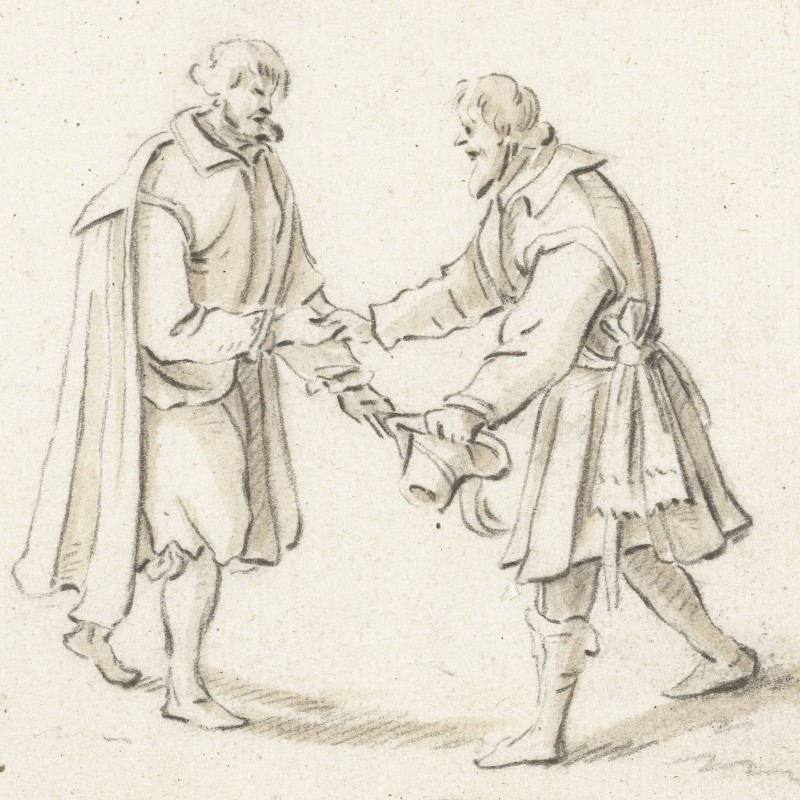
Samuel Kiechel and his companion decided to accept Hans Haas’ proposal and wait for him. The following day, a servant at the inn celebrated his wedding. The travellers were invited, and Kiechel wrote that it was a pleasant way to take their minds off the “bad air” in the city around them.3
Bad Air
One of the many dangers that awaited early modern travellers was illness. From injuries to epidemics, medical care, when available, fell far short of modern standards. Understanding of human physiology was rudimentary, and knowledge of how diseases spread was hazy at best. Epidemics were a particular danger. The Justinian Plague in the sixth century and the Black Death in the fourteenth century are best known for their devastating death tolls. But sporadic, regional outbreaks occurred throughout history. In addition to the Bubonic Plague, other infectious diseases such as smallpox, dysentery and typhus appeared regularly.
Kiechel did not mention anything specific about this epidemic. He called it the “Pest” (Plague), but with limited medical knowledge, most people used the term for any rapidly spreading, deadly disease. This epidemic was not confined to Posen; Austria was also affected. On his way from Vienna to Venice, Kiechel repeatedly encountered it and the precautions authorities took to prevent its spread.
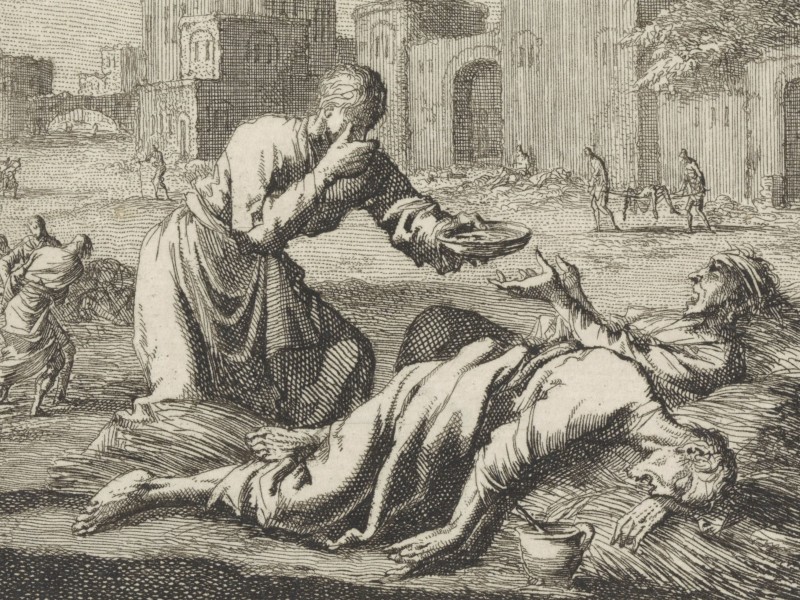
Sixteenth-century measures to deal with an epidemic included instructions on how to treat and isolate the sick, by quarantining them off or expelling them to pest houses outside the city, and how to dispose of their bodies. Furthermore, authorities restricted or prohibited social activities and imposed travel bans. Kiechel noted that Posen’s municipal authorities had locked down houses to quarantine the plague-stricken inhabitants.
All measures were aimed at stopping the epidemic from spreading. With limited knowledge of infectious diseases, people generally saw healing as in the hands of God. Kiechel wrote that the inhabitants of the quarantined houses were left to their own devices, and no one cared whether they had enough food. Because every contact was considered dangerous, people avoided it.
The causes and spread of infections and deadly diseases were not yet understood. Samuel Kiechel mentioned “bad air”. Air pollution was a popular theory since antiquity (miasma theory) and was used to explain why disease spread so quickly, especially in densely populated areas like cities. The causes of “bad air” included noxious vapours from rotting food or garbage in the streets, sewage, corpses and animal carcasses, and natural environments like swamplands. People used flowers, herbs and incense to purify the air, or fires to fumigate their houses. Appointed plague doctors wore beak-like masks filled with herbs when dealing with the infected.
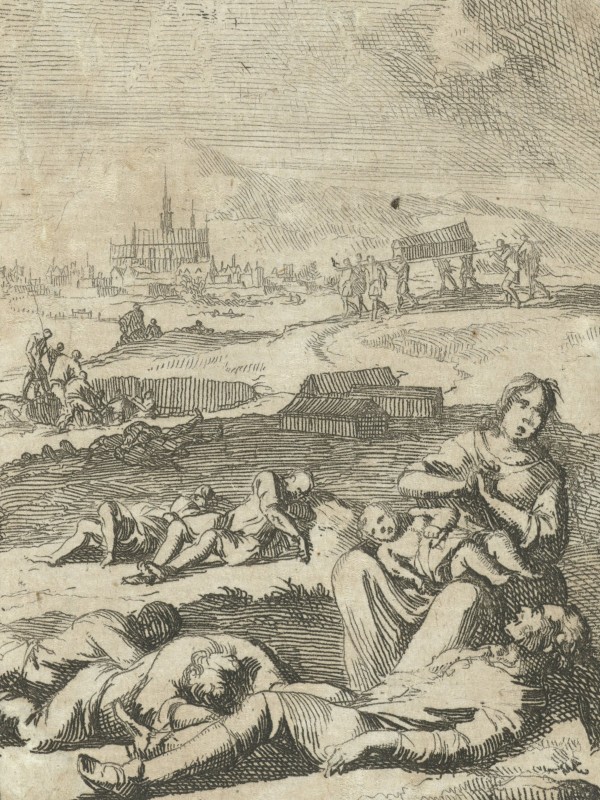
In regions where an epidemic had broken out, travellers like Samuel Kiechel and his companions were viewed with suspicion. They were required to carry documents, letters or permits to show that they had arrived from a place not yet affected by the disease. In addition, travellers faced the risk of being refused entry into towns and cities or being quarantined. Quarantine was to be avoided because it meant being crammed into a specially designated building or area with other people for an unspecified time. There was no guarantee of food, and hygienic conditions were poor.
Still, the journal shows that people did not shut themselves away and that social life continued. A wedding was held, and the travellers were invited. Kiechel does not mention any concern about participating or about staying in Posen for two days to wait for his new companion. Perhaps, in this highly religious period, people trusted that everything was in God’s hands, or perhaps the inn was fumigated and considered free of “bad air”.
In the coming weeks of Kiechel’s journey, our traveller will have to contend with these measures. He will face reluctant and suspicious guards at the gates of towns and cities, obtain the necessary permits, and, once in Italy, avoid being quarantined.
But health risks for travellers were not limited to epidemics.
A Painful Accident
On 11 October, Hans Haas had finished his business in Posen, and the three men left the following day. Samuel Kiechel, Haas and the Dutchman got into the carriage. Suddenly, something startled the horses, and they bolted, hit a dung heap, and tipped the carriage over. Kiechel wrote that the horses were fresh and daring and had never pulled a cart. He worried the journey would be hazardous.
The travellers picked up their belongings, put them back into the carriage, and walked until they were outside the city. There, the coachman mounted one of the horses harnessed to the carriage and rode it until both animals seemed to get used to it. However, a mile from the city, the horses ran off the road, and the carriage turned over again. Fortunately, no one was hurt.
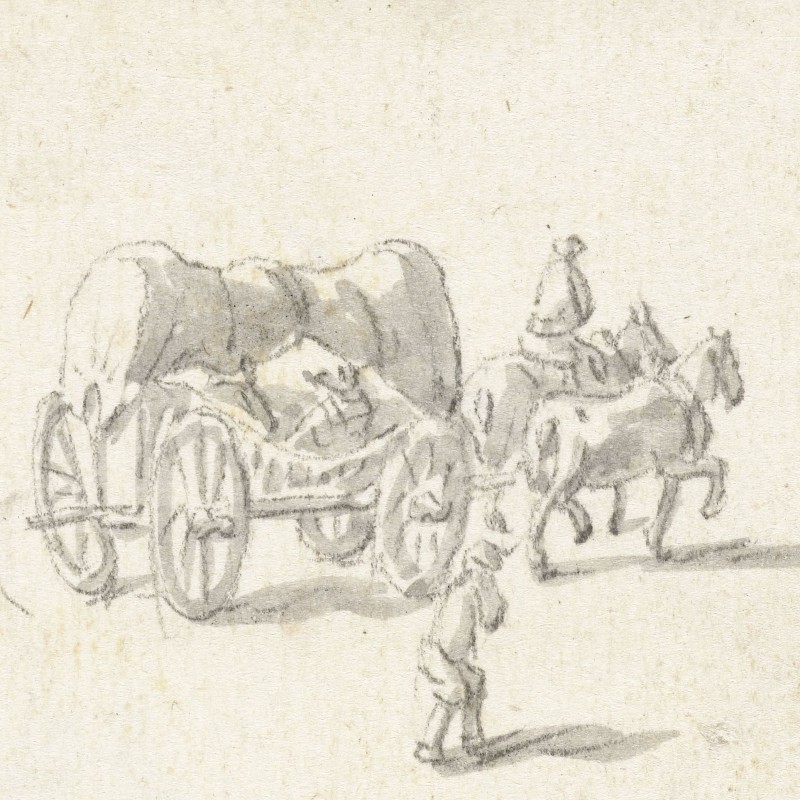
Half an hour later, the road turned into a sunken lane, and the coachman lost control of the horses. The animals started to run. Kiechel wrote that he jumped off the carriage. He thought he would land on the side of the road, but one foot slipped, and he fell between the wheels. The rear wheel rolled over his leg.
Samuel sat on the road and could not use his foot or put weight on his leg. The carriage weighed about ten centners (about 500 kg), and he feared it had done serious damage. His companions helped him back into the vehicle. They drove four more miles until they reached a town late at night. Various barns stood in the fields around it. The travellers broke open the door of one and put the horses and carriage inside. Next, they fed the horses and made their own beds on the straw. Kiechel’s leg hurt badly, but he could do nothing about it. They could not even make a fire in the barn.
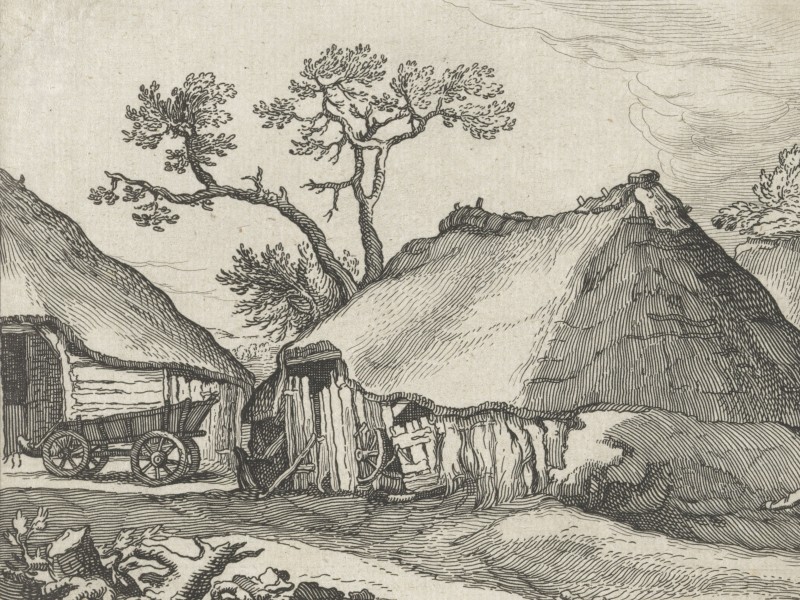
The following morning (13 October), the three men left before the town gates opened. They did not want to be caught by the barn’s owner, or they would have been in serious trouble. For lunch, they stopped in a field because peasants in the region had blocked the roads into their villages and admitted no one. Although Kiechel’s journal offers no explanation, the villagers likely took this measure to protect themselves from the plague.
Kiechel and his companions arrived that evening in a German village in Silesia, where they found accommodation. Our traveller wrote that the village belonged to a Herr von Kurzbach. Samuel checked his leg and found it swollen and blue, but it no longer hurt. He decided to avoid using it for now.
On 14 October, the three men continued their journey. Their route led them past rivers and lakes until they reached the vicinity of Breslau. Near the city, Kiechel saw many pleasant hamlets and villages.4
Getting Lucky
It was not the first accident Kiechel suffered on his journey. In Scandinavia, he had been thrown from a horse and landed on his neck, leaving him in pain for many days. Despite the pain, he was fortunate, as it could have ended much worse. Kiechel even wrote that the dung heap he landed on saved him.
The heavy cart rolling over his leg could have done serious damage, and Kiechel worried about it. It might not just have resulted in a broken leg, which would have been somewhat fixable, but a crushed bone that could have left him maimed and limping for the rest of his life. It would have ended his journey.
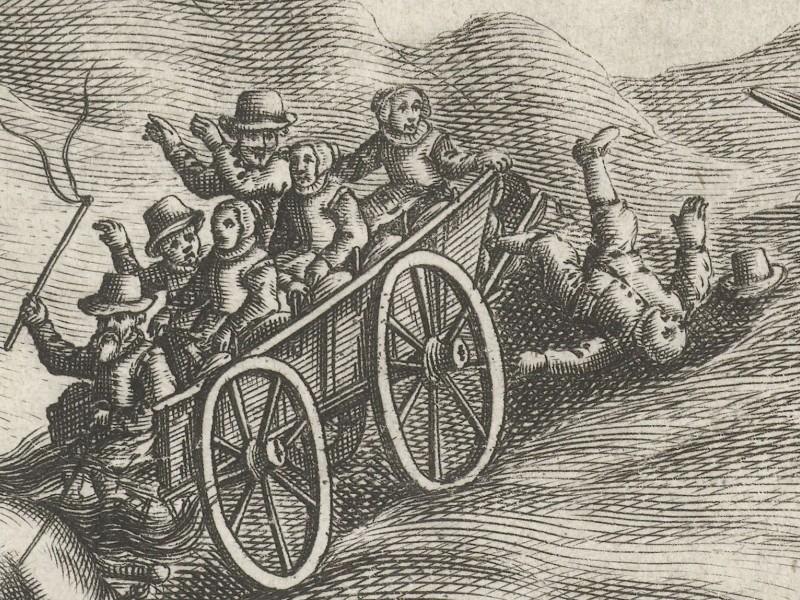
But apparently, our traveller was somewhat lucky when it came to injuries. By the next evening, despite the leg looking very swollen and blue, the pain was gone. Apart from some mobility issues he will hint at while in Breslau, Samuel will not mention this injury or any longer-lasting repercussions from it again. Maybe the cart was not as heavy as he guessed, or the road, a dirt road, was soft and his leg was pushed into the ground instead of bearing the full weight of the vehicle. In any case, Kiechel got lucky again.
Illustrations & References
All images are in order of appearance with links to sources on external websites:
- van Uden, Lucas, Landschap met mannen die uitgespannen wagen duwen, 1605 – 1673; Rijksmuseum Amsterdam.
- Ortelius, Abraham, Theatre of the World, Antwerp 1587, fol. 86v; Library of Congress.
- Poznań, in: Braun/Hogenberg, Civitates Orbis Terrarum (6), Cologne 1618, fol. 46v; Heidelberg University.
- Saftleven, Herman, Staande man en twee mannen elkaar begroetend, 1619 – 1685; Rijksmuseum Amsterdam.
- Luyken, Jan, Embleem: pest, 1695 – 1705; Rijksmuseum Amsterdam.
- Luyken, Jan, Landschap met aan de pest lijdende figuren, 1691; Rijksmuseum Amsterdam.
- Saftleven, Herman Twee wagens met paarden ervoor gevolgd door drie personen, 1619 – 1685; Rijksmuseum Amsterdam.
- Visscher, Claes Jansz., Boerderij en een wagen op een erf, 1620; Rijksmuseum Amsterdam.
- Anonymous, Titelprent van het pamflet Commedia vaetus (tweede deel), 1612; Rijksmuseum Amsterdam.
- For Kiechel’s journey to Vienna, I will continue to use the German names as found in the journal and add the modern names in parentheses. The Polish and Czech names can differ significantly from the German names, and I want to avoid unnecessary confusion. ↩︎
- Die Reisen des Samuel Kiechel aus drei Handschriften, K. D. Haszler (ed.), Stuttgart 1866, pp. 134f; Bayerische Staatsbibliothek. ↩︎
- Ibid., pp. 135f. ↩︎
- Ibid., pp. 136f. ↩︎