
Journal of Samuel Kiechel
18 – 24 November 1586
From Pontebba to Villach
“There is a shorter route to Venice via Mestre and Treviso, but we were worried we might be stopped because only eight days earlier the nobleman Maximilian von Dietrichstein, on pilgrimage to Loreto, had also come from Vienna as we did. He had presented his fede, letters of recommendation from the Venetian ambassador and His Majesty the Emperor, and was still quarantined with his servants for nine days.”
Die Reisen des Samuel Kiechel aus drei Handschriften, K. D. Haszler (ed.), Stuttgart 1866, p. 151; Bayerische Staatsbibliothek.
Through Friuli
Samuel Kiechel and his companions (the German Hans Haas, a Dutchman he had met in Gdańsk, and an Italian traveller) crossed the border from Austria to Italy without further issues and entered the region of Friuli. After the detailed account of the border formalities and problems, the journey down the mountains to Venice was largely uneventful, and Kiechel wrote little about it.
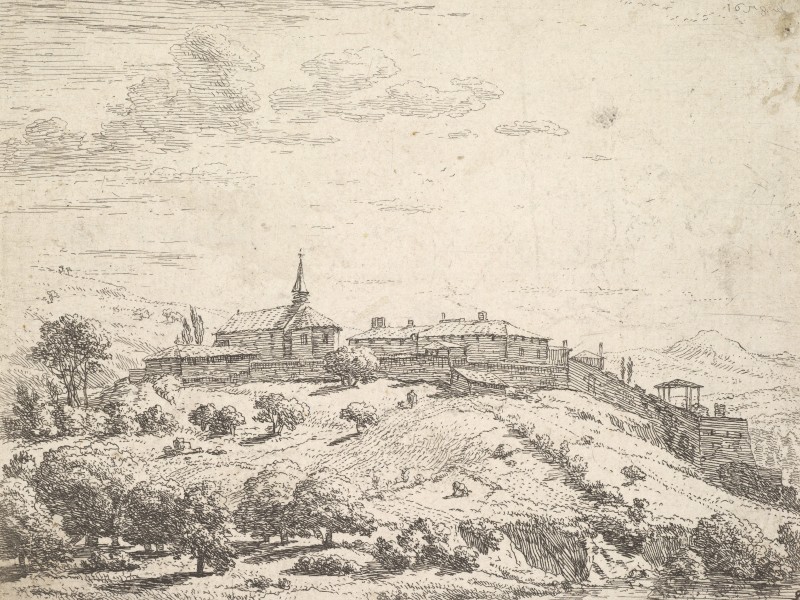
They rode from Pontebba at the Italian border for the rest of the day and arrived in Venzone in the evening, a town under Venetian rule. Kiechel noted that it was twenty-four Italian miles from Pontebba and added that five Italian miles (ca. 1850m) equalled one German mile (ca. 7400m).
The following morning, 19 November, the travellers continued and passed through San Daniele (San Daniele del Friuli). According to Kiechel, the town sat on a hill; it was small but pleasant, set in a beautiful, fertile landscape.
The group continued in the afternoon, but at a river crossing (the Tagliamento River), they had to wait a long time for the ferry to arrive. Because of this delay, night fell, and the travellers missed the road, so they arrived in Valvasone two hours into the night.
The next day, Kiechel and his companions rode past many fine country estates and summer houses belonging to the Venetian nobility. The land was flat and very fertile.
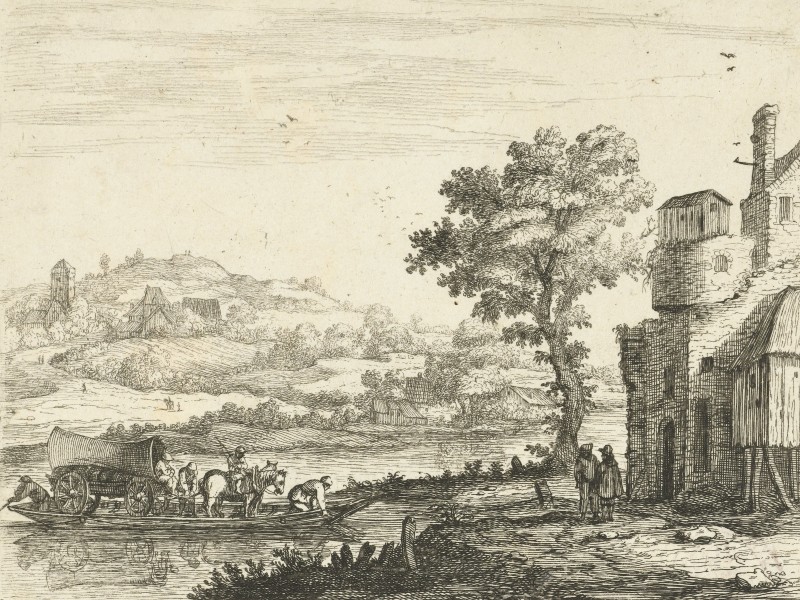
They arrived in the afternoon in Motta di Livenza, where they stayed the night. The town lay on the Livenza River and had many beautiful houses. Early the next morning, they set out and stopped at lunchtime at an inn. Kiechel called the place “a la Foschetta” (Fossalta di Piave). It stood on a waterway from which boats and gondolas departed for Venice.
Samuel Kiechel explained that the route he and his companions chose was not the shortest approach to Venice. A more direct route ran via Treviso and Mestre, but the travellers feared they would be stopped there because of the plague raging in Austria. They had heard that the nobleman Maximilian von Dietrichstein, who was on a pilgrimage to Loreto, had taken the direct route eight days earlier. He was stopped in Mestre despite his signed passport and letters of recommendation from the Venetian ambassador and His Majesty the Emperor. He and his entourage were quarantined for nine days. Our traveller mused that if this had happened to a nobleman, he and his companions would have been quarantined not for nine days but for four times nine, or forty days, regardless of their papers.
In Fossalta, the official who checked their passport had no concerns about their route or the document. Kiechel calls their travel permit a “foede” for the first time. A fede di sanità was a health certificate commonly demanded of travellers in Italy. While an early modern passport and a health certificate usually differed, in regions where an epidemic had broken out, they were conflated into the same document.
The travellers left their horses in Fossalta, hired a gondola to cross the Lagoon, and arrived in Venice one hour after nightfall.1
Kiechel’s Italian companion, who knew the city, took the group to an inn where they secured a room for the night. However, the place was not to Kiechel’s liking. It was quite crowded, and most people there spoke Italian. Samuel, Hans Haas and their Dutch companion decided to look for another place to stay. But first, their horses were still in Fossalta, and they wanted to collect them and take them to Mestre. Mestre was closer to the city and a good place to sell the animals.
To get their horses without being stopped or quarantined, the travellers paid for a Venetian fede di sanità. They hired a boat and returned to Fossalta. Their Italian companion did not accompany them.
The travellers paid the people who looked after their horses and rode off. They arrived in Treviso, a well-built, fortified Venetian city surrounded by water. However, the guards at the gate refused the travellers entry despite the new Venetian health certificate. The guards suspected trickery. Eventually, Kiechel’s Dutch companion, who spoke some Italian, told the guards off, claiming that they did their government in Venice a disservice by refusing to accept a Venetian document. The guards relented, and the travellers spent the night in Treviso.
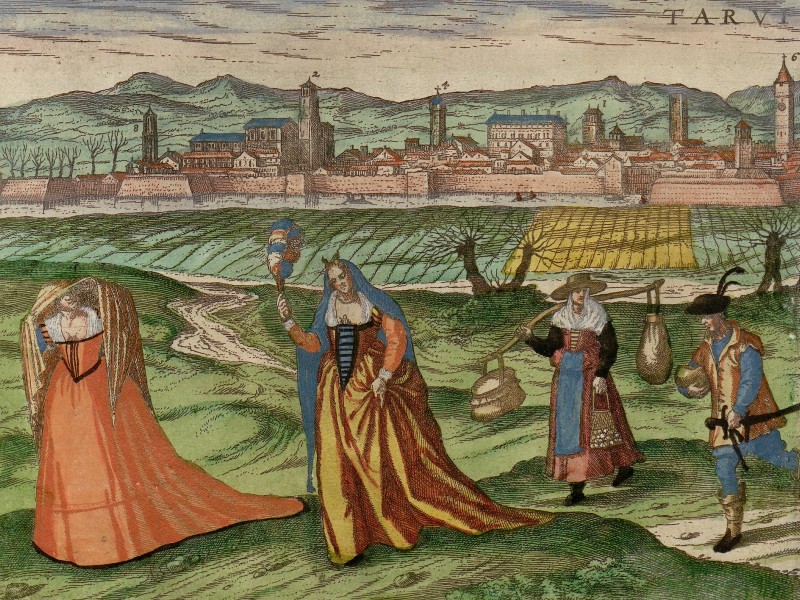
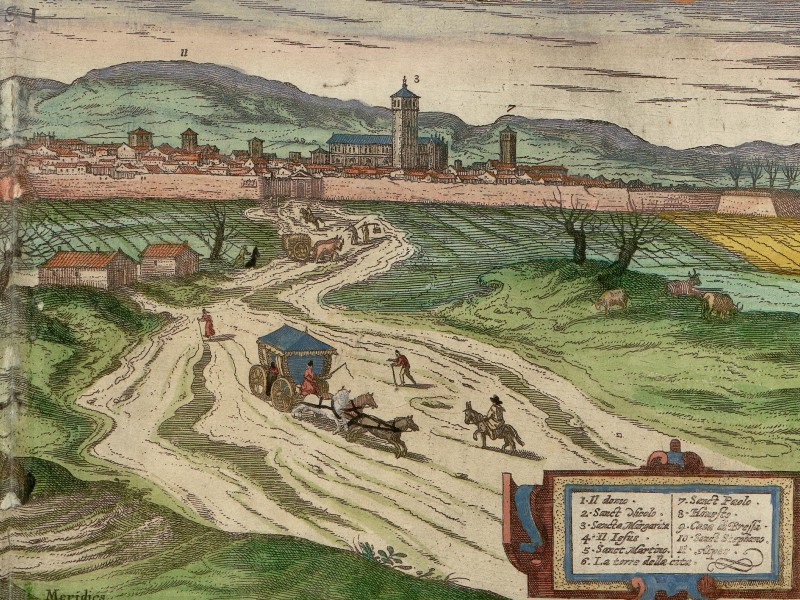
Terviso, 1599
On 24 November, Samuel, Hans Haas and the Dutchman left and rode to Mestre. There, they found a German innkeeper to care for the horses. That afternoon, the travellers returned to Venice and moved to a German inn called St Georg.2
Approaching Venice
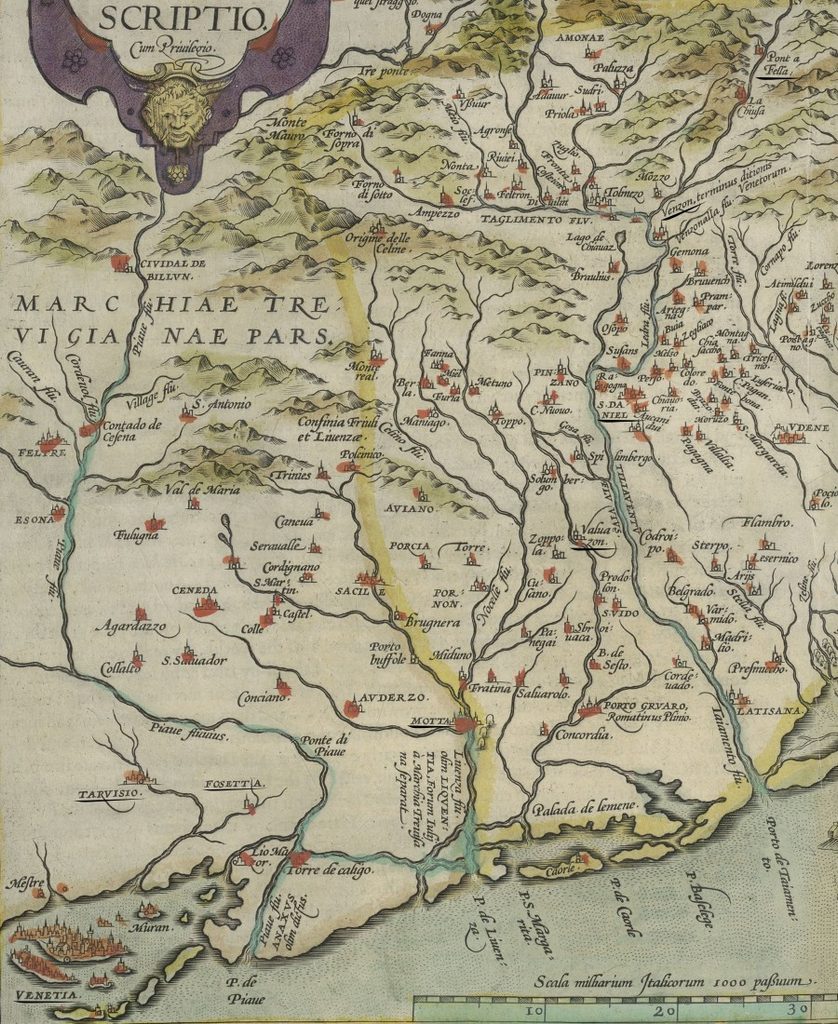
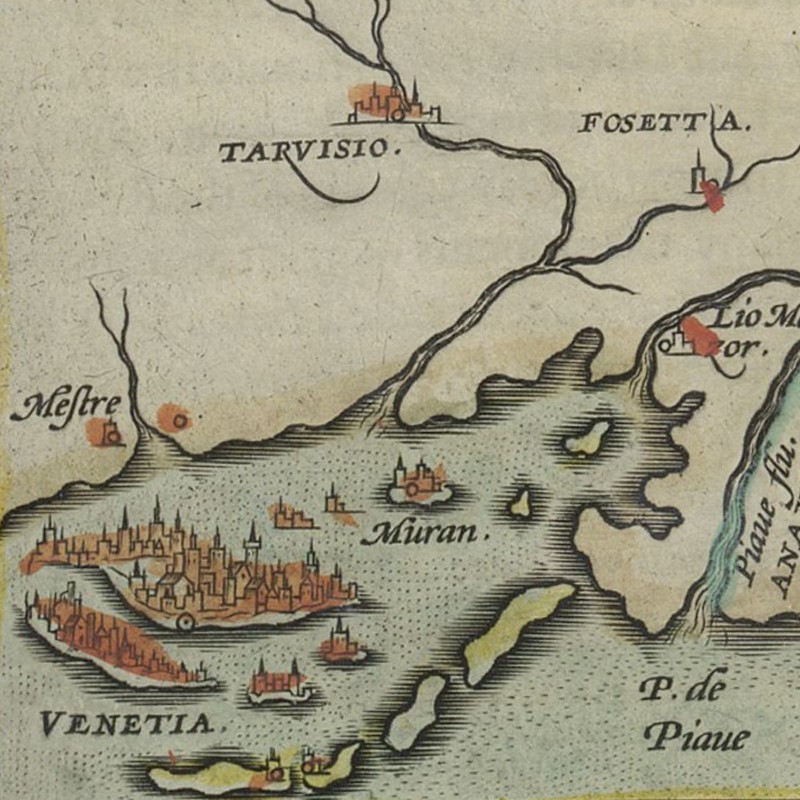
Map of Friuli with Pontebba (Pont a Fella), Venzone, San Daniele (S. Daniel), Valvasone (Valuazon), Motta di Livenza (Motta), Fossalta (Fosetta), Treviso (Tarvisio), Mestre and Venice (Venetia)
From the border at Pontebba, Samuel Kiechel and his companions followed the Fella River valley southward and down the mountains. The Fella flowed into the Tagliamento River just north of Venzone, the travellers’ first stop in the Venetian Terraferma.
Italy, like the Holy Roman Empire, was not a unified country but was fragmented into powerful city-states, independent republics, the Papal domain, and territories ruled by powerful Renaissance dynasties such as the Medici. In addition, southern Italy and Sicily came under Spanish dominion. The northeastern Italian region of Friuli had once belonged to the Patriarchate of Aquileia but became part of the Venetian Terraferma in the fifteenth century.
The Domini di Terraferma — or Stato da Tera (mainland domain), in contrast to the Venetian Stato da Màr (maritime domain) — were the Republic’s territorial possessions in northeastern Italy. While Venice was primarily a sea power focused on maritime trade, it needed to expand on the mainland to secure a steady supply of basic commodities for the city’s rapidly growing population.
Treviso and Mestre, the two towns Kiechel mentioned, were the first places Venice gained when the Republic expanded from its Lagoon into north-eastern Italy. Mestre lay north, across the water from Venice, and served as the main gateway into the city. Treviso was twenty kilometres further north.
Samuel Kiechel and his companions continued from Venzone along the Tagliamento River to Valvasone, then turned west and rode via Motta di Livenza to Fossalta di Piave. As our traveller noted, this last leg was a slight detour to avoid Treviso and Mestre. The detour was again due to the plague in Austria.
Kiechel also learnt that the nobleman Maximilian von Dietrichstein (1561-1611) was quarantined for nine days. The nobleman is somewhat difficult to identify. The Dietrichsteins were an old Austrian dynasty, with their family seat at Nikolsburg in Moravia. Samuel Kiechel passed through and mentioned the place on his journey to Vienna. But this family member seems to have held no prominent position and is hardly mentioned anywhere. This is unfortunate, as Kiechel will cross paths with him repeatedly and even insert himself into the nobleman’s entourage to tour the Venetian treasure chamber and witness a papal audience in Rome.
From Fossalta di Piave, the group travelled by boat to Venice. Fossalta was not directly on the shore of the Lagoon but on the Piave River, which flows into the Adriatic. However, extensive construction work around Venice began in the fifteenth century to connect the surrounding countryside to the city in the Lagoon. Canals were dug to regulate the water flowing into the Lagoon, reducing the risk of floods and the amount of sediment that arrived. The Canale Fossetta, dug in the fifteenth century, connected the Piave at Fossalta with the Sile River. The Sile originally flowed into the Lagoon until its course was changed in the seventeenth century. The boat route to Venice followed the Canale Fossetta to the mouth of the Sile in the Venetian Lagoon at Portegrandi.
Plague, Quarantine and the Limits of Governmental Control
Since leaving Posen (Poznań), Samuel Kiechel had encountered preventive measures against the plague. For travellers, these measures mostly meant obtaining a health certificate stating they had come from a place free of the illness, then arguing with the guards at the gates about the document’s validity. Overall, the precautions seemed more like an annoyance than real help in the event of a serious epidemic. This was due to a lack of understanding of how diseases spread, combined with a politically fragmented landscape that limited the authority’s ability to enforce the measures uniformly.
Once travellers crossed into Venetian territory, officials took the measures more seriously. Large, populous cities were particularly vulnerable to epidemics, and Venice had only recently experienced an outbreak of the plague (1575-1577). The city in the Lagoon therefore put regulations in place to prevent the spread of disease and, with its centralised authority, could be far more thorough than the haphazard approach taken elsewhere.
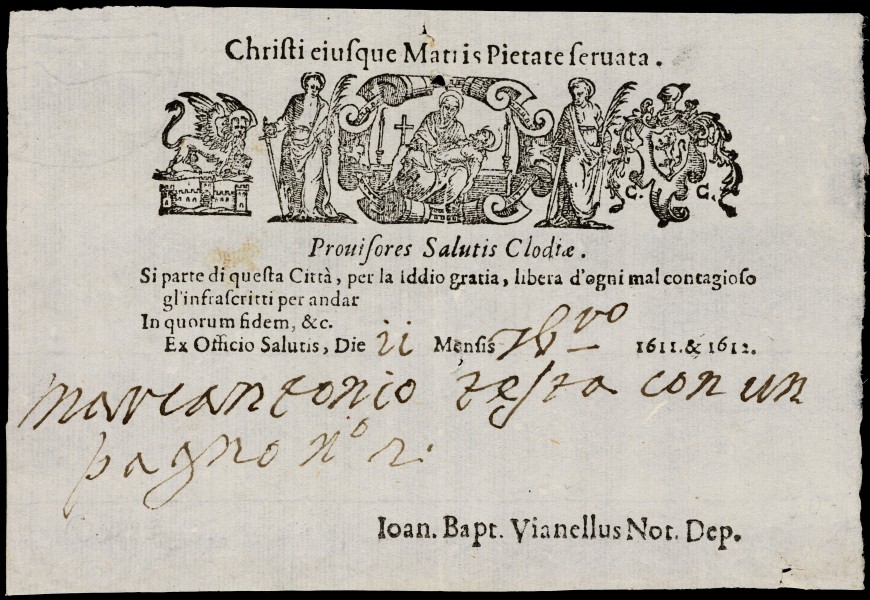
A fede di sanità from 1611. In centralised administrations, such as Venice, a form was printed in advance so the official had only to fill in the name and date.
As Samuel Kiechel noted, all travellers approaching Venice from the mainland had to pass the checkpoint in Mestre, the main access point to the city. Travellers without a valid fede di sanità were either forced to turn back or quarantined. If travellers arrived from a region suspected of plague, such as Austria at the time, they might be quarantined even with valid documents. The anecdote about Maximilian von Dietrichstein shows that social rank and presumably even the ever-helpful ‘Trinkgeld’ (tip or bribe) would not prevent quarantine. With only nine days, von Dietrichstein got off lightly.
Some travellers were quarantined in Mestre, but many were sent to the Lazzaretto Nuovo, a hospital on an island in the Lagoon, built in 1468. The Lazzaretto Nuovo was built to quarantine travellers arriving by sea or overland. As Kiechel noted, the typical stay was forty days. The term ‘quarantine’ actually derives from Italian ‘forty days’ (quaranta giorni)3, a period considered sufficient for latent symptoms of a disease to emerge. The number also had a religious connotation. Moses spent forty days and nights on Mount Sinai receiving the Ten Commandments, and Jesus spent forty days fasting in the desert. People with symptoms of plague were brought to the Lazzaretto Vecchio, a plague hospital built on a different island in 1423.4
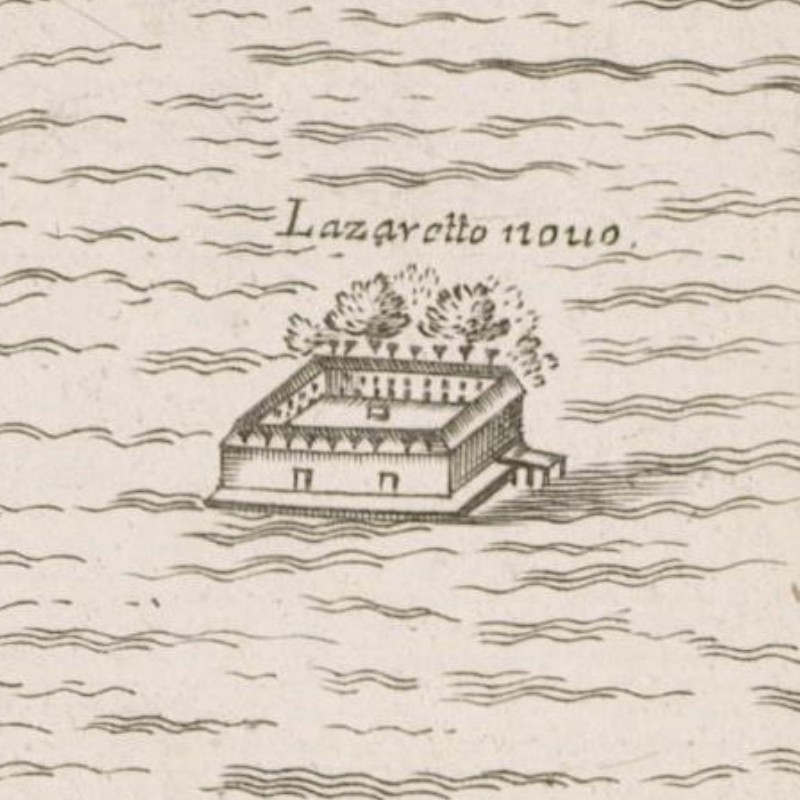
The Lazzaretto Nuovo in the Lagoon northeast of Venice
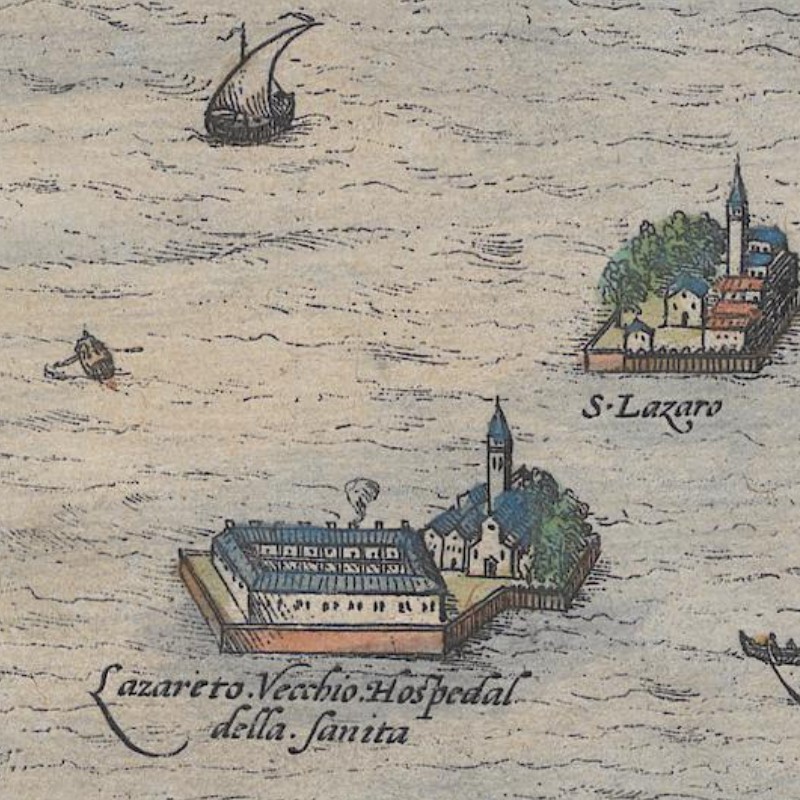
Lazzaretto Vecchio south of the city
However, Samuel Kiechel’s journey across the Alps and his approach to Venice also illustrate the limits of sixteenth-century rule and how easily travellers could circumvent it, provided they knew what lay ahead. Local knowledge and geographic awareness were essential. Today, modern technology makes information gathering easy. Kiechel had to rely on companions and guides or ask around, not only to reach his destinations but also to learn about local circumstances, customs and threats that unaware travellers might stumble into.
Samuel noted that the travellers asked the mayor of Villach for advice on border formalities. On the mayor’s advice, they exchanged their Vienna passport (combined with a fede di sanità) for a new paper claiming they had come from Salzburg. Salzburg lay west of Vienna, so the travellers apparently had avoided the eastern Alps and the area around Graz, where the plague had broken out.
As they approached Venice, the travellers knew they might be quarantined in Mestre despite their valid papers, but they also knew of an alternative route where their passport would not be questioned. Their Italian companion likely knew about the Venetian checkpoint, or they had been warned by other travellers or locals.
Their attempt to avoid Mestre on the first approach was time-consuming. The direct distance between Fossalta and Venice is about twenty-five kilometres. By boat, the distance was greater because they had to follow the canal and adjust their route to the Lagoon’s shoreline. Kiechel wrote that they arrived in Fossalta at lunchtime and presumably did not stay long. Their boat arrived in Venice an hour after nightfall. The journey therefore took approximately half a day, and the travellers had to make it twice to get their horses. However, the alternative might have been an awful forty days in quarantine.
To avoid trouble at the checkpoints on their way from Fossalta to Mestre, the travellers obtained fede di sanità from Venice. Neither the issuing authorities in Venice nor the guards in Treviso, who stopped the group, had any way of knowing whether the travellers told the truth or used trickery to avoid questions.
Protestant Dislike for Catholic Inns
Samuel Kiechel’s account of his arrival in Venice also includes comments on the local inns. Our traveller wrote that he was uncomfortable staying in an Italian inn because it was too crowded and the language was unfamiliar. This seems somewhat out of character for Kiechel, who was rarely bothered by different languages during almost one and a half years of travelling. When he complained about inns before, it was usually about the availability of food and drink or the cleanliness of a place. Our traveller had experienced worse accommodation.
One reason for his dislike might be that, in a huge city like Venice, the Italian inn was overcrowded. More likely, I would suggest, it was due to Kiechel’s aforementioned dislike of his Italian companion. However, the only reason Samuel gives is the man’s staunch Catholicism. If we follow Kiechel’s journal, the Italian appears to have been a helpful companion. He got their passport signed in Pontebba, likely knew about the quarantine in Mestre and the alternative route via Fossalta, and took them to an inn in Venice instead of leaving the group after they arrived.
Religion played an enormous role in sixteenth-century life, and while the Protestant Reformation was, after long conflicts, accepted in the Holy Roman Empire, in Italy, the home of the Catholic church, it was still perceived as a heresy. The struggle for acceptance, the persecutions and violent conflicts in the Empire were still in living memory and informed Kiechel’s point of view. In addition, the Inquisition was active in Italy and Protestant travellers had to be careful. Perhaps apprehension and fear led Kiechel to mistrust his Italian companion. Throughout the remainder of his journey through Italy, the Holy Land and Egypt, Samuel remains sceptical and on guard with the Catholics. He occasionally mocks them in his comments but also mentions individual positive experiences. Later in the journey, his writing even suggests a more benevolent view of Muslims than of Catholics. The Muslims seem to him to be just heretics who have not yet accepted the word of Christ. But the Catholics, clinging to ancient rituals and hierarchies, are occasionally considered beyond the pale.
Another aspect to consider is the choice of inns. In large, popular destinations like Venice, which attracted many foreign visitors, travellers could find guesthouses that catered to specific nationalities. Travellers tended to gravitate towards them, seeking the company of countrymen, new companions, information in their language, and sometimes guided tours. As Protestant travellers, Kiechel, Hans Haas and the Dutchman could expect a little more tolerance in a German inn than in an Italian one.
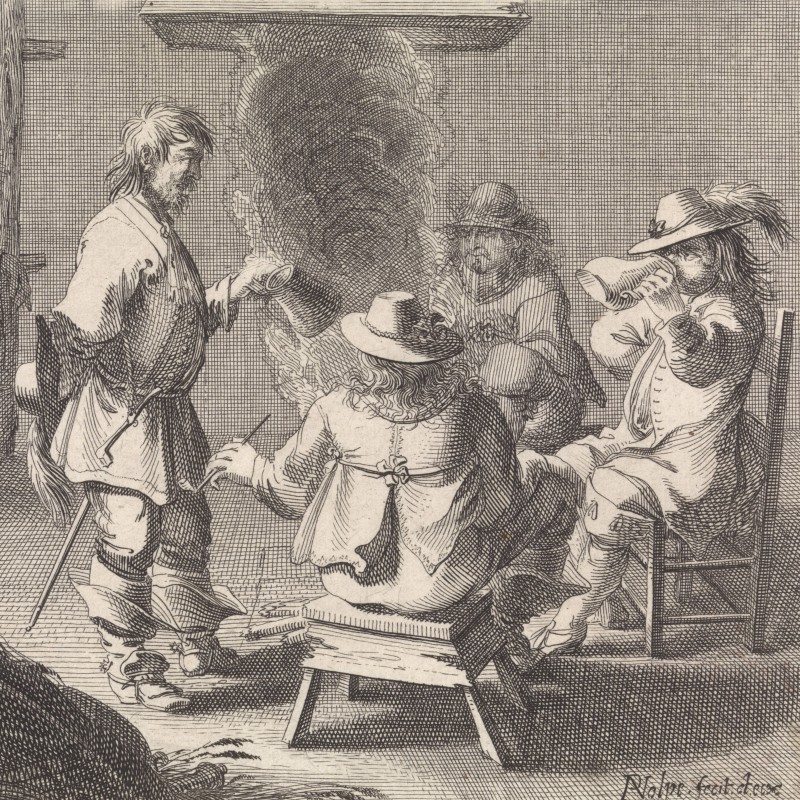
Kiechel stayed in London at the White Bear Inn, which was predominantly frequented by German-speaking travellers. Our traveller will mention similar establishments in Rome (“Beim Schwert” – At the Sword) and Naples (“Schwarzer Adler” – Black Eagle). In Venice, such a place was the St Georg Inn, also called “Deutsches Haus” (German House) or “Zur Flöten” (The Flute?). This place is not to be mistaken for the Fondaco dei Tedeschi near the Rialto Bridge, the large warehouse and inn of German merchants, first established in the thirteenth century and still there today.
Illustrations & References
All images are in order of appearance with links to sources on external websites:
- Anonymous, Plattegrond van Venetië, 1550 – 1649; Rijksmuseum Amsterdam.
- Dujardin, Karel, Walled village on a hill, 1658; Metropolitan Museum of Art, New York.
- van de Cappelle, Jan, Rivierlandschap met veerboot, 1640 – 1684; Rijksmuseum Amsterdam.
- Saftleven, Herman, Deels overdekte schuit met twee mannen, 1619 – 1685; Rijksmuseum Amsterdam.
- Ortelius, Abraham, Theatrum Orbis Terrarum, 1608, fol. 72v; Folger Shakespeare Library.
- Treviso, in: Braun, Georg, Hogenberg Frans: Civitates Orbis Terrarum (5), Cologne 1599, fol. 63v; Heidelberg University.
- Christi eiusque Matris Pietate servata : provisores salutis clodiae : si parte di questa città, per la iddio gratia, libera d’ogni mal contagioso gl’infrascritti per andar … / Ioan. Bapt. Vianellus Not. Dep., 1611; Wellcome Collection.
- Anonymous, Venetia, 1603 – 1655; Rijksmuseum Amsterdam.
- Venice, in: Braun, Georg, Hogenberg Frans: Civitates Orbis Terrarum (1), Cologne 1593, fol. 43v; Heidelberg University.
- Nolpe, Pieter, Mannen rond een vuur, 1623 – 1653; Rijksmuseum Amsterdam.
- Die Reisen des Samuel Kiechel aus drei Handschriften, K. D. Haszler (ed.), Stuttgart 1866, pp. 150f; Bayerische Staatsbibliothek. ↩︎
- Ibid., pp. 151f. ↩︎
- Online Etymology Dictionary. ↩︎
- Stub, Sara Toth, Venice’s Black Death and the Dawn of Quarantine; Sapiens: Anthropology Magazin; Conti Andrea A., Quarantine through History, in: International Encyclopedia of Public Health, 2. ed., 2017, pp. 229-235; Science Direct. ↩︎