
Journal of Samuel Kiechel
16 – 18 November 1586
From Villach to Pontebba
“I had a short pistol, less than three spans long. When I was told that they [the border guards] would not allow me to take it with me, I removed the lock and barrel, gave one of my companions the barrel and the other the lock, and kept the empty stock on my belt to cross without questions.”
Die Reisen des Samuel Kiechel aus drei Handschriften, K. D. Haszler (ed.), Stuttgart 1866, p. 150; Bayerische Staatsbibliothek.
In Villach
Halfway across the Alps, Samuel Kiechel and his companions (the German Hans Haas, a Dutchman he had met in Gdańsk and an Italian traveller) arrived in Villach, a small, well-built, pleasant town. Kiechel wrote that the place was heavily fortified and belonged to the Bishop of Bamberg. Our traveller noted his surprise that the bishop ruled a town so far from his diocese. Despite Villach being part of a bishopric, both Catholics and Protestants (Lutherans) lived in the town. Samuel also learnt that all goods transported along this route to and from Italy had to be unloaded and displayed for sale in the city.
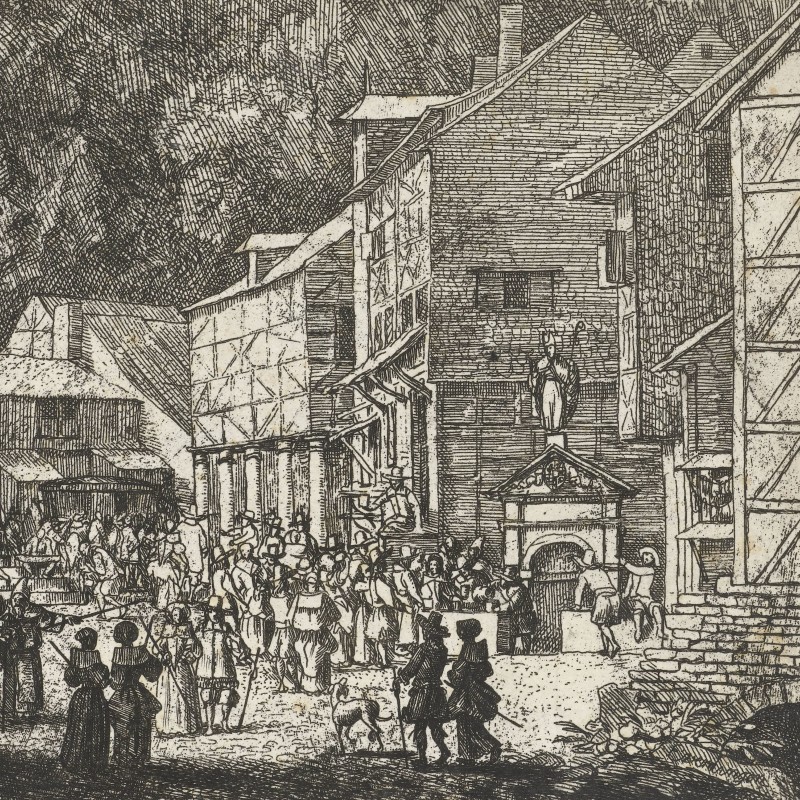
The travellers spent the morning of 16 November in Villach. Two of them went to the town’s mayor for advice on crossing the border. They asked whether their passport from Vienna would be accepted by the Italians. The mayor told them that, while he accepted their document because he had reliable information that Vienna was free of the plague, he had also heard that, in recent days, multiple merchants who had come from Vienna with the same travel document were stopped by the Italians in Pontebba and refused entry. They were stuck at the border for days before being allowed to cross.
The mayor told Kiechel and his companions that it would be best to dispose of the passport from Vienna. He would instruct the town’s scribe to write them a new document stating that they had arrived in Villach from Salzburg. If the Italian border guards asked them about the original document from Salzburg, they should say that they had left it in Villach. The travellers took the advice and paid the town’s scribe to write a new document for them.1
About Villach
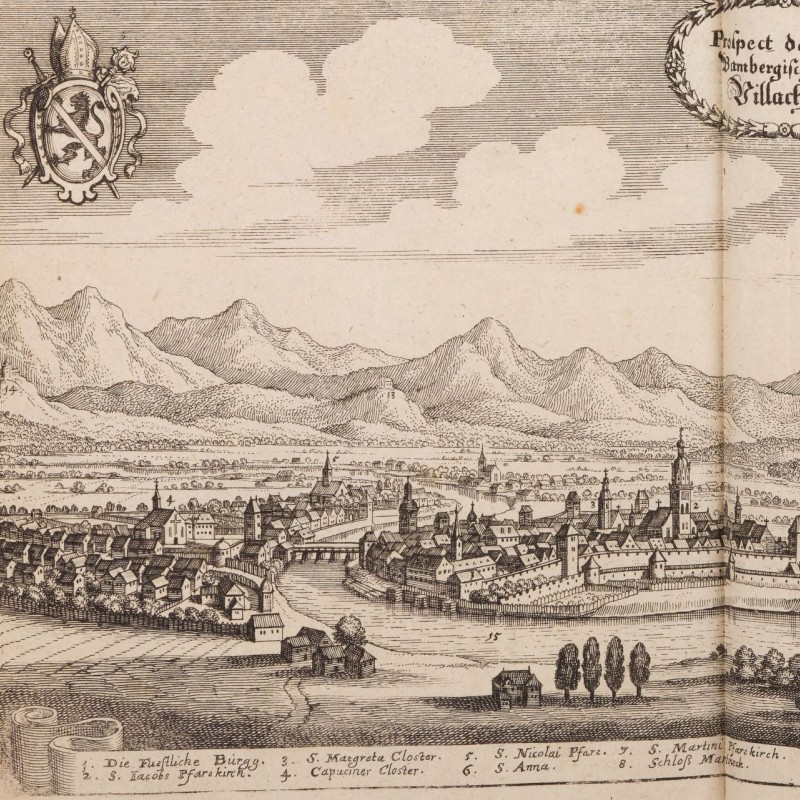
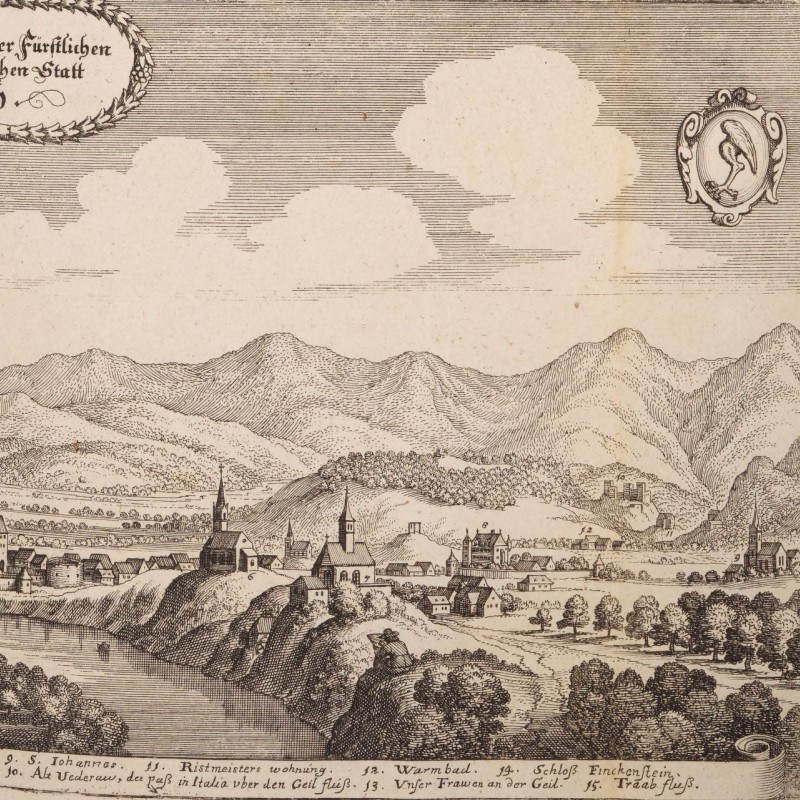
Villach, 1649
Villach was the last major town on the Austrian side of the border. With its advantageous location on the Drava River, the town had been part of routes across the eastern Alps since antiquity. The first wooden bridge across the river is mentioned in 878. The Drava was a fairly large river, flowing west to east. Every opportunity to cross such a river was valuable, and it was likely the only bridge in the region. This brought regular traffic and trade to Villach, as well as control over a critical route across the mountains. A view of Villach in Matthäus Merian’s Topographia Provinciarum Austriacarum (1649) shows the town and river before a mountain panorama. In the seventeenth century, the bridge across the Drava was still made of wood. Because of the river’s strong current, sleek wooden supports were preferable to massive stone pillars, as they offered less resistance to the water.
In the Middle Ages and early modern period, cities along the main trade routes held the so-called staple right, which required all merchants, even those who only wanted to pass through, to unload their goods and offer them for sale for a specified number of days (usually three days). Our traveller noted that this was also the case in Villach.
Furthermore, Samuel Kiechel noted that Villach belonged to the Bishopric of Bamberg. Bamberg is a city in northern Bavaria, some distance from Carinthia. However, in the Middle Ages and early modern period, it was not uncommon for bishoprics, monasteries and noblemen to hold territory in different parts of the Empire. The causes were usually land donations, inheritance, marriage or the buying and selling of territories. King Henry II (973-1024, Emperor from 1017) established the Bishopric of Bamberg in 1007 and donated Villach and the surrounding area to it. Villach remained a possession of the bishopric until 1759.
Despite being part of a Catholic bishopric, Villach had many Protestant inhabitants, as Samuel Kiechel noted. The town was a centre of the Protestant Reformation in Carinthia until the end of the sixteenth century. At the beginning of the seventeenth century, countermeasures by the Catholic Church and the bishop forced many Protestants to leave the town.
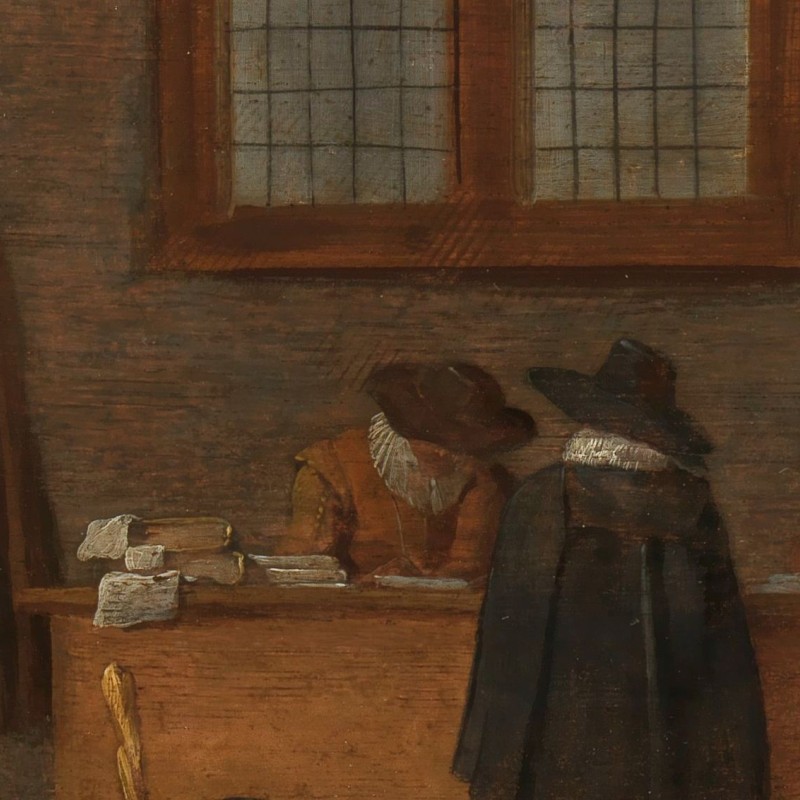
As the last major town before the border, Samuel Kiechel made the sensible decision to ask Villach’s mayor about border formalities and possible difficulties. The travellers had acquired a passport in Vienna, signed at every place they spent a night on the road up the mountains. The purpose of this passport was to prove that the group had not come from or stopped in a place where, at the time, a plague had broken out. But there was no guarantee that the document would be accepted at the Italian border. Asking the locals was therefore a good idea, and the mayor’s advice would prove useful.
Crossing the Border
With the new travel permit in their pockets, Samuel Kiechel wrote that the travellers had a good, inexpensive lunch and left Villach in the afternoon. Outside the town, the snow was deep, and they could barely see the road. But Kiechel noticed that part of the road was cut into the rock. He saw a plaque bearing the coat of arms of the Bishop of Bamberg on the left side of the road. According to our traveller, it stated that the Bishop had ordered the construction of this road.
This stretch was actually the remains of an old Roman road, with wagon tracks cut into the rocky ground. The road and the cart track are still visible today (Roman Road near Warmbad Villach).
The group stopped in the evening in the village of Uhelestein (?). Kiechel wrote that the inhabitants spoke a different language and that a monastery stood on a high, rocky outcrop. But the inn was dismal, and the travellers could not buy any food or drink.
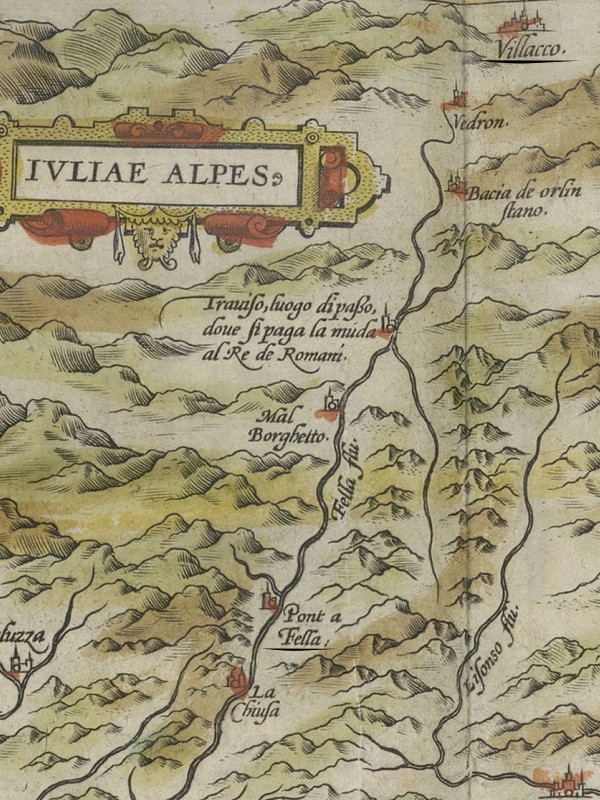
Map of the Julian Alps with Villach (Villacco) and Pontebba (Pont a Fella)
The village might have been Arnoldstein, which had the only monastery in the area. Today, Arnoldstein lies near the Austrian border with Italy and Slovenia. The different language Kiechel mentioned might have been South Slavic.
The travellers left Arnoldstein the next morning and rode to Pontebba, arriving in the afternoon. On the way, they entered a narrow valley (Val Canale) with small lakes and streams they had to cross. The weather was very cold, and because of the short daylight hours, they rode all day without a break.
Kiechel wrote that Pontebba was a small border town. A narrow river (Fella) flowed through it, marking the border between the Archduchy of Austria under Duke Charles (Charles II Francis of Austria, 1540-1590) and the Venetian territory. In the town, both German and Italian were spoken.2
The group stayed overnight in an inn on the Austrian side of the border. The German innkeeper asked where they had come from and offered to help them continue their journey. However, Kiechel noted in parentheses in his journal that this meant he would obstruct and hinder their departure as best he could. Apparently, the innkeeper had already done this to other travellers, who then had to stay in his inn for many days. Fortunately, Samuel and his companions quickly grew suspicious of the overly friendly man.
In the evening, an Italian border guard came to the inn to check the travellers’ passport. He asked where they had come from, and they said they had arrived from Salzburg. The guard asked for their Salzburg passport, and the travellers told him they had left it in Villach, where they had exchanged it for the new document, and they assumed they no longer needed the old one (just as the mayor of Villach had advised them).
All this happened with the innkeeper listening in. Afterwards, the man began pressuring the Italian guard to be more thorough. The guard should ask again where the travellers had come from, suggesting that Kiechel and his companions might not be truthful about their route.
However, the travellers had noticed this duplicity. Their Italian companion took their passport, went to the guard, gave him a few coins and had the paper signed while the innkeeper was not looking.
Later that evening, while having dinner, the innkeeper approached the travellers again and promised to help them continue their journey in the next one or two days. Again, Kiechel noted in his journal that this would probably have meant two weeks. Unaware that the travellers already had their passport signed, the innkeeper did not understand why the group was in good spirits and ignored his offers of help.3
The next morning, Samuel Kiechel and his companions prepared to leave. They paid for their accommodation, but the innkeeper, assuming the travel permit was still unsigned, did not understand why they were leaving. To prevent the travellers from getting away, the man feigned interest in Kiechel’s horse and offered to swap it for one of his animals. Samuel wrote that he was not sure what the innkeeper intended and did not care to find out. He mounted his horse and left with his companions.
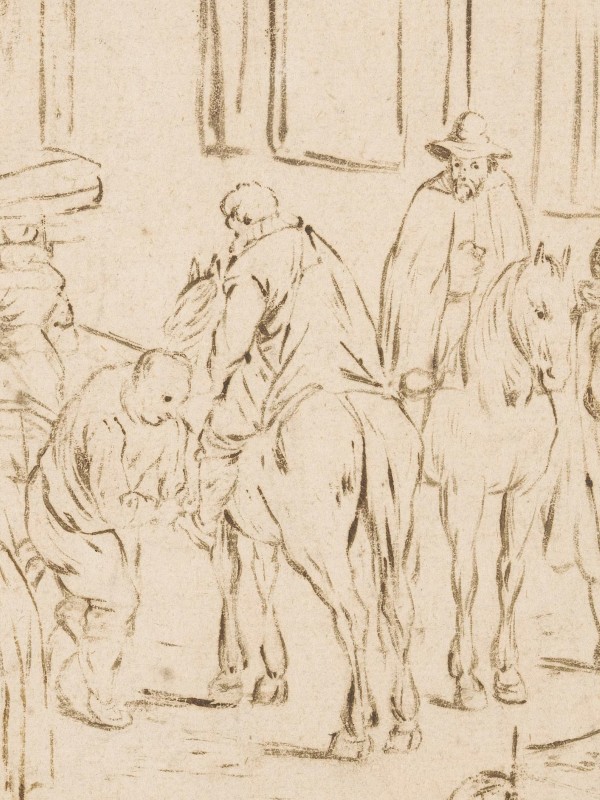
A mile from the inn, the travellers came to a defile between the mountains and the river. In this narrow gap, the Italians had built a guard post. The passport was signed again.
However, before the group could enter Venetian territory, the guards checked their weapons. Kiechel’s Italian companion carried two handguns and two long guns. He was allowed to keep the long guns but had to leave the handguns in Pontebba.
Samuel explained that guns shorter than three spans — the distance measured along the outstretched hand from the tip of the thumb to the tip of the little finger — were not allowed across the border. Kiechel also had a short firearm. But he had been forewarned about the restrictions and had taken it apart. He gave the lock to one companion, the barrel to another, and kept the stock. The guards did not notice and let him pass.4
Early Modern Border Formalities and Gun Control
Samuel Kiechel, like many early modern travellers, rarely mentioned borders or border crossings in his journal. Without the resources and technology of modern states, policing borders was difficult. Without border controls and checkpoints, there was little to notice or record for travellers. The exception was territories where geographic conditions forced travellers to use specific routes, such as the mountain passes through the Alps.
In such cases, travellers noticed and wrote about the issues surrounding border crossings. Apart from Kiechel’s journey over the English Channel, this is the only time in the journal when our traveller provided details not just about the border formalities but also the surrounding circumstances, from seeking advice in Villach to restrictions on certain items to the behaviour of the innkeeper at the border trying to exploit travellers.
Border formalities in the sixteenth century were certainly different from those today. Swapping documents in Villach shows how easily the route travellers had taken could be obscured. Unlike at modern borders, the Italian border guards had no way to check travellers. Also, Kiechel’s brief description shows that a few coins in the right hands — the often-mentioned ‘Trinkgeld’ — could always ease progress.
The duplicitous behaviour of the local innkeeper, trying to maximise his profit by keeping the travellers in his inn as long as possible, is unfortunately still something that can happen in some form today. Exploiting people unfamiliar with a place, local formalities and circumstances is timeless. Fortunately, the travellers noticed this. Kiechel had previously mentioned that one of his companions was Italian and that he mistrusted him. But in those circumstances, it was helpful that the Italian companion took their passport to speak with the Italian border guard. Their shared nationality, as well as the coins, worked in the travellers’ favour.
The guard’s signature on their passport was apparently the main obstacle to crossing the border. Kiechel did not mention any further issues with or doubts about their passport the following day when the group arrived at the Italian border post. But the travellers’ baggage was apparently checked for weapons.
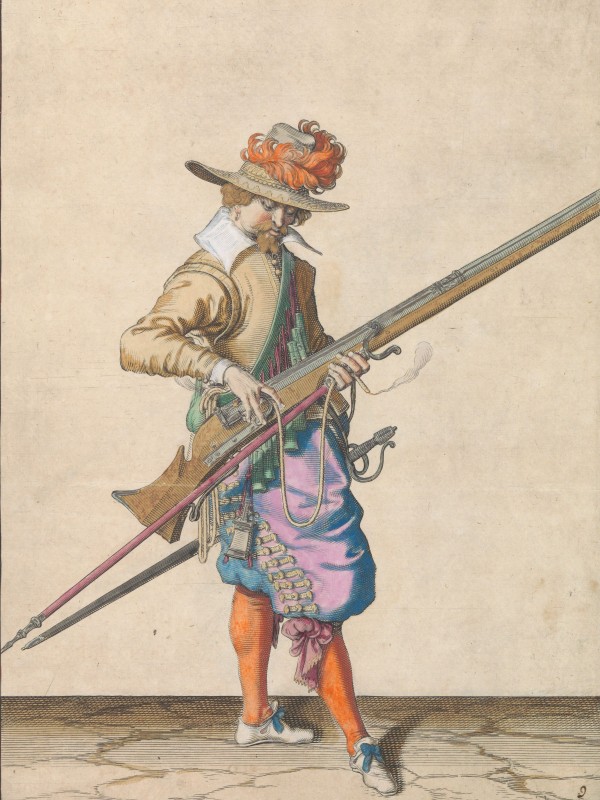
Soldier with a matchlock arquebus, ca. 1597-1607
As in previous instances when Kiechel mentioned that he had been armed, he did not say where he got the weapon from, whether he acquired it depending on circumstances or had brought it along from home. While in Livonia, he mentioned carrying a long gun. Now he had a short firearm.
Military technology in the sixteenth century was marked by the rapid spread of gunpowder weapons, from large siege guns to small pistols. The long gun of Samuel Kiechel’s companion was likely an arquebus, a matchlock gun widely used in Europe at the time. Matchlock means the firing mechanism relied on a burning cord attached to a lever. Pulling the trigger lowered the cord towards a small pan of gunpowder, igniting it. The gunpowder then ignited the charge in the barrel.5
The pistol, Kiechel mentioned, was undoubtedly a wheellock pistol. The wheellock first appeared in the early sixteenth century and revolutionised firearm development. The wheellock mechanism used a spring-driven steel disk and a clamp that held a piece of pyrite. The spring was wound back by hand and locked until the trigger released it. Upon release, the disk struck the pyrite, producing sparks that ignited the powder. The wheellock was compact, could be made ready in advance, and did not require a burning match or piece of cord. While matchlocks were predominantly used in long guns, the wheellock helped develop and spread the pistol as an effective firearm. Because of its size and ability to be primed beforehand, it was ideally suited for horsemen and modernised cavalry warfare. The first widespread use of the new technology occurred in the later stages of the Italian Wars (1494-1559), a conflict among Italian city-states that evolved into a struggle between Habsburg Spain and the Holy Roman Empire against France.6
The use of wheellocks in firearms spread quickly. But the new pistols raised a political issue, which brings us back to Samuel Kiechel’s experience. The much smaller wheellock pistols, which no longer needed a burning match to operate, were easy to conceal and considered the ideal weapon for assassins. Their widespread use also fuelled fears that they might be used during social unrest, and the weapons were popular with bandits. Consequently, throughout the mid- and late sixteenth century, Italian city-states attempted to ban the use and sale of wheellock pistols to the public, or at least to restrict their use by issuing permits.7
The long guns of Samuel Kiechel’s companion caused no issue with the guards. Difficult to conceal and clunky to handle, they were no immediate threat. But the wheellock pistols were confiscated, a sign that restrictions were in place. And as usual, there were ways to circumvent them.
Kiechel did not explain how he knew about the restrictions and apparently did not warn his companion. In preparation for the border crossing, he had taken his pistol apart and distributed the components among his companions. I do not know how difficult it was to remove the lock and barrel from the gun, but our traveller managed it, and the Italian border guards did not notice. To give an idea of what the gun and its parts might have looked like, this image from the Wikipedia page on the wheellock shows a disassembled sixteenth-century wheellock pistol.
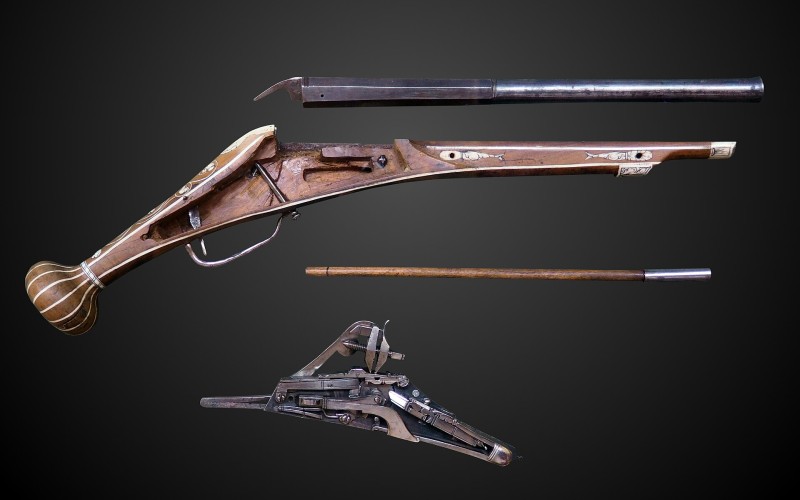
Disassembled sixteenth-century wheellock pistol
Illustrations & References
All images are in order of appearance with links to sources on external websites:
- van den Hoecke, Robert, Soldaten bij een weg, 1632 – 1668; Rijksmuseum Amsterdam.
- van Everdingen, Allaert, Gezicht op Spa met een waterbron, 1631 – 1675; Rijksmuseum Amsterdam.
- Zeiller, Martin, Merian, Matthäus, Topographia Provinciarum Austriacaru[m] Austriae Styriae/ Carinthiae, Carniolae/ Tyrolis. etc: Das ist Beschreibung Und Abbildung der fürnembsten Stätt Und Plätz in den Osterreichischen Landen Under und OberOsterreich/ Steyer/ Kärndten/ Crain Und Tyrol, Frankfurt am Main 1677 [1649], fol. 60v; Bayerische Staatsbibliothek.
- de Bloot, Pieter, The Lawyer’s Office, 1628; Rijksmuseum Amsterdam.
- Ortelius, Abraham, Theatrum Orbis Terrarum, 1608, fol. 72v; Folger Shakespeare Library.
- Anonymous, Marktscène, 1600 – 1699; Rijksmuseum Amsterdam.
- de Gheyn, Jacques, Soldaat die de lont op de haan van zijn musket de juiste plek en vorm geeft, 1597 – 1607; Rijksmuseum Amsterdam.
- Rama, Disassembled Wheellock pistol, 16th. century; Wikimedia Commons.
- Die Reisen des Samuel Kiechel aus drei Handschriften, K. D. Haszler (ed.), Stuttgart 1866, pp. 147f; Bayerische Staatsbibliothek. ↩︎
- Ibid., p. 148. ↩︎
- Ibid., p. 149. ↩︎
- Ibid., p. 150. ↩︎
- Hall, Bert S., Weapons and Warfare in Renaissance Europe. Gunpowder, Technology and Tactics, Baltimore 1997, pp. 95f. ↩︎
- Ibid., pp. 190-194. ↩︎
- Ibid., p. 192; Fletcher, Catherine, Firearms and the State in Sixteenth-Century Italy: Gun Proliferation and Gun Control, in: Past & Present, Vol. 260/1, 2023, pp. 3–37. ↩︎