
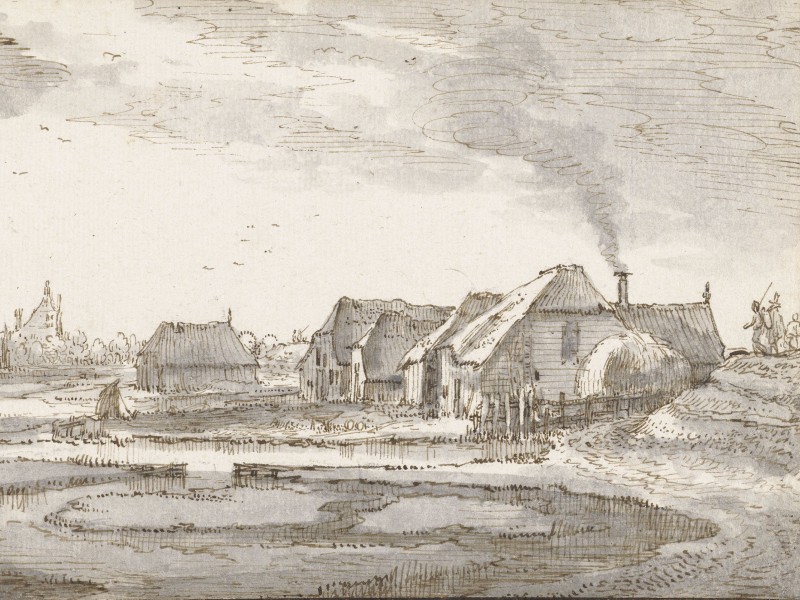
A village on the Spaarndammerdijk, ca. 1605-1615
Plaisante Plaetsen (Pleasant Places)
In 1611/12, the Amsterdam draftsman, printmaker and publisher Claes Jansz. Visscher released a set of landscape prints titled Plaisante Plaetsen (Pleasant Places). The set included twelve images depicting the countryside around Haarlem.1 As an introduction, the title page of this publication invites readers to “enjoy the varied view of country houses and the surprising turns in ever delightful roads …”. Similar to the introduction in the Civitates Orbis Terrarum, Visscher presents his prints as a substitute for travelling, stating: “The Pleasant Places here you can contemplate with ease, devotees who have no time to travel far, situated outside the agreeable city of Haarlem or thereabouts”.2
The countryside surrounding Haarlem has long been regarded as particularly exceptional. The Haarlem Woods, which were burned down during the Spanish siege of 1572/73, had been replanted by the time of Visscher’s publication. They were a popular destination for short trips from Haarlem and, due to their proximity, from Amsterdam.3
Claes Jansz. Visscher possessed a remarkable talent for choosing the right motifs to appeal to his customers’ tastes. It is reasonable to assume that his potential audience was either familiar with the specific locations or that the images conveyed a sense of familiarity with what was generally considered at the time a pleasant place.4

Haarlem and the Haarlem Woods
The prints in Pleasant Places depict villages and farms in and around the Haarlem Woods, as well as two inns, the lighthouse and church at Zandvoort, the leper house and the ruins of Huis ter Kleef.


Pleasant Places (1611/12): clockwise from the top left: Paters herberg, Potjes herberg, leper house and Huis ter Kleef
The two inns, Potjes herberg and Paters herberg, were popular destinations for travellers and day-trippers alike, offering refreshments and accommodation. The beer was particularly cheap in the inns around Haarlem because they operated outside the city’s jurisdiction and could sell their drinks tax-free.5
According to his journal, Samuel Kiechel certainly appreciated good beer and was mindful of his spending. The inns in the Haarlemer Woods might have suited his taste, but in 1585, the area still bore signs of destruction from the siege.
The leper house and Huis ter Kleef in the Pleasant Places served as sites of remembrance. Visscher dedicated his set of landscape prints to commemorate the siege of Haarlem (1572-73). The title page features Haarlem’s coat of arms and an allegory depicting the siege. In 1612, the Dutch Republic remained entrenched in the Eighty Years’ War, although the conflict had calmed down with a twelve-year truce. In this context, the city’s residents were still aware of the location of the main Spanish encampment, now the leper house, and of the destruction of the medieval castle Huis ter Kleef during the siege.6
The Origins of Dutch Landscape Art
While Visscher’s prints gained popularity and inspired other artists to publish works depicting the Haarlem surroundings, they did not mark the beginning of the landscape genre. Its origins are in Antwerp. In 1559 and 1561, Hieronymus Cock, an Antwerp publisher, issued two sets of small prints illustrating the rural scenery around the city. The title page of Cock’s landscape series indicates that the scenes were created “ad vivum” — from life.7 The prints mainly focus on the landscape, fields, houses or farmsteads, with very few people depicted. Consequently, they do not portray the ‘real life’ of a workday, with people going about their routines, but instead highlight the calm, static tranquillity of a Sunday.8


Countryside around Antwerp, 1559/1561
The southern Low Countries, particularly the wealthy city of Antwerp, had a lively art scene, with a society that valued spending money on art to decorate their homes. Artists produced large numbers of paintings and prints featuring domestic scenes, landscapes or still lifes. The price range of these artworks varied from affordable to expensive, making them accessible not only to the wealthy.
Following the Dutch revolt, the sack of Antwerp in 1576 and the increasing Spanish suppression of Dutch Protestants, many people fled to the northern provinces. Among them were wealthy merchants, artisans, draftsmen, printmakers and painters. The immigrants from the Spanish Netherlands brought with them a substantial collection of paintings and prints to the north. Among them were most likely Hieronymus Cock’s prints, which had been republished in 1601.9
The influx was so substantial that local artists in cities such as Amsterdam, Haarlem and Leiden saw their livelihoods threatened. In the northern Dutch provinces, many artists continued to depend on patronage, producing high-priced paintings for select clients.10 These artists complained, demanding that their guilds introduce restrictions on the sale of imported art. While some restrictions were put in place, they had little effect.11
However, instead of the feared collapse of the Dutch art market and the impoverishment of local artists, the opposite happened. Dutch burghers began to imitate the behaviour of their new southern neighbours, creating a demand for affordable paintings and prints. Import restrictions meant that local artists, often children of immigrant families, stepped in to supply the market with their works. Contemporary accounts describe how households were filled with paintings. Interest in purchasing art was not limited to the wealthy but extended to the general public, and soon, paintings and prints were no longer sold directly by artists but through art dealers at auctions, markets, shops or lotteries. With the market flooded with inexpensive art, competition was focused on offering high-quality works and using techniques that allowed for quick production.12

Interior of a Book and Art Store
A major reason for the sudden surge of interest in art, especially landscapes, was the republication of Hieronymus Cock’s landscape prints by Claes Jansz. Visscher in 1611/12. Visscher started his publishing business in 1605 and built a collection of prints by purchasing many plates from other publishers. Buying used plates or copying them was common at the time.13 In this way, Visscher also tried to acquire the printing plates for Cock’s landscape series, and after failing, he copied twenty-six of the forty-four views.14
Visscher deliberately focused on the landscape prints of Antwerp’s surroundings. As a shrewd businessman, he would not have gone to the trouble of reworking the plates without a clear market in mind. One potential group of buyers could have been the many people who emigrated from Brabant to the Dutch Republic. On the title page, Visscher credited the series to Pieter Bruegel, a well-known Antwerp artist. This misattribution may have been intentional, aimed at the immigrant market to increase sales.15
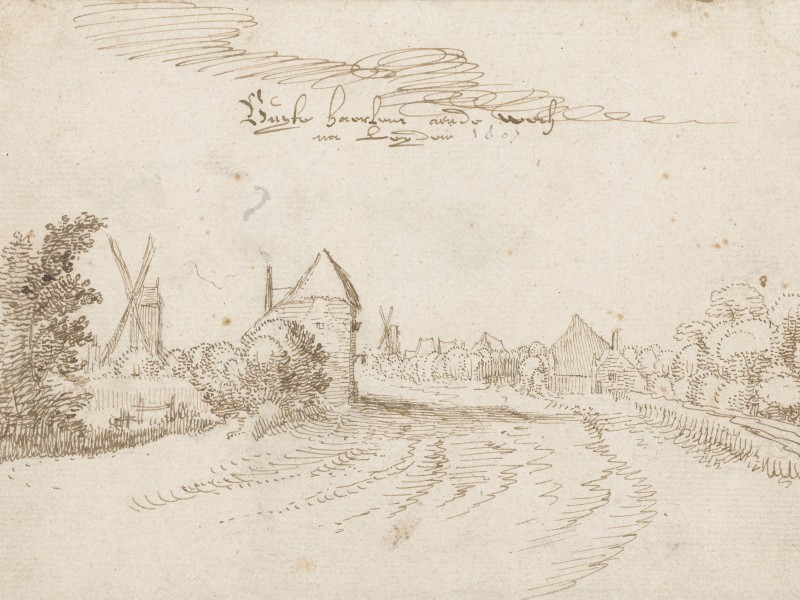

Visscher’s drawing and print of the road from Haarlem to Leiden
Republishing Cock’s series in 1612 may have inspired Visscher to issue some of his own drawings. A notable difference between Cock’s original series and Visscher’s re-publication, as well as between the older and younger generations of printmakers and publishers, was the technique used. Older publishers engraved their prints on copper plates, while Visscher and other young printmakers employed etching techniques.16
Engraving involved cutting images into the surface of the printing plate with sharp tools and physical strength. In contrast, etching employed chemicals; the images were burned onto the plate with acid. Etching offered several advantages: it required no special training, was more cost-effective, involved less labour and was quicker. Additionally, etching produced softer lines on the plate, making it more suitable for capturing the atmospheric qualities of landscapes.

Pleasant Places (1611/12), Road through the Dunes in the area of Haarlem
Visscher established himself as one of the leading publishers of landscape prints. His efforts resonated not only with consumers but also with artists. In part, Visscher envisioned his prints as sources of inspiration and workshop models.17
After Visscher published his collection of Pleasant Places, landscapes quickly became a very popular subject for drawings and paintings. The images featured a wide range of motifs. Some depict farmsteads and villages, while others display maritime scenes, such as boats sailing on Dutch canals or dunes along the shoreline. Domestic scenes and people are often included, such as carts or boats with passengers, people bringing in the harvest, or travellers on the road. The new genre had captured the public’s imagination.

Jan van Goyen, Sandy Road with a Farmhouse, 1627
However, the interest in and success of landscape art were not solely due to its novelty. The context of the Eighty Years’ War has to be considered. The newly established Dutch Republic needed to forge its own political and cultural identity. Images of the Dutch landscape, its villages and towns, its charming and pleasant places, as well as locations that reminded people of their daily struggles, helped unify the population around the idea of what it meant to be Dutch.
For anyone interested, the digital collection of the Rijksmuseum in Amsterdam is a treasure trove of landscape sketches, drawings and paintings from that period. The majority of exhibits are in the public domain and are a significant source for illustrating Samuel Kiechel’s journey.
Realism or Idealism?
Similar to the artists who contributed city views to the Civitates Orbis Terrarum, Hieronymus Cock, Claes Jansz. Visscher and many others aimed for a new ideal of realism by drawing places “from life”. However, this claim is subject to debate and remains part of ongoing scholarly discussion. As mentioned earlier, landscape scenes featuring rural motifs often do not depict the harsh realities of daily life. Additionally, nature scenes can sometimes appear overly tranquil, romantic or dramatic. Some landscape views, primarily paintings, are also attributed with allegorical meanings.

Claes Jansz. Visscher, Road between ditches in a polder with farms and trees, ca. 1615 – 1620
Despite efforts towards realism, the landscapes were not portrayed as they truly were, but in an idealised version of how they should appear. When Claes Jansz. Visscher republished Hieronymus Cock’s landscape prints of Brabant in 1612; they depicted a countryside that no longer existed. The prolonged conflict with Spain had severely affected the region, which was still recovering.18 Samuel Kiechel travelled through Brabant and visited Antwerp while returning from London. His descriptions highlight the desperate and perilous conditions faced by travellers in this war-torn area.
I am not an art historian and do not feel qualified to debate this issue of realism versus idealism. But I should clarify my use of landscape and cityscape views to illustrate Samuel Kiechel’s journey.
For this project, the question of realism, or perceived realism, is of little importance. The artists and engravers could only choose motifs and scenes familiar to them. Even if the final image is somewhat idealised, it still reflects their expectations and knowledge. As most locations Kiechel travelled through are difficult to identify accurately — particularly the landscapes rather than the cities — the issue of realism becomes even less relevant. Instead of showing exactly what the traveller saw, these paintings and prints offer an impression of the type of countryside he experienced.

Jan van Goyen, Landscape with three horsemen, 1631
Illustrations & References
All images are in order of appearance with links to sources on external websites:
- Visscher, Claes Jansz., Spaarndammerdijk bij de Braakjes, ca. 1605 – ca. 1615; Rijksmuseum Amsterdam.
- Deventer, Jacob van, Haerlem met den Hout en het huis te Cleeff, 1550-1570; Noord-Hollands Archief.
- Visscher, Claes Jansz., Pater`s herberg, 1612; Rijksmuseum Amsterdam.
- Visscher, Claes Jansz., Potjes herberg, 1611; Rijksmuseum Amsterdam.
- Visscher, Claes Jansz., Leprozenhuis in Haarlem, 1612; Rijksmuseum Amsterdam.
- Visscher, Claes Jansz., Gezicht op Huis ter Kleef te Haarlem, 1611; Rijksmuseum Amsterdam.
- Doetechum, Johannes and Lucas van, Fields and a Village Road with Post Mill, 1559/1561; National Gallery of Art, Washington.
- Doetechum, Johannes and Lucas van, Country House with a Ditch, 1559/1561; National Gallery of Art, Washington.
- Doetechum, Johannes and Lucas van, Village Road with Farm and Sheds, 1559/1561; National Gallery of Art, Washington.
- Doetechum, Johannes and Lucas van, Country Village with Church Tower, 1559/1561; National Gallery of Art, Washington.
- de Bray, Salomon, Interieur van een boek- en kunsthandel, c. 1620 – c. 1640; Rijksmuseum Amsterdam.
- Claes Jansz. Visscher, De weg naar Leiden buiten Haarlem, 1607; Rijksmuseum Amsterdam.
- Claes Jansz. Visscher, De weg naar Leiden, 1612; Rijksmuseum Amsterdam.
- Visscher, Claes Jansz., Duinweg in de omgeving van Haarlem, 1612; Rijksmuseum Amsterdam.
- van Goyen, Jan, Sandy Road with a Farmhouse, 1627; Metropolitan Museum of Art, New York.
- Claes Jansz. Visscher, Weg tussen sloten in een polder met boerderijen en bomen, ca. 1615 – ca. 1620; Rijksmuseum Amsterdam.
- van Goyen, Jan, Landschap met drie ruiters, 1631; Rijksmuseum Amsterdam.
- Onuf, Alexandra, Envisioning Netherlandish Unity: Claes Visscher’s 1612 Copies of the Small Landscape Prints, in: Journal of Historians of Netherlandish Art, 3:1 (Winter 2011). ↩︎
- As translated in: Gibson, Walter S., Pleasant Places: The Rustic Landscape from Bruegel to Ruisdael, Berkley 2000, p. 93. ↩︎
- Ibid,. pp. 93-96. ↩︎
- Ibid., p. 98. ↩︎
- Ibid., pp. 98-99. ↩︎
- Ibid., pp. 100-101. ↩︎
- Onuf, Envisioning Netherlandish Unity; Gibson, Pleasant Places, pp. 2-9. ↩︎
- Gibson, Pleasant Places, pp. 9-13. ↩︎
- Ibid., pp. 27-28. ↩︎
- Sluijter, On Brabant Rubbish, p. 6. ↩︎
- Ibid., pp. 6-7. ↩︎
- Sluijter, On Brabant Rubbish, p. 9; Honig, Elizabeth Alice, Stevenson Stewart, Jessica, Cui, Yanzhang, Economic Histories of Netherlandish Art, in: Journal of Historians of Netherlandish Art, 15:2 (Summer 2023), pp. 3-6. ↩︎
- Gibson, Pleasant Places, pp. 32-33. ↩︎
- Onuf, Envisioning Netherlandish Unity, p. 1. ↩︎
- Ibid., p. 3; Sluijter, On Brabant Rubbish, pp. 13-14. ↩︎
- Bakker, Boudewijn, The Netherlands Drawn from Life: An Introduction, in: Journal of Historians of Netherlandish Art, 10:2 (Summer 2018); Gibson, Pleasant Places, pp. 37-38. ↩︎
- Onuf, Envisioning Netherlandish Unity, p. 7. ↩︎
- Ibid. ↩︎