
Journal of Samuel Kiechel
2 – 18 July 1586
From Vilnius to Riga
“Besides Martinists, there are many different religions and sects in Vilnius. They all have their own churches and services, including Papists, Calvinists, Jesuits, Russians or Muscovites, Anabaptists, Zwinglians, and Jews, who also have their synagogues. There are also heathens and Tatars, because all religions have Libertatem conscientiae [freedom of conscience].”
Die Reisen des Samuel Kiechel aus drei Handschriften, K. D. Haszler (ed.), Stuttgart 1866, p. 103; Bayerische Staatsbibliothek.
In Vilnius
According to the journal, Vilnius is the capital of Lithuania. Lithuania itself is called a Grand Duchy and has its own duke. But the land is under the protection of the King of Poland. Vilnius is very large, wide, but poorly built. The city has no fortifications, and people can enter and leave it during the night. Most houses in Vilnius are built of wood, and the roofs are covered with wooden planks. The exceptions are two streets, the most noble in the city. German merchants and other craftsmen live there. These foreigners have their own churches and priests whom they pay themselves.1
Samuel Kiechel spent almost two weeks in Vilnius. He visited the ducal palace and wrote that it was large but old. Within the palace grounds, he saw a large, beautiful church and a new building. Kiechel heard that this new part of the palace was beautiful inside, but could not enter to see for himself. The river Vilna (Lithuanian: Neris, Polish: Wilia) flows past the palace, and the city has its name from it.2
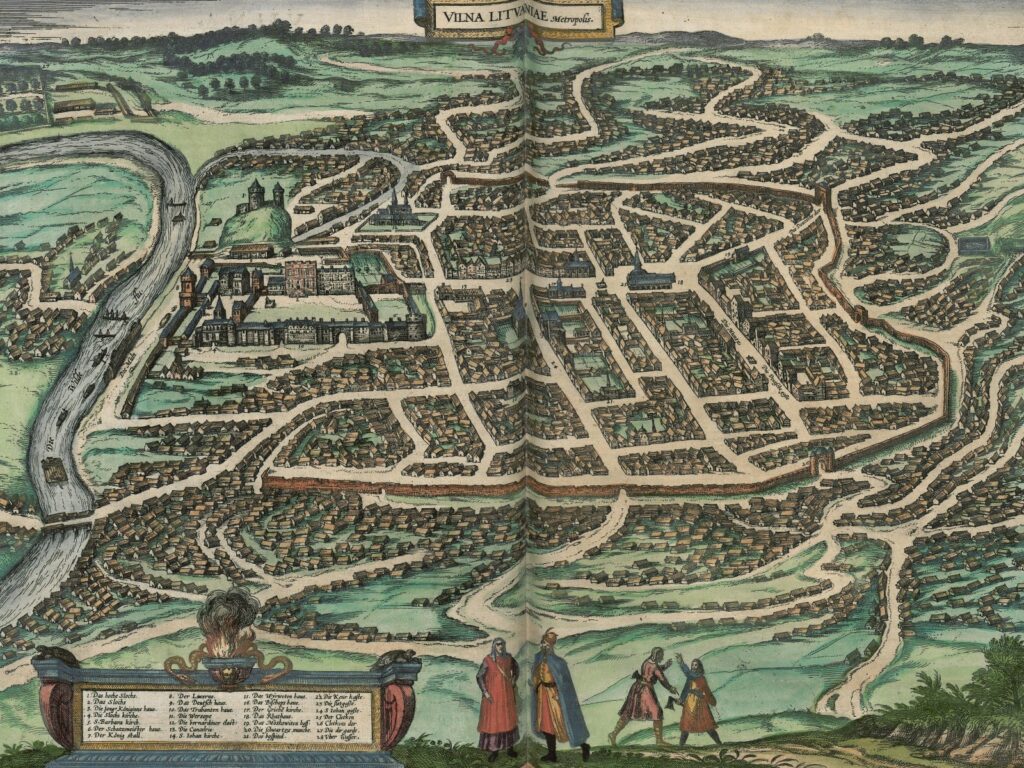
Vilnius, 1581
A bird’s-eye view of Vilnius is in the third volume of the Civitates Orbis Terrarum. The city is depicted as a large, sprawling place. For a city on the periphery of Europe, the artist who drew the bird’s-eye view knew it well and had presumably been there. On the left side of the view lies the river. Beside it, on a hill, stands the old castle of Vilnius. Its main tower (Gediminas’ Tower, Gedimino pilis) remains and is today one of the city’s major sights. Below, at the foot of the hill, is the Palace of the Grand Dukes. The palace was built in the fifteenth century and remodelled in the sixteenth century. This is most likely the new building Kiechel described. The palace was demolished in 1800 but was reconstructed between 2002 and 2018.
The view of Vilnius includes a legend in the lower-left corner. It contains twenty-eight numbered entries of notable and important buildings in the city. Number four is the Palace Church Kiechel mentioned (Vilnius Cathedral).
On the right side of the image, a street named German Street (“Die Deutsche goße”) is visible. This is one of the two streets Kiechel mentioned, and its name points to its inhabitants. The buildings on this street indeed look somewhat different from most houses in Vilnius. Our traveller’s observation that much of Vilnius was built of wood seems accurate.
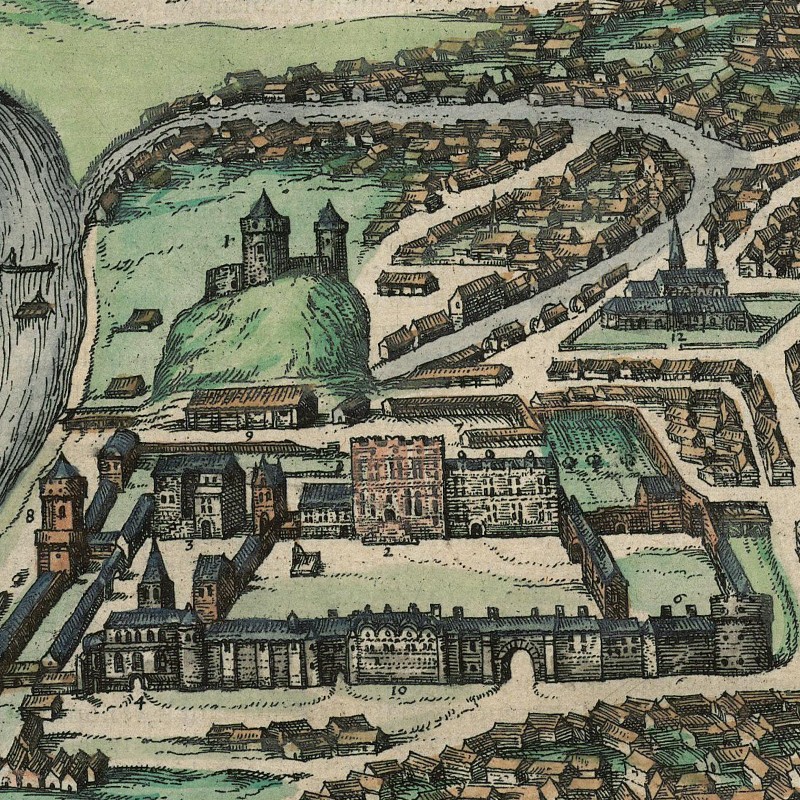
The Palace of Vilnius (2), with the old castle (1) on the hill in the background and the church in the bottom-left corner (4)
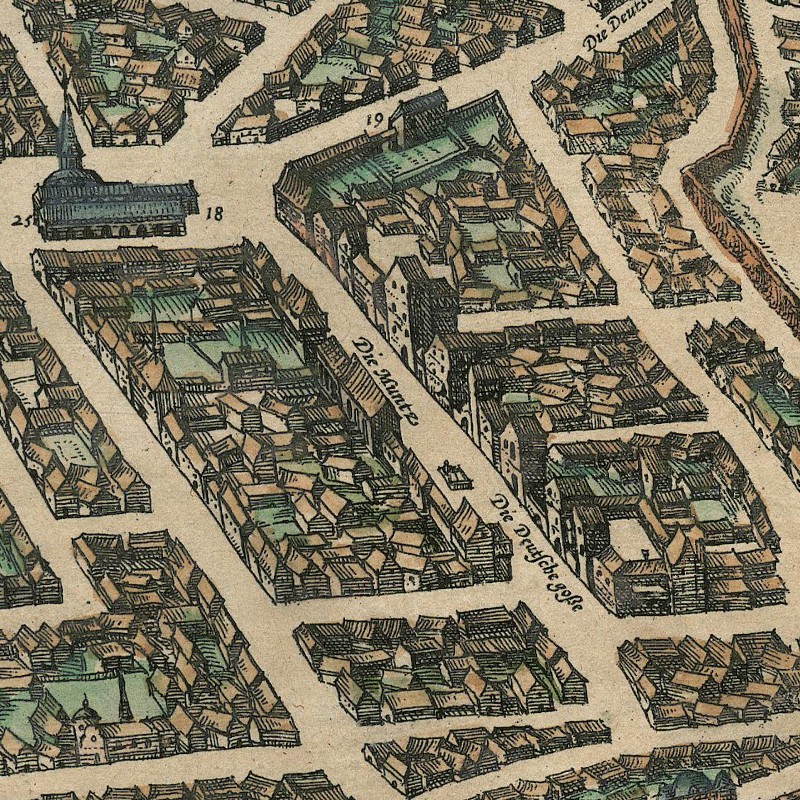
The German street (“Die Deutsche goße”)
Samuel Kiechel noted that followers of many different religions and sects live in Vilnius. He mentioned Martinists, Papists, Calvinists, Jesuits, Russians or Muscovites, Anabaptists, Zwinglianists and Jews. They all have their own churches and religious services. In addition, there are the pagan Tatars. In Vilnius, all religions and sects are free.3
The presence of various religions in Vilnius and the freedom they enjoyed might have surprised Samuel Kiechel. While the Reformation had sparked deep conflicts and religious persecution across the rest of Europe, the Polish-Lithuanian Commonwealth, and in particular Vilnius, were centres of religious freedom at the time. For Jews especially, Vilnius became a safe haven and cultural centre known as “Jerusalem of the North”.
The journal continues: Leather production is one of the main industries in Vilnius. For this industry, animal skins from Livonia, Muscovy and other places are imported. All leather workers are German master craftsmen. They are mostly from Silesia and are very protective of their privileges. No one is allowed to train a Pole or a Lithuanian for fear that these privileges might be revoked. The masters take only German men as apprentices. Otherwise, not many other trades are practised in Vilnius. Flax is grown in large quantities, made into twine and exported to Nuremberg.
Kiechel’s observation about the German craftsmen only taking Germans as apprentices sounds to modern ears quite discriminatory. But it was not uncommon at the time to restrict access to certain trades. The guilds usually did it to guarantee the quality of their products and keep the prices stable. Too many craftsmen producing the same products were to be avoided.
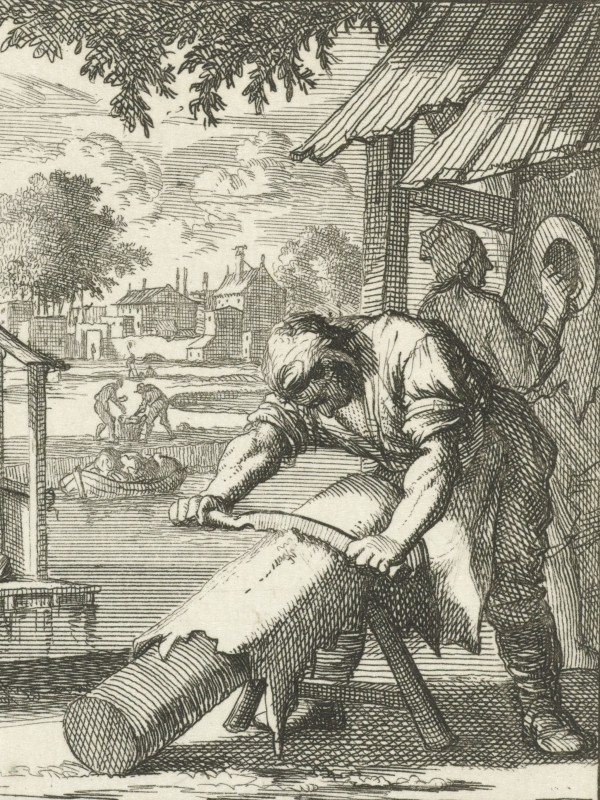
Leatherworker
In Vilnius, since the late Middle Ages, the Grand Dukes of Lithuania have sought to persuade Western craftsmen to settle in their domain. They were granted tax exemptions and many other privileges. But at the time of Kiechel’s visit, the duchy was no longer a quasi-heathen territory on the periphery of Europe eager to catch up with Western technology, but rather part of a large, confident empire (the Polish–Lithuanian Commonwealth). As our traveller mentioned, the German master craftsmen feared losing their privileges if they opened up their market.
Foodprices
Kiechel also made some economic observations: The cost of living for food and beer is very affordable in Vilnius. Much wildfowl is on offer except for partridges. But hazel grouse are available for one Polish Groschen each. According to our traveller, a Polish Groschen was worth two Kreuzer. Rabbits are sold for five Kreuzer, wood grouse for nine to ten Kreuzer. As was his habit, Kiechel compared the value of foreign coins to those he was familiar with. A Kreuzer was a low-value coin used in southern Germany.
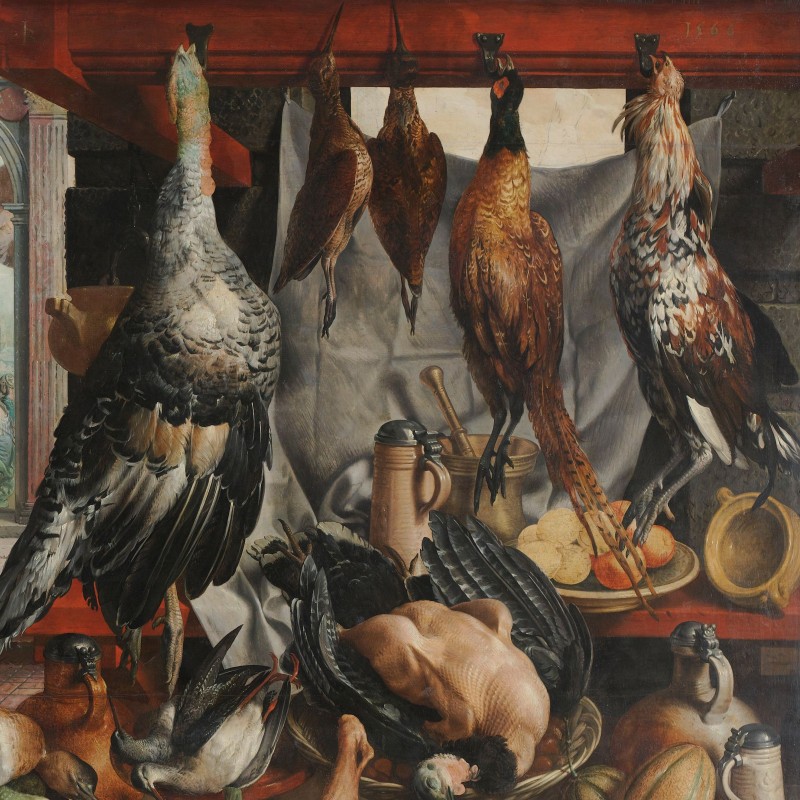
Our traveller furthermore mentioned that his host told him that during the winter, so much game is caught around the city that a partridge or a hazel grouse is sold for one Kreuzer and a hare for three and a half to four Kreuzer. Sometimes, so much wildfowl is caught in the winter that it is exported to Königsberg (Kaliningrad) and Danzig (Gdańsk). The hares have a white pelt during the winter, just like in Sweden.
Finally, Kiechel noted that a young chicken is sold for one and a half to two Kreuzer and an old chicken for four to five. Beef, veal and mutton are also available in large quantities, and grain is not expensive. But fish are not abundant because the river that flows past Vilnius is fairly narrow.
Regarding the available beverages, Kiechel wrote that the water in Vilnius is poor and the beer is of low quality. But the mead is so good, it is exported to other places. Wine from the Rhineland and Hungary is available but very expensive.
To Riga
Kiechel spent eleven days in Vilnius and was looking for an opportunity to travel to Livonia. He met a German merchant from Westphalia who had bought leather and intended to travel to Riga. Together, they hired two Tatars to guide them. Kiechel’s new companion spoke the local language (probably Lithuanian) and could therefore communicate with the Tatars. Both men had their own vehicle drawn by a single horse.
The distance from Vilnius to Riga was forty miles, and Kiechel paid his Tatar four Guilders. Our traveller noted that this was not expensive, as he had his own cart and did not need to share it. The Tatar had to provide his own provisions and food for the horse.
Kiechel had travelled with a Tatar from Grodno to Vilnius and, apart from some general observations and cultural stereotypes, had not mentioned any mistrust towards the man. Now, he wrote that he and his new companion did not trust the two Tatars they had hired. Kiechel noted that he had heard rumours that travellers had come to harm from the Tatars. The two Tatars Kiechel and his companion had hired had to promise to ensure their safety, as was customary among them.4
Kiechel’s mistrust towards their guides stands in contrast to his previous experiences with the Tatars. It is possible that the Tatars, as an ethnically distinct people, were generally more distrusted. Also, banditry was not uncommon in the region. But it is also possible that our traveller was influenced by his new companion’s opinions. Since Kiechel spoke no Lithuanian or Polish, he had to rely on information from people who spoke German or, in an emergency, Latin. Naturally, such third-hand information was already loaded with individual prejudices.
They left Vilnius on the evening of 13 July. The countryside around the city was flat and sandy. When they came to a hill, the Tatars would help their horses by pushing the cart. Kiechel estimated that on average, such a cart would travel eight to ten miles per day.
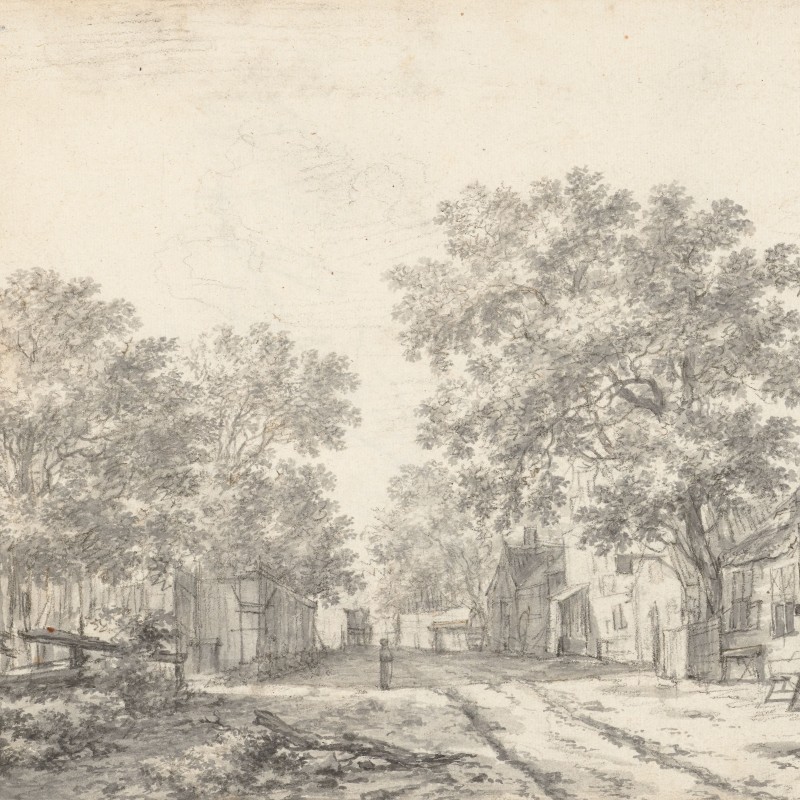
On the day of his departure from Vilnius, Samuel Kiechel and his companion travelled three miles and arrived at night in a village called Picquel (?). The two travellers slept on their carts as it was customary when travelling with Tatars. Kiechel noted that provisions had to be bought in the cities and brought along for the journey. On the road and in the villages, there was little food or drink available for sale.
The following morning, the travellers continued on their journey along a sandy track through dense forests. At lunchtime, they stopped on an open meadow where the horses could graze. The group spent the night in the village of Armantsch (?).
On 15 July, Samuel Kiechel and his companion travelled along a good road and stopped at noon in a forest. In the evening, they arrived at a village and spent the night outside it in a meadow. Kiechel wrote that they slept on the grass because it was the height of summer and very warm. The following day, they travelled another nine miles before stopping in a field. Their provisions were running low, but they were close to the next town, where they could replenish them.
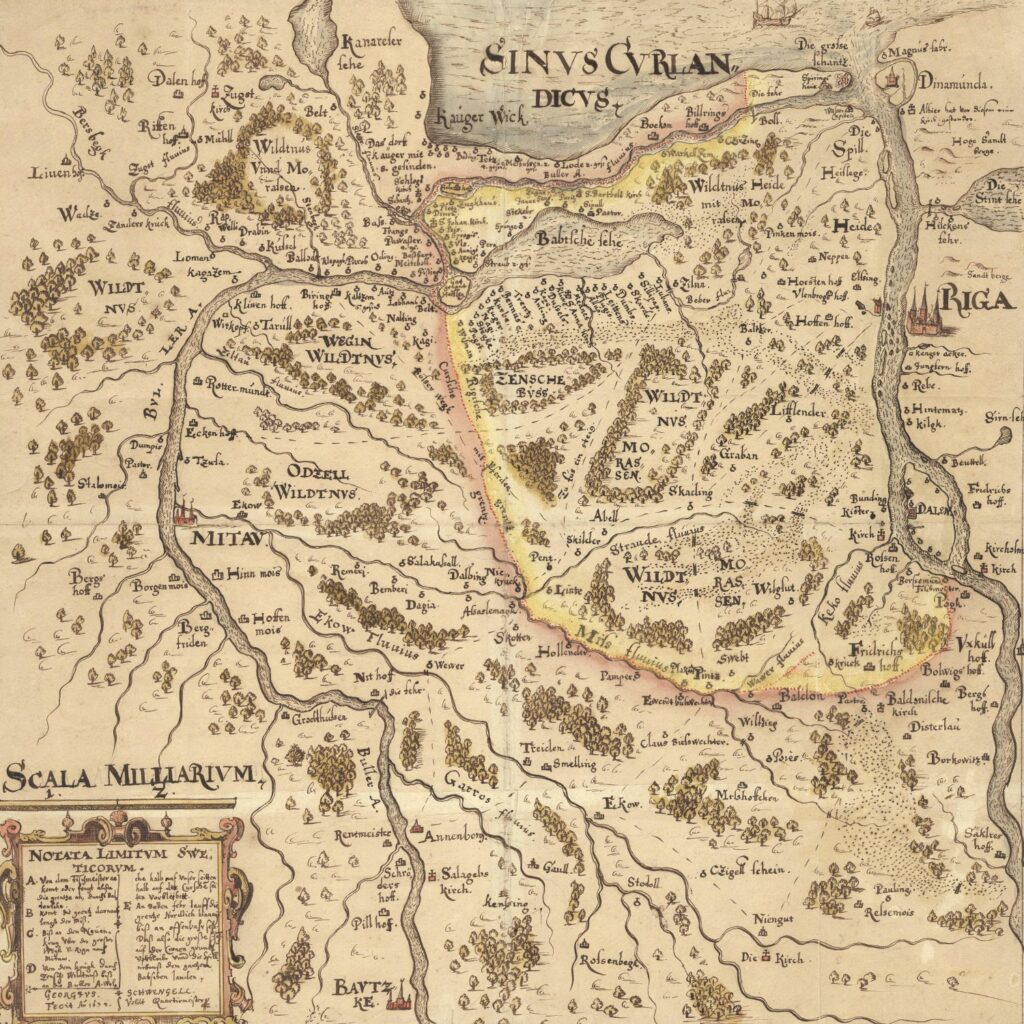
The area south of Riga, including Bauska (“Bavtzke”) in the lower-left corner and Riga in the top right, 1634.
The next morning, they travelled three miles and arrived in the small town of Bautschburg (Bauska). The town was in the Duchy of Courland and had a castle. According to Kiechel, the castle was in bad shape. The Duke of Courland had his residence in the town of Mittau (Jelgava) seven miles away, but Kiechel wrote that he did not visit this town because it was not on his route. However, our traveller learnt that the Duke of Courland was a Westphalian nobleman from the Kettler dynasty and not born to the title. He also noted that the people of this land spoke their own language, which was quite different from Lithuanian.5
The Duke of Courland was Gotthard Kettler (1517-1587). He had been the last Master of the Livonian branch of the Teutonic Order. During the Livonian War (1558-1582), the Livonian confederation, a mixture of free cities, the Livonian branch of the Teutonic Order, the Archbishopric of Riga and the three Bishoprics of Courland, Dorpat and Ösel-Wiek, could not withstand Russian attacks and fell apart. Gotthard Kettler decided to convert to Protestantism and to make the Order’s remaining territory into a Duchy. He sought the protection of the Kingdom of Poland and the Grand Duchy of Lithuania. In the Treaty of Vilnius of 1561, Kettler, as Duke of Courland, became a Polish vassal.
The travellers stayed in Bautschburg until lunchtime because it was Sunday. They had some food and beer and bought provisions for the remainder of the journey to Riga. They left in the afternoon and travelled through pleasant and fertile countryside. But the land was not very populated. The group spent the night again in a field, but the weather had changed, and it was raining heavily. The travellers had to spend the night under their carts, where it was somewhat dry.
The following morning, they left early because the rain had woken them up. It continued to rain throughout the day, and Kiechel’s clothes were soaked. In the afternoon, they arrived close to Riga. The last obstacle was a wide river, the Düna (Daugava). The river had to be crossed by ferry, and the travellers got off their carts. The carts and horses had to stay on this side of the river, and all goods that arrived from Vilnius and other places in Lithuania had to be loaded on boats.6
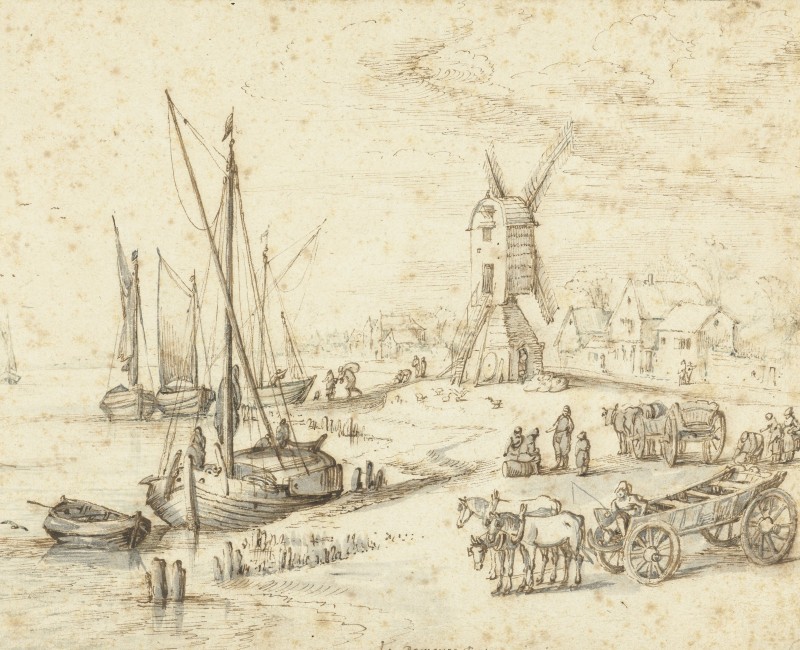
Kiechel was astonished by the river’s size. He wrote that it was about a quarter of a mile wide. When they crossed it, the wind picked up, and the water got so rough that Kiechel became afraid. The boat on which they crossed the river was small and shabby. Nevertheless, the travellers arrived in Riga in the evening.
Illustrations & References
All images are in order of appearance with links to sources on external websites:
- Vilnius, in: Braun, Georg, Hogenberg Frans: Civitates Orbis Terrarum (3), Cologne 1593, fol. 59v; Heidelberg University.
- Luyken, Caspar, De Leerbereider, 1694; Rijksmuseum Amsterdam.
- Bueckelaer, Joachim, The Well-stocked Kitchen, 1566; Rijksmuseum Amsterdam.
- van Ruisdael, Jacob Isaacksz, Village Road, 1660 – 1665; Rijksmuseum Amsterdam.
- Schwengell, Georgius, Riga – Schlock – Mitau – Bauske – Üxkull, 1634; Swedish National Archives, Stockholm.
- Brueghel, Jan, Een molen aan een drukbevaren rivier, 1620; Rijksmuseum Amsterdam.