
Journal of Samuel Kiechel
26 June – 1 July 1586
From Grodno to Vilnius
“I left Grodno with a Tatar. He had a wretched-looking horse and a cart. Many Tatars live in this land and work mostly as carters. They carry people and goods from place to place for little money.”
Die Reisen des Samuel Kiechel aus drei Handschriften, K. D. Haszler (ed.), Stuttgart 1866, p. 101; Bayerische Staatsbibliothek.
In Grodno
Having crossed the dense forests of the wilderness, Samuel Kiechel arrived in Grodno (Hrodna). He wrote that the city was unfortified, on the banks of the river Memel (Neman, Belarus: Nioman, Poln.: Niemen, Lith.: Nemunas). Our traveller heard that the Memel flows towards Kaunas in Lithuania and that it is possible to continue along the river to Königsberg. The Polish King had a residence in Grodno. His palace had been recently rebuilt, and construction was not yet finished. Kiechel learnt that the King spent much time in Grodno because the surrounding countryside was ideal for hunting. Sometimes he went hunting for eight days without returning to the city.1
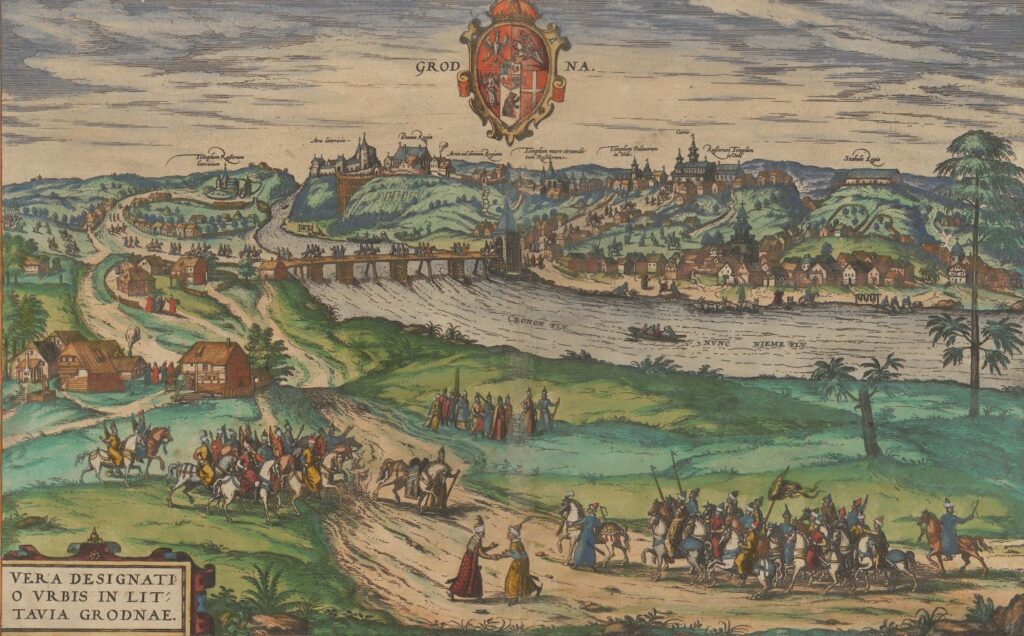
Grodno, 1568
A profile view of Grodno appears in volume two of the Civitates Orbis Terrarum. The image presents the city from the south-west. Grodno is unfortified and looks rather small and spread out. The castle is in the centre of the view, on a low hill behind the bridge across the Neman River. The view also includes three Russian Orthodox churches and one Polish Catholic church. Many figures are seen in the image. A large group of horsemen crosses the bridge, and in the foreground, two groups of riders meet. The clothing of those two groups appears to be in the fashion of Eastern Europe and the Ottoman Empire.
The view in the Civitates is a reworked copy of an engraving by Matthias Zündt of Nuremberg, dating to 1568. Zündt had made this panorama to commemorate the assembly of the representatives of the estates of the realm called by Sigismund II Augustus (1520-1572), King of Poland, in 1567 in Grodno. A small text at the upper right edge of Zündt’s view informs the reader that embassies from Muscovy, the Ottoman Empire, the Tatars (Crimean Tatars) and Wallachia had also arrived.
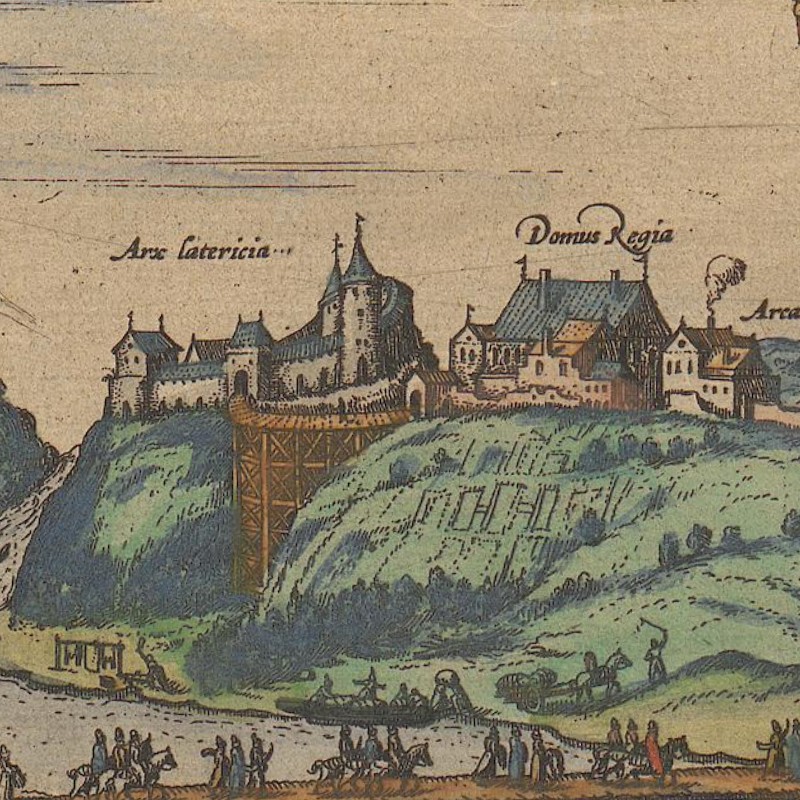
Grodno Castle
Grodno Castle was originally built as a wooden fort in the eleventh century, rebuilt as a stone structure in the fourteenth century, and again during Stephen Báthory’s rule in the sixteenth century. The royal palace in Grodno is on a hill in the centre of the view. But it is still the old medieval building, as the original view was made before Stephen Báthory ordered its reconstruction in Renaissance style.
Grodno, with its central location within the Polish-Lithuanian Commonwealth, access to river transport and trade along the Neman, and the rich hunting grounds of the former wilderness west of the river, became a popular residence for various monarchs. In this wilderness, large animals such as the aurochs and the European bison could still be found and hunted. As Kiechel noted, the king (Stephen Báthory, 1533-1586) spent much of his time in Grodno, making it the de facto capital of the Commonwealth.
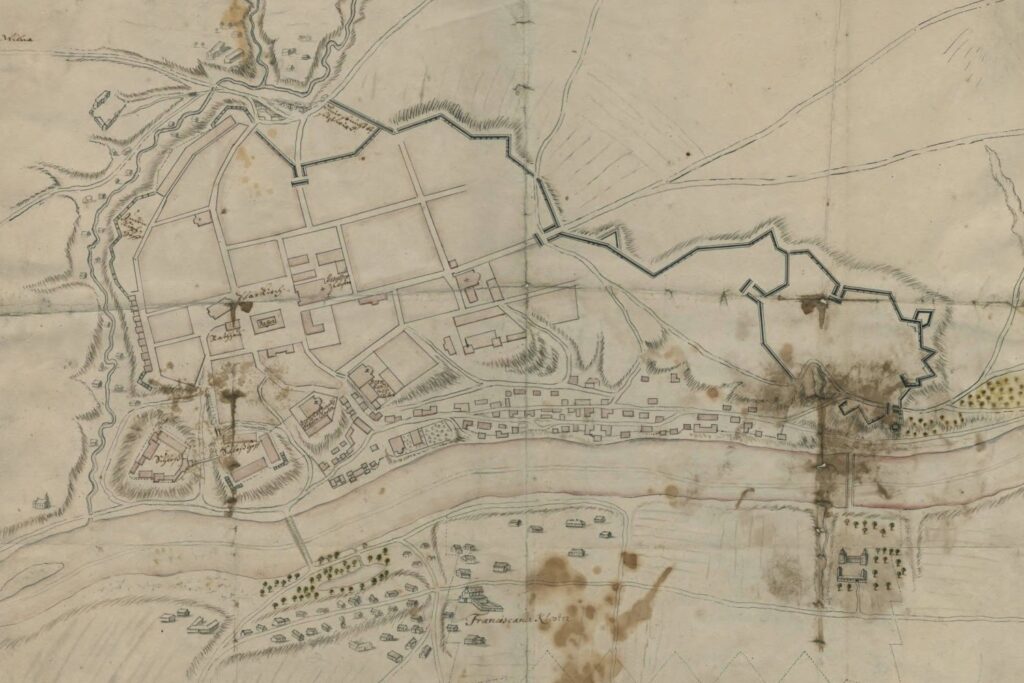
Grodno, 1655
Watching the King
Samuel Kiechel further noted that King Stephen Báthory was in Grodno at the time of his visit. Our traveller witnessed him riding from his residence to the church. Kiechel wrote: The King is a good-looking man; he is tall and strong. His clothing is in the country’s fashion. He wears a small Polish hat with a thick plume of black heron feathers. When he rides from the castle to the church, he does so in great splendour. In front and behind him ride many noblemen and knights. His guards line the street from the castle to the church. The guards are husars and hajduks; they are wicked, mean men. Their horses are beautiful and graceful, and their riding gear is exquisitely decorated. The Poles like to invest in such splendour.2
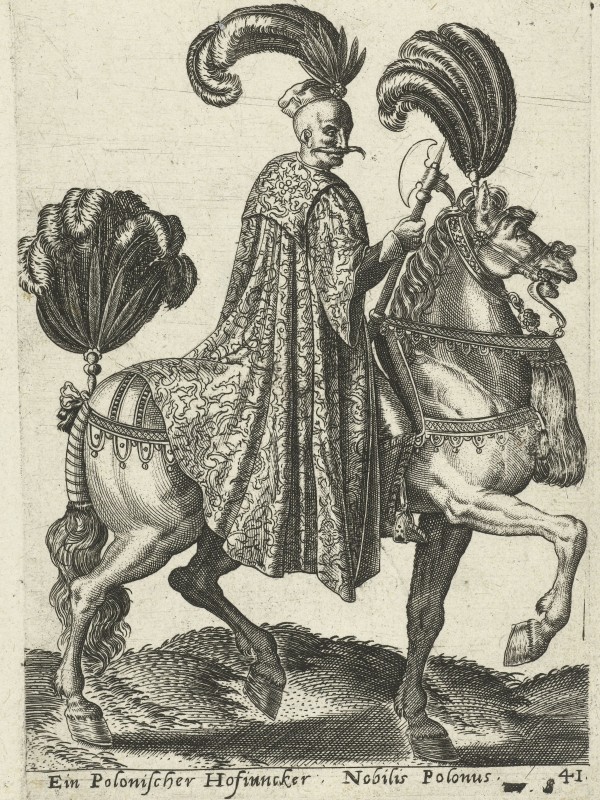
Polish nobleman, 1577
Husars were originally light cavalry units from Hungary. Hajduks were Hungarian irregular infantry, border guards, and, in the eyes of the Ottomans, bandits. That Hungarian troops were in Grodno as the king’s guards was tied to Stephen Báthory’s origins. His family was Hungarian nobility, and before he was elected as King of Poland and Grand Duke of Lithuania in 1576, he was the Voivode of Transylvania.
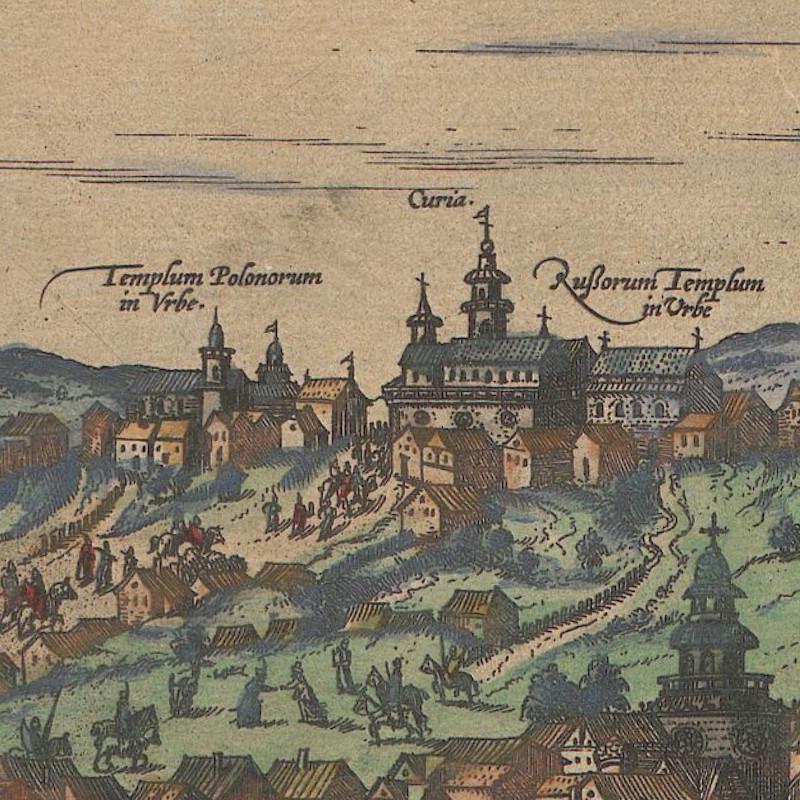
The Polish (Catholic) church and one of the Russian (Orthodox) churches in Grodno. Stephen Báthory presumably went to the Catholic church,
Kiechel went into the church, where the king was listening to a Latin sermon. The service took one hour. Afterwards, when the king rode back to the castle, our traveller saw the artist Scotus, who was at the time in the king’s service. According to our traveller, he was a well-known artist. He rode with other members of the court in front of the king. His position in the entourage of Stephen Báthory was a sign of the high favour the artist enjoyed.3 (I could not find anything about this artist.)
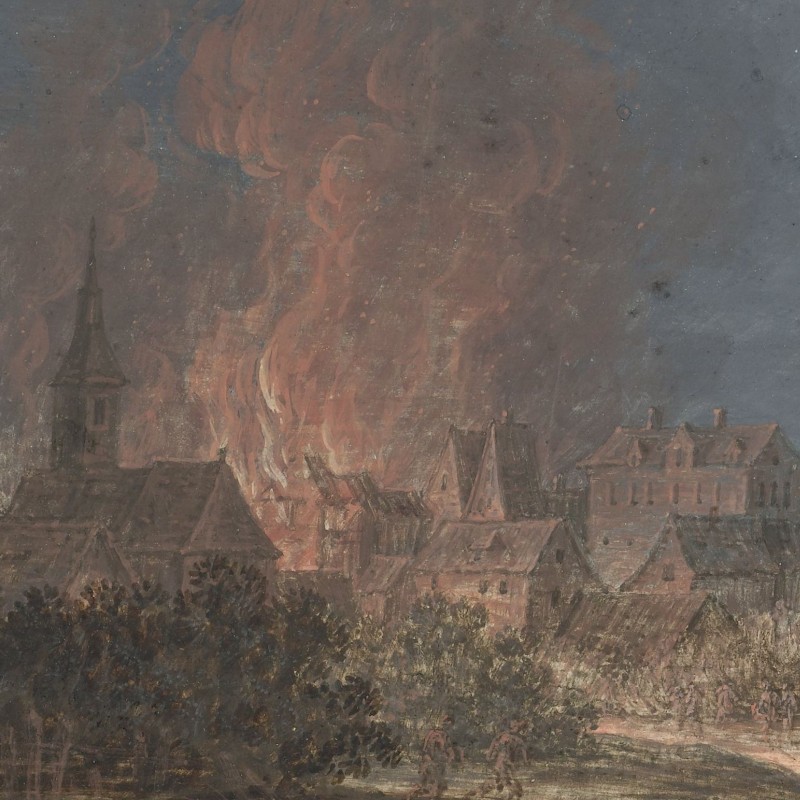
Stephen Báthory spent the whole Sunday in Grodno and gave audiences. The following morning, 27 June, he went hunting. In the afternoon of that day, a fire broke out in the quarters of the artist Scotus. The fire was noticed, and bells were rung in alarm. This led to some turmoil because initially no one knew what the ringing of the bells meant.4
Kiechel followed others and ran towards the castle. He saw the fire had already reached the roof and guessed that, in the heat and smoke, no one could survive there for long. But then Scotus climbed out of the building and onto the roof.5
The fire was soon extinguished with much help. Kiechel wrote that if the wind had blown the fire into the city, it might have burnt it down, as most buildings were made of wood. The roofs of the houses were covered with wooden tiles, as was the roof of the large church.6
Departure
Samuel Kiechel left Grodno on the evening of 28 June. He had hired a Tatar with a cart and a wretched-looking horse to take him to Vilnius. Many Tatars live in Lithuania, Kiechel wrote. They mostly work as carters, providing transport for people and goods for little money.
Kiechel mentions that he was unable to speak with the Tatar. Another Tatar with his cart travelled with them, and he had a Polish student as a passenger. To talk to the student, Kiechel had to use Latin.
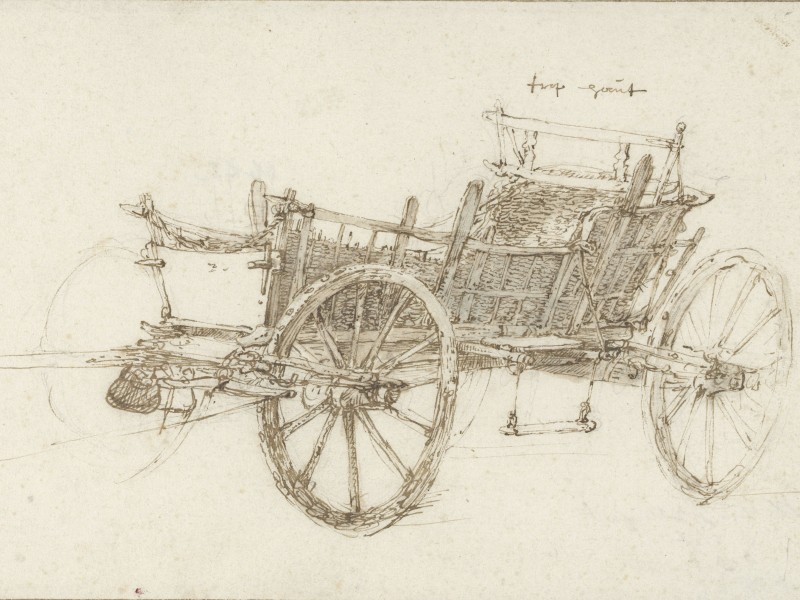
Kiechel described the Tatars’ cart. It was called a “Coless”. These vehicles were small and narrow, and only one horse was used to pull them. Not more than one passenger could ride in it. But the cart was seven feet long, and during the night, a person could lie down on it. The vehicle had four wheels of the same type made from strong willow bent into a circle. Nothing on the “Coless” or the harness of the horse contained iron, rope or leather. The cart was made of wood, and the harness was of braided bast fibres. This was done because there were so many forests in Lithuania that a Lithuanian sitting in a tree would make himself a pair of shoes and all the equipment for his horse from bark and bast fibres, and braid them together.7
Tatars in Lithuania
While fighting the Teutonic Order in the west, the Grand Duchy of Lithuania expanded eastward deep into what is today Belarus, Ukraine and western Russia. The Lithuanians took advantage of the aftermath of the Mongol invasion in the thirteenth century, which destroyed the empire of the Kyivan Rus’. The Lithuanian dukes were flexible in their strategies. In addition to military conquest, marriages and treaties were used to expand the Duchy. Naturally, this expansion brought Lithuania into contact with, and occasional conflict with, the Golden Horde, the successors of the Mongols. From the fourteenth century onward, Tatars from the Golden Horde, and after it fell apart, its successor Khanates (foremost the Crimean Khanate) came to Lithuania as mercenaries. The last Khan of the Horde, Tokhtamysh, even fled with his followers to Lithuania after being defeated in 1398.
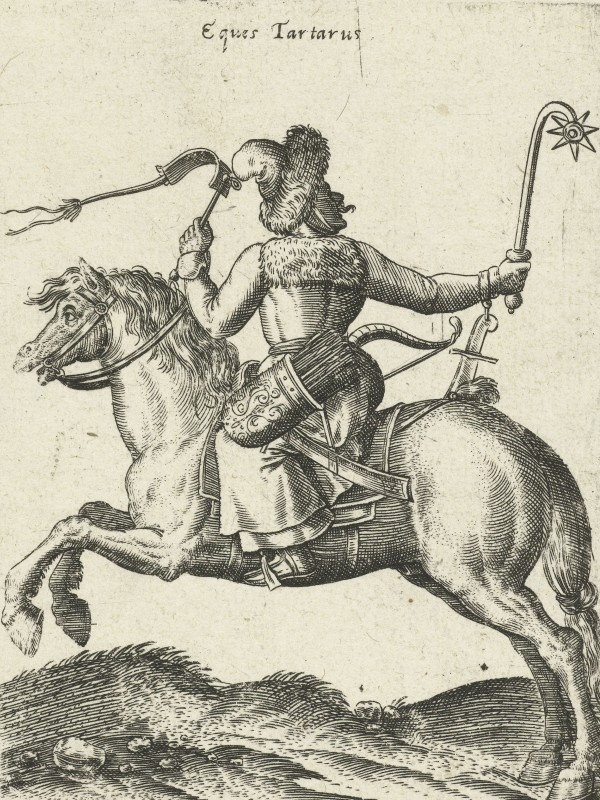
Tatar horseman, 1577
The Tatars were settled south of Vilnius, and their communities still exist today. Villages such as Keturiasdešimt Totorių (Forty Tatars) are a reminder of their long history and legacy in the Duchy.
Travelling to Vilnius
At night, Kiechel and the Tatar arrived in a village called Ostscha (?), two miles from Grodno, where they spent the night.
Kiechel noted that the Tatars don’t stop at lunchtime to feed their horses, and a traveller needs to be prepared and has to take provisions with him. However, when they come to a nice meadow or a bit of woodland, they like to unhitch the horse from the cart and let it graze there. During the summer months, they often spent the nights outside in the fields. In dry weather, they sleep on their cart, and in rainy weather, they sleep under it.8
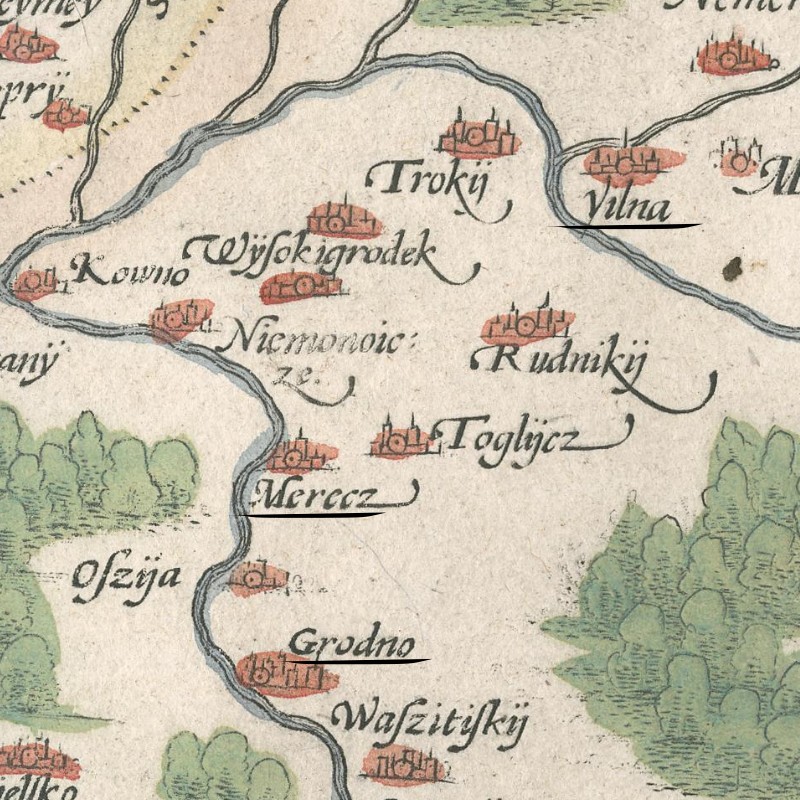
Map segment with Grodno, Merkinė (Merecz) and Vilnius (Vilna)
The travellers arrived in Merkinė in the evening, ten miles from the village where they had set out in the morning. Kiechel could not find accommodation in the town because the inn was full. He had to sleep outside and without dinner.
Early in the morning on 30 June, Samuel Kiechel and his Tatar left Merkinė. When they were a mile from the town, they saw the carriage of the lord of Merkinė, a Polish nobleman, coming from the opposite direction. Six horses pulled his carriage, and another twenty were herded in a field beside the road. The carriage stopped beside the cart, and the nobleman asked Kiechel who he was, where he came from, and where he intended to go. As he spoke Polish, Kiechel did not understand a word and could not answer. The nobleman called for a servant who spoke German, and our traveller answered all the questions. Afterwards, Samuel was allowed to continue.
But this was not the end of the encounter. When Samuel Kiechel and the Tatar had travelled just two or three gunshots (ca. 700 metres), the nobleman’s servant came running after them. He reprimanded Kiechel for having spoken to such an important nobleman without getting off his cart. The nobleman felt insulted and ordered his servant to beat Kiechel off the cart. But by then Samuel had already got out of the cart by himself. He begged the servant to pardon his behaviour and explained that he had not been aware of the custom that people had to get out of their carts when they met someone in a field. Kiechel was so worried about the threat of violence that he continued to walk beside the cart until the nobleman’s carriage and the servant were out of sight.9
After reporting on this incident, Kiechel commented that the Poles were very prideful and wanton people, especially in their own land. He also wondered whether the servant had acted on his master’s orders or of his own volition.10
In the evening, Kiechel, the Polish student and the Tatars made camp beside a brook. They made a large fire and slept beside it. The Tatars let their horses graze all night.
The next day, when the group was only three miles from Vilnius, they came to an unpleasant stretch of forest where the road descended a very steep hill. At the bottom of the hill was a long valley with about thirty villages and smaller hamlets. The villages were mostly populated by Tatars who served the King of Poland. When the king demanded it, they had to go and fight in his wars.11
The long valley was likely the Vokė River valley just south of Vilnius. Along this river, the first Tatars settled in Lithuania in the fourteenth century.
Samuel Kiechel noted: The Tatars are rough, crude, but very tough people. When one of them has a horse that is too old to be used for anything, he will ride it for one or two hours until its muscles are warm and it begins to sweat. Then they cut the horse’s throat, butcher it and eat it. They use horses in the way people at home (Kiechel’s home) use oxen or other animals. The Tatars live a very wretched life.12
The travellers continued on their way and, after another two miles, arrived in Vilnius. Kiechel found accommodation in the house of a German man named Anthoni of Leipzig.
Illustrations & References
All images are in order of appearance with links to sources on external websites:
- Grodno, in: Braun, Georg, Hogenberg Frans: Civitates Orbis Terrarum (2), Cologne 1575, fol. 48v; Heidelberg University.
- Anonymous, Plan des Retrenchement fait devant Grodno par l’armée de la Majeste K Zariene, 1655; Swedish National Archives, Stockholm.
- de Bruyn, Abraham, Poolse jonker te paard, 1577; Rijksmuseum Amsterdam.
- Dietzsch, Barbara Regina, Brand in een dorp, 1677 – 1719; Rijksmuseum Amsterdam.
- van Ostade, Isaac, Een reiswagen, 1645 – 1649; Rijksmuseum Amsterdam.
- de Bruyn, Abraham, Tartaarse ruiter, 1577; Rijksmuseum Amsterdam.
- Ortelius, Abraham (ed.), Theatre of the World, Antwerp 1587, fol. 86v; Library of Congress.