
Journal of Samuel Kiechel
13 – 23 February 1586
From Jönköping to Norrköping
“I had a young, lively horse pulling my sledge. When we went downhill, the sledge struck the back leg of the horse. The startled animal began galloping down the slope at full speed. I was afraid for my life but could not disembark from the sledge.“
Die Reisen des Samuel Kiechel aus drei Handschriften, K. D. Haszler (ed.), Stuttgart 1866, p. 62; Bayerische Staatsbibliothek.
To Jönköping
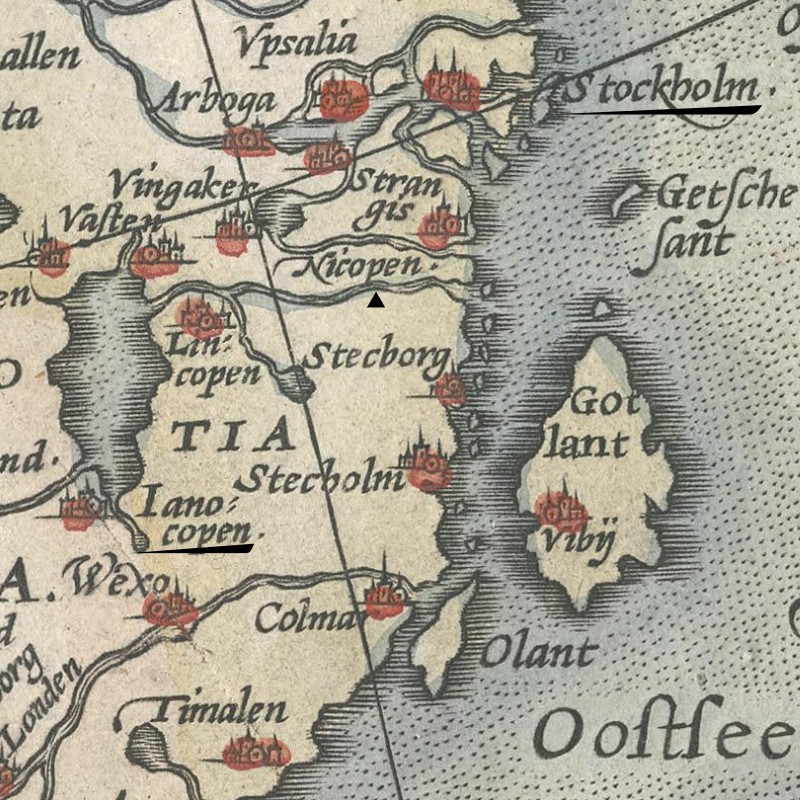
Southern Sweden between Jönköping (Ianocopen) and Stockholm; Norrköping is not on the map, but I marked its location with a black triangle
Samuel Kiechel and his two companions, merchants from Lübeck, continued their journey through Sweden. They left the house of the parish priest, who had allowed them to stay for one night, and travelled through barren, mountainous terrain. Whenever they saw a village or farmstead, it was typically surrounded by wilderness or positioned in a gap between mountains. All the travellers saw were forests, with no shortage of mountains and rock faces. In winter, the landscape was covered with ice and snow. Kiechel wondered what the people of these regions subsisted on and noted that the inhabitants rarely encountered foreigners.
During the day, the travellers passed three staging posts where they changed horses. From the context of Kiechel’s narrative, these staging posts were probably the appointed hosts mentioned earlier, who provided travellers with food, drink and transport. Referring to them as staging posts, “posten”1 in the journal, was likely due to Kiechel’s familiarity with the postal stations in Germany that offered similar services.
At the third staging post, the group received the last available horses. The peasant who supplied them sent two young boys to lead the animals back once the travellers had reached the next village. Kiechel noted that the boys were only about seven or eight years old.
They continued their journey but had not yet reached their destination when night fell. The travellers became lost in the darkness and spent two hours travelling through the night, trying to find the road again. Eventually, they arrived at a small hamlet with a mill and three or four farmhouses. One of the locals was a host but proved reluctant to assist due to the travellers’ late arrival. According to Kiechel, the hamlet was called Abüe (Åby?) and the group stayed there overnight.
Travelling at night was dangerous, especially if the travellers were unfamiliar with the area; travelling in Scandinavia during winter also meant dealing with short days. Olaus Magnus, who had explored further north in Scandinavia than Samuel Kiechel, wrote in the Historia de Gentibus Septentrionalibus that the local people gather rotting wood and bark from oak trees and place them at fixed distances along a pathway. He also mentioned a type of mushroom that grows on oak trees. At night, these things emit a faint light and help travellers to stay on the road.2
The rotting wood and bark contain fungi. The light is a byproduct of the fungi breaking down the wood for energy and food. This phenomenon is commonly known as foxfire or fairy fire.
Kiechel and his companions continued their journey the following morning. A pathway had been carved into the deep snow by other sledges, allowing for quicker progress than the previous day. Whenever possible, they used frozen lakes as roads. At the last stop, where the group changed horses, night was already falling. However, the three men still faced a three-mile journey across a high mountain.
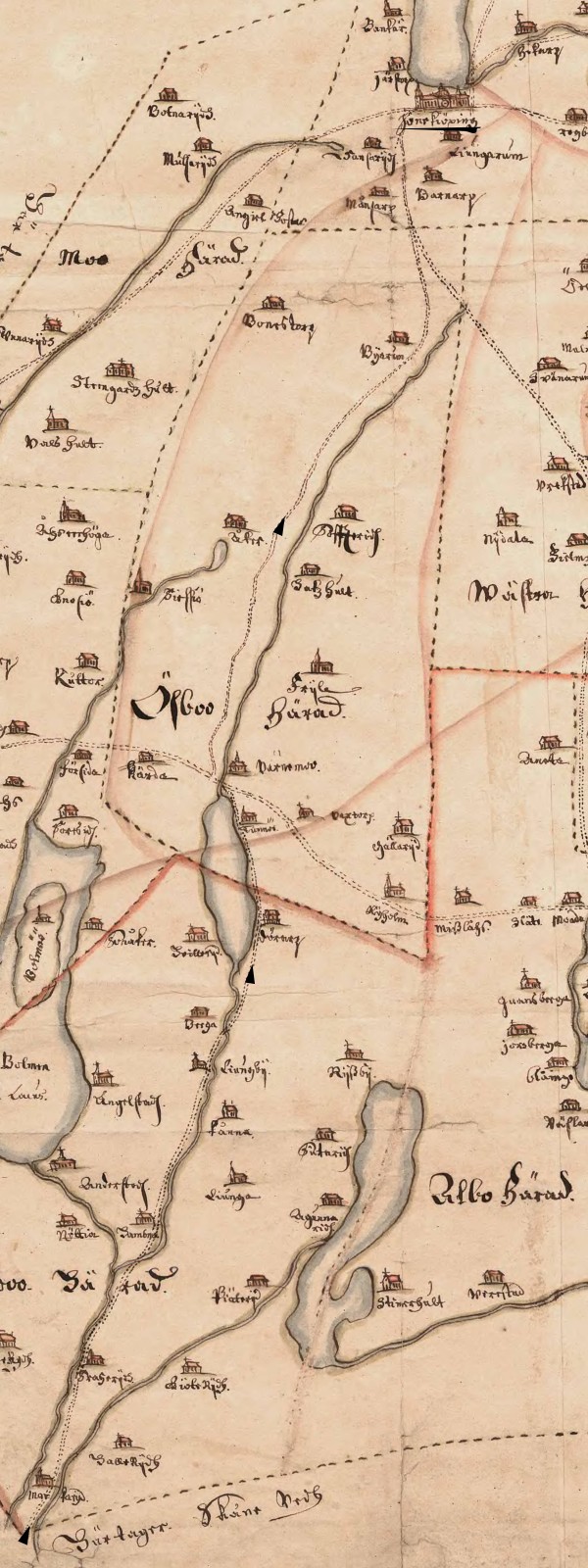
The likely route Samuel Kiechel took from the Danish border at the bottom of the map to Jönköping at the top
Kiechel mentioned that in this area, Swedish troops had taken positions when the Danes tried to enter the country. Tall fir trees grew there, and the Swedes had cut them down to block the pass and close the road. They further fortified their barricade with mounted guns and other weapons. This probably happened during the Northern Seven Years’ War (1563-1570), when many exhausting, inconclusive skirmishes took place between the Danish and Swedish armies.
Having reached the top of the mountain, the travellers faced a dangerous descent. The sledges were moving at a very fast pace, and the road was a hollow lane with no room for the horses to leave the track and slow down. Fortunately, the travellers arrived safely in the town of Jönköping at midnight.
Carnival in Jönköping
Jönköping is a major town in the Swedish province of Småland, situated on the southern tip of Lake Vättern. Samuel Kiechel and his companions spent the night there. The following day was a Sunday, and it was the festive season of Carnival (Shrovetide). Our traveller noted that it was widely celebrated throughout Sweden and observed that during this period, people prepared large quantities of food, including brawn, ham, pigs’ heads, tongue, smoked meat, bacon and other items. All this food had a long shelf life and would still be served a month or six weeks later, just as the travellers had been served meat on their journey that had been cooked around Christmas.3
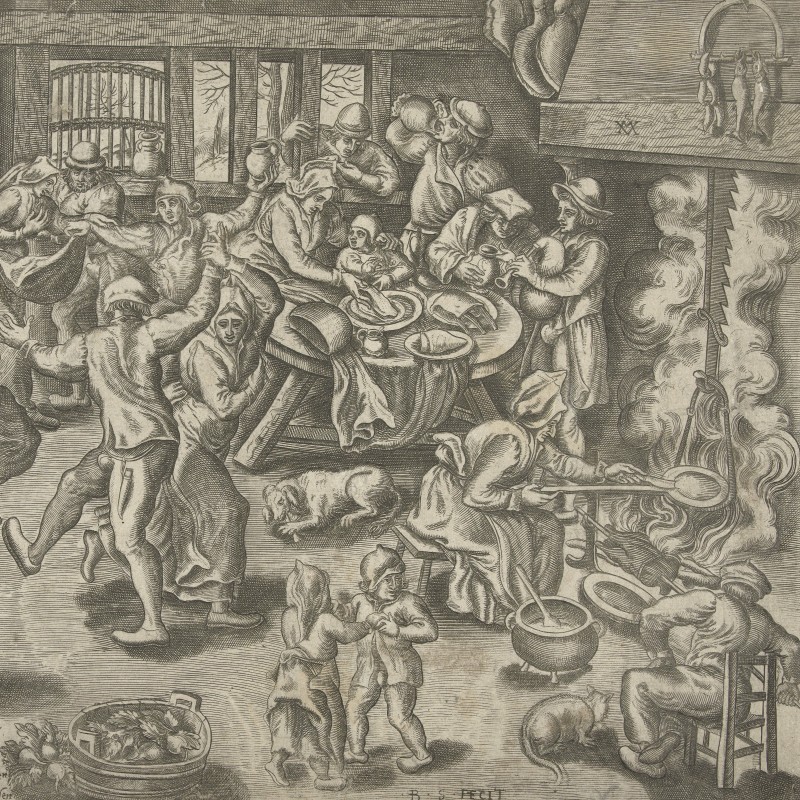
Carnival celebrations
For Christians, Carnival was a time for feasts, signalling that Lent, the traditional period of repentance and fasting, was soon to begin. All the food that might otherwise spoil was eaten. Our traveller mentioned that large quantities of food, especially meat, were prepared, primarily to preserve them. However, it is reasonable to assume that, given the limited preservation methods and the length of Lent (forty days), most of it was consumed during the Carnival festivities.
The clergyman Olaus Magnus disapproved of the carnival celebrations in Scandinavia, particularly the dressing up and foolish behaviour. He wrote that the wealthy cover their faces with black silk, dress up, wear golden and silver belts, and speak with altered voices. The common people follow suit, dressing up and acting foolishly. Butchers put horned skulls on their heads and make noises like goats or pigs. Fishermen walk around with their nets spread out. Such behaviour is permitted only during the six days before Lent begins.4
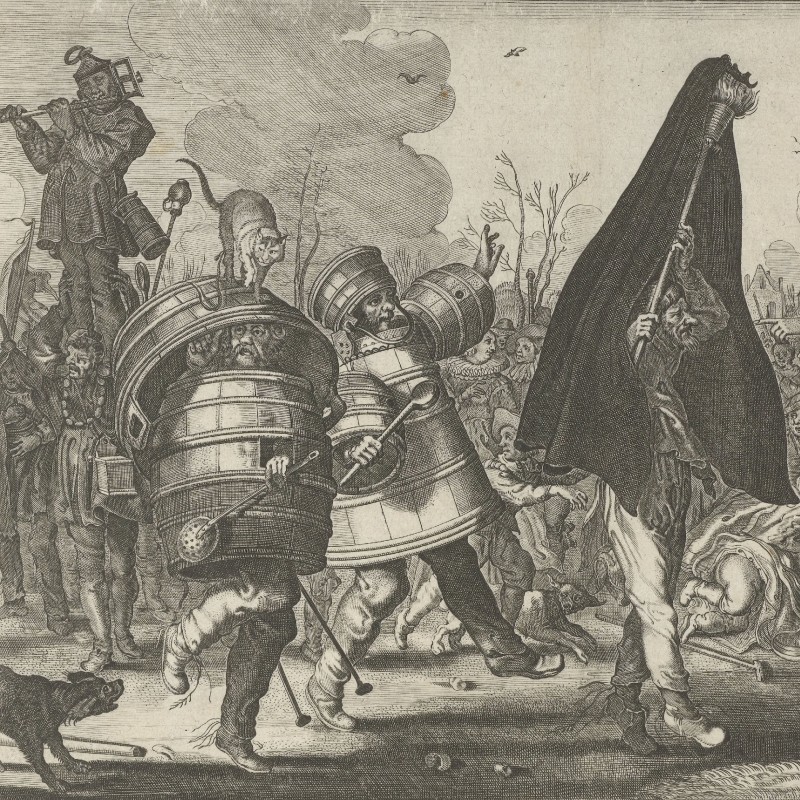
Carnival parade
Samuel Kiechel and his companions stayed at the house of the mayor of Jönköping, where they were also invited to lunch. Kiechel mentioned that the group carried a stock of beverages in nine glass bottles because wine or beer was unavailable in many parts of Sweden. They shared some of their drinks with their host, which was presumably much appreciated.
After lunch, the travellers hired horses for two miles and left Jönköping. Kiechel observed that the town was nestled in a valley, and as they departed, the road led back into the mountains. To the left of the road was a vast lake, one mile wide and eighteen miles long (Lake Vättern). According to Olaus Magnus’ Historia, Lake Vättern had very clear water with a light green hue. A prominent monastery was situated on an island within the lake, and on the northern shore lay rich ore mines.5
A Devastating Loss
After two miles, the travellers sent the horses back to Jönköping and hired new ones. Samuel Kiechel wrote that the horse harnessed to his sledge was small, brave, and full of energy. As they continued their journey, our traveller noted that he fell somewhat behind his companions. Suddenly, his horse sped up and chased after the other sledge. Kiechel couldn’t stop the animal; the sledge hit a stone, tipped over, and he fell out. However, the horse did not stop. It kept running, dragging the sledge behind it. When it reached the other sledge, Kiechel’s horse finally slowed and stopped.
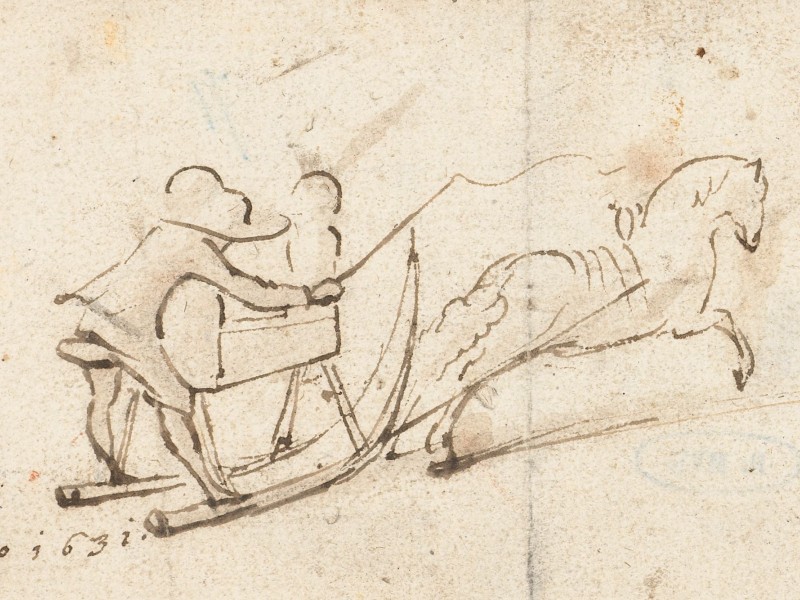
The crash had serious consequences. The group’s supply of beverages was in the sledge. Kiechel had secured it with some rope, but it had fallen out and was being dragged behind. Eventually, the rope snapped, and the store’s lock opened; three full bottles fell out and shattered. The loss of the bottles weighed heavily on the travellers.
In the evening, the group stopped in the hamlet of Gränna and resumed their journey the following day (14 February). They travelled along Lake Vättern and arrived at the house of a wealthy parish priest for lunch. The priest already had other guests, but the travellers were invited to join them. Food and drink were served, and they were treated very well before continuing.
More Difficulties and Accidents
In the late afternoon, Kiechel and his companions lost their way again. They reached a small river, but it was too deep to cross. The travellers could not see a bridge, so they followed the river. After some time, they heard dogs barking on the other side. Assuming there was a house or village nearby, they searched for a way to cross the river. Eventually, they found a bridge, but it was well past nightfall. On the other side of the river was a small hamlet where they stayed overnight in a peasant’s house. According to Kiechel, the hamlet was named Onsdau.
Wasting so much time getting lost led Samuel Kiechel to reflect on his experiences of travelling in Scandinavia so far. He wrote: It is difficult for a foreigner who does not know the roads or speak the local language. The peasants rarely accompany the horses they rent out, nor do they send a servant along. Often, only a small boy is sent to return the animals. These boys were poorly dressed, and Kiechel was surprised that they suffered no frostbite.
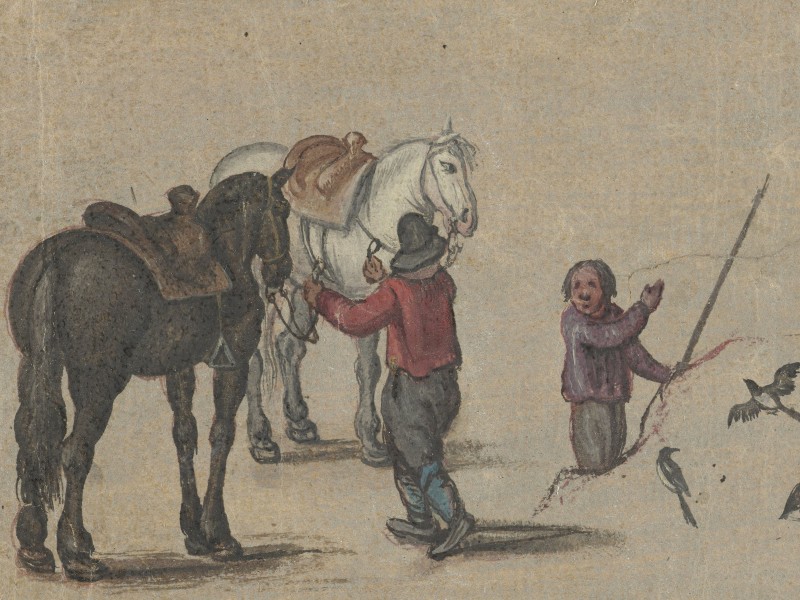
The three travellers continued their journey the following morning. Samuel had a quick and lively horse pulling his sledge. When they descended a hill along a sunken lane, the sledge bumped into the horse’s hind legs. Startled, the animal bolted and galloped at full speed down the hill. In the sledge, Kiechel was scared but did not dare to jump off because of the high speed. Fortunately, at the bottom of the hill was a frozen lake where our traveller could let the horse run until it tired and slowed down.
A quarter of a mile further along the road, the same thing happened again. But this time, there was no frozen lake, and the road led towards a bridge. Kiechel decided it was safer to jump off, as he feared he might otherwise be dragged into the water below the bridge. The horse continued at speed, and the sledge crashed into various obstacles. When the animal had calmed down and Kiechel had caught up to it, he inspected the sledge and found it too damaged to be of further use. To his relief, the group’s store of drinks was this time not on his sledge. It would have been destroyed, and they would have lost all their wine.
After another hour of travel, the three men arrived in Linköping. They did not stay but continued on their way, stopping in the evening in Söderköping. Both towns are in the province of Östergötland.
Söderköping and Norrköping
According to the journal, Söderköping is situated on an arm of the Baltic Sea that extends into the town. Despite its cold, rocky, desolate and mountainous landscape, the residents produce more food than they need. Consequently, large quantities of produce are exported to Lübeck each year. The grain exported from there is of higher quality than Polish or Lithuanian grain and commands a higher price.6
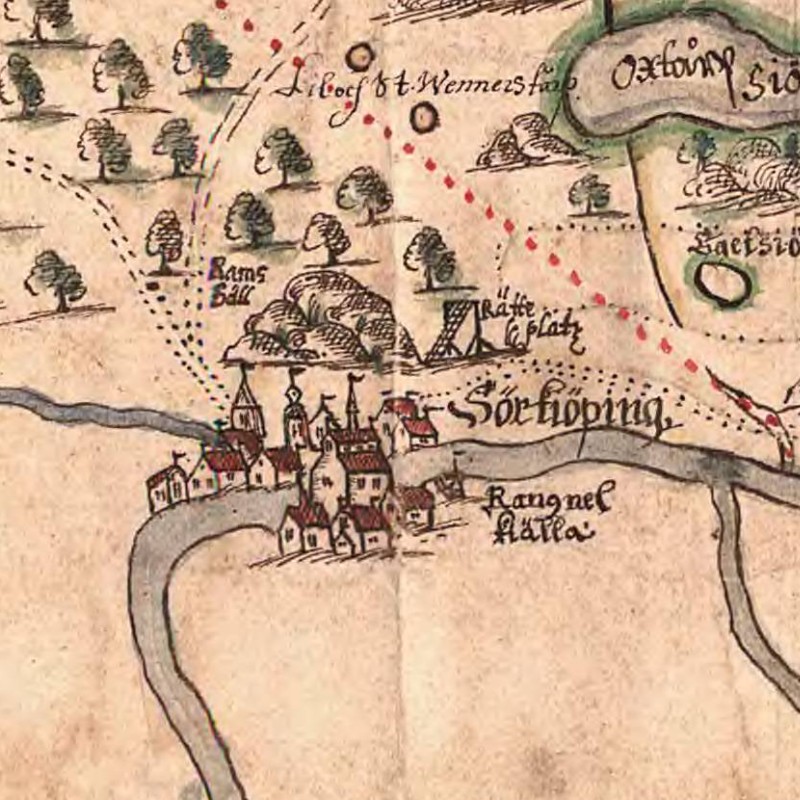
Söderköping, 1653
It may seem odd that Sweden’s cold countryside produces enough grain for export, but Olaus Magnus also mentioned this. In his Historia, he wrote that the locals cultivate rye, wheat, barley and oats.7 The land is dotted with mills powered, depending on location, by wind, water, man or horses. Most of the surplus grain is exported to Danzig (Gdańsk/Poland), a city specialising in grain trade. However, much is also exported to Portugal, Spain, France, England, Scotland, Holland and Brabant.8
Our traveller added that Söderköping is the most prestigious town in Östergötland. Near the town is a high, rocky hill with steep cliffs that resemble a wall. This hill was called Ramsberg (Ramunderberget). No vegetation is said to grow on or around it.
Kiechel stayed in Söderköping for a day because his companions had business there. In the afternoon of 17 February, the three men left and travelled the short distance to Norrköping.
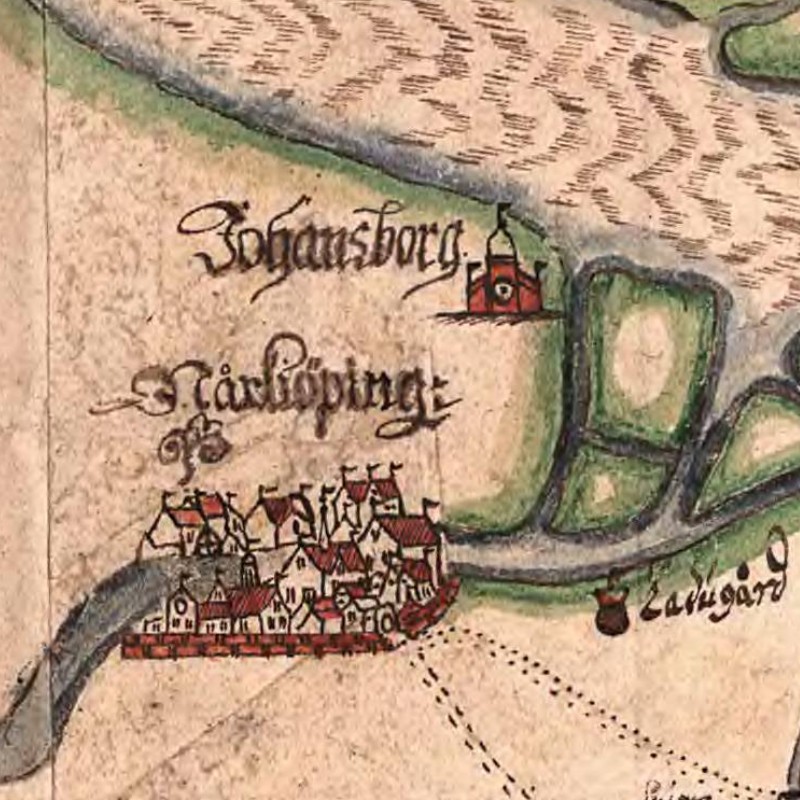
Norrköping, 1653
According to our traveller, Norrköping is situated on the shore of a large freshwater lake (Lake Glan). The lake measures twenty-eight Swedish miles in length and two to three miles in width. Its exit is immediately beside the city, where the water flows through rocks and around rocky outcrops, forming a large river that eventually enters the Baltic Sea. As the river makes its way to the sea, it descends from a high elevation. The rushing water powers numerous mills built along its banks.9 The river Kiechel described is the Motala Ström. It drops twenty-two metres through various waterfalls and rapids.
Samuel Kiechel further reported that salmon are caught in Norrköping. He learned that the salmon swim upstream against the current to reach the waterfalls, where they are caught in large numbers. Every year, many hundredweights are exported.
Illustrations & References
All images are in order of appearance with links to sources on external websites:
- van der Neer, Aert, Winter Landscape near a Town with Kolf Players and Horse-Drawn Sleighs, c. 1650 – c. 1655; Rijksmuseum Amsterdam.
- Ortelius, Abraham, Theatre of the World, Antwerp 1587, fol. 90v; Library of Congress.
- Anonymous, Småland och Öland, generalkartor; Riksarkivet Stockholm.
- van den Bos, Balthazar, Vastenavond, 1528 – 1580; Rijksmuseum Amsterdam.
- Anonymous, Carnavalsoptocht, 1625; Rijksmuseum Amsterdam.
- ter Borch, Gerard, Vier studies van een paard en arrenslee, 1631; Rijksmuseum Amsterdam.
- van de Venne, Adriaen Pietersz, Man twee paarden vasthoudend en een man bij vogels, 1600 – 1662; Rijksmuseum Amsterdam.
- Anonymous, Östergötland, detaljkartor, 1653; Riksarkivet Stockholm.
- Die Reisen des Samuel Kiechel aus drei Handschriften, K. D. Haszler (ed.), Stuttgart 1866, p. 60; Bayerische Staatsbibliothek. ↩︎
- Olai Magni historien, Der Mittnachtigen Länder …, Basel 1567, pp. 60f; Bayerische Staatsbibliothek. ↩︎
- Reisen des Samuel Kiechel, p. 61. ↩︎
- Magni historien, Der Mittnachtigen Länder, p. 361. ↩︎
- Ibid., p. 63. ↩︎
- Reisen des Samuel Kiechel, p. 63. ↩︎
- Magni historien, Der Mittnachtigen Länder, p. 326. ↩︎
- Ibid., pp. 332f. ↩︎
- Reisen des Samuel Kiechel, pp. 63f. ↩︎