
Journal of Samuel Kiechel
25 November – 19 December 1586
In Venice
“Just above the main door where you enter St. Mark’s Church are four beautiful, artfully cast metal horses, all the same size but each in a different posture, very delicate and well made. They once stood in Constantinople, in Galata, opposite the city, where mostly Christians live. The Venetians conquered them and took the horses to Venice.”
Die Reisen des Samuel Kiechel aus drei Handschriften, K. D. Haszler (ed.), Stuttgart 1866, p. 160; Bayerische Staatsbibliothek.
The Basilica
Beside the Doge’s Palace, St. Mark’s Basilica was a major attraction for visitors to Venice. Samuel Kiechel described it as an impressive yet delicate building. Above the main entrance to the basilica, Kiechel saw four well-crafted, delicate metal horses. They were all the same size, but each stood in a different posture. Our traveller heard they were from Galata, a part of Constantinople where most Christians lived. The Venetians had conquered the city and taken the horses with them.
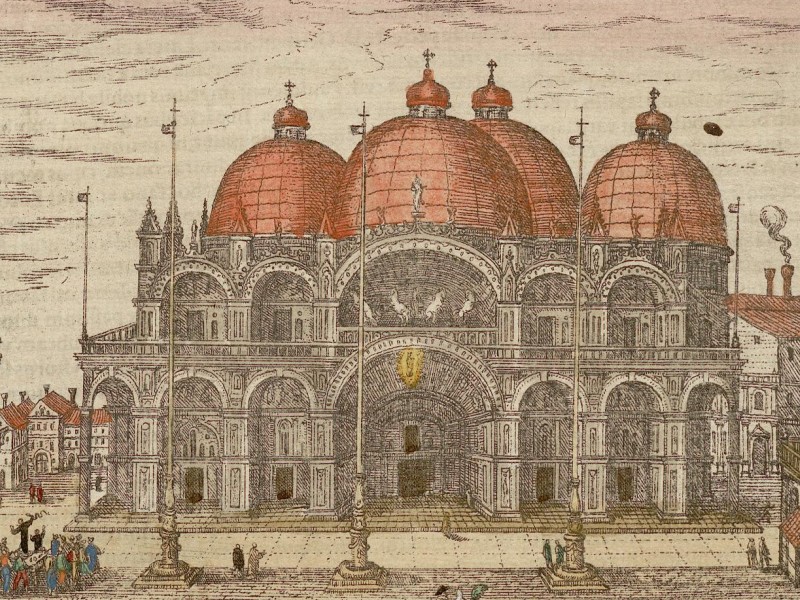
St. Mark’s Basilica, 1599
Inside the church, Kiechel noted that the walls, pillars and floor were made of marble. The vaulted ceiling was decorated with mosaic scenes set against a gold background. At the entrance to St. Mark’s, Kiechel was shown a large jasper. He estimated that it was one and a half feet long and half a foot wide. He heard that the gemstone was valued at 5000 Thaler.
Furthermore, Kiechel was told that the body of St. Mark, martyred in Alexandria, Egypt, was buried in the church. St. Mark was the patron saint of Venice, and his feast day (25 April) was always widely celebrated.1
I have written in the past about the difficult issue of the calendar in the sixteenth century. As a Protestant, Samuel Kiechel used the old, no longer astronomically correct Julian Calendar, while Catholic territories had adopted the new Gregorian Calendar. To avoid mistakes on my part and confusion for those who read the journal, I use the dates Kiechel recorded in his journal throughout this project (Julian Calendar). Our traveller wrote that he spent 25 November to 18 December in Venice. Italy was Catholic, so for the city’s inhabitants it was 5 to 28 December, which meant Kiechel spent Christmas there.
Samuel wrote that, on 15 December according to the old calendar and 25 December according to the new, the Venetians celebrated Christmas. He witnessed the celebrations and watched the Doge and the Venetian nobility leave the palace and walk to St Mark’s Basilica for Mass. It was pleasant to watch. Kiechel observed that no other Christian place had so many beautiful older people. The splendour of the procession was impressive. In the church, the altar of St Mark’s was decorated with gems and other items from the treasure chamber. In the afternoon, beautiful music was played.
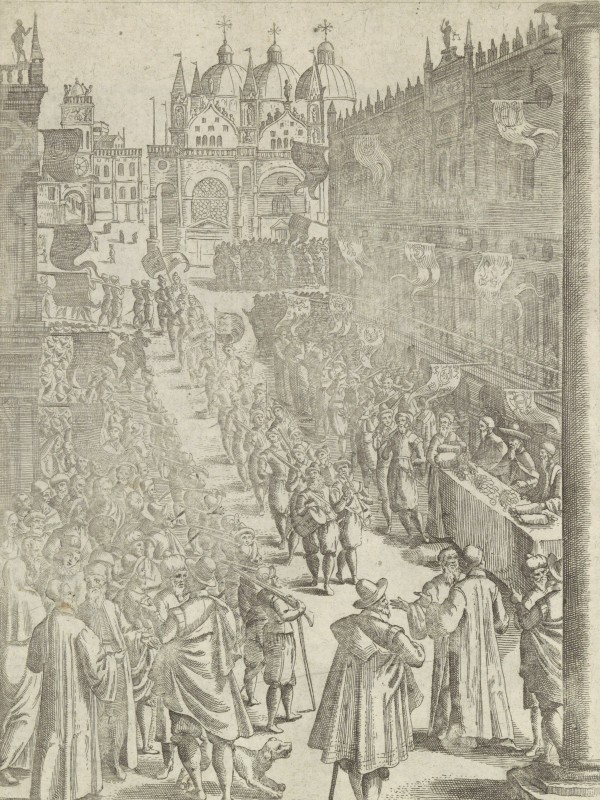
During this festive day, three large banners were raised on St Mark’s Square. According to the journal, the three banners showed the coats of arms of three kingdoms: Venice, Crete and Cyprus. But because Cyprus was no longer under Venetian rule, a banner celebrating the victory over the Turks at sea was shown instead.2
Venice, St. Mark’s and Byzantium
Samuel Kiechel’s comments on the basilica are frustratingly brief. I can only assume our traveller was overwhelmed and struggled to put his impressions on paper. The church remains as spectacular today as it was when he visited.
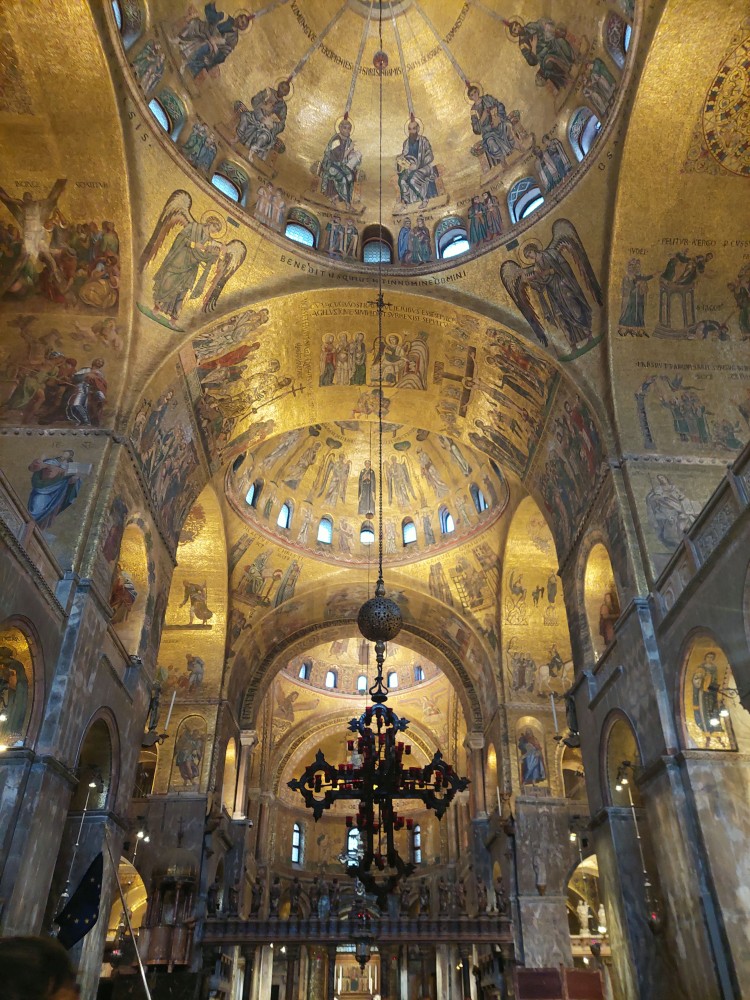
Inside St. Mark’s Basilica (Since there are no sixteenth-century images showing the interior of the church, and since it has not changed much since then, I used some modern photos.)
St. Mark’s Basilica is a unique church. It was modelled on the Church of the Holy Apostles in Constantinople and blends Byzantine, Romanesque and Gothic architectural styles. The first church at this site was built in the ninth century. After a fire destroyed most of it, it was rebuilt in the tenth century. The current building dates from the eleventh century, when St. Mark’s was extensively rebuilt and expanded to reflect the growing prosperity and power of the city and its population.
The interior of St. Mark’s is, as Samuel Kiechel wrote, covered with gold-ground mosaics. According to a modern guide to the church, the mosaics cover about 8,000 square metres across the domes, arches, vaults and walls. The mosaics are in a distinctly Byzantine style and technique. The tiles, called tesserae, were made of gold leaf enclosed in two layers of glass and cut into small squares.3
Work on the interior began in the eleventh century, following the extensive reconstruction programme. Artists from the Byzantine Empire, as well as local craftsmen trained in the style, set the mosaics. With some reconstructions, replacements and repairs, work continued through the centuries, but by the time of Samuel Kiechel’s visit, most of the interior decoration must have been in place and not dissimilar to what we can still see today. Used to the comparatively drab decoration of the churches north of the Alps, the splendour of St. Mark’s must have been breathtaking to our traveller. It was not just the intricacy of the mosaics depicting the life of Christ and the fact that the place was coated in gold. The glass-covered tiles of the mosaics reflected the light. Set at slight angles rather than on a flat surface, each tile reflected the light differently, giving the interior a consistent sparkle that dazzled visitors.
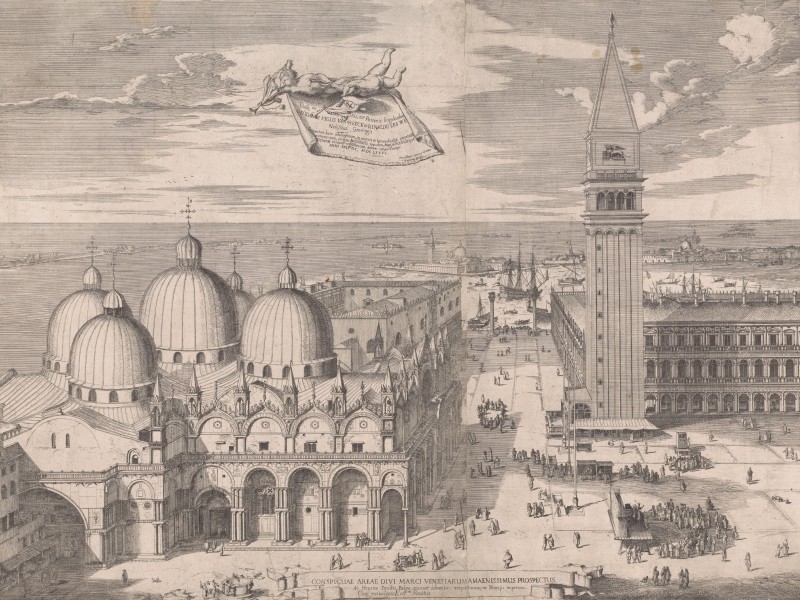
The predominance of Byzantine art in St. Mark’s reflects Venice’s long historical connection to the Eastern Roman (Byzantine) Empire. In the tumultuous centuries after the fall of the Western Roman Empire in Italy, the area around the lagoon remained one of the last Byzantine outposts, part of the Exarchate of Ravenna. The lagoon’s inaccessibility likely spared its small settlements the fate that befell other territories. At the periphery of the Eastern Empire, itself beset by external threats and internal divisions, and under pressure from its neighbours (Lombards, Franks), a strong sense of autonomy developed among the people of the lagoon. The Exarchate of Ravenna fell to the Lombards in the eighth century, but by then Venice was, for all intents and purposes, independent. However, the connection with Constantinople, the capital of the Byzantine Empire, was never severed.4
With its small territory, the Republic’s economy was built on maritime trade. From the Adriatic, enterprising Venetian merchants spread to trading ports in the east. Constantinople was a major port of call. Throughout the Middle Ages, the city on the Bosporus was the largest, most prosperous and most cosmopolitan place in Europe. It preserved a Roman self-image that all the younger kingdoms in Western Europe, with their barbaric origins, could only dream of. For Venice, as part of the Byzantine Empire, Constantinople represented the richest available marketplace, and many leading Venetian families developed strong ties to the city, with family members receiving Byzantine court titles. But not only valuable exotic merchandise flowed from Constantinople to Venice. Artistic and cultural influences also spread.
The Venetians offered naval support to the Byzantine Empire, and when the Normans, who had just conquered Sicily, launched a large invasion of Greece in 1081, Venetian ships helped to fend them off. In return for this support, Emperor Alexios I Komnenos (1057-1118) granted Venice unprecedented privileges in the empire: the Venetians were no longer considered outsiders and were exempt from the merchandise tax and other dues.
These privileges deepened the relationship between the Republic and the empire. During this period, work on the mosaics in St. Mark’s took place, and a new altarpiece was commissioned from Constantinople to be integrated into the existing tenth-century altar. The altarpiece, the Pala d’Oro, is considered a masterpiece of Byzantine craftsmanship.
But the good times ended in the late twelfth century. Venice was locked in a long-running feud with Genoa and Pisa over access to trade in the eastern Mediterranean and the Black Sea. Violent confrontations between the Italians were not uncommon, and when the Venetians attacked the Genoese quarter in Constantinople and refused to pay reparations afterwards, Emperor Manuel I Komnenos (1118-1180) had all Venetians arrested (1171). The event did not lead to a permanent break because many Venetian families had vested interests in the empire, but by the time a new agreement was reached and the Venetians returned (1187), the situation in Constantinople had fundamentally changed. Emperor Manuel had died in 1180, and his underage son and successor, Alexios II, had been murdered by Manuel’s cousin, Andronikos. Under Andronikos’ rule, the Genoese and Pisans in the city were massacred (1182) before the deeply unpopular emperor was himself deposed and killed in 1185. The new emperor was Isaac II Angelos, who was deposed and imprisoned by his brother in 1195. Isaac’s son Alexios fled Constantinople to Venice, where he began promising the cash-strapped participants of the Fourth Crusade rich rewards for returning him to the throne.5
Venice and the Spoils of the Fourth Crusade
Samuel Kiechel noted that he saw four finely crafted, delicate bronze horses above the main entrance to St. Mark’s Basilica. He learnt that they were from Galata, a part of Constantinople, and that the Venetians had conquered Galata and taken the horses.
Galata was the Genoese quarter, located on the other side of the Golden Horn from Constantinople. The horses, dating back to the second or third century, were not from Galata but probably stood at the Hippodrome in the city. They, together with an enormous amount of other precious items, were among the loot the Venetians brought home after Constantinople was captured and sacked in the Fourth Crusade.
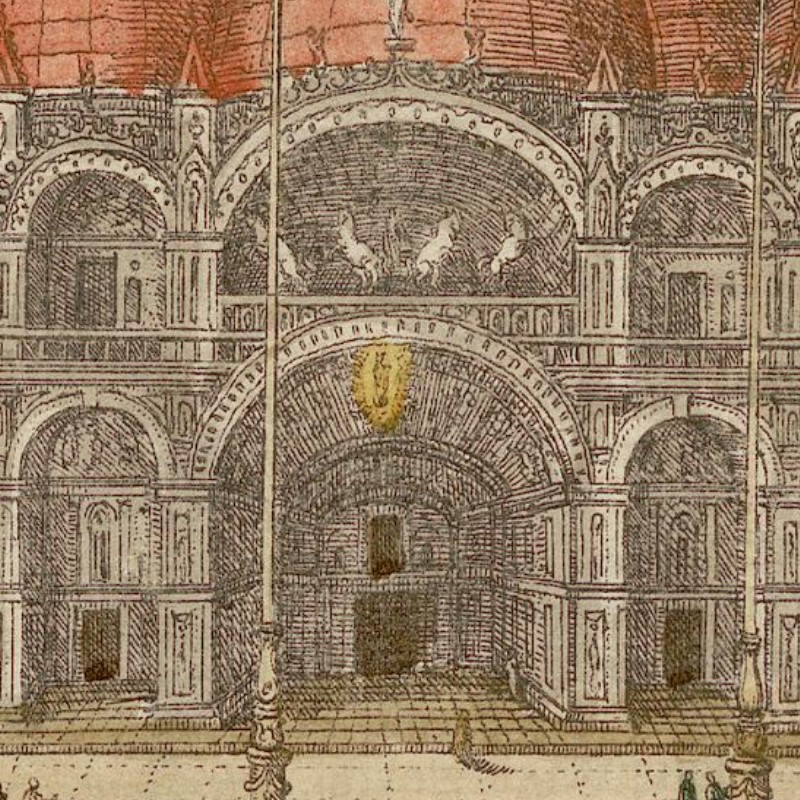
Entrance to St. Mark’s Basilica with the four horses above
The Fourth Crusade was originally destined for Egypt. Venice had agreed to provide transport, but when it was time to depart, there was far less enthusiasm for the endeavour than its organisers had expected. Fewer participants meant less money, and the Crusaders were now in debt to the Republic. The Venetians could ill afford the shortfall, since they had invested their own resources to build the requested transport ships. The Doge, Enrico Dandolo, convinced the leaders of the crusade that he would forgive some of their debt if they helped to capture the town of Zadar on the Dalmatian coast (today Croatia). Zadar had been a Venetian dependency but had switched allegiance to the Kingdom of Hungary in the 1180s. It was now considered a threat to Venetian shipping in the Adriatic. The crusaders agreed, and despite the Pope’s protests, they captured and sacked the city in 1202.
While this eased some of the financial pressures, the planned crusade was still an enormously expensive enterprise. In this situation, the promise of rich rewards by Alexios IV Angelos, son of the deposed Emperor Isaak II Angelos, for help to return him to the throne was well received. For many Western knights who knew little about Byzantine politics, it likely sounded like a just endeavour, especially since Angelos promised to submit the Eastern Orthodox Church to Rome’s authority. The Venetians, who were well aware of the regular dynastic upheavals in Constantinople, probably saw this offer as a way to recoup their losses.
The crusade was diverted to Constantinople, and the city was besieged. In the confusion, much of the city was set on fire, and the emperor, Alexios III Angelos, brother of the deposed Isaak, fled. Alexios IV was proclaimed emperor, but the expected rewards for the crusaders’ help were not forthcoming. After decades of instability, the Byzantine treasury lacked the resources to pay. In addition, Alexios was unpopular with the population, as he had brought a hostile army to the city. His promise to submit the Orthodox Church to Rome did not win him the people’s support. With frustrated and restless crusaders outside the walls and a hostile population inside, Alexios lasted only six months on the throne before he was deposed and killed. In the ensuing hostilities, the crusaders besieged the city a second time and, after breaking through its defences, captured and sacked it (1204).6
The Sack of Constantinople by a crusader army is considered one of history’s great tragedies. Apart from the loss of life, much of the ancient city was destroyed by fire. The churches and palaces were stripped of their decorations, and most plundered items were melted down. Only the Venetians, with their knowledge and long experience of the Byzantine Empire’s arts and crafts, collected and shipped many rare objects home.
St. Mark’s Basilica was not only a place of religious introspection and a showcase for masterful Christian iconography to spiritually uplift visitors. The church was also the treasure house of the Republic, where it could display its loot.7
The Treasures of Venice
On 30 November, Samuel Kiechel learnt that Maximilian von Dietrichstein, the Austrian nobleman who had been quarantined en route to Venice, and a Spaniard were to be shown the treasures of Venice. According to our traveller, this was a special honour, and the Venetians took counsel before bestowing it on anyone. Kiechel approached von Dietrichstein’s entourage and claimed to be one of his servants. No one questioned him, and he was allowed inside.8
Although our traveller did not say whether this happened with the nobleman’s consent, either von Dietrichstein or some of his servants were aware of it. As fellow German travellers, they likely stayed at the same inn, where they could have made contact. In any case, Samuel would pull the same trick again to witness a papal audience in Rome and would also join von Dietrichstein in Naples on a tour of the ruins of Pozzuoli.
The treasure chamber was in St. Mark’s Basilica, with the entrance on the right, opposite the palace. It was a dingy place, Kiechel wrote, like a chapel, and it needed lighting. The chamber was secured by three iron doors.
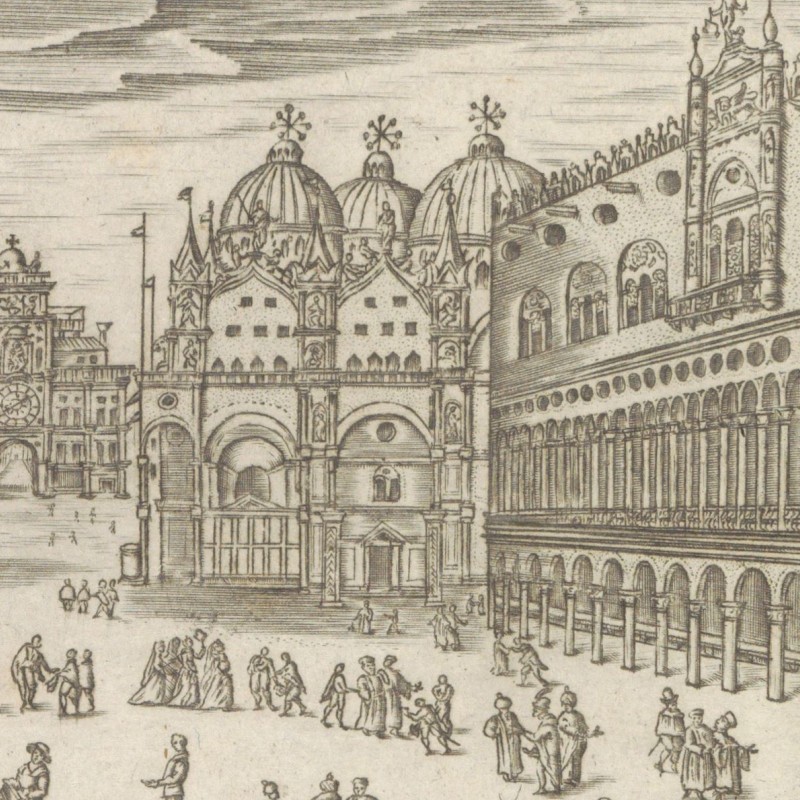
The entrance to the treasury? Kiechel wrote that it was on the right side of St. Mark’s Basilica, opposite the Doge’s Palace (the building on the right)
Inside stood a large iron box, secured with locks and bolts. Officials appointed by the council unlocked it and went inside. Kiechel wrote that a cabinet was placed outside the box, probably a display case, and the noblemen were each given a candle and shown the following items:
- A jug made of a stone called camachi (?). It was hollow inside, and a candle was placed there; the stone’s colours and veins became transparent.
- A huge jug made of chalcedony that could hold two Angster of wine or water. (Angster was an oddly shaped, popular drinking vessel in the fifteenth and sixteenth centuries. It was made of glass and consisted of an onion-shaped body that narrowed upward into a neck with three to five tubes, sometimes twisted, and a bowl-shaped spout.)
- A cauldron made from a single garnet. It was deep and a span wide, like a hat. A candle was placed inside so visitors could see the stone’s colours.
- A beautiful agate.
- A bowl made of turquoise, almost as large as the bowl of a human skull, and capable of holding an Angster of wine.
- “Ein brasma, düe muetter von schmarall” (Schmarall is an old German word for Smaragd (emerald), but I have no idea what the rest means)
- A “Karfunkel”. The men who showed the items said it weighed half a pound. (Karfunkel is an old German word for red gemstones such as garnet, ruby or spinel)
- A sapphire, half a pound in weight and larger than a pigeon’s egg.
- A red and yellow horn of a male unicorn.
- A white and yellow horn of a female unicorn. Both were one and a half cubits long and set with a golden ring at both ends and in the middle.
- A diamond that Henry, King of France (Henry III, 1551-1589), had given to the city as a gift when he was visiting. It sat on a golden foot a span high, and above the stone was a golden “gülgen”. (Possibly ‘Gilge’, an old German word for lily, since this was a French present and the lily was an important element of French heraldry (fleur-de-lis))
- The crown of the King of Cyprus. The kingdom was no longer under Venetian rule and now belonged to the Ottoman Empire.
- The crown of the Kingdom of Crete.
- The crown of Venice, which was placed on the head of the elected Doge. The first two crowns were made of pure gold and set with wonderful gems and pearls. The Doge’s crown was set with many pearls the size of hazelnuts and covered with carmine red velvet. It was not round like the other two crowns but had a slight tip at the front.9
Furthermore, Kiechel noted that there were twelve female breasts made of gold and decorated with gems and pearls in the treasure chamber. In addition to the items mentioned, our traveller reports that he also saw many golden plates, goblets, bowls and similar valuable items. The whole display was so impressive, Kiechel wrote that he would visit the treasure chamber a second time upon his return to Venice.
The Treasury
At the time of Samuel Kiechel’s visit, the Treasury of St. Mark’s Basilica contained a wide variety of valuable, artistically unique and outstanding items. Most were from the workshops of Constantinople and arrived as part of the loot from the Fourth Crusade. Kiechel mentioned only a few items he was shown before cutting his description short, noting that he had seen many more.
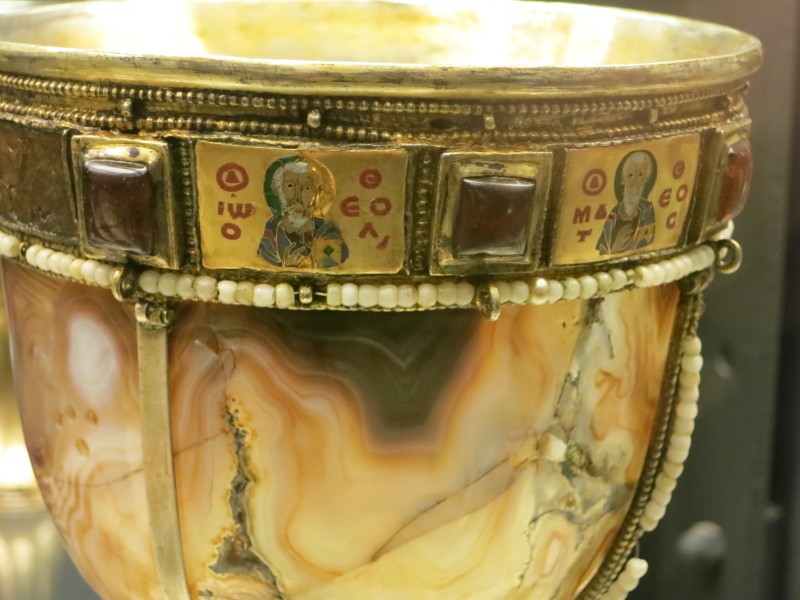
While the basilica and its interior decorations survived the centuries largely intact, the treasury of St. Mark fell victim to Napoleon and his army. The French occupied the city in 1797, marking the end of the Republic. To pay for the war, the treasury was looted, and all valuable items were melted down.10
It is therefore difficult to reconstruct what Samuel Kiechel saw, and his descriptions are often imprecise and hard to interpret. The first few items he mentioned appear to have been hardstone carvings. Hardstone carving is the ancient art of carving semi-precious stones such as rock crystal, agate, jasper or chalcedony into decorative vessels, cups, statues and other objects.
Our traveller was also fascinated by the gems and mentioned an agate, a sapphire and a ‘Karfunkel’ stone. The unicorn horns were likely narwhal tusks, which were typically sold in Europe as unicorn horns in the Middle Ages.
Kiechel also mentioned seeing many golden plates, goblets and bowls. These items were probably not simply solid gold dishes. The treasury contained many enamelled items. Enamelling, the technique of fusing powdered glass onto any material surface that can withstand the temperature, is an ancient method of decorating objects.
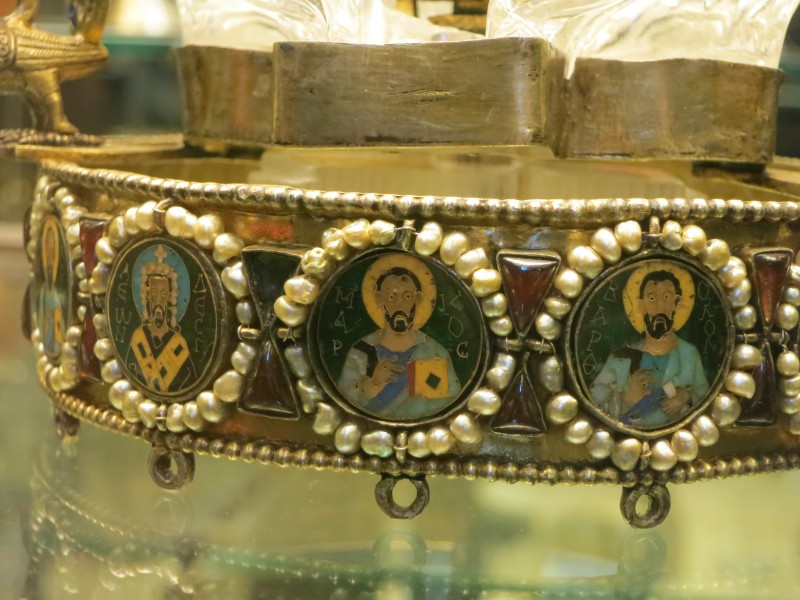
Byzantine enamel in St. Mark’s Treasury
In Byzantium, cloisonné enamelling was perfected. Byzantine craftsmen used fine gold threads to create an image on a surface. The gaps between the threads were then filled with coloured glass paste. The resulting images were often of members of the ruling dynasty or religious figures. Many enamelled bowls, goblets or liturgical items found their way to Venice as part of the cultural and artistic transfer of the twelfth century, such as the above-mentioned Pala d’Oro, or in the wake of the sack of the Byzantine capital. Despite the losses, the treasury still houses the best collection of Byzantine metalwork and enamelling today.11
Illustrations & References
All images are in order of appearance with links to sources on external websites:
- St. Mark’s Basilica, in: Braun, Georg, Hogenberg Frans, Civitates Orbis Terrarum (5), Cologne 1599, fol. 60v; Heidelberg University.
- Anonymous, Optocht op het San Marcoplein te Venetië, 1610; Rijksmuseum Amsterdam.
- Daiane Dnli, Interior of St. Mark’s Basilica; pexels.com
- Smidts, Hendrick, Gezicht op het San Marcoplein, 1676; Rijksmuseum Amsterdam.
- Anonymous, Platea divi Marci Venetiis, c. 1570 – 1660; Rijksmuseum Amsterdam.
- Brad Hostetler, Treasury of the Basilica di San Marco, Venice; flickr.com
- Brad Hostetler, Treasury of the Basilica di San Marco, Venice; flickr.com
- Die Reisen des Samuel Kiechel aus drei Handschriften, K. D. Haszler (ed.), Stuttgart 1866, pp. 153-160; Bayerische Staatsbibliothek. ↩︎
- Ibid., p. 160. ↩︎
- https://stmarksbasilica-guide.com/what-to-see/golden-mosaics/ ↩︎
- Gasparri, Stefano, The Origins of Venice. Between Italy, Byzantium and the Adriatic, in: Skoblar, Magdalena (ed.), Byzantium, Venice and the Medieval Adriatic. Spheres of Maritime Power and Influence, c.700-1453, Cambridge 2021, pp. 98-110. ↩︎
- Angold, Michael, Venice in the Twelfth Century. Between the Adriatic and the Aegean, in: Skoblar, Magdalena (ed.), Byzantium, Venice and the Medieval Adriatic. Spheres of Maritime Power and Influence, c.700-1453, Cambridge 2021, pp. 296-315; Crowley, Roger, City of Fortune. How Venice Won and Lost a Naval Empire, London 2011. ↩︎
- Crowley, City of Fortune, pp. 26-118. ↩︎
- Perocco, Guido, Venice and the Treasury of San Marco, in: The Metropolitan Museum of Art, The Treasury of San Marco Venice, Milan 1984, pp. 5-33, see p. 24. ↩︎
- Reisen des Samuel Kiechel, p. 155. ↩︎
- Ibid., pp. 155f. ↩︎
- Perocco, Guido, History of the Treasury of San Marco, in: The Metropolitan Museum of Art, The Treasury of San Marco Venice, Milan 1984, pp. 65-68. ↩︎
- Frazer, Margaret E., Byzantine enamels and goldsmith work, in: The Metropolitan Museum of Art, The Treasury of San Marco Venice, Milan 1984, pp. 109-203. ↩︎