
Journal of Samuel Kiechel
3 – 8 August 1586
In Pleskau
“The houses of the city are of poor quality, except for the churches and the city wall. They are made of wood and covered with wooden planks. The Grand Duke’s palace is made of wood, and I heard that rich people and noblemen do not live in stone houses because they claim it is unhealthy. Some wealthy noblemen wear rich clothes but live in houses that cost no more than 15 or 20 Reichsthaler.”
Die Reisen des Samuel Kiechel aus drei Handschriften, K. D. Haszler (ed.), Stuttgart 1866, p. 116; Bayerische Staatsbibliothek.
Arrival
Travelling up the Velikaya River from Lake Peipus, Samuel Kiechel and his companions, two English merchants, reached the Russian city of Pleskau (Pskov). The boat moored at the quay, and the travellers disembarked. Kiechel and his companions registered their arrival with the Muscovite officials at the harbour. The officials asked for their names, where they had come from, what goods they brought or wanted to buy, and whether they had any other reason to come to Pleskau. They recorded the travellers’ names and the goods the merchants brought. According to Kiechel, they did this for taxation as well as security; the Muscovites were distrustful and wary because their land was wide and open.1
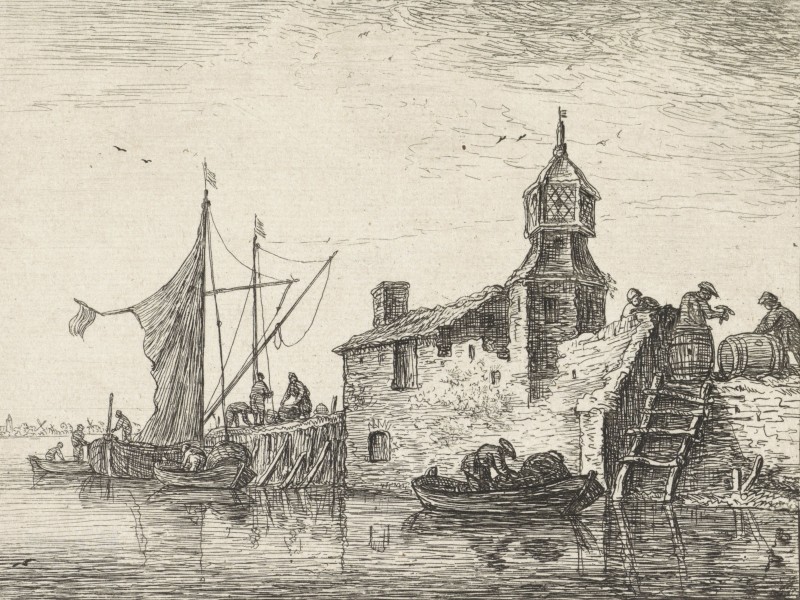
The questions of the Russian officials could have proved dangerous for our traveller. Kiechel was no merchant. He wrote that if he had said he wanted to see the country, the Muscovites would have suspected him of being a spy. According to our traveller, the Russians are very rough, uneducated people who rarely leave their country. They can’t believe someone would visit their land just to see it and learn about their customs and traditions.2
Fortunately, one of Kiechel’s companions, aware of the potential difficulties, helped him out. When the Muscovite officials asked our traveller why he had come, his companion answered for him. He also registered several pieces of damask from his own cargo in Kiechel’s name.3
The travellers were then allowed to leave the harbour area, but Samuel wrote that he did not enter Pleskau. He noted that no foreigner, not even those who live and trade in the city, could enter without permission. The German merchants who come to Pleskau have their own house (a large trading post) opposite the city on the other side of the river. There, each merchant has his own room and storage area for his goods. A bridge connects the trading post to the city, and foreigners may walk on it but not cross it.4
Pleskau lies on the southern shore of Lake Peipus at the confluence of the Velikaya and Pskova. The larger Velikaya flows past the city, while the Pskova flows through it. On the spit where the two rivers meet stands the Krom, the fortress of Pleskau, built in the twelfth century. Samuel Kiechel must have seen it on the eastern bank as he came up the Velikaya.
The German trading post Kiechel mentioned was most likely on the other side of the Pskova River, within the city’s outer walls. The Pskova is narrower than the Velikaya and easier to bridge. It also lay within the city’s perimeter. It is unlikely that German merchants would have chosen to live in a house in the open country outside the walls, especially after the long Livonian War.
At the German trading post, Samuel paid one Guilder per week for food. Drinks had to be paid separately. He considered this a reasonable price and noted that poultry was particularly cheap. He noticed that many merchants from cities of the Hanseatic League, especially from Lübeck, were in Pleskau. Besides the German merchants, only the English were allowed to trade in Russia.5
In the late sixteenth century, Elizabethan England is better known for its exploits in the Atlantic and for raiding Spanish shipping. So why did English merchants hold such a prominent position in Russia, allowing them to trade and travel there?
The Muscovy Company
For centuries, the cities of the Hanseatic League dominated northern Europe’s trade routes. In particular, Riga, Reval (Tallinn), and Dorpat (Tartu) tightly controlled trade with Russia. But in the sixteenth century, the League fell into decline, and many of its former member cities lost their independence. Merchants from other countries gained access to markets around the Baltic Sea. Soon, the Dutch, with their superior ships, dominated the grain trade from Poland, Prussia, and Lithuania to the west.
Another party interested in trade with the East was England. In 1553, an English expedition seeking the Northeast Passage to China landed on the coast of the White Sea in northern Russia. The English explorers made contact with local merchants and, after hearing of their arrival, were invited by Ivan IV to Moscow. Ivan was keen on trade with the West, especially if it bypassed the Baltic Sea, and they reached an agreement.
Back in England, the Muscovy Company was established in 1555 to exploit this newfound trade connection. It was a joint-stock company formed to raise capital for trade expeditions to Russia. English merchants also hoped to establish trade links with China and southern Asia via a land route. The merchant Anthony Jenkinson (1529-1610) undertook four expeditions to Russia to negotiate trade agreements and privileges for English merchants. He also travelled south towards the Black and Caspian Seas and even reached northern Iran.
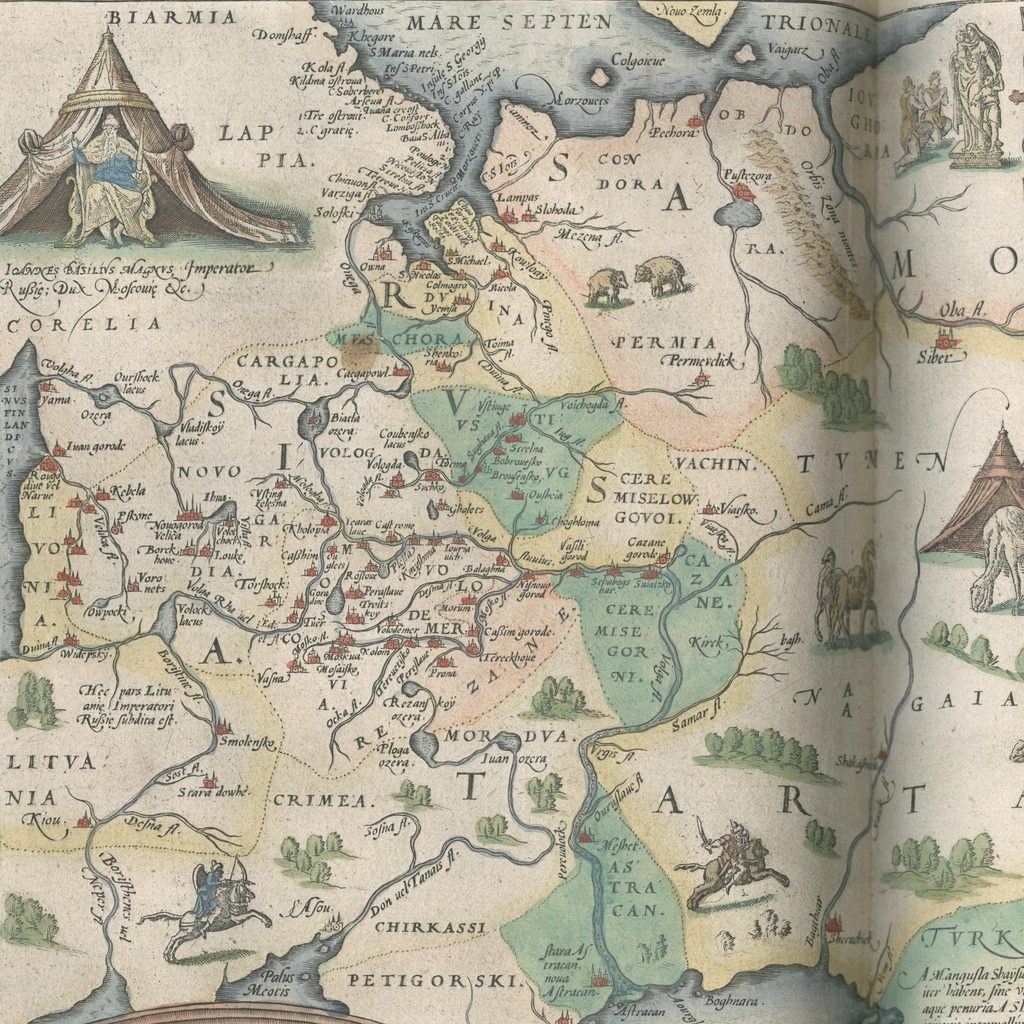
Anthony Jenkinson’s map of Russia from the sixteenth century.
In addition to his diplomatic mission, Anthony Jenkinson drew a map of Russia. The map focuses on the places he visited; therefore, the route from Arkhangelsk via Moscow and down the Volga River is fairly detailed, while Russia’s western borderlands with Livonia and Lithuania are quite vague. Jenkinson’s map was printed in Abraham Ortelius’ prestigious atlas Theatrum Orbis Terrarum. Compared with other maps in the atlas, the map of Russia shows that, for regions outside Western Europe, geographic knowledge still depended on personal experience and local knowledge. If Samuel Kiechel had mapped northeastern Europe, it would have looked quite different, with much more focus on Livonia.
In 1584, Ivan IV ordered the construction of a fortress on the Northern Dvina close to its mouth into the White Sea. It would become the city of Arkhangelsk. After Russia’s defeat in the Livonian War and its loss of access to the Baltic Sea, Arkhangelsk became the main Russian port for trade with Western Europe. However, individual English merchants also travelled via the Baltic Sea and Livonia; for example, the two companions Kiechel had arrived with in Pleskau.
Pleskau
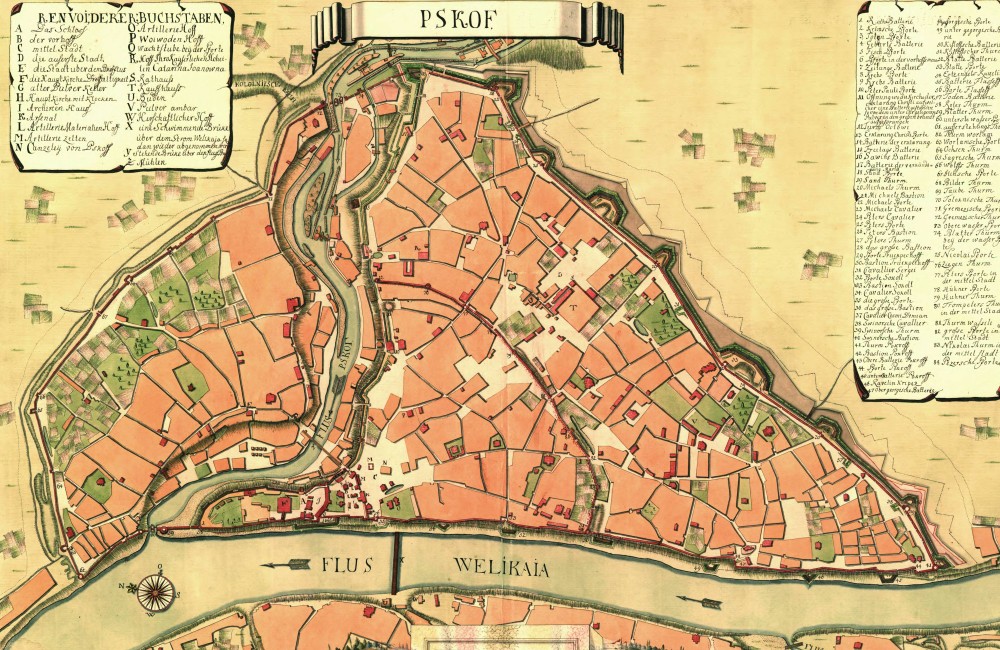
Pleskau (Pskov) in the late seventeenth or early eighteenth century
Samuel Kiechel wrote that Pleskau is the first city beyond the border to Livonia that belongs to the Grand Duke of Muscovy. Apart from Moscow, where the Grand Duke kept court, Pleskau was his most prominent and most fortified city. Kiechel heard that Moscow had no fortifications at all. Even Pskov was only fortified by a wall on one side, and there were no bulwarks or moats. The river protected the other side of the city.6
Pleskau expanded gradually, as most cities did. It spread from the fortress south and east between the two rivers, then across the Pskova River. While I could not find any contemporary maps or views, by the time of Kiechel’s visit the city had three rings of walls, each following the city’s expansion. Apart from the fortress walls, a wall south of it was built during the rule of Daumantas, a Lithuanian nobleman who fled to Pleskau in the thirteenth century. Another wall was constructed along the Pskova and Velikaya Rivers at the end of the fourteenth century, when the city was part of the Grand Duchy of Lithuania. The outer wall, which also included land on the other side of the Pskova, was built in the late fifteenth century. Contrary to Kiechel, it is also very unlikely that the city was unfortified towards the river.
According to the journal, Kiechel’s freedom to explore Pleskau was severely limited. The traveller was not allowed to cross the river and visit the Old Town around the fortress. He had to remain north of the Pskova River, in the part of the city that was likely just a suburb. This restriction likely limited his knowledge of the city’s fortifications. From the descriptions, it seems that Kiechel either never noticed the outer wall or forgot about it when he wrote his journal. For him, the walls of Pleskau were those on the other side of the Pskova River, visible from the German trading post.
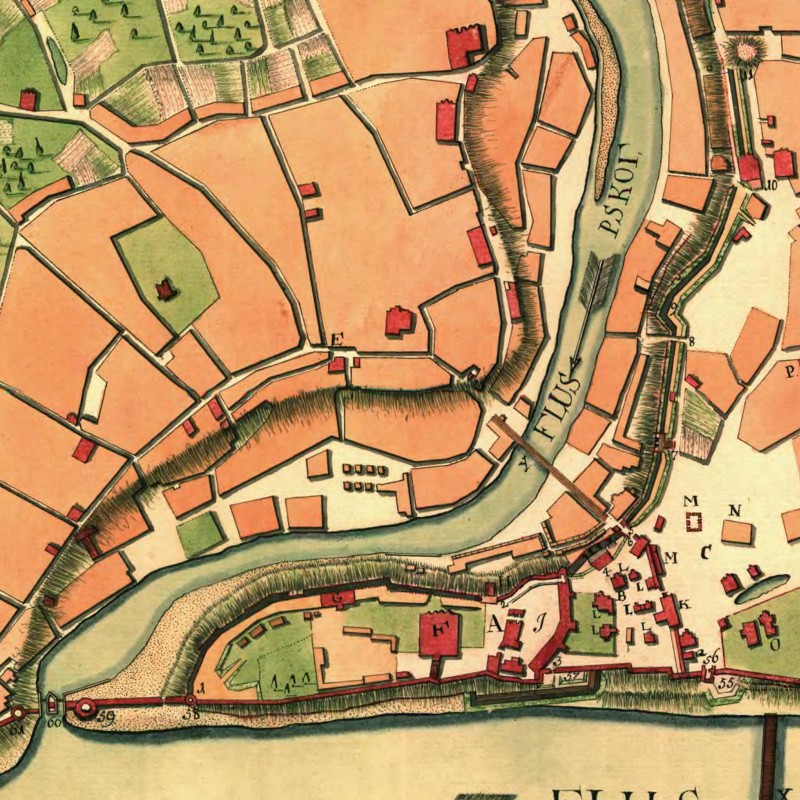
Fortress and Old Town of Pleskau, with the Pskova River separating it from the suburb to the north of the river, where the German trading post presumably stood
Our traveller learnt that King Stephen of Poland had laid siege to Pleskau during the Livonian War. He had come with an army of 80,000 men but could not take the city. According to Kiechel, the Muscovites fought harder to defend their cities and fortresses than in open battle. He added that the Muscovites are hard-working and tough. They withstand hunger and thirst better than others because their food and drink are always meagre.7
Stephen Báthory unsuccessfully besieged Pskov in 1581/82. After Sweden and Poland-Lithuania finally decided to act together against Russia in the later stages of the Livonian War, Báthory decided that, instead of fighting the Russian army in Livonia, he would attack Russian territory. He captured Polotsk in 1579 and Velikiye Luki in 1580. Polotsk is today in northern Belarus, and Velikiye Luki is in Russia, close to the border with Belarus. Both cities are about 200-250 km south of Pleskau (Pskov). Taking Pleskau would have cut off Russian access to Livonia and forced Tsar Ivan IV (the Terrible) to back down. The 80,000 men Kiechel mentions were probably too large. Báthory’s army is estimated to have been 50,000 men strong. Pleskau held out, but despite the failure to capture the city, the attack into Russian territory and subsequent successful Swedish attacks in northern Livonia pushed Ivan to seek peace.8
Churches and Burials
According to our traveller, the churches of Pleskau are made of stone and, in their own way, are pretty and elegant. They have round towers like the Greek churches and are clean and well kept. No one who is not an Orthodox Christian is allowed to enter them, and they are unlocked only for services. The ceremonies, worship, singing and sacraments are conducted in the Greek style. The Russians have many religious holidays, and they fast three times a year. Our traveller added that there are no religious sects or different confessions in Russia, and everyone has the same religion.9
Samuel continues: Orthodox priests may marry. But if a priest’s wife dies, he is not allowed to marry again if he wants to keep his post. If a priest marries a second time, he must leave the church and take up a different trade.
If an inhabitant of Pleskau dies and the family is too poor to pay for an expensive burial in the church, the person will be buried in a cemetery outside the city. The cemetery is on the other side of the river, fifteen minutes from the city centre. There, the Russians dig a deep pit with space for many thousands of bodies.
Samuel Kiechel wrote that he went for a walk on the bridge when he witnessed a funeral procession. The dead body lay on a sledge pulled by a horse. It was in an open box, and a small child sat on top of it. It was a strange sight to our traveller, especially at this time of year, as it was the middle of summer. A priest accompanied the procession, clothed in his robes, walking in front of the sledge. The priest sang in Russian, and many people followed the sledge, carrying burning candles and an incense container. At the cemetery, the body, covered in white linen, was lowered with a rope into the pit and placed on top of other corpses already there.10
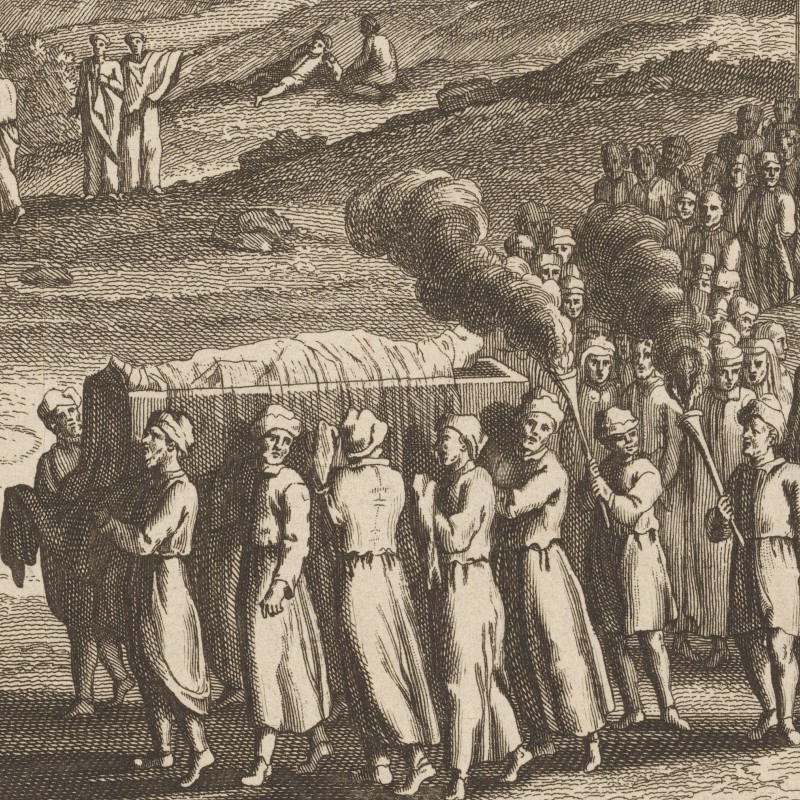
Kiechel noted that the pit was covered with a wooden roof to prevent water from accumulating at the bottom. When it is full, they cover the pit with earth and break down the wooden roof. Then they dig a new pit right beside the old one. Samuel noted that in the summer, the open pit released an unpleasant stench that could be smelled from far away. Kiechel knew this because he walked with another German man to the cemetery and paid the graveyard keeper a few coins to look into the pit. Our traveller wrote that he had covered his nose and mouth, but the stench was still unbearable, and he thought he was suffocating.11
The People of Pleskau
Pleskau is large and has a few suburbs outside the wall, Kiechel further wrote. The houses in the city are made of wood and are poorly built. The roofs are covered with wooden planks. Only the churches and the wall are solid stone constructions. Even the Grand Duke’s palace was made of wood, and so were the houses of the city’s noblemen. Apparently, the Russians considered it unhealthy to live in stone houses. Our traveller was told that the wealthy noblemen of Pskov wore expensive clothing but lived in houses costing no more than fifteen to twenty Reichsthaler (large silver coins).12
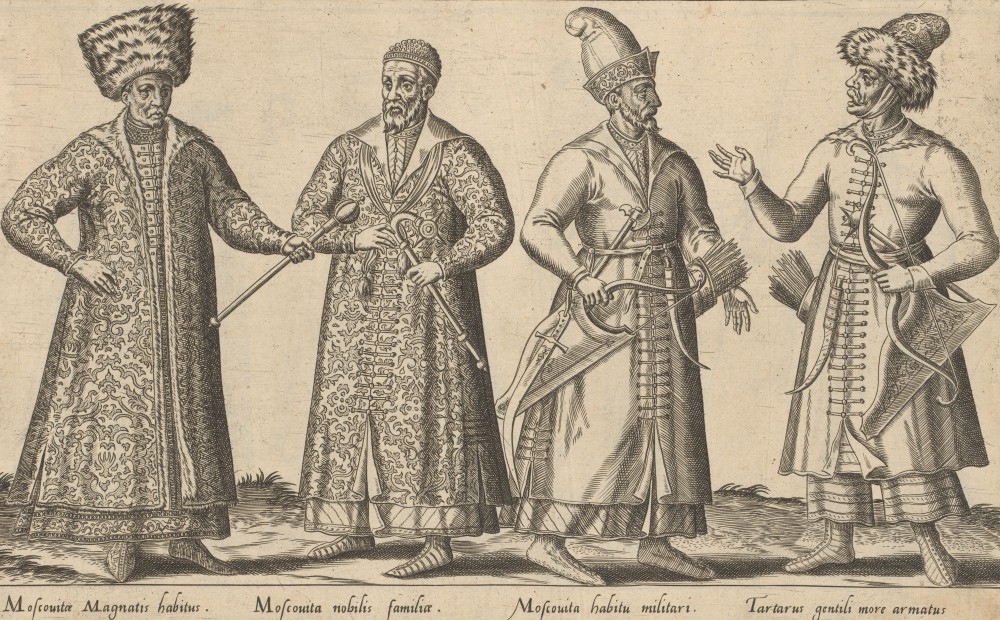
Costume prints of people in Russian clothing, ca. 1580
The people of Pleskau are rough and ill-mannered. They show no respect to anyone and will not take off their hats to high- or low-born people. They wear long coats of good cloth, similar in style to Armenian clothing, and there are few differences in clothing between the genders. Men and women wear high boots with the soles reinforced with iron hobnails. The women go out on the streets fully veiled. Only their eyes are visible. The Russians consider it disgraceful if more than a woman’s eyes are visible, both in the street and at home. In their houses, the women have their own rooms. Their clothes are clean and well kept.
Samuel further wrote: The food the Russians consume is of poor quality. They have no fruit other than apples and pears. Instead, they grow “agurien” and eat large quantities of them. (I could not determine what kind of fruit “agurien” are.) Kiechel noted that he saw Russians eat six, seven or eight of them unpeeled. They drink nothing but water with them. Russian meals consist of half-baked bread that is still very doughy, onions, lots of garlic, lettuce and similar raw items. Such foodstuffs, Kiechel wrote, need “brantwein” (distilled spirits) to be eaten. He heard that some of them drink a fourth of a Maß (ca. 1.1 l) of “brantwein” in one go. Kiechel also learnt that when a Muscovite is invited as a guest, he will consider himself poorly treated if there is no “brantwein” already at the table even before he sits down.13
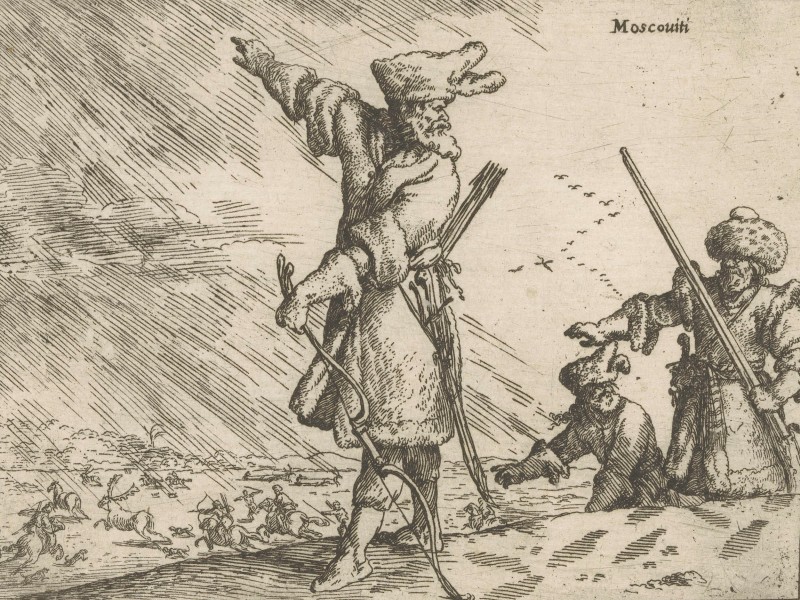
Russian hunters, 1636
Regarding trade, the Muscovites export furs from animals such as marten, sable, lynx, wolf and fox, as well as large quantities of squirrel pelts. They also export wax, flax, hemp and the skins of oxen, moose and other animals. In return, they import cloth, silk clothes and small wares from the German merchants.14
For the small wares, Kiechel used the term ‘Krämereien’. The word can mean quite a lot of different things, from smaller, high-value luxury articles to household items, or, in later centuries, useless or superfluous stuff.
Samuel continued: When a German merchant agrees to trade with a Muscovite, Russian officials record their agreement. These officials also collect taxes on the goods. They write the contract for tax reasons, but also to ensure the Muscovite merchant sticks to the agreement and does not pull out.15
Change of Plans
Samuel Kiechel spent eight days in Pleskau, but there was little to see or do, and he soon had enough of it. He wrote that at first he wanted to travel farther into Russia. The two English merchants he had met in Dorpat (Tartu) were on their way to Moscow, and Kiechel had decided to join them.
But while in Pleskau, he was dissuaded from his plan. Kiechel learnt from a German merchant that no foreigner was allowed to enter Russia without a passport — a written permission from the Governor of Pleskau. In addition, Samuel was warned about the difficulties of travelling in this country. The distance from Pleskau to Moscow was 150 German miles, and there was little of interest to see between the two cities. The land was mostly desolate, and there was just one other large city along the way: Novgorod. Samuel wrote that he had already seen more than enough deserted and bleak places. The country’s size meant it would be difficult to leave, and he would have to spend the next winter there. Our traveller feared he did not have the money for such an adventure, despite the low price of food. So, in conclusion, Samuel Kiechel decided to abandon his plans, not travel to Moscow, and instead return to Livonia.16
Illustrations & References
All images are in order of appearance with links to sources on external websites:
- Ortelius, Abraham, Theatre of the World, Antwerp 1587, fol. 88v; Library of Congress.
- Waterloo, Anthonie, Aanlegplaats bij een gebouw met een toren, 1630 – 1663; Rijksmuseum Amsterdam.
- Ortelius, Abraham, Theatre of the World, Antwerp 1587, fol. 91v; Library of Congress.
- Anonymous, Pskof; Riksarkivet Stockholm.
- Anonymous, Manier van Begraven, 1600 – 1699; Rijksmuseum Amsterdam.
- de Bruyn, Abraham, Vier Russen, gekleed volgens de mode, 1580; Rijksmuseum Amsterdam.
- Baur, Johann Wilhelm, Moscouiti, 1636; Rijksmuseum Amsterdam.
- Die Reisen des Samuel Kiechel aus drei Handschriften, K. D. Haszler (ed.), Stuttgart 1866, p. 115; Bayerische Staatsbibliothek. ↩︎
- Ibid. ↩︎
- Ibid. ↩︎
- Ibid., pp. 114-116. ↩︎
- Ibid., pp. 116f. ↩︎
- Ibid., 115f. ↩︎
- Ibid. ↩︎
- Frost, Robert I., The Northern Wars. War, State, and Society in Northeastern Europe, 1558 – 1721, Harlow 2000, p. 44. ↩︎
- Ibid., p. 117. ↩︎
- Ibid., pp. 117f. ↩︎
- Ibid. ↩︎
- Ibid., p. 116. ↩︎
- Ibid., pp. 118f. ↩︎
- Ibid., pp. 119f. ↩︎
- Ibid. ↩︎
- Ibid., pp. 116f. ↩︎