
Journal of Samuel Kiechel
“Short account and description of the journey of me, Samuel Kiechel of Ulm, from 23 May 1585 to the last day of June 1589, first from Ulm to the Kingdom of Bohemia and then to other kingdoms, countries and cities; followed by a journey from Venice to the Holy Land, to Jerusalem through Samaria, Galilee, through the Kingdom of Syria, Aleppo, Cyprus, Egypt to St. Catherine or on Mount Sinai, the Kingdom of Crete, to Rhodes and other islands in the archipelago as well as to Constantinople and other places in the Levant, which I have happily completed, highest thanks to the Lord.”
Die Reisen des Samuel Kiechel aus drei Handschriften, K. D. Haszler (ed.), Stuttgart 1866, p. 1; Bayerische Staatsbibliothek.
On 23 May 15851, a young man named Samuel Kiechel left his home in Ulm and walked out of the city gate. He crossed the bridge over the Danube and perhaps looked back one last time. What was on his mind? Was he filled with excitement for the adventure ahead? Or was he anxious, aware that a journey entailed many dangers and he might not return?
Samuel was about to undertake an adventure that would ultimately last four years and cover over 30,000 kilometres (~19,000 miles). He would visit popular locations such as Elizabethan London, Venice, Rome, and Jerusalem. However, his curiosity would also lead him to Scandinavia, Lithuania and Livonia in northern and northeastern Europe, as well as down the Italian Peninsula to Sicily and Malta. The route Samuel Kiechel followed on his journey is available here.)
The Traveller
Born in Ulm in 1563, Samuel was the son of Matthäus Kiechel, a craftsman, successful merchant and member of the guild of cloth shearers. Matthäus Kiechel held various official positions in Ulm. However, the Kiechels were a relatively new family and not part of the patriciate — the old, established dynasties of a city. The family’s name was first documented in Ulm’s records in 1501 when the barber Lorenz Walter Kiechel was granted citizenship.2
From barber to craftsman and successful merchant, the family became wealthy and influential within a remarkably short time. With their newly acquired status among the elite of Ulm and presumably with ambitions to join the ranks of Ulm’s patricians, Samuel’s parents wanted to provide their sons, Samuel and his older brother Daniel, with the right start in their careers. They received an education appropriate to their social rank to prepare them to take over their father’s business.3
Travelling was considered the finishing touch to the education of a young man from a wealthy family. Initially, it was the preserve of noble families. However, merchants and wealthy citizens began to copy this behaviour and adapt it to their circumstances.
The journeys usually followed a set pattern. A young man travelled with a friend, a family member, a teacher or, depending on their wealth, servants. He would follow a pre-planned route, visiting specific, predetermined places and people. Merchants would send their sons abroad to learn and work in the business of a friend, family member or trusted partner. Young noblemen would spend time at foreign courts to be introduced into aristocratic society, learn about etiquette and establish social contacts. Travellers from both social groups also travelled to study at a university or visit places of religious significance. A successful journey promised prestige and career advantages for the traveller and would later come to be known as the ‘Grand Tour’.
Samuel Kiechel’s journey diverged from the established behaviour of his peers. His family had come into wealth within a few decades and had presumably not yet established a network of friends, family and business partners in Europe to support Samuel’s journey. Just as the elite in the cities modelled their sons’ educational journeys on the behaviour of the nobility, the Kiechels copied their peers’ behaviour and sent their son abroad. However, as his journal shows, without experience and connections, Samuel Kiechel followed his interests and inclinations. Left to his own devices, his behaviour shows remarkable similarities to modern backpackers.
The Journal
Samuel Kiechel left behind a journal of his adventures, offering a rare glimpse into the daily life of a sixteenth-century traveller. Kiechel was no habitual or eloquent writer; his style is somewhat unreflected and immediate. The uneven and haphazard nature of the journal entries suggests he wrote them without an audience in mind. The journal was likely just a private token of remembrance or a form of report. Samuel wrote in his native Swabian dialect and did not include an introduction or customary dedication to a benefactor, mentor or his parents.
Unlike many of his contemporaries, who often described the places they visited in detail or engaged in discussions on political, cultural or religious topics, Kiechel focused on the practicalities of travel. He wrote about stubborn horses, the availability of food and drink, and the various temporary companions he had encountered along the way. His personal experiences appear genuine, and he refrained from exaggeration and self-promotion. Uncomfortable experiences and mistakes are neither omitted nor trivialised.
Although the many practical details in the journal suggest that Kiechel wrote it while travelling or at least took notes, he must have revised it after returning home. On a few occasions, he mentions experiences later in the journey, such as comparing the body of Catherine de Valois in Westminster Abbey, London, to an Egyptian mummy, which he must have added retrospectively.
While the original manuscript is lost, its contents have been preserved in a handwritten copy from the seventeenth century and a printed edition from 1866. The first page of the handwritten copy features a picture of the traveller. It is part of the Ulm Library collection.
The printed edition of the journal was published by Konrad Hassler in 1866. Hassler still had access to the original manuscript while preparing his work. This edition is available online for anyone interested in reading it firsthand.
Illustrations & References
All images are in order of appearance with links to sources on external websites:
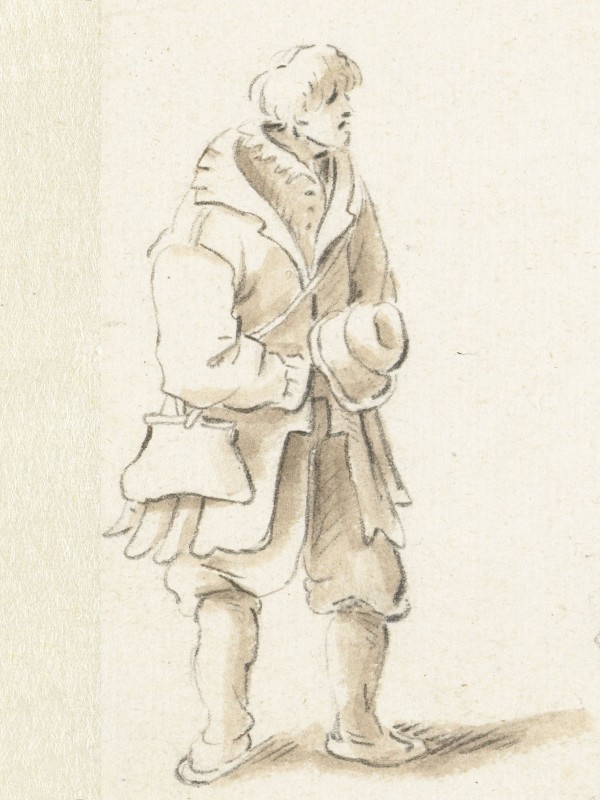
- Saftleven, Herman: Een zittende en drie staande mannen, 1619 – 1685; Rijksmuseum Amsterdam.
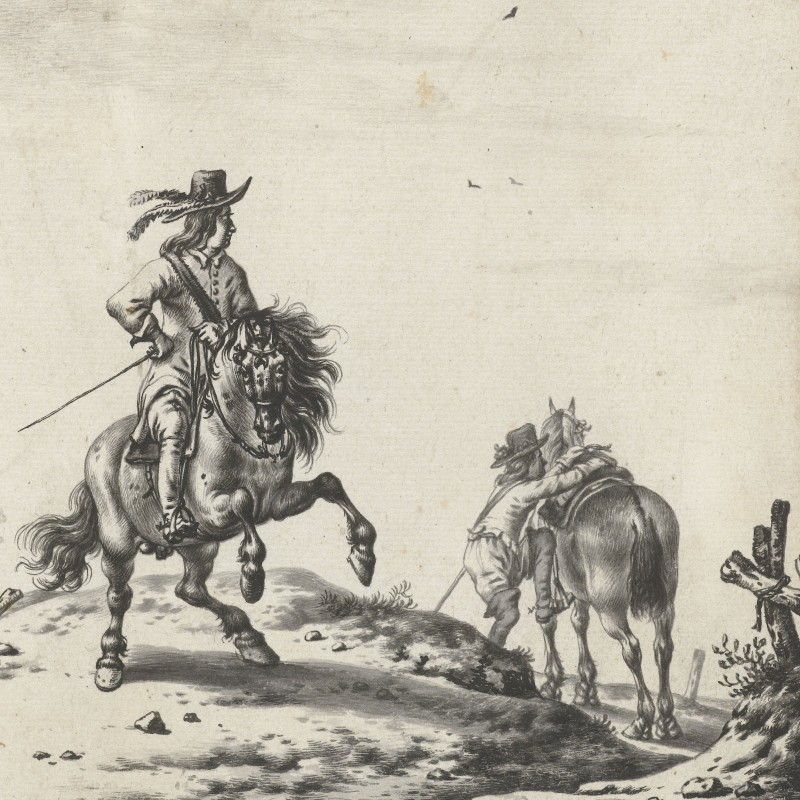
- Verbeeck, Pieter Cornelisz., Twee ruiters, 1620 – 1654; Rijksmuseum Amsterdam.
- Both the Julian and the Gregorian Calendar were in use. Pope Gregory XIII instigated a calendar reform in 1582. The Catholic realms of Europe adopted the new calendar, but Protestants refused. Ulm would not adopt the new calendar until 1700, so Kiechel used the old Julian calendar in his journal. To avoid confusion with the journal, I use Kiechel’s dates. The date of departure in the Gregorian Calendar was 02 June 1585. ↩︎
- von Koenig-Warthausen, Gabriele, Die Reisen des Samuel Kiechel 1585-1589, in: Ulm und Oberschwaben. Zeitschrift für Geschichte und Kunst , Vol. 34, 1955, pp. 66-75. ↩︎
- Specker, Hans Eugen, “Kiechel, Samuel” in: Neue Deutsche Biographie 11 (1977), pp. 575-576; URL: https://www.deutsche-biographie.de/pnd128823844.html#ndbcontent ↩︎