
Journal of Samuel Kiechel
29 July – 2 August 1586
From Dorpat to Pleskau
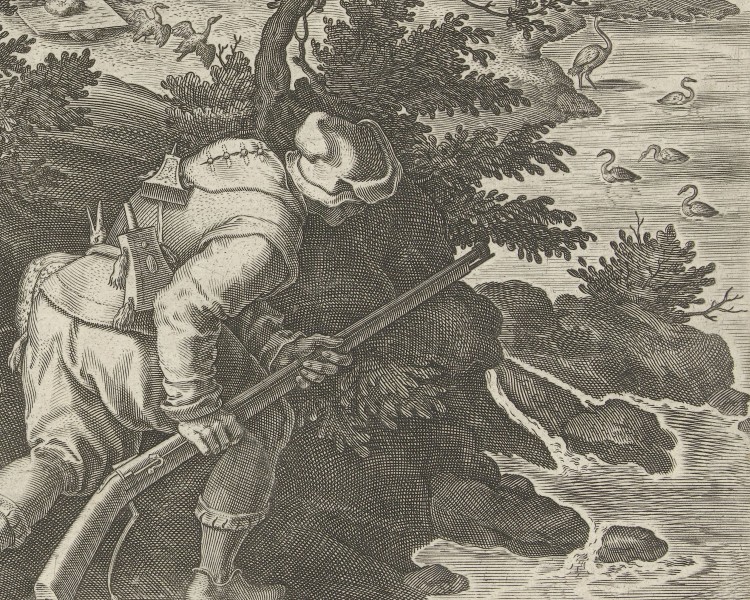
“There are many herons and ducks in this area, so I spent an hour walking around trying to shoot one, but I had no success. I went back to the boat and tried to get on board, but I fell into the water with my gun and powder flask. The boat was a bit away from the shore, and two oars were placed to connect it to the land. When I tried to walk across the oars to board, one of them slipped away.”
Die Reisen des Samuel Kiechel aus drei Handschriften, K. D. Haszler (ed.), Stuttgart 1866, p. 113; Bayerische Staatsbibliothek.
Dorpat (Tartu)
The gates of Dorpat were heavily guarded, and during the day only one gate was open to allow people to enter or leave the city. Before Samuel Kiechel was allowed in, the innkeeper had to come to the gate to vouch for him.
Kiechel wrote: Dorpat is a frontier city on the border with the land of Muscovy. It is small and poorly fortified. Before the war, it was home to a wealthy population, with beautiful houses, and was the seat of an archdiocese. The church is still visible but badly damaged. Few people live in the city, and there are few undamaged houses. Within Dorpat is a castle where a Polish nobleman resides. He now rules the city. The guards at the gate are Polish too, and Kiechel described them as bad and devious people.1
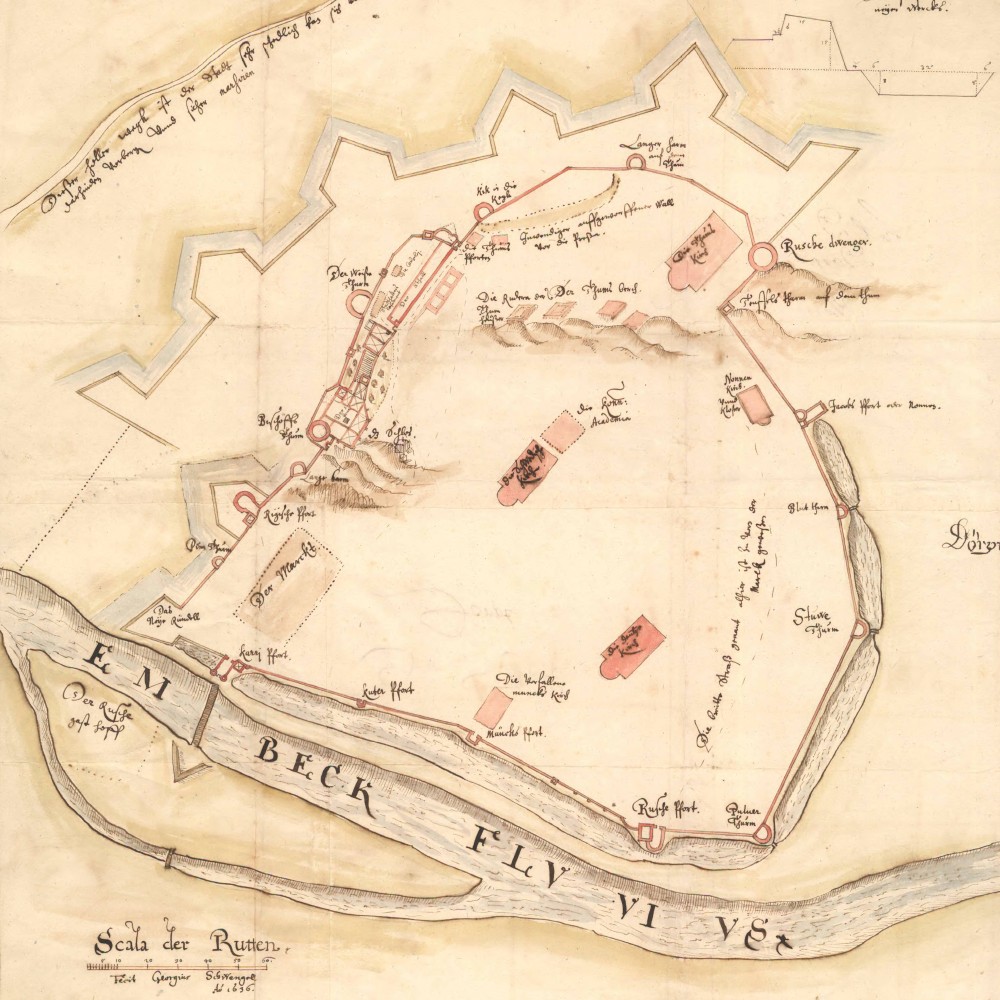
Dorpat, 1636
Dorpat was the third-largest city in Livonia after Riga and Reval (Tallinn). Although it lacked direct access to the sea, the city lay at the crossroads of a trade route from northern Livonia to the south and the Embach River (Emajõgi), which flowed into Lake Peipus and on to Russia. Dorpat was a member of the Hanseatic League, and the lucrative trade with Russia, which the three Livonian cities monopolised, made it a wealthy and attractive place for merchants.
The city was founded in the early thirteenth century by German knights of the Livonian Brothers of the Sword, a military order established in Riga in 1202, who had conquered the region. But the place had long been an Estonian settlement. In the eleventh century, the Grand Duke of Kyiv invaded the area and had a castle built on Toome Hill (Toomemägi, today part of Tartu’s Old Town). The Estonians soon destroyed the castle and reconquered the area. This brief episode of Russian rule would, centuries later, form part of Ivan IV’s historical claim over Livonia, his demand for tribute from Dorpat, and, eventually, be part of the reason for the outbreak of the Livonian War (1558-1583).2
The Livonian War left its mark on the city. Dorpat and Narva were the first cities to fall to the Russian advance, with Dorpat surrendering on 18 July 1558. Early in the war, Ivan IV had not yet succumbed to paranoia, and the quick advance of his troops confirmed his belief that the war was divinely ordained. He therefore attempted to win over the Livonians. The people in places like Narva and Dorpat, who had surrendered to him, retained some of their privileges, and he left part of the local German administration in place.3 But the situation in the city would eventually deteriorate due to the long and exhausting war and Ivan’s mental decline. Kiechel wrote of a depopulated city with many damaged or destroyed houses.
Following the Russian conquest, the Bishopric of Dorpat was disbanded. The Bishops of Dorpat had once ruled one of the large territorial domains in Livonia. Its decline had already begun with the arrival of the Protestant Reformation in the early 1520s. Like the citizens of Riga and Reval, the people of Dorpat converted to Protestantism. Iconoclasts damaged the old cathedral, which then fell into disrepair.4 During the Russian occupation of the city, it was finally destroyed. Kiechel mentioned the cathedral’s ruins, and they are still there today.
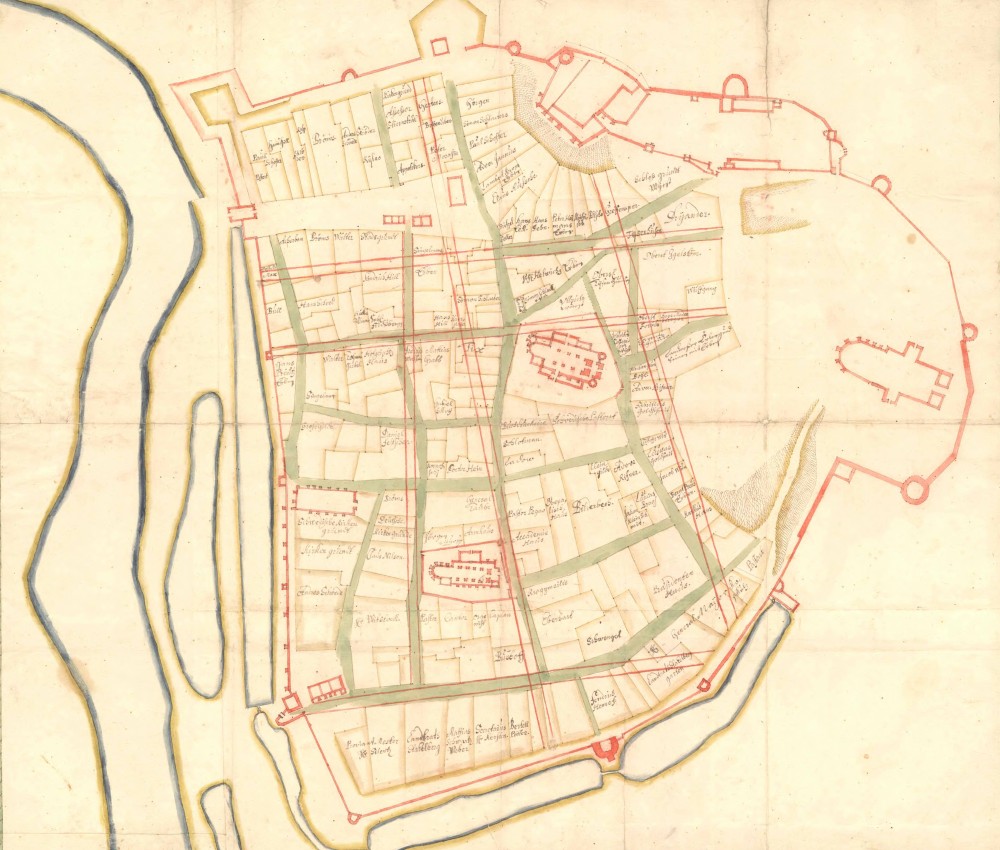
Plan of Dorpat from 1638. The ruins of the cathedral lie on the right edge (west) of the city.
The Treaty of Yam-Zapolsky (1582) ended the war between Russia and Poland-Lithuania. Ivan IV had to give up all claims to Livonian territory, and Dorpat came under Polish rule. As Kiechel wrote, a Polish nobleman served as the city’s new governor. Kiechel’s judgement that the Poles were bad and devious people is somewhat difficult to explain. He did not make it clear whether he meant only the Polish guards in Dorpat or the Polish people in general. Dorpat had just come under Polish rule and was at the far end of the Commonwealth territory. Soldiers and mercenaries stationed there might have been less disciplined and more arbitrary in their dealings with people at the gate, especially foreign travellers. On the other hand, Kiechel had an unpleasant encounter with a Polish nobleman a few weeks earlier, which might have left a bad impression. While our traveller often seemed quite open to others, he was also swayed by personal experiences and by the opinions of people he trusted and who appeared to have local knowledge.
River Journey
Samuel Kiechel stayed in Dorpat for just one night. While he was in the city, two English merchants arrived from Reval (Tallinn) on their way to Pleskau (Pskov). Kiechel joined them, and together they hired a boat to take them there. The travellers bought provisions and, on the evening of 29 July, went to the river ready to depart. When they arrived at the quayside where their boat was moored, they noticed that three other passengers were already on board. Kiechel wrote that he and his new companions had hired the boat and boatman for themselves and did not intend to take any more passengers. But the boatman, a Muscovite, had instead decided to allow more people on board, to the travellers’ displeasure.
The boat and passengers left Dorpat at seven in the evening. They travelled along the small but deep river Embach (Emajõgi), which flowed into Lake Peipus six miles downstream from the city. However, that evening they travelled only one mile before it became too dark to continue. The boatman moored his craft on the riverbank, and since it was a small vessel, the passengers got out and had their dinner there. Samuel and his two English companions were in a good mood and ate most of the provisions they had brought along. According to the journal, they expected to cross Lake Peipus quickly and reach Pleskau.5
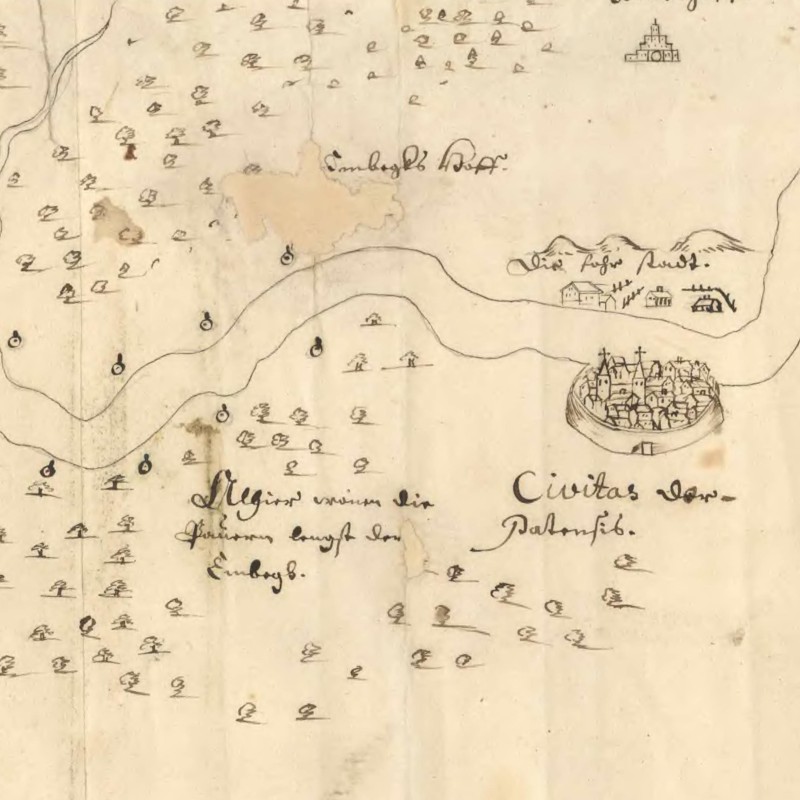
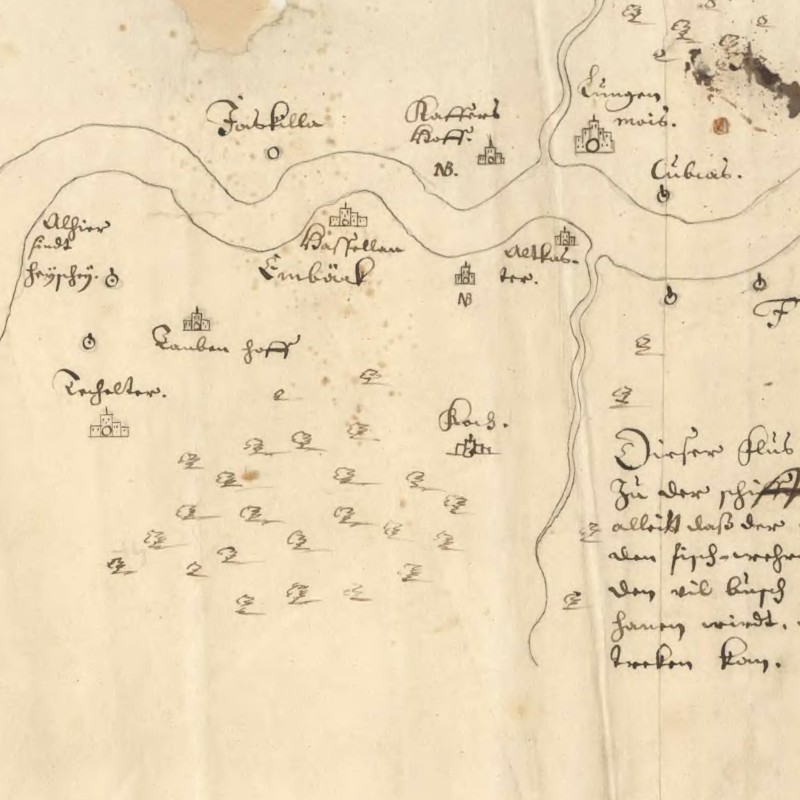
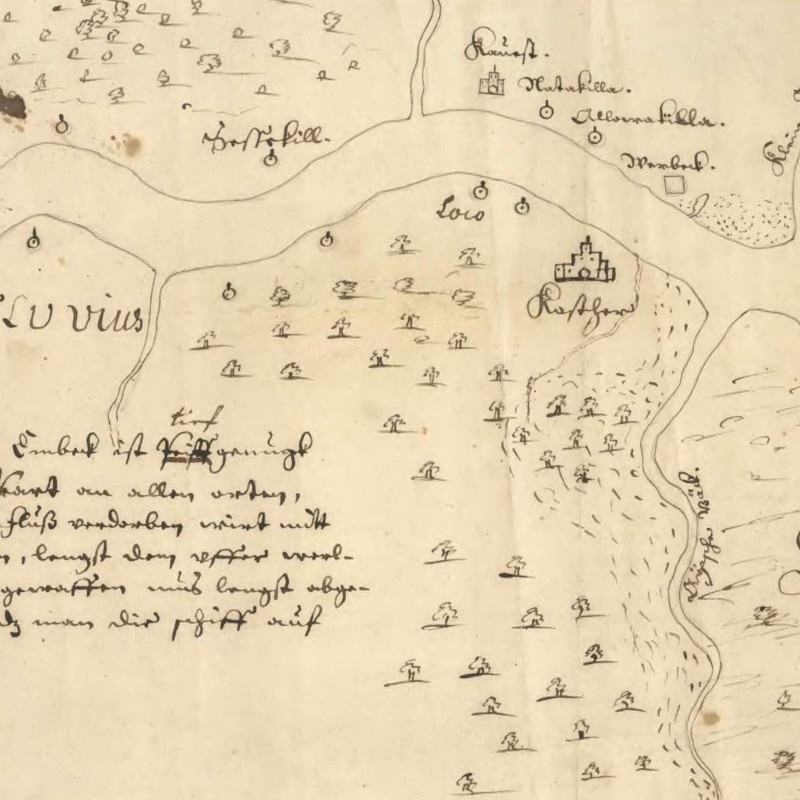
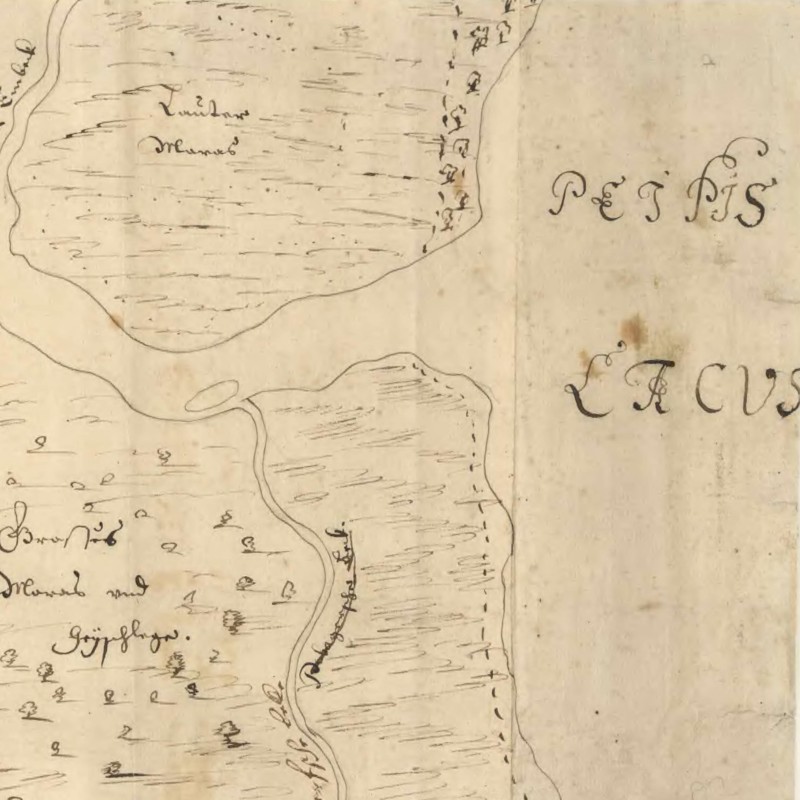
Seventeenth-century map of the Embach River (Emajõgi) from Dorpat on the left to its mouth at Lake Peipus.
Samuel and his companions slept on the riverbank, taking turns to keep watch. Each man had a long gun. He noted that the local population could not be trusted and that travellers had to be watchful.6
As usual with weaponry, Kiechel did not write where he got the gun or whether he had brought it on the journey. His remark about the local population, which consisted mostly of Estonians and Russians, could be seen as prejudiced. But it is important to keep in mind that Livonia had just emerged from a long and very destructive war. While travelling there, Kiechel regularly described Livonia’s desolate, depopulated state, and a constant sense of danger and mistrust accompanied him throughout his journey.
On the morning of 30 July, the boat continued down the Embach River, but the wind had slackened. Kiechel noted that the banks on both sides were very wet and overgrown with grass that reached up to the knee. In the late afternoon, they finally entered Lake Peipus. The shore of the lake was too swampy to sleep there, so the passengers had to spend the night on the boat.
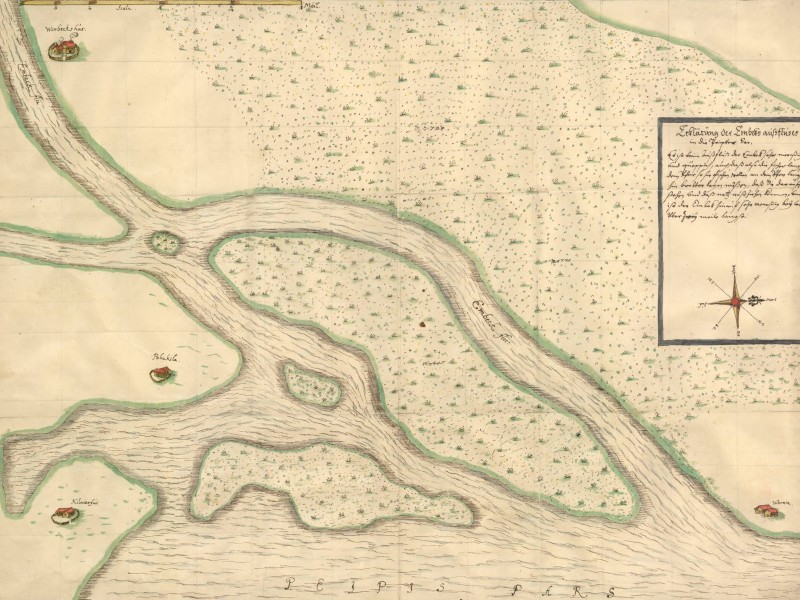
Seventeenth-century map of the mouth of the Embach River at Lake Peipus. As Samuel Kiechel wrote, the surrounding area looks swampy.
Lake Peipus
Samuel Kiechel wrote in his journal: Lake Peipus is a large inland lake. Seventy-two rivers and streams flow into it, but it has only one outlet. The lake is forty German miles long (296 km) and twelve miles wide (88 km)7, and it borders three domains: the lands of the Muscovite Grand Duke of Russia, the Kingdom of Poland and the Kingdom of Sweden. Goods exported from Pleskau must pay a toll to all three lords. This is most cumbersome for boats travelling to Narva in the north, as they must first sail to Dorpat to pay the toll. They must sail up the river Embach to Dorpat, then back down to the lake. Due to this detour, a journey that would normally take about three days now takes two to three weeks. Kiechel would eventually have to make this detour on his return journey from Pleskau.8
Our traveller further noted that Lake Peipus is very shallow, with many sandbanks. The boats on this lake have to be built to cope with it. They are wide, open vessels with a shallow draught. Despite some of the boats carrying 600 hundredweight (ca. 30,000 kg or 30 t), their draught is just slightly more than one ell (between 50 and 60 cm ). The boats are the product of great craftsmanship. Apart from the anchor and some parts where the sails are fastened, no iron or nails are used in the construction. Everything is tied together with plant fibres and other strong materials.9
After sleeping on the boat at the mouth of the Embach River, they set out to cross the lake the following day. The wind had picked up, promising a quick crossing. The boatman hoisted a sail, and Kiechel noted that the Muscovites had a strange way of sailing. He wrote that the sail was fastened to long poles at the prow of the vessel.
After sailing about two miles, the wind turned and strengthened. Soon they were forced back to the shore they had left that morning and took refuge from the wind in a fisher’s hut. The inhabitants offered them only some dried fish and beer. Kiechel wrote that he already regretted having eaten most of his provisions on the first night.
While on the shore, waiting for the wind to calm, Samuel saw many herons and ducks and decided to try to hunt them. However, after an unsuccessful hour, he returned to the boat. The boat was a short distance from the shore, and two oars had been placed as a gangplank. When Kiechel stepped on them, one oar gave way, and he fell into the water with his gun and powder flask.
The wind calmed in the afternoon but did not change direction. The boat left the shore, but they had to use the oars to make progress. Another night was spent on board.10
At sunrise the following day, the boat and passengers continued along the shore of Lake Peipus. The wind had not turned, and they rowed all day. Provisions were running low, and there were no settlements nearby to resupply. Around the lake, Kiechel saw only forest. Because the wind was unsteady, they did not dare attempt to cross the lake. The passengers spent another night on the boat. A piece of bread was all Kiechel and his companions had left to eat. They shared it, each mournfully recalling the provisions they had bought in Dorpat and eaten the first night. Kiechel noted, however, that there were no shortages of fleas on board.
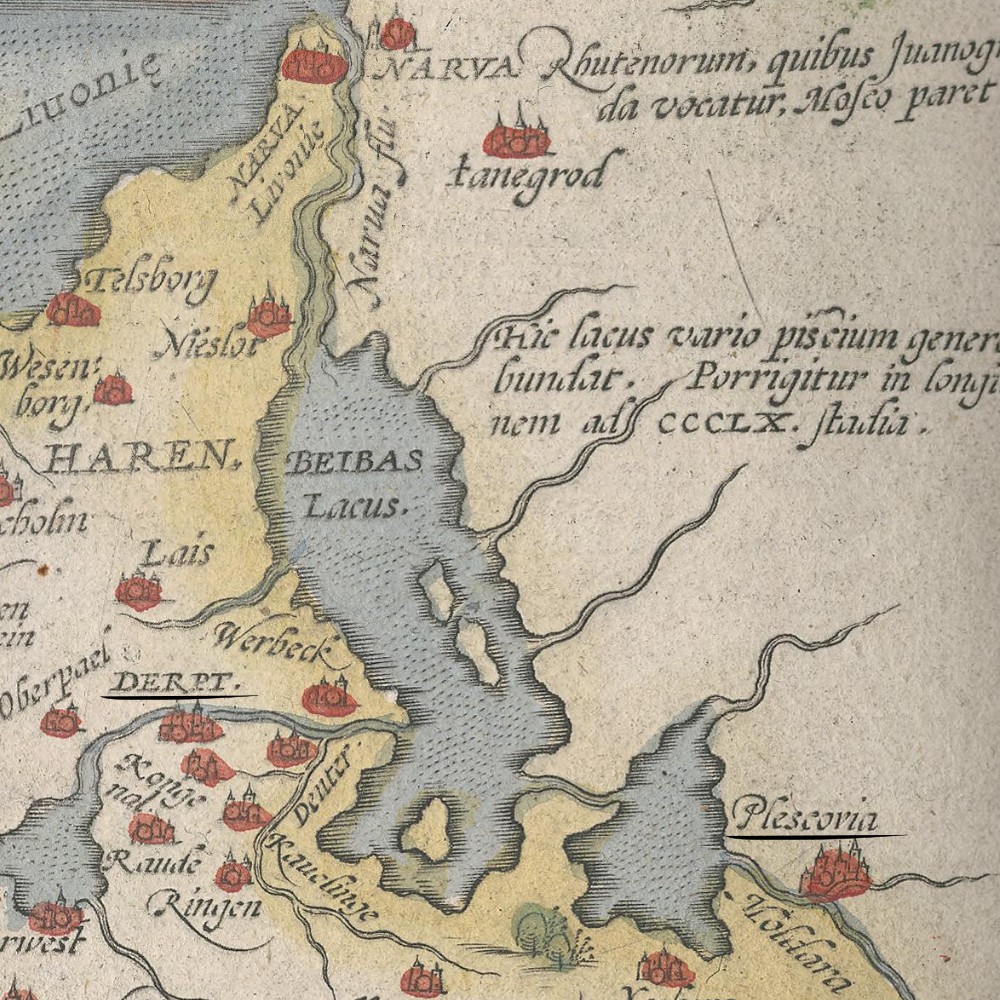
Map of northeastern Livonia with Dorpat (Derpt), Lake Peipus (Beibas Lacus) and Pleskau (Plescovia), 1587
The Embach River enters Lake Peipus near the midpoint of its western shore. Pleskau lies at the southern tip of the lake. Lake Peipus is a continuous body of water that actually consists of two large and one small lake. The northern part is Lake Peipus, while the southern part is Lake Pskov. The Warm Lake connects both. The boat with Samuel Kiechel on board did not have to cross the lake but could sail south along its coast, as they eventually did. However, this assessment is based on modern maps. Kiechel did not know the local geography, and sixteenth-century maps of this remote region are not very accurate. This lack of local knowledge certainly contributed to our traveller’s distress and worry about the provisions.
Without provisions, they could not wait for the wind to turn and continued rowing the following day. Around lunchtime, the boat finally reached the mouth of the Velikaya River, which led from Lake Peipus to Pleskau. Near the mouth stood a tower. It belonged to the Muscovites and was garrisoned. The boat had to stop there, and one of the guards from the tower came and asked the boatman about his passengers. The guard then asked each passenger for some money. They paid and were allowed to continue upstream towards the city.11
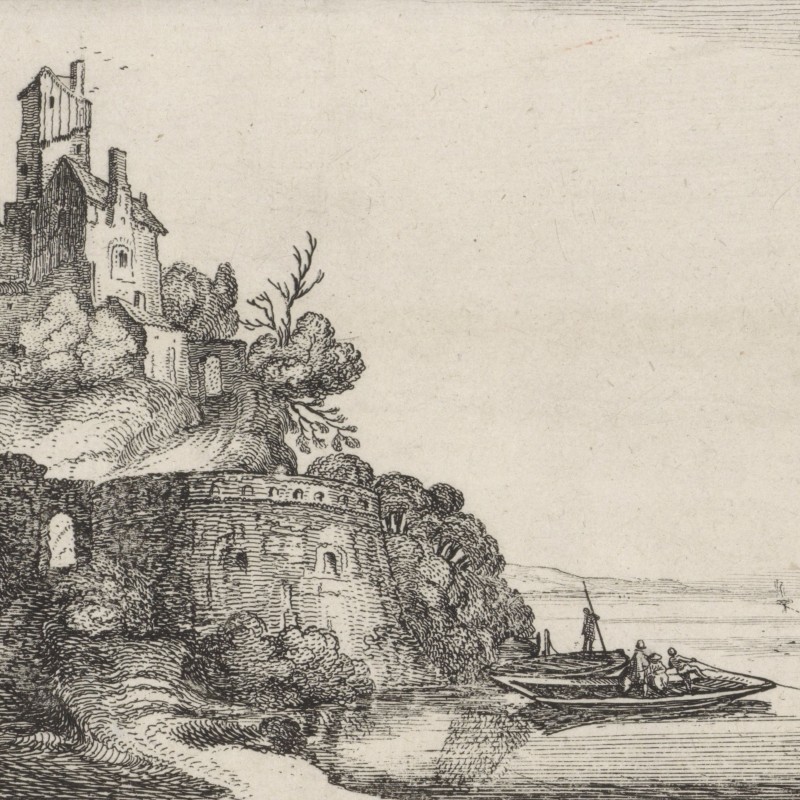
In the journal, Samuel Kiechel called this sort of payment a “trinkgeld” (German for a tip/tipping). It was something between a tip and a bribe, depending on who was asking for it or offering it. Throughout the journal, Kiechel mentions that he paid “trinkgeld”. Sometimes it was for services rendered or to thank someone. At other times, it was clearly a bribe to smooth over difficulties, or he was blackmailed into paying.
When the boat entered the river, the wind finally turned, and they could sail to Pleskau. Along the banks of the river, Kiechel saw many villages and a few monasteries. They arrived in the city in the afternoon.
Illustrations & References
All images are in order of appearance with links to sources on external websites:
- van de Velde, Jan, Reizigers bij een kapel aan een rivier, 1603 – 1641; Rijksmuseum Amsterdam.
- Anonymous, Östersjöprovinserna. Dorpat, 1636; Riksarkivet Stockholm.
- Anonymous, Dorpat, 1638; Riksarkivet Stockholm.
- Anonymous, Ryssland, floder och kanaler. Flodvägen från Pecnan till Peipus, 17th ct.; Riksarkivet Stockholm.
- Anonymous, Ryssland, floder och kanaler. Embachs åmynnigh i Peipus, 17th ct.; Riksarkivet Stockholm.
- Galle, Philips, Eendenjacht, 1578; Rijksmuseum Amsterdam.
- Ortelius, Abraham, Theatre of the World, Antwerp 1587, fol. 88v; Library of Congress.
- van de Velde, Jan, Rivierlandschap met kasteel, 1615; Rijksmuseum Amsterdam.
- Die Reisen des Samuel Kiechel aus drei Handschriften, K. D. Haszler (ed.), Stuttgart 1866, pp. 111f; Bayerische Staatsbibliothek. ↩︎
- Angermann, Norbert, Brüggemann, Karsten, Geschichte der Baltischen Länder, Ditzingen, 2018, p. 18. ↩︎
- Ibid., p. 103. ↩︎
- Ibid., pp. 88f. ↩︎
- Reisen des Samuel Kiechel, p. 112. ↩︎
- Ibid. ↩︎
- One German mile is about 7400 metres or 7.4 kilometres. ↩︎
- Ibid., pp. 120f. ↩︎
- Ibid., p. 122. ↩︎
- Ibid., p. 113. ↩︎
- Ibid., p. 114. ↩︎