
Journal of Samuel Kiechel
29 October – 8 November 1586
In Vienna
“Down from the armoury, towards the water, we were shown the arsenal; inside were several galleys used on the Danube against the Turks during the war. I was amazed that such large ships could navigate such a small river; in my estimation, they were as large and had as many benches as the galleys I would later see in Venice.”
Die Reisen des Samuel Kiechel aus drei Handschriften, K. D. Haszler (ed.), Stuttgart 1866, p. 143; Bayerische Staatsbibliothek.
Excursion to Pressburg (Bratislava)
Samuel Kiechel and his companions, Hans Haas and a Dutchman he met in Danzig (Gdańsk), arrived in Vienna. But Kiechel did not stay. He wrote that he left the city the next day and travelled with a merchant in the man’s coach towards Pressburg (Bratislava). The reason for this trip was that our traveller wanted to buy a horse and thought that it was easier and possibly cheaper to get one in Pressburg. Meanwhile, his two companions remained in Vienna.
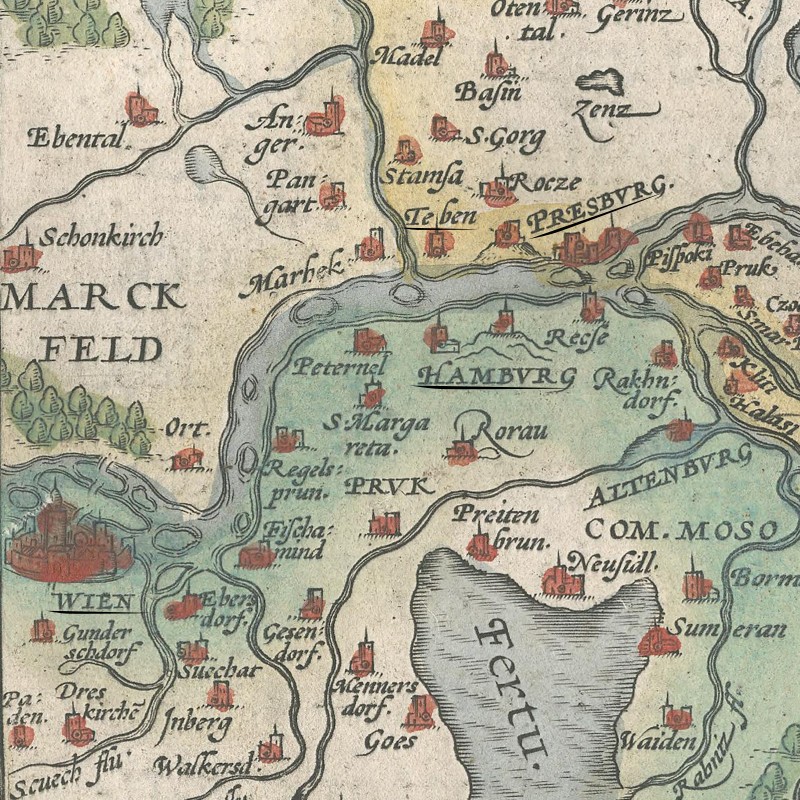
Map of the are between Vienna (Wien) and Pressburg (Presbvrg) with Hainburg (Hambvrg) and Devín Castle (Teben)
Kiechel and the merchant arrived in Hainburg (Hainburg an der Donau) in the evening. A castle stood high on a rock outcrop above the town. On the other side of the Danube, Samuel saw another castle. It was called Theben (Devín Castle), and our traveller learnt that it belonged to Stephen Báthory, the King of Poland. Theben Castle stood at the border between Austria and Hungary (today Slovakia) on a peninsula formed by the Morava and Danube rivers.
Kiechel stayed in Hainburg for the night. He mentioned that in the town’s inn, a group of chimney sweeps and tinkers were gambling and, after a while, started to fall out and argue. He and the merchant left the next morning and arrived in Pressburg before lunchtime. It was a Sunday and Kiechel wrote that they arrived during Mass.
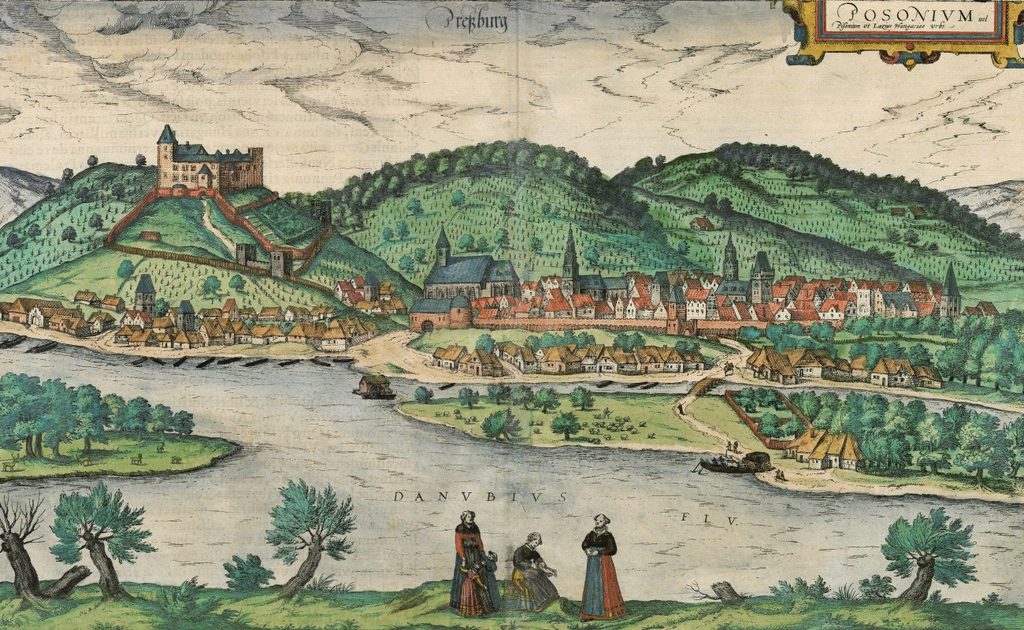
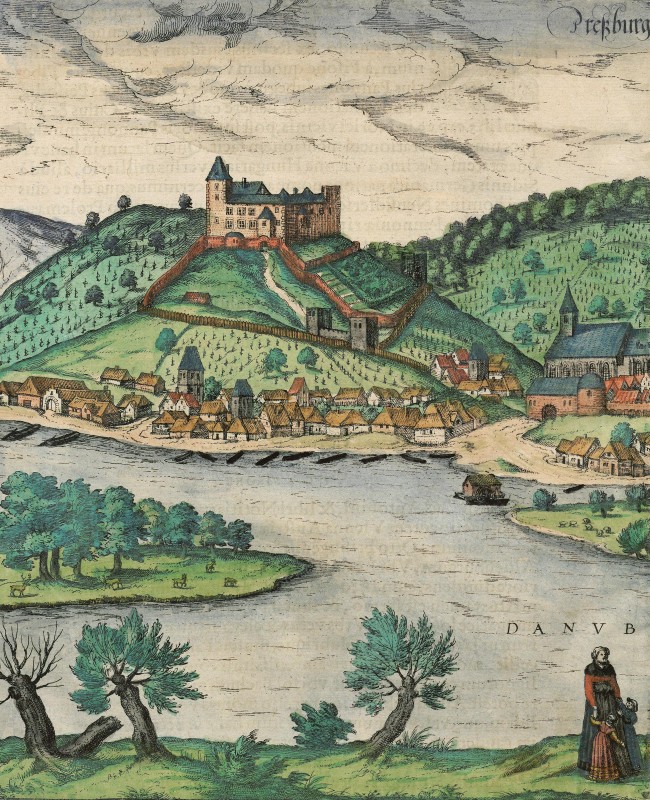
Pressburg was also on the Danube. Kiechel described the city as not large, well-built and inhabited by Germans and Hungarians. A fortified palace stood on a high hill beside the city. A Hungarian nobleman from the Pálffy family (Nikolaus Pálffy of Erdőd, 1552-1600) resided there. Otherwise, the city was not well fortified, and the citizens guarded the gates.
However, Samuel’s hope to buy a horse in Pressburg was in vain. The animals on offer were not what he wanted. So he returned to Vienna on 31 October. He rode in a coach with a doctor, and despite their late start, they arrived that evening.1
The Habsburgs and Royal Hungary
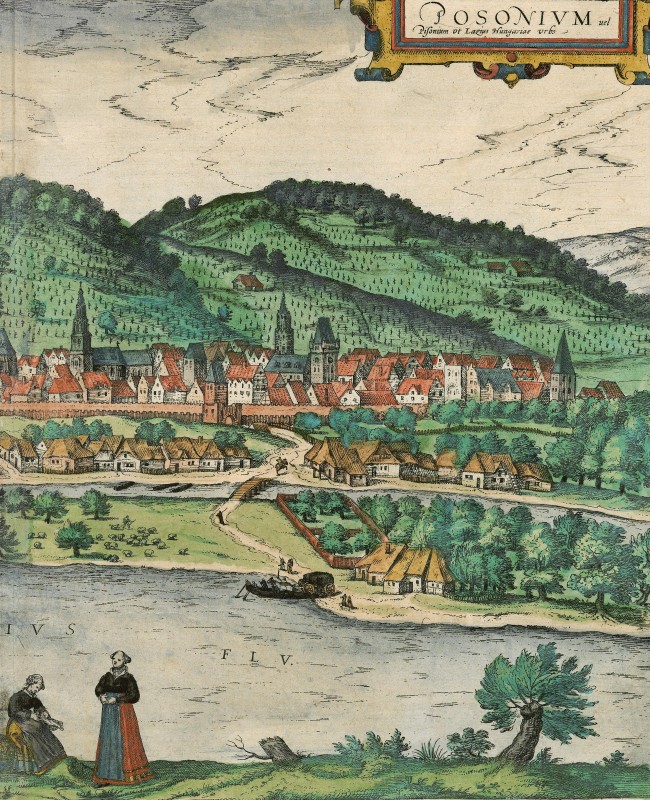
Pressburg (Bratislava) was the capital of Royal Hungary. Volume four of the Civitates Orbis Terrarum includes a view of the city from the south across the Danube River. As Kiechel wrote, the city was not large, but well built and somewhat fortified. Around it are a few suburbs. On a hill on the left side of the image is the palace Kiechel mentioned.
The political situation in Hungary was somewhat difficult in the sixteenth century. The medieval Kingdom of Hungary had faced mounting pressure from the expanding Ottoman Empire since the fourteenth century. The conflict continued with varying success for both sides until the early sixteenth century, when a Hungarian army under King Louis II of Bohemia and Hungary (1506-1526) was wiped out at the Battle of Mohács in 1526.
King Louis died in the battle, and the Kingdom broke apart. The Ottomans occupied and annexed southern Hungary. The northwestern part came under Habsburg rule. Louis’ sister Anne (1503-1547) was married to Ferdinand of Habsburg (1503-1564, later Emperor Ferdinand I). Because Louis had died without an heir, Ferdinand had, through this marriage, a legitimate claim to the Hungarian throne. But because Hungary was an elective monarchy, the Hungarian nobility had to accept him.
Opposition to the Habsburg takeover came from John Zápolya (1487-1540), the Voivode of Transylvania, who also declared himself a candidate for the throne. The lesser nobility backed Zápolya, and they proclaimed and crowned him King of Hungary in November 1526. The Hungarian magnates chose Ferdinand and crowned him in December that year. While Ferdinand could establish his rule in the northwest, now called Royal Hungary, a rival Hungarian Kingdom remained in the east around Transylvania. Isolated and facing the powerful Habsburgs, Zápolya sought support from the Ottoman Empire, and his domain became a de facto Ottoman protectorate.
To complicate matters a little further, Samuel Kiechel mentioned the Polish King Stephen Báthory. John Zápolya’s son, John II Sigismund (1540-1571), under increasing Habsburg pressure, negotiated the Treaty of Speyer in 1570. John II relinquished his title as King of Hungary in favour of Maximilian II (1527-1576), Ferdinand’s son. In turn, Maximilian recognised him as Prince of Transylvania. While Transylvania remained part of the Kingdom of Hungary and therefore under Habsburg suzerainty, the Ottoman Empire retained considerable influence in the Principality. John II died a year later without an heir, and the nobility elected the Hungarian nobleman Stephen Báthory (1533-1586) as Voivode. In 1575, Báthory was elected King of Poland and Grand Duke of Lithuania. This did not mean that Transylvania became part of his new domain. It remained part of the Kingdom of Hungary with Stephen Báthory’s brother as governor. Samuel Kiechel had watched Stephen Báthory go to church when he visited Grodno (Hrodna) a few months earlier.
Of the places Kiechel mentioned, the town of Hainburg lay on the border between Habsburg Austria in the Holy Roman Empire and Royal Hungary, ruled by the Habsburgs but never part of the Empire. Devín Castle stood in a strategically valuable location on the Danube and had long been a Hungarian border fortress. But when Royal Hungary became part of the Habsburg domain after 1526, it lost its relevance. Apparently, at some point in the second half of the sixteenth century, it was given to Stephen Báthory as a present — a sign that it was now mere property without military value.
Visiting Vienna
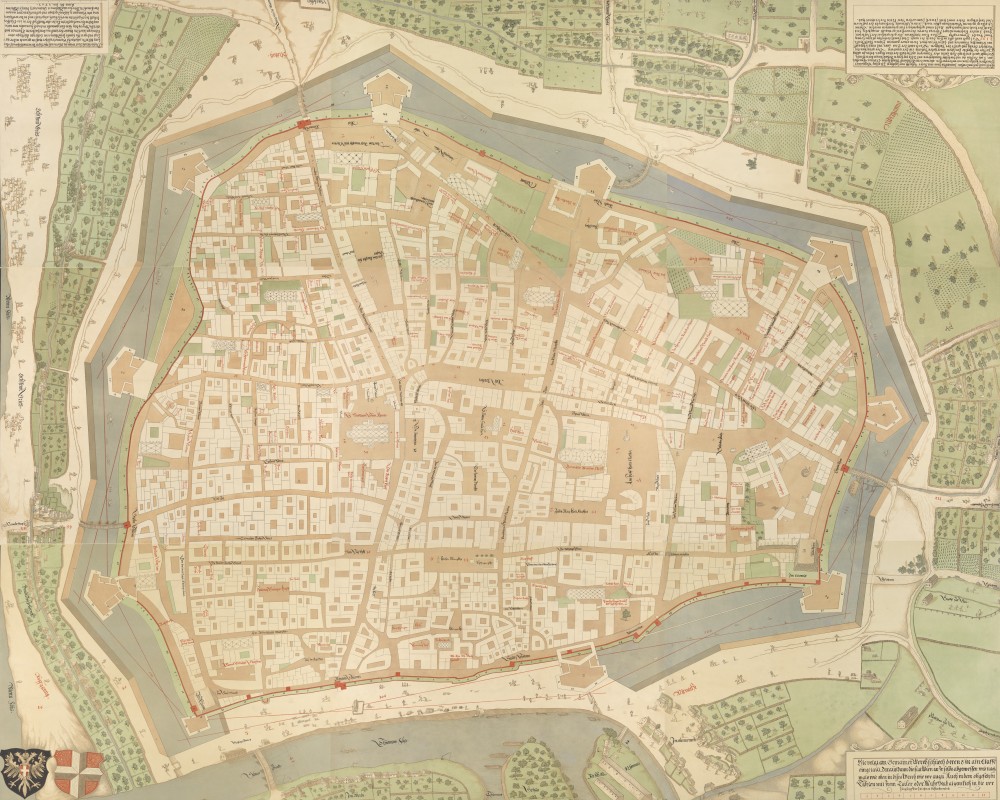
Plan of Vienna from 1547 (printed in 1857)
Samuel Kiechel had returned to Vienna and reunited with his two companions. He wrote that Vienna was the capital of Austria; it was not large but well-built and fortified. Outside its walls were large suburbs and beautiful gardens, and the Danube flowed past the city. Vienna belonged to the Emperor (Rudolf II, 1552-1612) and his brother, Archduke Ernest (Ernest of Austria, 1553-1595), resided there. At the Archduke’s palace, visitors could watch him as he sat down to eat.2
A Vienna citizen showed Kiechel and his companions the armoury. According to our traveller, it was worth the visit. They saw many beautiful mounted guns, along with other arms and armour. From the armoury they walked towards the river and were shown the arsenal. The arsenal held many galleys that were used on the Danube against the Turks (Ottoman Empire) during the war. Kiechel was astounded that such large ships could be used on such a small body of water because they were just as large and had as many banks for the rowers as the galleys he would later see in Venice and other places in the Mediterranean. Samuel counted twelve galleys.
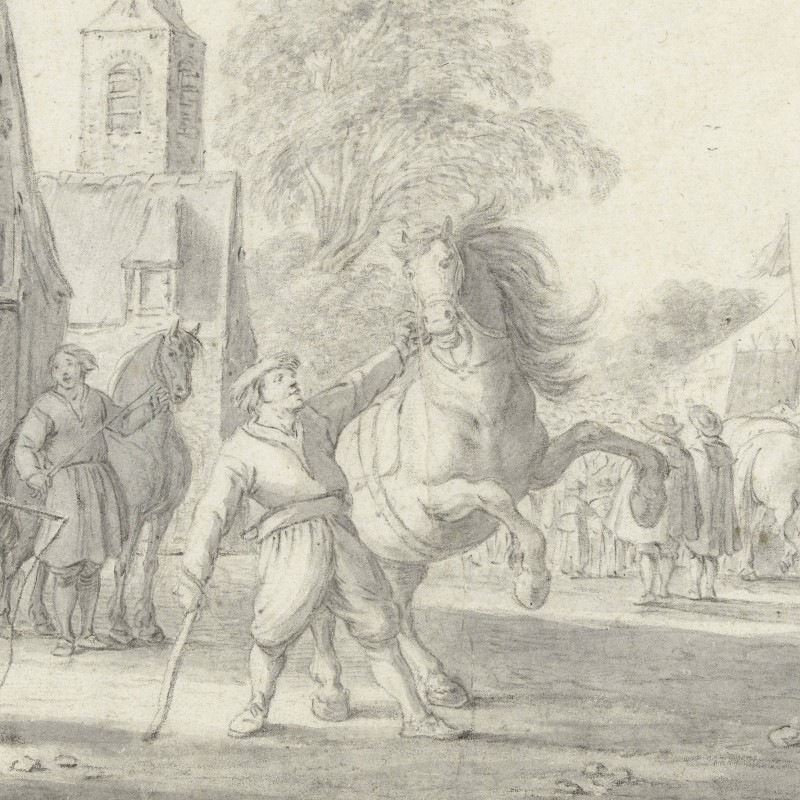
After his unsuccessful attempt to buy a horse in Pressburg, Kiechel visited Vienna’s horse market, but again he could not find a suitable animal. While he wandered the market, a man approached him and said he knew a carter with a beautiful young horse that would be better suited to riding than to pulling a cart. Kiechel told the man to bring the horse to his inn at noon the following day. The man did so, and our traveller inspected the animal. It was a five-year-old grey horse with a tinge of red in its coat, not large but well-built and healthy. Kiechel bought it for twenty-two Reichsthaler and, in retrospect, wrote that the horse served him well on the journey to Venice.
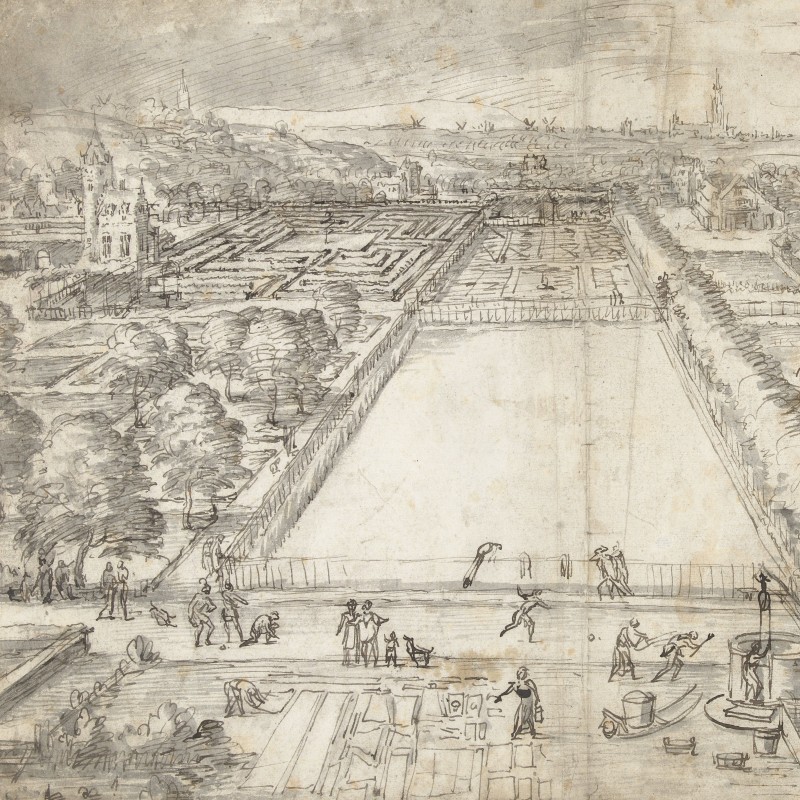
On 6 November, after lunch, Kiechel and his companions rode out to visit the imperial garden. The garden was one mile from the city and looked like a small town from a distance. He saw many towers, and a wall surrounded it. The construction must have been expensive, Kiechel mused, and it was not yet finished. A two-mile-long canal was dug from the river to the garden.
It was already late in the year, so all fruits had been picked, the flowers had lost their petals, and the herbs had withered. There was little to see except the waterworks and the towers, which were delicately built inside and painted with works of art. The travellers also saw an imperial palace there, but its construction was also not yet finished.
Furthermore, Samuel Kiechel mentioned that a zoo lay a short distance away. It was very large but on the other side of the Danube. Kiechel had heard that many different kinds of wild animals were kept in there. Unfortunately, it was late in the day, and the travellers did not have time to visit. They decided to return to the city.
About Vienna, Kiechel mentioned that he had not seen such deep cellars anywhere else. Sometimes there were two or three below each other. He also mentioned an unappealing custom: during the day, people would pass through houses as if they were public streets. The houses had been built to accommodate this custom, but Kiechel still found it difficult to accept.3
Habsburg Vienna
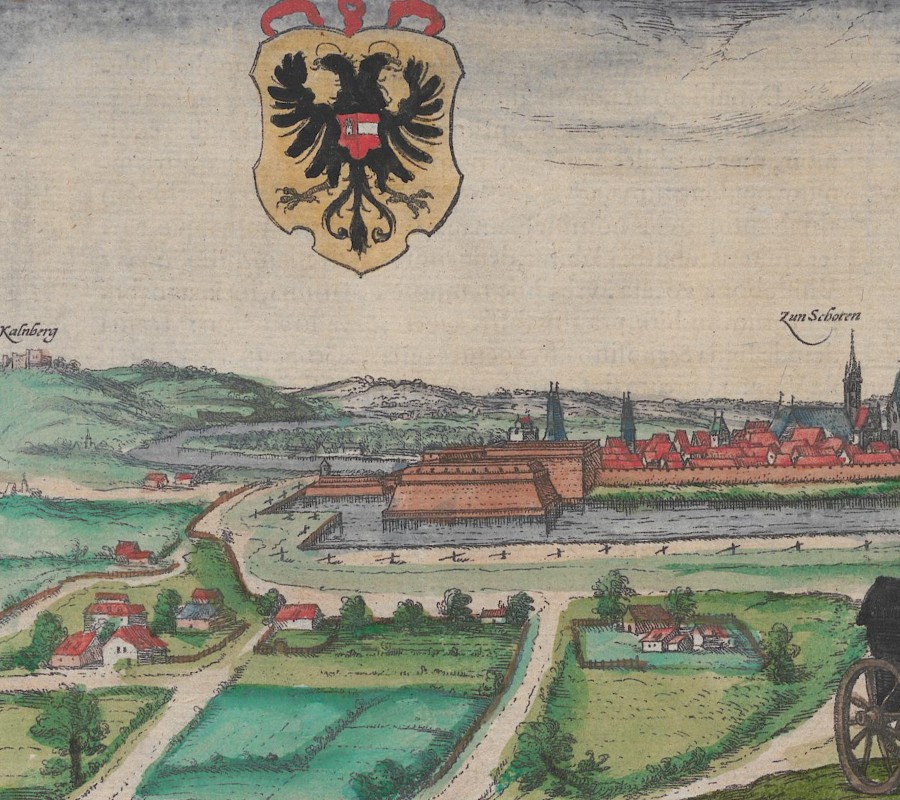
Vienna, 1572
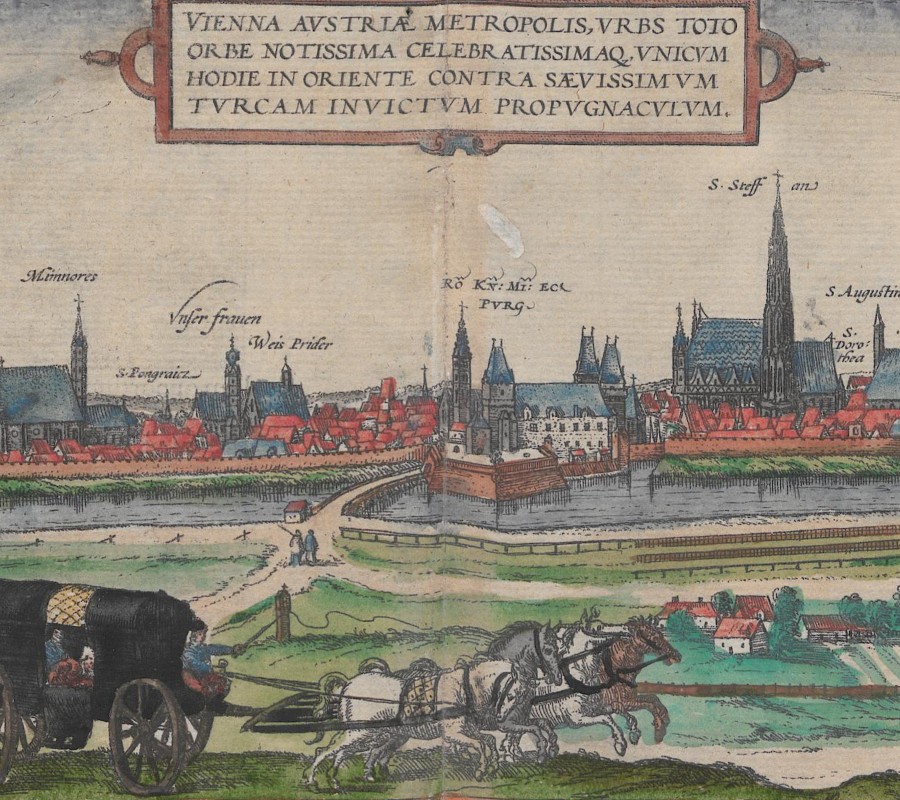
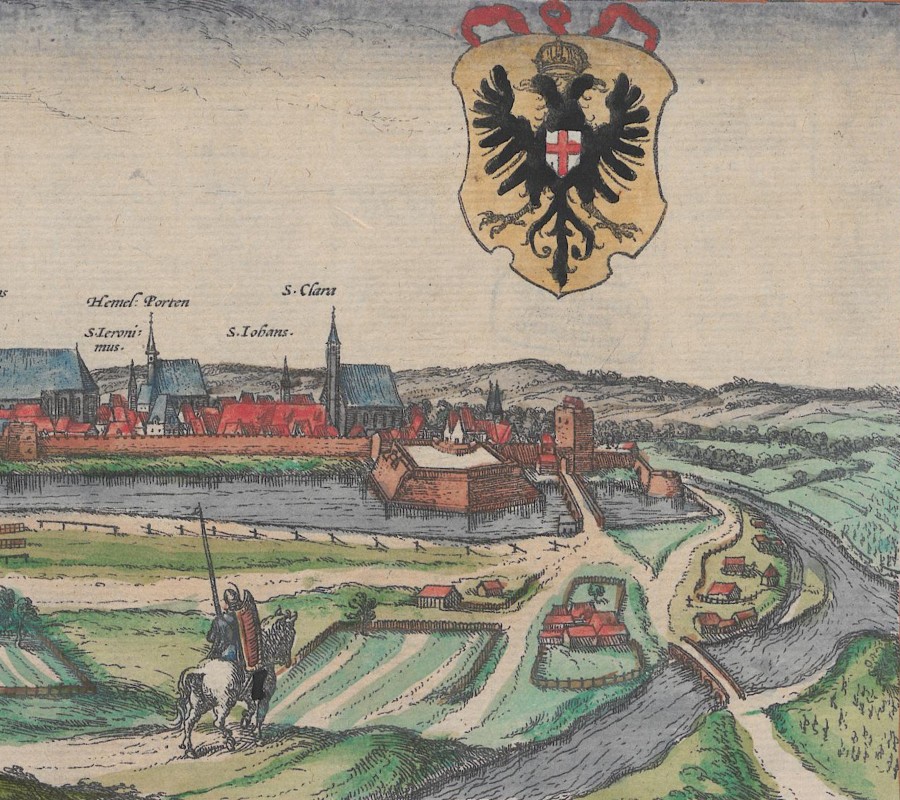
Two views of Vienna are in the Civitates Orbis Terrarum. The first is a profile view from the north. The city’s skyline forms the backdrop. Buildings such as St. Stephen’s Cathedral, the Hofburg and various churches are identified by name. In front of the city is the Danube, and in the foreground, a coach drawn by four horses drives toward Vienna.
Vienna, 1618
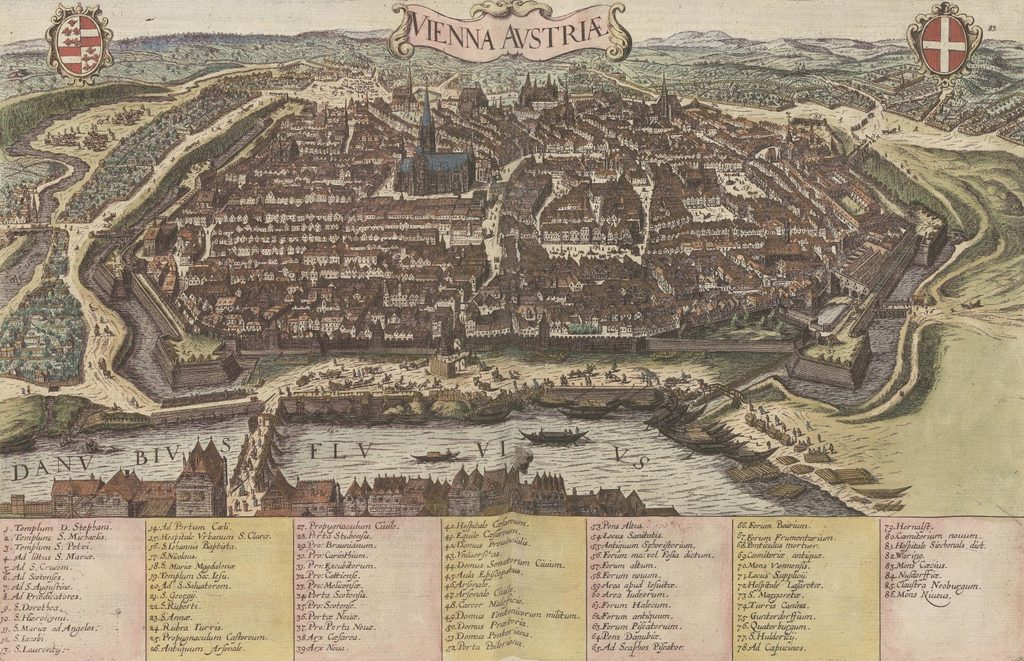
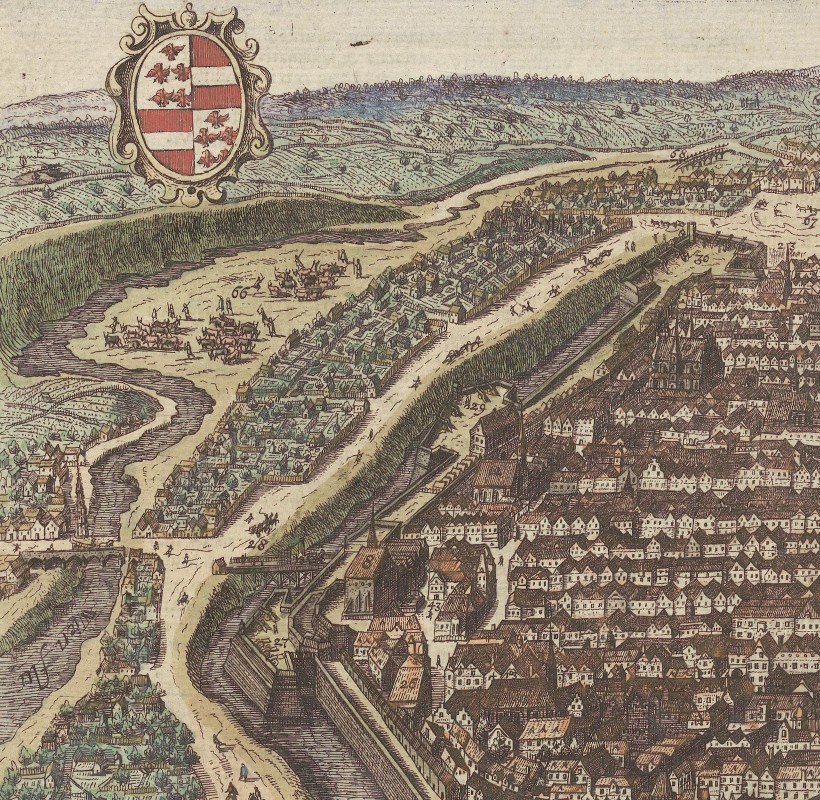
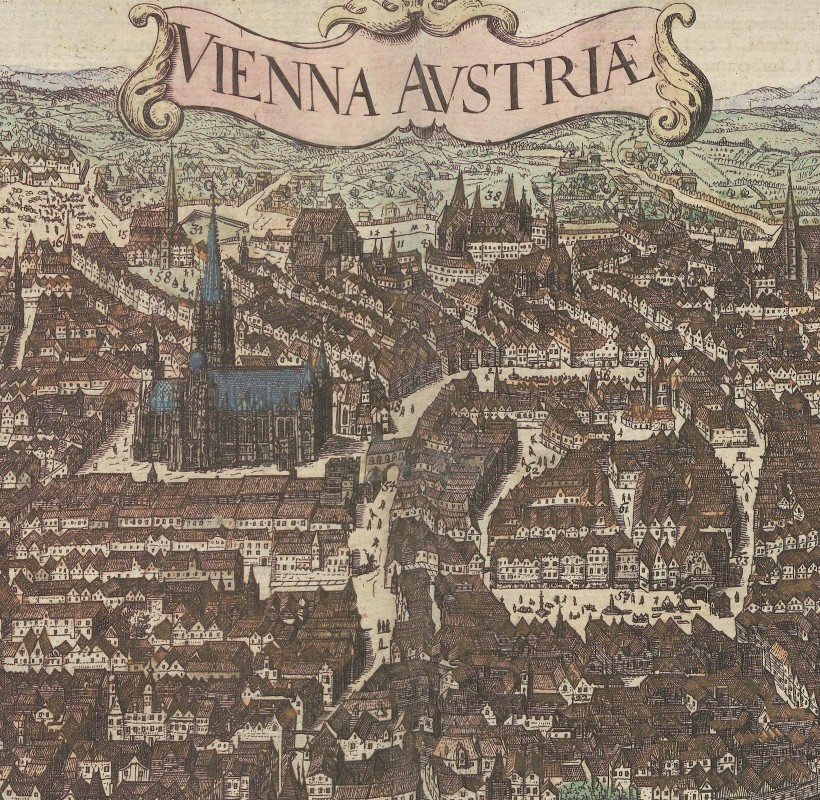
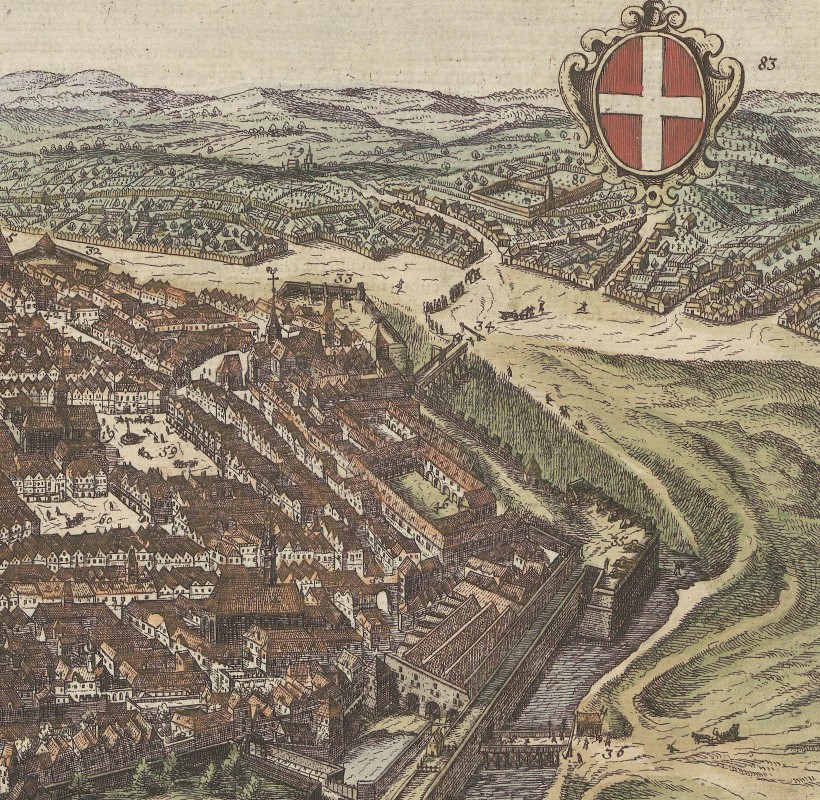
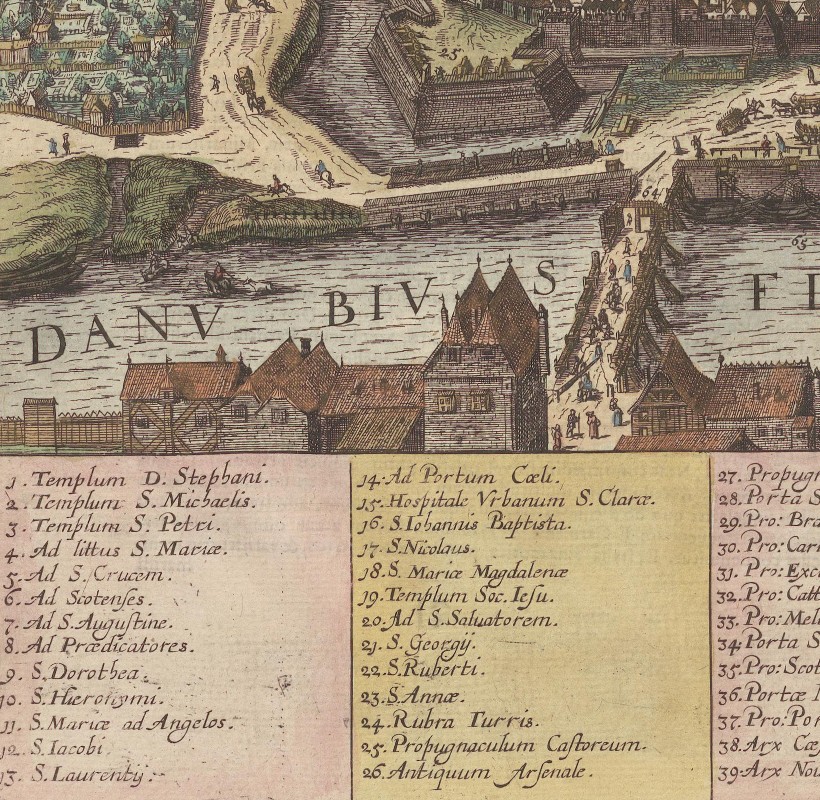
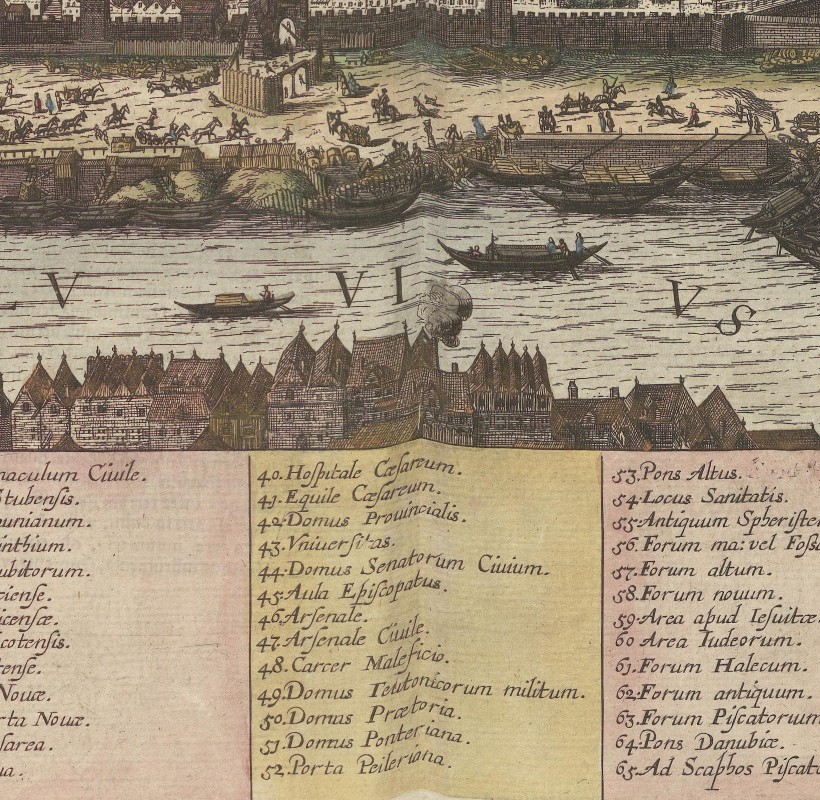
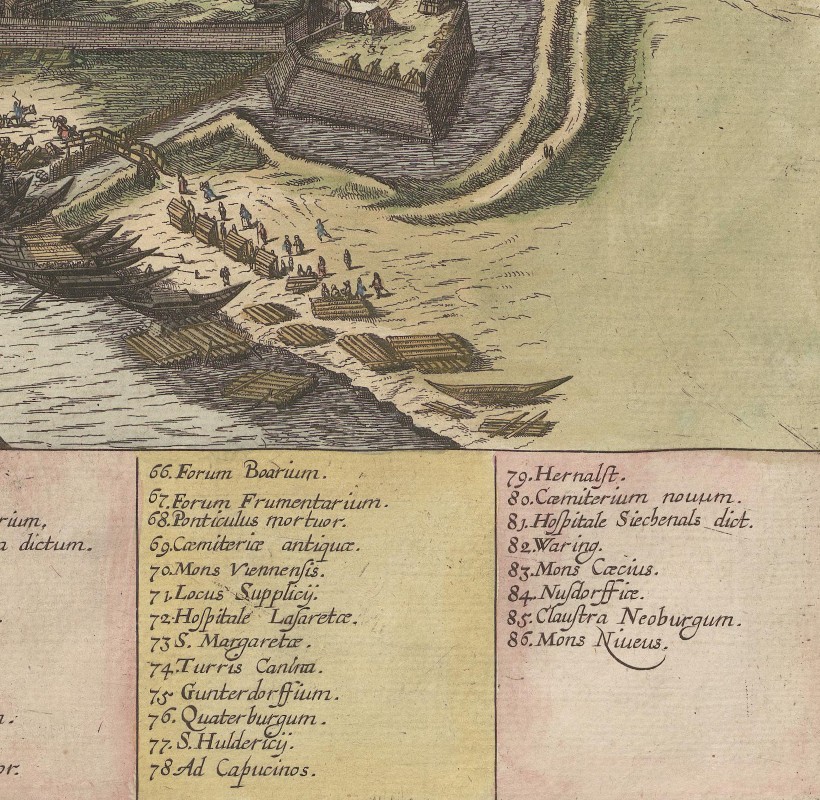
The second image of Vienna in the Civitates is an incredibly detailed bird’s-eye view with a legend at the bottom identifying eighty-five buildings in and around the city. The view is also from the north with the Danube in the foreground.
Vienna is closely connected to the Habsburg Dynasty. The city was the capital of their ancestral homeland, Austria, since the thirteenth century and in 1558, when Ferdinand I was elected Emperor, it became an imperial city and capital of the Holy Roman Empire. Apart from the short time between 1583 and 1612, when Emperor Rudolf II moved his court to Prague, Vienna remained the capital of the Holy Roman Empire and, from 1804, the Austrian Empire.
As home to the imperial court, the city attracted investment, expanded and became a centre for arts and sciences. In addition, Vienna was an important trade hub, with the east-west trade route along the Danube and the north-south route across the Alps to Venice and Trieste.
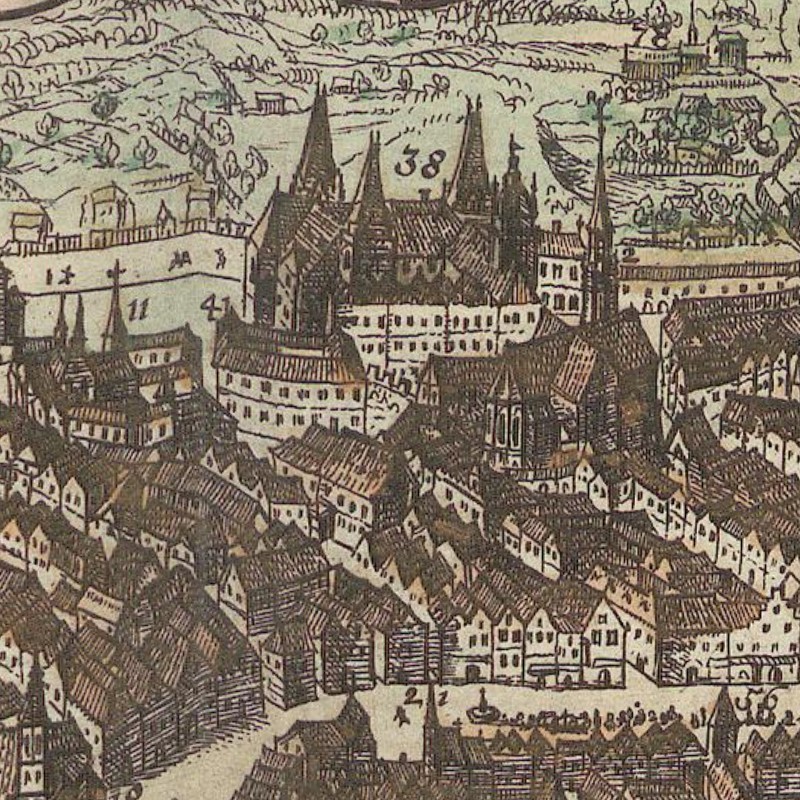
The Hofburg (38), 1618
Kiechel mentioned that Archduke Ernest of Austria, the governor of the province of Austria, resided in a palace in the city. Ernest was the younger brother of the current Emperor Rudolf II. Rudolf had moved his residence to Prague, and Kiechel saw him when he visited Prague Castle. The palace in Vienna where the Archduke lived was the Hofburg. It still exists today but has been rebuilt and expanded massively over the intervening centuries.
Kiechel’s comment that visitors can watch the duke when he sits down to eat refers to a seemingly popular and common feature of royal public life. Members of a ruling dynasty were celebrities of the early modern age, and travellers like Samuel Kiechel wanted to observe them. He had already watched the Swedish Royal family have lunch in Kalmar, seen Queen Elizabeth I give a public audience, and observed the Polish King Stephen Báthory and Emperor Rudolf II go to church.
The imperial garden our traveller visited is now Schönbrunn Palace, where construction began in the 1560s. As with the Hofburg, Schönbrunn can be visited today, but the palace and the surrounding gardens have been rebuilt.
Kiechel’s final observations about Vienna’s cellars and people’s houses being used like public streets are somewhat oblique, and I haven’t found anything on the subject so far.
The Armoury and Arsenal
The sixteenth century was a particularly dramatic time for the city on the Danube. After the Battle of Mohács in 1526 and the partition of the old medieval Kingdom of Hungary, the Ottoman Empire advanced into the heart of Europe and became a direct neighbour to Austria. In addition, both Ferdinand of Habsburg and the Hungarian nobleman John Zápolya were crowned Kings of Hungary. Against his more powerful rival, Zápolya sought Ottoman support.
Sultan Suleiman I, the Magnificent, took advantage of this conflict and tried to turn the situation in his favour. In May 1529, he left Constantinople with a huge army for Vienna. By the end of September, they stood before Vienna’s walls. The city was ill-prepared. The defenders were heavily outnumbered, and Vienna’s old medieval walls were no longer adequate against early modern siege techniques, especially the Ottomans’ rapid adoption of heavy gunpowder artillery.
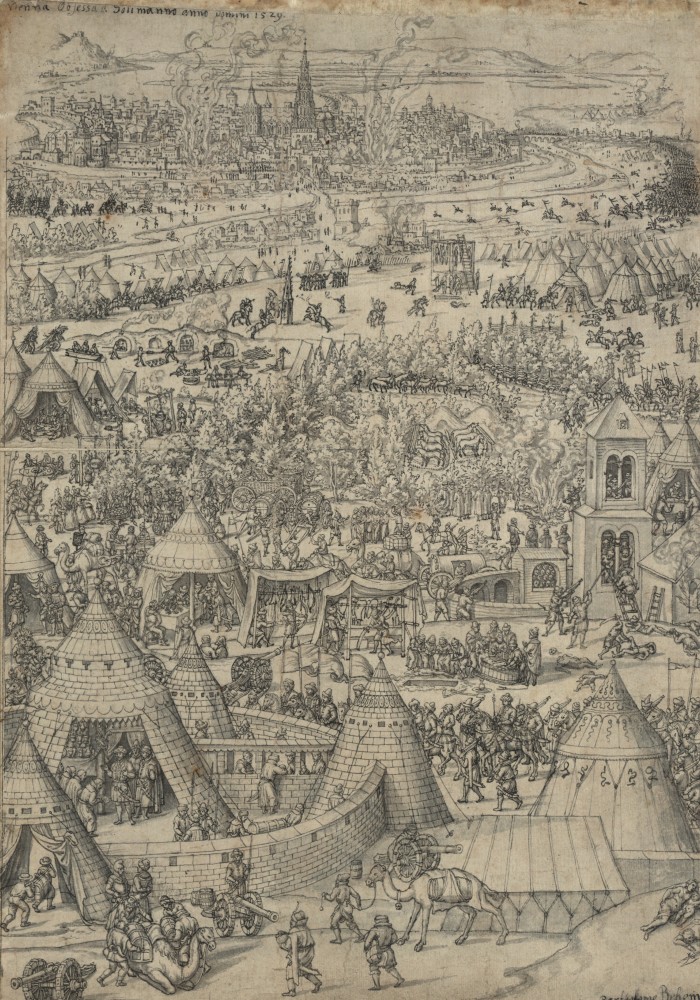
Drawing of the Siege of Vienna, 1529
Fortunately, wet weather and poor roads had plagued the Ottoman advance, forcing the Sultan to abandon his heaviest guns. Disease spread through the army, and by the time the siege began, the Ottoman forces were greatly reduced. The siege lasted only two weeks (27 September to 15 October). More rain made the gunpowder wet, preventing the artillery from breaching Vienna’s old walls. The lack of a quick success, high casualties and overextended supply lines forced Suleiman to abandon the siege and retreat.
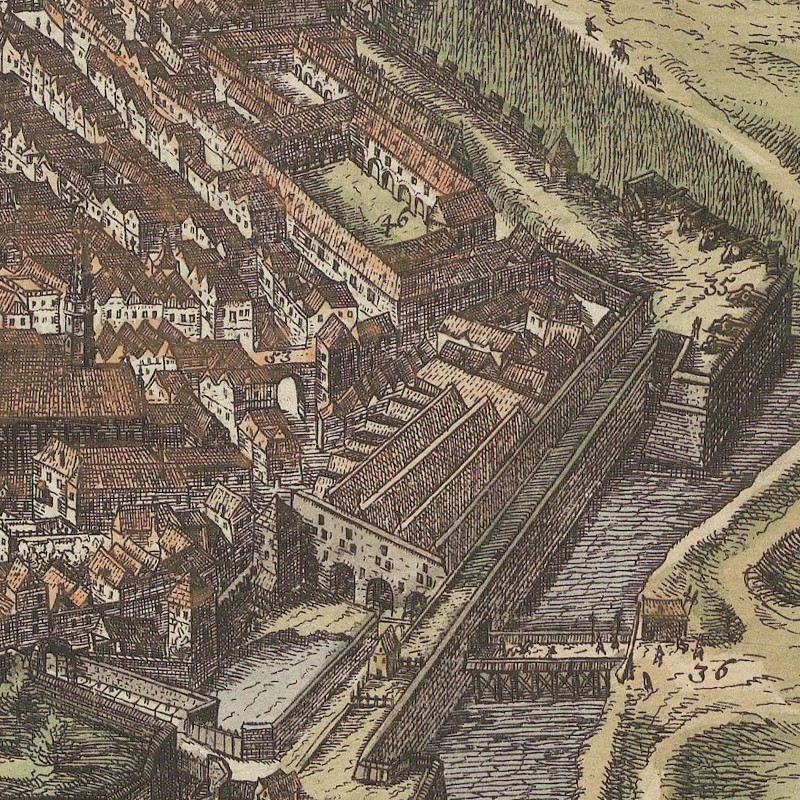
The armoury (46) and the arsenal just below it. The three long halls, each with a large gate, were where the galleys were housed.
While Vienna had survived the siege, the Ottoman threat remained. The Habsburgs invested heavily in modernising and reinforcing their capital’s defences. The bird’s-eye view shows a city surrounded by walls reinforced by bulwarks and a moat. Samuel Kiechel visited the armoury and reports positively about it. Apparently, it was well stocked.
Our traveller also mentioned Vienna’s arsenal. During the siege, the Ottomans had sent warships up the Danube that wiped out the Austrian ships. In response, the Habsburgs ordered the construction of a new arsenal and had it integrated into the city’s fortifications. Kiechel visited it and saw twelve large galleys housed there. He was amazed by their size, comparable to the galleys used in the Mediterranean.
With the Ottoman Empire occupying much of Hungary, the border remained uncomfortably close to the Austrian capital. Kiechel’s trip to Pressburg in Royal Hungary took just about a day. Eventually, about a hundred years after our traveller visited Vienna, the Ottoman Empire would return and besiege the city a second time (1683).
Preparations to Cross the Alps
On 7 November, Samuel Kiechel and his companions made ready to leave Vienna, cross the Alps and travel to Venice. They went to the city’s chancery for a passport. Kiechel wrote that they were worried about the plague. He learnt that there were no cases in Vienna and that the city was cleaner than it had been in eleven years, but that was not the case elsewhere. The passport they obtained was valid only in Austria and would not be accepted in Germany because of reports of plague victims in Augsburg.
Our traveller had already encountered outbreaks of the plague in Posen and on his way to Vienna. He knew that the passport might not be accepted in the towns they had to pass through. The document was basically a letter with the travellers’ names, probably a statement that the city was free of the plague, and Vienna’s seal. Regarding Vienna’s cleanliness, Samuel meant there was no ‘bad air’ in the city; a popular belief that the plague was transmitted by noxious, foul air.
The following afternoon, Kiechel and his two companions, Hans Haas and the Dutchman he met in Danzig, left Vienna. An Italian horseman from Siena also accompanied them. They arrived in the evening in a place called Neudorf, two miles from Vienna.4
Illustrations & References
All images are in order of appearance with links to sources on external websites:
- Ortelius, Abraham, Theatre of the World, Antwerp 1587, fol. 84v; Library of Congress.
- Pressburg, in: Braun, Georg, Hogenberg Frans: Civitates Orbis Terrarum (4), Cologne 1593, fol. 44v; Heidelberg University.
- Wolmut, Bonifaz, von Camesina, Albert, Plan von Wien, 1547 (print from 1857–1858); Wien Museum Inv.-Nr. 30641/1, Online Collection.
- van de Velde, Esaias, Paardenmarkt, 1600 – 1630; Rijksmuseum Amsterdam.
- van Valckenborch, Frederik, Kasteel met een park in de nabijheid van een stad, 1576-1597; Rijksmuseum Amsterdam.
- Vienna, in: Braun, Georg, Hogenberg Frans: Civitates Orbis Terrarum (1), Cologne 1593, fol. 41v; Heidelberg University.
- Vienna, in: Braun, Georg, Hogenberg Frans: Civitates Orbis Terrarum (6), Cologne 1618, fol. 21v; Heidelberg University.
- Beham, Barthel (Bartholomäus), Vienna obsessa a Solimanno anno 1529, 1529; Wien Museum, Inv.-Nr. 97022, Online Collection.
- Die Reisen des Samuel Kiechel aus drei Handschriften, K. D. Haszler (ed.), Stuttgart 1866, pp. 141f; Bayerische Staatsbibliothek. ↩︎
- Ibid., p. 141. ↩︎
- Ibid., pp. 142-144. ↩︎
- Ibid., p. 144. ↩︎